
Introduction
"This bill we sign today is not a revolutionary bill. It does not affect the lives of millions. It will not restructure the shape of our daily lives."
So said President Lyndon Johnson at the signing of the Hart-Celler Immigration Bill thirty years ago next month, on Oct. 3, 1965. The legislation, which phased out the national origins quota system first instituted in 1921, created the foundation of today's immigration law. And, contrary to the president's assertions, it inaugurated a new era of mass immigration which has affected the lives of millions.
Despite modifications, the framework established by the 1965 act remains intact today. And, while the reform proposals now being discussed in Congress, the administration, and the Commission on Immigration Reform would reduce the total number of legal immigrants, they would maintain the fundamentals of the 1965 act — family reunification and employment preferences. So it behooves us on this 30th anniversary to look at the act and the expectations its sponsors had for it.
Under the old system, admission largely depended upon an immigrant's country of birth. Seventy percent of all immigrant slots were allotted to natives of just three countries — United Kingdom, Ireland and Germany — and went mostly unused, while there were long waiting lists for the small number of visas available to those born in Italy, Greece, Poland, Portugal, and elsewhere in eastern and southern Europe.
The new system eliminated the various nationality criteria, supposedly putting people of all nations on an equal footing for immigration to the United States. The new legislation (P.L. 89 236; 79 Stat. 911; technically, amendments to the Immigration and Nationality Act of 1952) substituted a system based primarily on family reunification and needed skills.
In the shadow of the Statue of Liberty, President Johnson criticized the old policy at the signing ceremony:
"This system violates the basic principle of American democracy -- the principle that values and rewards each man on the basis of his merit as a man. It has been un-American in the highest sense, because it has been untrue to the faith that brought thousands to these shores even before we were a country." (Johnson, Lyndon B., Public Papers of the Presidents of the United States, U.S. Government Printing Office, Washington, D.C., 1966, pp. 1037-1040.)
Despite the noble words, the architects of the 1965 law did not see it as a means of significantly changing the immigration flow — it was considered more a symbolic act, an extension of civil rights sentiments beyond our borders. Proponents repeatedly denied that the law would lead to a huge and sustained increase in the number of newcomers and become a vehicle for globalizing immigration. Many senators and representatives believed that the new, equal quotas would not be fully used by European, Asian, and Middle Eastern nations. In addition, they did not foresee the expansion of non-quota admissions (those not covered by numerical limits) under the act's strengthened provisions for family reunification.
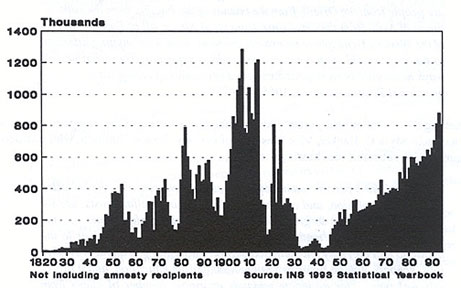
The unexpected result has been one of the greatest waves of immigration in the nation's history — more than 18 million legal immigrants since the law's passage, over triple the number admitted during the previous 30 years, as well as uncountable millions of illegal immigrants. And the new immigrants are more likely to stay (rather than return home after a time) than those who came around the turn of the century. Moreover, this new, enlarged immigration flow came from countries in Asia and Latin America which heretofore had sent few of their sons and daughters to the United States. And finally, although the average level of education of immigrants has increased somewhat over the past 30 years, the negative gap between their education and that of native-born Americans has increased significantly, creating a mismatch between newcomers and the needs of a modern, high-tech economy.
This paper offers a brief overview of the issues relating to the anniversary, including quotes from many of the participants, as well as an outline of the law's consequences.
Setting
The liberalization of immigration policy reflected in the 1965 legislation can be understood as part of the evolutionary trend in federal policy after World War II to end legal discrimination based on race and ethnicity — essentially, the immigration bill was mainly seen as an extension of the civil rights movement, and a symbolic one at that, expected to bring few changes in its wake.
In 1957, Congress passed the first civil rights law since Reconstruction, another in 1960, and two important bills in 1964 and 1965. Moreover, Supreme Court decisions and state and local laws also struck at the remnants of legal racism. The immigration bill was merely another step in this process.
The connection between civil rights legislation and abolishing the national origins quotas was explicit. As Rep. Philip Burton (D-CA) said in Congress:
"Just as we sought to eliminate discrimination in our land through the Civil Rights Act, today we seek by phasing out the national origins quota system to eliminate discrimination in immigration to this nation composed of the descendants of immigrants." (Congressional Record, Aug. 25, 1965, p. 21783.)
And Rep. Robert Sweeney (D-OH) said:
"Mr. Chairman, I would consider the amendments to the Immigration and Nationality Act to be as important as the landmark legislation of this Congress relating to the Civil Rights Act. The central purpose of the administration's immigration bill is to once again undo discrimination and to revise the standards by which we choose potential Americans in order to be fairer to them and which will certainly be more beneficial to us." (Congressional Record, Aug. 25, 1965, p. 21765.)
Other politicians also thought the immigration law needed to be changed. Much earlier, President Truman, in the message accompanying his (unsuccessful) veto of the 1952 McCarran-Walter Act (which had maintained the national origins quota system), wrote:
"These are only a few examples of the absurdity, the cruelty of carrying over into this year of 1952 the isolationist limitations of our 1924 law. In no other realm of our national life are we so hampered and stultified by the dead hand of the past, as we are in this field of immigration." (Truman, Harry S., Public Papers of the Presidents of the United States. U.S. Government Printing Office, Washington, D.C., 1961, pp. 443-444.)
In 1960, President Dwight D. Eisenhower declared to Congress:
"I again urge the liberalization of some of our restrictions upon immigration...we should double the 154,000 quota immigrants ... we should make special provisions for the absorption of many thousands of persons who are refugees." (Eisenhower, Dwight D., Public Papers of the Presidents of the United States, U.S. Government Printing Office, Washington, D.C., 1961, pp. 308-310.)
President John F. Kennedy's immigration message to Congress on July 23, 1963, assailed the national origins quota system as having "no basis in either logic or reason." He complained,
"It neither satisfies a national need nor accomplishes an international purpose. In an age of interdependence among nations, such a system is an anachronism for it discriminates among applicants for admission into the United States on the basis of the accident of birth." (Kennedy, John F., Public Papers of the Presidents of the United States, U.S. Government Printing Office, Washington, D.C., 1964, pp. 594-597.)
Foreign policy concerns also motivated some to support change in the national origins system. With the decolonization of Africa and Asia, and with ongoing competition with the Soviet Union for the hearts and minds of the developing world, the quota system was seen as an embarrassment. Vice President Hubert H. Humphrey, for instance, said the existing immigration law stood in contrast to the growth of refugee legislation aimed at forming international linkages and having "the respect of people all around the world." (Congressional Record, June 27, 1952, p. 8267.)
Others favored a change in the law for more personal reasons — they had relatives who were on long immigration waiting lists because of small quotas for their countries. Italy, for instance, had an annual quota of 5,666 immigrants, Greece 308, Poland 6,488, Yugoslavia 942, and so on. Joseph Errigo, National Chairman of the Sons of Italy Committee on Immigration, was upset at the small size of Italy's quota and urged Congress to "abolish a system which is gradually becoming unpopular and inoperative." Italy had 249,583 people waiting for admission into the United States. (U.S. Senate Subcommittee on Immigration and Naturalization of the Committee on the Judiciary, Washington, D.C., Feb. 10, 1965, p. 407.)
Details
The Hart-Celler Act of 1965:
- Established the basic structure of today's immigration law.
- Abolished the national origins quota system (originally established in 1921 and most recently modified in 1952), while attempting to keep immigration to a manageable level. Family reunification became the cornerstone of U.S. immigration policy.
- Allocated 170,000 visas to countries in the Eastern Hemisphere and 120,000 to countries in the Western Hemisphere. This increased the annual ceiling on immigrants from 150,000 to 290,000. Each Eastern-Hemisphere country was allowed an allotment of 20,000 visas, while in the Western Hemisphere there was no per-country limit. This was the first time any numerical limitation had been placed on immigration from the Western Hemisphere. Non-quota immigrants and immediate relatives (i.e., spouses, minor children, and parents of U.S. citizens over the age of 21) were not to be counted as part of either the hemispheric or country ceiling.
- For the first time, gave higher preference to the relatives of American citizens and permanent resident aliens than to applicants with special job skills. The preference system for visa admissions detailed in the law (modified in 1990) was as follows:
- Unmarried adult sons and daughters of U.S. citizens.
- Spouses and children and unmarried sons and daughters of permanent resident aliens.
- Members of the professions and scientists and artists of exceptional ability.
- Married children of U.S. citizens.
- Brothers and sisters of U.S. citizens over age twenty-one.
- Skilled and unskilled workers in occupations for which there is insufficient labor supply.
- Refugees given conditional entry or adjustment — chiefly people from Communist countries and the Middle East.
- Applicants not entitled to preceding preferences — i.e., everyone else.
Predictions
Although the 1965 bill was intended only to end discrimination, some people feared a major increase in immigration and a change in the source countries of immigrants. Supporters of the measure assured doubters that this would not happen.
Rep. Emanuel Celler (D-NY), a sponsor of the bill, told his colleagues:
"With the end of discrimination due to place of birth, there will be shifts in countries other than those of northern and western Europe. Immigrants from Asia and Africa will have to compete and qualify in order to get in, quantitatively and qualitatively, which, itself will hold the numbers down. There will not be, comparatively, many Asians or Africans entering this country. .. .Since the people of Africa and Asia have very few relatives here, comparatively few could immigrate from those countries because they have no family ties in the U.S." (Congressional Record, Aug. 25, 1965, p. 21812.)
Attorney General Robert Kennedy told House immigration subcommittee members,
"I would say for the Asia-Pacific Triangle it [immigration] would be approximately 5,000, Mr. Chairman, after which immigration from that source would virtually disappear; 5,000 immigrants would come the first year, but we do not expect that there would be any great influx after that." (U.S. Congress, House, 1964 hearings, p. 418.)
And in a letter to The New York Times, he called for repeal of the national origins system:
"The time has come for us to insist that the quota system be replaced by the merit system...It deprives us of able immigrants whose contributions we need...It would increase the amount of authorized immigration by only a fraction." (The New York Times, Aug. 24, 1964, p. 26.)
Senate immigration subcommittee chairman Edward Kennedy (D-MA.) reassured his colleagues and the nation with the following:
"First, our cities will not be flooded with a million immigrants annually. Under the proposed bill, the present level of immigration remains substantially the same ... Secondly, the ethnic mix of this country will not be upset ... Contrary to the charges in some quarters, [the bill] will not inundate America with immigrants from any one country or area, or the most populated and deprived nations of Africa and Asia ... In the final analysis, the ethnic pattern of immigration under the proposed measure is not expected to change as sharply as the critics seem to think."
Sen. Kennedy concluded by saying,
"The bill will not flood our cities with immigrants. It will not upset the ethnic mix of our society. It will not relax the standards of admission. It will not cause American workers to lose their jobs." (U.S. Senate, Subcommittee on Immigration and Naturalization of the Committee on the Judiciary, Washington, D.C., Feb. 10, 1965. pp. 1-3.)
In 1965, new Attorney General Nicholas Katzenbach testified:
"This bill is not designed to increase or accelerate the numbers of newcomers permitted to come to America. Indeed, this measure provides for an increase of only a small fraction in permissible immigration." (U.S. Senate, Subcommittee on Immigration and Naturalization of the Committee on the Judiciary, Washington, D.C., Feb. 10, 1965, p.8.)
Secretary of State Dean Rusk, when asked about the number of people from India who would want to immigrate, responded:
"The present estimate, based upon the best information we can get, is that there might be, say, 8,000 immigrants from India in the next five years ... I don't think we have a particular picture of a world situation where everybody is just straining to move to the United States ... There is not a general move toward the United States." (U.S. Senate, Subcommittee on Immigration and Naturalization of the Committee on the Judiciary, Washington D.C., Feb. 10, 1965, p.65.)
[Note: There were actually 27,859 Indian immigrants over the five years following passage of the bill, three times Secretary Rusk's predicted level. From 1965 through 1993, immigration from India totaled 558,980.]
Senator Hiram Fong (R-HI) answered questions concerning the possible change in our cultural pattern by an influx of Asians.
"Asians represent six-tenths of 1 percent of the population of the United States ... with respect to Japan, we estimate that there will be a total for the first 5 years of some 5,391 ... the people from that part of the world will never reach 1 percent of the population .. .Our cultural pattern will never be changed as far as America is concerned." (U.S. Senate, Subcommittee on Immigration and Naturalization of the Committee on the Judiciary, Washington, D.C., Feb. 10, 1965, pp.71, 119.)
[Note: From 1966 to 1970, 19,399 immigrants came from Japan, more than three times Sen. Fong's estimate. Immigration from Asia as a whole has totaled 5,627,576 from 1966 to 1993. Three percent of the American population is currently of Asian birth or heritage.]
Rep. Sidney Yates (D-IL) supported the bill as a reaffirmation of "our devotion to the principle of equal justice for peoples previously subject to discrimination," but did not see it as ushering in a new era of mass immigration:
"I am aware that this bill is more concerned with the equality of immigrants than with their numbers. It is obvious in any event that the great days of immigration have long since run their course. World population trends have changed, and changing economic and social conditions at home and abroad dictate a changing migratory pattern." (Congressional Record, August 25, 1965, p. 21793.)
Another rosy prediction from a supporter of the bill, Sen. Claiborne Pell (D-RI):
"Contrary to the opinions of some of the misinformed, this legislation does not open the floodgates." (Congressional Record, Sept. 20, 1965, p. 24480.)
The original version of the bill gave top preference to people with special skills, but that was changed in the final version to the current nepotistic emphasis on family relationship. A Washington Post editorial was no better at predicting the result than the bill's congressional supporters:
"The most important change, in fact, was in direction, shuffling the preference categories to give first consideration to relatives of American citizens instead of to specially skilled persons. This had more emotional appeal and, perhaps more to the point, insured that the new immigration pattern would not stray radically from the old one." (The Washington Post, Oct. 4, 1965, p. 16.)
Even Sen. Strom Thurmond (R-SC), who voted against the bill out of concern for overpopulation, didn't think the new preference system would mean much of a change:
"The preferences which would be established by this proposal are based, I believe, on sound reasoning and meritorious considerations, not entirely dissimilar in effect from those which underlie the national origins quotas of existing law." (Congressional Record, Sept. 17, 1965, p. 24237.)
A few of the congressmen who opposed the bill did see that the new system, even with tight labor controls, meant a drastic change.
Republican Vice Presidential candidate Rep. William Miller of New York wrote:
"We estimate that if the President gets his way, and the current immigration laws are repealed, the number of immigrants next year will increase threefold and in subsequent years will increase even more ... shall we, instead, look at this situation realistically and begin solving our own unemployment problems before we start tackling the world's?" (The New York Times, Sept. 8, 1964, p. 14.)
[Note: Although immigration did increase as dramatically as Rep. Miller predicted, it took longer than he thought. By 1968 — when the law fully took effect — the 1965 level of 290,697 had increased to 454,448, "only" a 56 percent increase.]
Another opponent, Sen. Spessard Holland (D-FL), told his colleagues:
"What I object to is imposing no limitation insofar as areas of the earth are concerned, but saying that we are throwing the doors open and equally inviting people from the Orient, from the islands of the Pacific, from the subcontinent of Asia, from the Near East, from all of Africa, all of Europe, and all of the Western Hemisphere on exactly the same basis. I am inviting attention to the fact that this is a complete and radical departure from what has always heretofore been regarded as sound principles of immigration." (Congressional Record, Sept. 22, 1965, p. 24779.)
Among those who more accurately foresaw the future effects of the change in immigration law was a certain Myra C. Hacker, Vice President of the New Jersey Coalition, who testified at a Senate immigration subcommittee hearing:
"In light of our 5 percent unemployment rate, our worries over the so called population explosion, and our menacingly mounting welfare costs, are we prepared to embrace so great a horde of the world's unfortunates? At the very least, the hidden mathematics of the bill should be made clear to the public so that they may tell their Congressmen how they feel about providing jobs, schools, homes, security against want, citizen education, and a brotherly welcome ... for an indeterminately enormous number of aliens from underprivileged lands."
"We should remember that people accustomed to such marginal existence in their own land will tend to live fully here, to hoard our bounteous minimum wages and our humanitarian welfare handouts ... lower our wage and living standards, disrupt our cultural patterns ..."
"Whatever may be our benevolent intent toward many people, [the bill] fails to give due consideration to the economic needs, the cultural traditions, and the public sentiment of the citizens of the United States." (U.S. Senate, Subcommittee on Immigration and Naturalization of the Committee on the Judiciary, Washington, D.C., Feb. 10, 1965. pp. 681-687.)
Results
Legal Immigration to the United States, 1820-1994
The 1965 changes unwittingly ushered in a new era of mass immigration. The current level of immigration is actually higher than the graph below indicates because illegal immigration is much higher now than ever before, with a conservative estimate of 300,000 new permanent illegal immigrants each year. The result is an influx of more than 1 million people a year, with no natural end in sight.
Return Migration
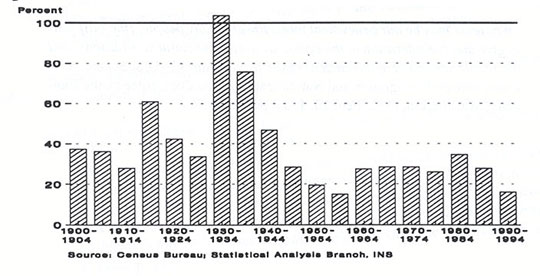
Another factor in intensifying the impact of immigration is a reduced rate of emigration — that is, more of today's newcomers stay for their whole lives, rather than returning to the old country after a few years. Note that in the 1930s, emigration was higher than 100 percent, meaning that during the Great Depression more people left the country than entered.
Change in Source Countries of Immigrants
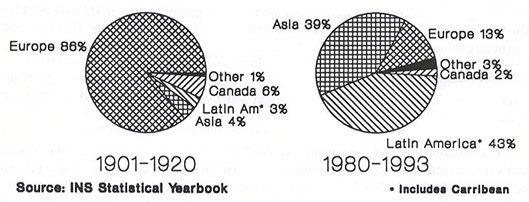
Despite the protestations of the 1965 act's sponsors, the sources of immigration have changed radically. This is partly due to the fact that there are fewer people in Europe are seeking to leave, now that most countries there are modern and industrialized. The ending of the national origins quotas opened the doors to mass entry of people from Asia and Latin America (regions where people are far more likely to want to emigrate), and the law's emphasis on family reunification ensured that those through the door first would be able to bring in their relatives, freezing out potential immigrants from Europe and from other developing nations.
Growing Education Gap
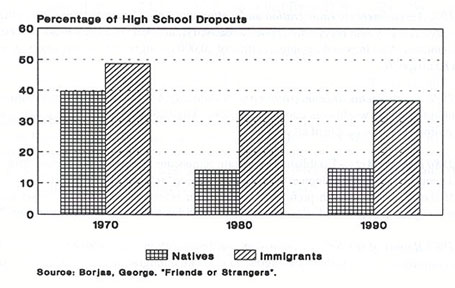
Although the percentage of high school dropouts among immigrants has fallen somewhat, the gap between natives and the foreign born has grown significantly, with immigrants more than twice as likely as native-born Americans not to have completed high school. This contributes to a growing pool of blue-collar workers competing for a shrinking number of well-paying jobs.
Chronology
1882 Chinese Exclusion Act — Barred the entry of any Chinese for 10 years, made permanent in 1904 until it was rescinded in 1943.
1907 Gentlemen's Agreement — Barred the entry of Japanese and Koreans.
1917 Immigration Act — Passed over President Wilson's veto, it established a literacy test and created the "Asiatic Barred Zone," virtually prohibiting immigration from Asia.
1921 Quota Act (Johnson Act) — Set the first immigration quotas in the nation's history, equal to 3 percent of the foreign born of admissible nationality in the 1910 census. There was still no limit on immigration from the Western Hemisphere.
1924 Immigration Act (Johnson-Reid Act) — Set an annual ceiling of 154,227 for the Eastern Hemisphere. Each country had a quota representative of its population in the U.S. as of the 1920 census.
1952 Immigration and Nationality Act (McCarran-Walter Act) — Passed over President Truman's veto, it reaffirmed the basic provisions of the national origins quota system, and the annual ceiling remained 154,277. It abolished immigration and naturalization exclusions against Asians and allotted 100 visas for each Asian country. In addition, the act instituted a system to give preference (within the national origins quotas) to foreigners with education or skills, as well as relatives — this was the predecessor of today's preference system. Immigration from Latin America and the Caribbean remained exempt from numerical limits.
1965 Amendments to Immigration and Nationality Act (Hart-Celler Act) — See "Details" section of this paper.
1976 Amendments to Immigration and Nationality Act — Extended a version of the seven-category preference system previously applied to Eastern Hemisphere countries to all Western Hemisphere countries. Also imposed an annual ceiling of 20,000 immigrants from any one country in the Western Hemisphere.
1978 Amendments to Immigration and Nationality Act — The two hemispheric ceilings were combined into a worldwide quota of 290,000. The U.S. now had a policy that, on paper, applied uniformly to the people of all countries.
1980 Refugee Act — Established a separate admissions policy for refugees, eliminating the previous geographical and ideological criteria, and defining "refugee" according to United Nations norms. It abolished the seventh preference category for refugees (see Details). It set a separate target for refugees at 50,000 and reduced the annual worldwide ceiling for immigrants to 270,000.
1981 Report of the Select Commission on Immigration and Refugee Policy — The 16-member commission was created by Congress to evaluate immigration and refugee laws, policies, and procedures. The Commission's recommendations were summed up as follows by its chairman, the Rev. Theodore Hesburgh: "We recommend closing the back door to undocumented, illegal migration, opening the front door a little more to accommodate legal migration in the interests of this country, defining our immigration goals clearly and providing a structure to implement them effectively, and setting forth procedures which will lead to fair and efficient adjudication and administration of U.S. immigration laws."
1986 Immigration Reform and Control Act (IRCA) — Tried to control and deter illegal immigration by providing amnesty and temporary status to all illegal aliens who had lived in the United States continuously since before January 1, 1982; extended a separate, more lenient amnesty to farmworkers; imposed sanctions on employers who knowingly hire illegal aliens; increased inspection and enforcement at U.S. borders.
1990 Immigration Act (IMMACT) — Modified and expanded the 1965 act; it significantly increased the total level of immigration to 700,000, increasing available visas 40 percent. The act retained family reunification as the major entry path, while more than doubling employment-related immigration. The law also provided for the admission of immigrants from "underrepresented" countries to increase the diversity of the immigrant flow.
Contacts
Many of those involved in the debate 30 years ago are still with us, either in Congress or retired, and their recollections might be worth noting. Among them are:
Sen. Edward Kennedy, (202) 224-4543. He ushered the bill through the Senate.
Sen. Robert Dole (R-KS), (202) 224-6521. Then a congressman, Sen. Dole voted for the bill.
Sens. Strom Thurmond (R-SC) (202) 224-5972, and Robert Byrd (D-WV), 224-3954, voted no.
Former President Gerald Ford, then a congressman, voted yes.
Former Sen. Albert Gore Sr., the Vice President's father, voted yes.
Former Sen. Eugene McCarthy voted for the bill in 1965, but has since criticized the direction of U.S. immigration policy.
Others who voted for the 1965 bill: Sen. Daniel Inouye (D-HI); Sen. Claiborne Pell (D-RI); Rep. George Brown Jr. (D-CA); Rep. Sam Gibbons (D-FL); Rep. Patsy Mink (D-HI); Rep. Sidney Yates (D-IL); Rep. Lee Hamilton (D-IN); Rep. Andrew Jacobs Jr. (D-IN); Rep. John Conyers Jr. (D-MI); Rep. John Dingell (D-MI); Rep. Joseph McDade (R-PA); Rep. Henry Gonzalez (D-TX); former Sen. George McGovern; former Rep. Dan Rostenkowski.
Others who voted against the bill: Rep. James Quillen (R-TN); Rep. E. (Kika) de la Garza (D-TX).