
Download this Backgrounder as a pdf
Read the Panel Discussion Transcript
Read coverage in the Christian Science Monitor
Many advocates of high immigration argue that it fundamentally changes the nation’s age structure, and is very helpful in solving the problem of an aging society. Demographic data, however, show that immigration has only a very small impact on the problem. While immigrants do tend to arrive relatively young, and have higher fertility than natives, immigrants age just like everyone else, and the differences with natives are not large enough to fundamentally alter the nation’s age structure. The debate over immigration should focus on other areas where it actually has a significant effect.
Among this Backgrounder’s findings:
- In 2000 the average age of an immigrant was 39, which is actually about four years older than the average age of a native-born American.
- Even focusing on only recent immigration reveals little impact on aging. Excluding all 22 million immigrants who arrived after 1980 from the 2000 Census increases the average age in the United States by only about four months.
- In 2000 66.2 percent of the population was of working-age (15 to 64). Excluding post-1980 immigrants it is 64.6 percent.
- Looking at the full impact of post-1980 immigrants reveals that if they and all their U.S.-born children are not counted, the working-age share would have been 65.9 percent in 2000, almost exactly the same as the 66.20 percent when they are all included.
- Immigration also does not explain the relatively high U.S. fertility rate. In 2000 the U.S. fertility rate was 2.1 children per woman, compared to 1.4 for Europe, but if all immigrants are excluded the rate would still have been 2.0.
- Looking to the future, Census Bureau projections indicate that if net immigration averaged 100,000 to 200,000 annually, the working age share would be 58.7 percent in 2060, while with net immigration of roughly 900,000 to one million, it would be 59.5 percent.
- Census projections are buttressed by Social Security Administration (SAA) estimates showing that, over the next 75 years, net annual legal immigration of 800,000 a year versus 350,000 would create a benefit equal to only 0.77 percent of the program’s projected expenditures.
- It is not clear that even this tiny benefit exists, because SSA assumes legal immigrants will have earnings and resulting tax payments as high as natives from the moment they arrive, which is contrary to a large body of research.
Introduction
That American society is aging is undeniable. In 2000 the average age in the country was 36 years, compared to 33 years in 1980. Many advocates of high immigration argue that immigration is very helpful in dealing with the challenges created by an aging society by making the country significantly more youthful. Ben Wattenberg of the American Enterprise Institute is one of the most prominent thinkers espousing this point.1 And he is by no means alone. Washington Post columnist Charles Krauthammer has said that America has been “saved by immigrants” from the kind of aging taking place in other first-world countries.2 The primary worry among such advocates is that there will not be enough people of working-age to support the economy or pay for government.3 This Backgrounder will attempt to answer the question, Does immigration actually change America’s age structure and, if so, by how much?
Methodology
In order to determine the actual impact of immigration on aging, we examined four separate areas. First, we examined Census Bureau data to determine how immigration has changed the age structure in America. If immigration fundamentally transforms the age structure of the country, then the record level of immigration in recent years should have had some discernable impact. To determine this, we used the 2000 Census and removed the foreign-born population and then recalculated average age and what demographers call the “dependency ratio.” The dependency ratio is the share of the population that is not of working-age.
Second, we calculated the fertility rate (average number of children born per woman) in the United States with and without immigrants using the June 2000 Current Population Survey (CPS) collected by the Census Bureau. Again, if immigration makes America a much younger society then it should have a significant impact on fertility rates. Using actual data collected by the Census Bureau such as the 2000 Census and June CPS has the great advantage of not being based on speculation about the future. Projections, while certainly very useful in some ways, suffer from the obvious problem that those doing them have to make assumptions about future death and fertility rates 20, 40, or even 100 years into the future. On the other hand, projections are the only way to gain insight into the possible impact of immigration in the future. For this reason, the third approach we used was to examine population projections made by the U.S. Census Bureau that look at how differing levels of immigration will effect the share of the population that is of working age. In the fourth and final section, we examine specific estimates made by the Social Security Administration that look at how legal immigration affects the Social Security system.
Impact of Current Immigration on Age Structure
We ran a number of separate simulations to estimate the effect of immigration on the aging of American society. Using the 2000 Census, we removed all immigrants, then just those who arrived in 1980 or later and then only those who arrived in 1991 or later.4 For the purposes of this report, the term foreign-born and immigrant are used synonymously, unless otherwise specified.5 Analysis of this kind is relatively easy because the 2000 Census asked immigrants what year they came to live in America. Once the desired population is removed, we then recalculated the age structure in America. We also examined the impact of post-1980 and post-1991 immigrants and included their U.S.-born children.6 To do this we removed these recent immigrants plus all of their U.S.-born children from the 2000 Census and then recalculated the working-age share of the population. It should be pointed out that 90 percent of illegal aliens are estimated to have responded to the 2000 Census.7 Thus all the results in this section reflect the impact of both legal and illegal immigration.
Impact of Immigration on Fertility
Using the June 2000 CPS, we calculated the Total Fertility Rate (TFR) of women in the United States. Total Fertility Rate is one of the most common measures of fertility used by demographers. It represents the average number of children a woman will have in her lifetime.8 The June 2000 CPS is specifically designed to calculate TFR for women age 15 to 45 because it asks respondents about recent births. The Survey also asks respondents if they are immigrants.9
Like the examination of age structure discussed above, we estimated TFR in the United States with and without immigrants in order to determine how much immigrants are changing the nation’s fertility.10 We also looked at births per thousand for women in their child-bearing years, which is another common measure of fertility. Again we removed immigrants from the data and then recalculated births per thousand. Unlike our estimates using the 2000 Census, we did not try to exclude recent immigrants and recalculate TFR because in 2000 almost all births to immigrants were to post-1980 immigrants. Immigrants who arrived in the 1960s or 1970s were generally too old by 2000 to have children and thus accounted for only tiny fraction of births in that year.
Like the 2000 Census, the vast majority of illegal aliens are thought to have responded to the 2000 CPS. Also, like our analysis of the 2000 Census, by working with current data we are able to estimate the actual impact of immigration on the nation’s overall fertility, without having to make any assumptions about the future.
Projected Impact of Immigration.
The third approach is to rely on population projections published by the Census Bureau. As part of its projections published in 2000, the Census Bureau made various assumptions about the future level of immigration and reported its impact on the share of the population that is of working age through 2100. We used these projections to examine immigration’s impact on the age distribution in American society. It should be pointed out that in 2004 the Census Bureau released what it called “interim” projections based on the results of the 2000 Census. The interim projections are not final and do not include dependency ratios based on various levels of immigration. Thus we rely on the final projections released in 2000.
Social Security Projections.
The fourth part of this Backgrounder examines projections done by the Social the Security Administration that estimate the impact of different factors over the next 50 or 75 years. One of the variables SSA examines is how the level of immigration will change money flowing into and out of the system. Some of this information is provided in the trustee’s report issued each year by SSA.11 In addition, at the request of Sen. Chuck Hagel (R-Neb), SSA provided more detailed information in 2004 and 2005 on the estimated impact of legal immigration in two memos.12 We used all of this information to estimate the effect of different levels of legal immigration on the Social Security system.
Results
Average Age
Overall Impact of Immigrants on Average Age
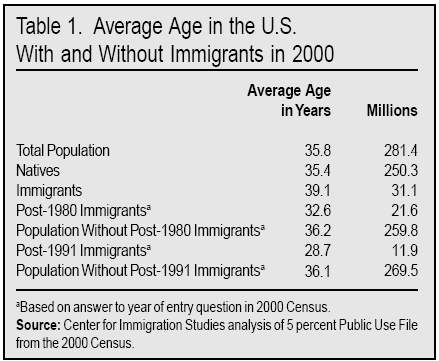
Table 1 reports the average age in the United States with and without immigrants based on the 2000 Census. The first row shows that in 2000, the average age of the entire U.S. population was 35.8 years. The average age of native-born Americans was 35.4 years, and for immigrants it was 39.1 years. It may be surprising to some, but immigrants are actually older on average than natives. This means that if all immigrants are removed from the 2000 Census, the average age in the United States would actually be 35.4 (the age of natives), slightly younger than the overall average age of 35.8 when immigrants are included.
This does not necessarily mean that the argument that immigration makes the age structure younger is entirely wrong. As we will see, the issue is more complex. But it does show that immigrants, even those who may originally arrive very young, grow older just like everyone else. The average age of just-arrived immigrants in April 2000 (when the Census was conducted) was almost 10 years younger than the average native. It must be remembered that these figures include everyone from illegal aliens to foreign students, who responded to the Census. But, the higher average age of immigrants overall reminds us that it is simply not enough to say that because immigrants tend to arrive young, they make America significantly more youthful. The actual impact of immigration depends on several factors, including the number of immigrants, the size of the age differences between new immigrants and the existing population, and of course, the aging of immigrants.
Recent Immigrants’ Effect on Average Age
Another way to think about the impact of immigration is to examine the effect of only recently arrived immigrants. Those who argue that immigration fundamentally changes the age structure generally have in mind newer arrivals. Table 1 reports the average age of the population, excluding only recent immigrants. Looking first at the immigrants who arrived in 1980 or later, we see that they are somewhat younger than natives — almost 32.6 years compared to 35.4 years for natives. In the 2000 Census there were nearly 22 million post-1980 immigrants living in the United States. Without them, the average age in the United States would be 36.2 years. This compares to 35.8 years, the actual average age of the country when post-1980 immigrants are included. The difference is less than 0.4 years or a little over four months.
Even though the 20 years prior to 2000 saw the largest flow of new immigrants in American history, and almost 22 million of those immigrants still lived in the United States in 2000, the impact on the nation’s average age is very modest. This, of course, is not surprising because the average age of post-1980 immigrants in 2000 was nearly 33 years, which is not that different than the 36 years for the rest of the population. Mathematically, this small difference means that post-1980 immigration cannot have much impact on the overall average age of the country.
Turning to post-1991 immigrants, we again see a small effect on the average age. While post-1991 immigrants are slightly under 29 years of age on average, Table 1 shows that if the nearly 12 million post-1991 immigrants are excluded, the average age in America would be 36.1. Again, this compares to 35.8 when these immigrants are included. Thus, post-1991 immigrants have a slightly smaller impact on overall average age in America than do post-1980 immigrants. It must be remembered that although post-1991 immigrants are significantly younger than natives on average, they account for only about 4 percent of the total population. Even post-1980 immigrants account for about 8 percent of the total population. While recent immigrants may have a very large effect on some aspects of American society, their direct effect on the average age is very modest.
It should be pointed out that the average age figure for natives of 35.4 includes the U.S.-born children of recent immigrants. If the children of post-1980 immigrants are excluded, all of whom are under age 21 in 2000, the average age for natives would be 36.1 years. As for the overall population, if post-1980 immigrants and all of their U.S.-born children are excluded, the overall average age in the United States would be 36.8 compared to the 35.8 when they are included. In short, the average age in the United States is about 36 years with the 28 million post-1980 immigrants and their children, and without them it would have been 37 years. While average age is not the only way to look at the age structure of the nation, the results above make clear that immigration in the 20 years prior to 2000, including all of the immigrants’ children, has had only a very modest impact the country’s average age.
Working Age Share
While the impact of immigration on the average age in the United States is small, this may not be the best measure of the nation’s demography as it relates to age. When looking at the economic impact of the nation’s age structure, demographers often examine the share of the total population that is of working age, which is typically 15 to 64. The share of the population that is of working age relative to those who are not in this age group is referred to as the population’s dependency ratio.13 This may be a better test of the argument about the need for immigration since the primary justification made by high-immigration advocates is that there will not be enough workers to support the economy or pay for government. A higher working-age percentage is generally viewed as better for the economy because it means there are more potential workers relative to those who do not work, and who have to be supported by the efforts of others.
Table 2 shows that in the 2000 Census, 66.2 percent of the nation’s total population was of working age, including immigrants. The working-age percentage for natives is 64.2 percent and for immigrants it was 81.9 percent. Clearly, immigrants are much more likely than natives to be between 15 and 64. If all 31 million legal and illegal immigrants are removed from the 2000 Census, then the working age share of the population would be 64.2 — the share for natives. While not a huge difference, the two percentage-point increase immigration creates is not trivial. Table 2 also shows that if just post-1980 immigrants are excluded, then the effect is somewhat smaller. Without post-1980 immigrants, 64.6 percent of the population would be of working-age, 1.6 percentage points lower than the 66.2 percent when they are included.
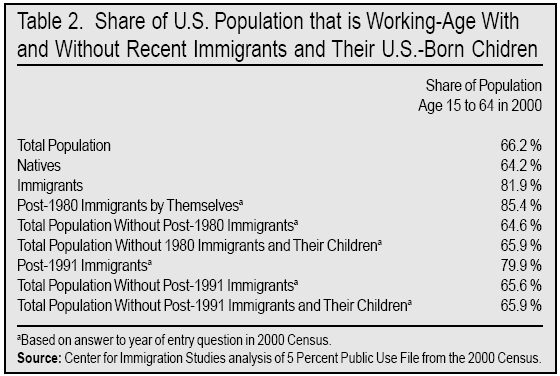
Post-1991 immigrants have the smallest impact. Their exclusion would mean that 65.6 percent of the population would be of working age, only 0.6 percentage points different than the 66.2 when they are included. But as was the case with average age, the question is more complex than just the direct impact of immigrants on the working-age population. As our analysis of average-age illustrated, the impact of the U.S.-born children of immigrants has to also be considered.
Immigrants and Their Children
Looking at immigrants plus their children is important because it represents the total effect of immigration on the country and its age distribution. Advocates of high immigration often point to the fact that immigrants tend to have larger families than natives as one of the benefits of immigration. While it is certainly correct that immigrants tend to have higher fertility than natives, this fact has important implications for the dependency ratio. Children under age 15 generally do not work and, like those over age 64, are supported by the efforts of others. Moreover, government expenditures on those under age 15 are significant not only for public schools, but also for a host of means-tested programs specifically targeted at children. For this reason they are part of the “dependent” population. Including the U.S.-born children of immigrants is a better measure of the impact of immigration because these children represent the full impact of immigration on the nation’s population.
Table 2 shows that when recent immigrants and their U.S.-born children are excluded, the percentage of the population that is of working age changes very little. Excluding post-1980 immigrants and their U.S.-born children from the 2000 Census would mean that 65.9 percent of the nation’s total population would be of working age. Again, this compares to the 66.2 percent if these immigrants and their children are included. The impact is so small because almost all of the children born in the United States to post-1980 immigrants were under age 15 in 2000 and are therefore part of the dependent population.
Table 2 also shows that post-1991 immigrants and their U.S.-born children have about the same effect on the dependency ratio as post-1980 immigrants and their children. If the concern about the changing age structure of our society is motivated by a decline in the number of workers relative to the rest of the population, Table 2 shows that recent immigration has almost no impact on this problem. While advocates of high immigration like to focus on the fact that immigration increases the number of workers in America, they often fail to appreciate the full effect of immigration. Immigration adds to both the working-age population and the dependent population. Because of post-1980 immigration, there were roughly 28 million more people in the country than there would otherwise have been. This certainly makes for a larger population and a more densely settled country. But it does not appreciably change the dependency ratio.14
Immigration at the State Level
Although it is clear that immigration in the last 20 years has had little impact on the share of the population that is of working age at the national level, this might not be true at the sub-national level. States differ in their age distributions, and it is certainly possible that immigrants are drawn to states were there are relatively few people of working age. Table 3 examines this question in detail. The states are ranked based on the share of the population (including the District of Columbia) that is of working age (15 to 64), excluding post-1980 immigrants and their U.S. born children. Thus, the states at the top of table can be seen as those most in need of working age people. In general, the table shows that immigrants who arrived in the last 20 years were not particularly attracted to such states. Of the 15 states that have the smallest working age share, only three rank in the top 15 in terms of immigrant-receiving states: Florida, Arizona, and New Jersey.
Of course, states differ in size, but post-1980 immigrants account for only 5 percent of the population of the 15 states with the lowest working-age share on average. This compares to 8 percent of the population nation-wide. Clearly there are exceptions; Florida was the forth leading immigrant-receiving state. But, it is also a very unusual state because it is the nation’s leading retirement destination, making for a relatively old native population. The same could be said to a lesser extent of Arizona as well. This does not change the basic fact that immigrants are not particularly attracted to states that would seem to be most in need of young people. Immigrant settlement patterns are driven by many factors, but the existing age distribution of states, and thus the supposed need for young workers, would seem to be largely irrelevant to where immigrants go.
Impact of Immigration on Working-age Share in States
Table 3 also reports how much post-1980 immigrants and their children changed the working age share of each state. As already discussed, in 2000 65.9 percent of the population was of working age when post-1980 immigrants and their children are removed, compared to 66.2 when they are included. The same basic pattern holds at the state level. In almost every state, immigration has only a small impact on the dependency ratio, if at all. In only one state, Florida, does immigration increase the working age share by more than one percentage point. And in only four others does it increase the working age share by more the 0.5 percentage points. In states like South Dakota, Iowa, Pennsylvania, Nebraska, Connecticut, and Kansas, where there has been concern in recent years about the inability to hold on to their young populations, immigration has had almost no impact. It seems very unlikely that immigration will have any meaningful impact on the age structure of such states. Young natives generally leave these states because of weak economies, particularly job growth. Immigrants like everyone else, tend to move to states where employment prospects are good. Put simply, if a state has trouble holding on to its native-born young population, it will likely attract only a modest number of immigrants. As a result, immigration is not going to fundamentally change the age structure of these aging states. If these states are truly interested in attracting more young workers, then they may need to adopt reforms that will make them more attractive to natives and immigrants alike.
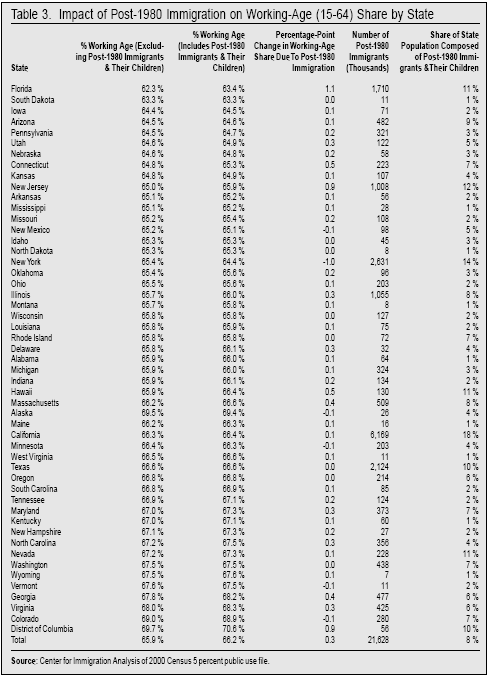
But if they did attract a large number of immigrants, the effect on the dependency ratio would almost certainly be small. Consider California, the nation’s top immigrant receiving state. Post-1980 immigrants and their children comprise 18 percent of the total population, yet immigration has a trivial impact on the working-age share of the population, changing it by only 0.1 percentage point. The case of California indicates that even if a state does attract large numbers of immigrants, the effect on the dependency ratio may still be very small.
Fertility
America’s Relatively High Fertility
Another way to think about the impact of immigration on the age structure of American society is to consider its effect on fertility. Fertility is very important when examining the aging of society because children born in America today will likely live for eight decades or more. Thus current births have enormous implications for the future age structure of the country.
In almost every industrial democracy, the fertility rate has fallen below what has traditionally been thought of as the replacement rate — 2.1 births per woman. (There is some debate about whether a rate somewhat lower than 2.1 might still be sufficient to replace an existing population, given the dramatic decline in infant mortality and overall death rates in industrialized countries.) It is undeniably true that Americans do tend to have more children than any other western society, with fertility hovering at or near replacement level. Thus, America does not face the same kind of inverted population pyramid as other western countries, with all that this may imply about economic growth or funding for social services. In 2000, for example, the Total Fertility Rate (TFR) of the United States was a little less than 2.1 compared to 1.3 for Japan and South Korea, 1.4 for Europe, and 1.5 for Canada. But, the question remains, is immigration the primary reason for America’s relatively high fertility?
America’s Total Fertility Rate
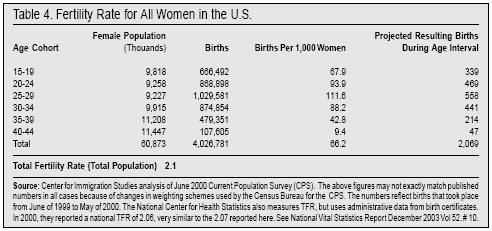
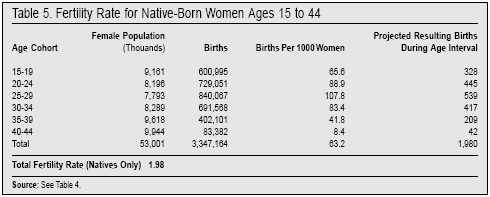
Table 4 reports TFR and births per thousand for the entire U.S. population based on the June 2000 Current Population Survey collected by the U.S. Census Bureau. The table shows that women in America ages 15 to 44 had a TFR of roughly 2.1 (2.069) and 66 births per thousand. Table 5 shows TFR for native-born women only. In 2000, native-born American women had a TFR of about 2.0 (1.98) and 63 births per thousand.15 Thus, the nation’s 31 million immigrants increased births per thousand in the United States from 63 to 66, or 4.5 percent. As for TFR, immigration increased births per woman by 0.09 (about 4 percent), from 1.98 to 2.07, a very modest effect. Without immigrants, American fertility would still be about two children per woman. Thus it is absolutely clear that the much higher overall TFR in the United States compared to Europe or other western democracies is not due to immigration. For example, of the 0.7 children per woman difference between the United States and Europe, 0.6 or 86 percent of it would exist even if there were no births to immigrants in the United States. Native-born American women, for whatever reason, have significantly more children on average than women in other developed countries.
Immigrant Fertility
While native-born American women have higher fertility than those in other developed countries, this does not mean they have as many children on average as immigrants. In 2000, there were 86 births per thousand to immigrant women (ages 14 to 44) in the United States and immigrant TFR was 2.71. Again, this compares to 63 births per thousand for native women and a native TFR of 1.98. So it is true that immigrants tend to have higher fertility than natives. But this higher fertility does not have a large impact on overall fertility rates in the United States. It must be remembered that, in 2000, eight out of 10 births in the United States were to natives. Although higher than that of natives, immigrant fertility is not sufficiently high to fundamentally change the nation’s overall fertility rate. When compared to those in other industrialized democracies, the fertility of women in America is indeed exceptional. But that is due almost entirely to natives.
Population Projections
The analysis above looks at the actual impact of current immigration. The evidence shows that, at least so far, the record level of immigration in recent decades has had little impact on the average age, dependency ratio, or the nation’s fertility rate. The question remains: What is the likely impact of future immigration? This is perhaps the most germane question for policymakers because future immigration is something they have control over. On a periodic basis the Census Bureau attempts to project the size and composition of the U.S. population in the future. Those projections can provide some insight into immigration’s likely impact on American society.
The Impact of Future Immigration.
In 2000, the Census Bureau created population projections using various assumptions.16 One set of assumptions examined population size and dependency ratios over the next century based on different levels of immigration. Figure 1 converts the dependency ratios calculated by the Census Bureau into percentages and reports the share of the population that will be 15 to 64 with different levels of immigration, an age range that is a standard measure of dependency. The Census Bureau projections show that if the net level of immigration (legal and illegal) averaged 100,000 to 200,000 a year between 2000 and 2060, the working-age share of the population would be 58.7 percent in 2060. (Net immigration refers to the difference between the number of people settling in the country each year and the number leaving.) If net immigration (legal and illegal) were to be about 900,000 to one million a year , the working-age share of the population would be 59.5 percent in 2060. Thus, the difference between the low and middle immigration projections is only 0.8 percentage points. Its high immigration projections assume net annual immigration of about 1.6 million a year until 2015 and a steady increase to 2.7 million to 2030, thereafter it would stay between 2.7 and 2.8 million through 2050 and then rise slowly thereafter. Even at this extraordinarily high level of immigration, the Census Bureau reports that 60.8 percent would be of working age in 2060. Again, this compares with 58.7 percent under their low immigration projection. Hardly a huge difference, and of course, the high immigration projections assume a level of immigration that is politically unlikely in the extreme.
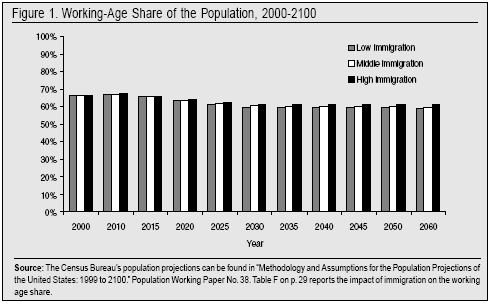
Unfortunately, at the time this Backgrounder went to press, the Census Bureau had not updated its immigration-specific projections. Subsequent research has shown that net immigration is actually higher than the one million the Bureau used for its middle range immigration projections, though the current net level of immigration of ~1.25 million is still well below the level assumed in its high immigration projections. While newer projections will result in a larger overall projected population, there will almost certainly not be any significant changes in age structure as they relate to immigration. The January 2000 projections still provide a good idea of the likely impact of immigration. What is important about these projections is that they show that although there is a very large difference between net immigration of 100,000 to 200,000 a year or roughly one million a year or even two to three million a year, these large differences have little impact on the working-age share of the nation’s total population.
It must be remembered that the population is already very large, so it is difficult for immigration to fundamentally transform the nation’s age structure even with very high levels of immigration. Moreover, immigrants grow older with time just like natives, and children and retirees both have to be supported by the efforts of others. As a result, immigration adds to both the working-age and dependent population. As the Census Bureau itself states in the discussion that accompanies its projections, immigration is “highly inefficient” at reducing the dependency ratio in the long term.17
Social Security
One of the most common arguments in favor of immigration is that it will help save Social Security.18 Social Security, or more accurately the Old-Age and Survivors and Disability Insurance (OASDI) system, is based on the “pay as you go” principle, meaning that current tax payments go to pay the benefits of current retirees. (Throughout this section we use the terms Social Security or Social Security system and OASDI interchangeably.) When today’s workers retire, workers in the future will pay them their benefits. Thus, adding workers through immigration, it is argued, will significantly extend the solvency of the program.
Of course, today’s immigrant workers are tomorrow’s retirees. And as we have seen, both now and in the future immigration has only a tiny impact on the working-age share of the population. The dependency ratio or working-age share discussed above compares the size of the 15-to-64-year-old population to those under 15 and over 64. This makes perfect sense when considering funding for all levels of government because workers provide the taxes spent on both the elderly and children, most notably in the case of children for education. But education is mostly a state and local expense, while Social Security is entirely funded by the federal government. On the other hand, the ultimate source of funding for any government program is the same — taxpayers. Thus it may make little sense to view the Social Security program in isolation. After all, if expenses and tax payments rose dramatically for programs other than Social Security, the ability to fund the OASDI system would be impaired because taxpayers would lack the income to pay for it. Also, Congress has chosen to use the current Social Security surplus to pay for general expenses — everything from education and law enforcement to defense. So far $1.5 trillion has been taken out of the OASDI trust fund to pay for non-Social Security programs. This money has been replaced by IOUs from the federal government in the form of U.S. treasury bonds.
Nonetheless, it is common to treat Social Security as a separate program, so it may make sense to examine the ratio of workers to retirees. But doing so still shows immigration has a very modest impact on the nation’s age structure. The Census Bureau’s low immigration projections, which assume 100,000 to 200,000 net immigrants a year, show that in 2060, 27 percent of the adult population (age 15+) would be 65 or older, compared to 26 percent in their medium immigration projections, which assume net immigration of 900,000 to one million per year.19 Thus, even focusing on only working-age people relative to retirement age people shows a very small effect from immigration.
How Large Is Social Security’s Problem?
According to the 2004 report of the Social Security trustees, current expenditures for the program will exceed current revenue in 2018, but there is enough money in the trust fund to pay out benefits until 2042. But of course, the OASDI trust fund is comprised solely of IOUs from the government to itself. This includes hundreds of billions of dollars in interest payments that the government owes itself. And like the IOUs, these interest payments are incorporated into SSA projections and are the reason the fund is said to have enough money to pay benefits until 2042. Each year the SSA reports the program’s “actuarial balance,” sometimes referred to by SSA as the “actuarial deficit,” which is the difference between projected income and projected costs, assuming no change in current law.20 They report the actuarial balance as a percentage of “effective taxable payroll” over 50 or 75 years. Effective taxable payroll is basically the sum of all the earnings subject to the Social Security tax American workers will make over the time period. Throughout this study we use information drawn from the Social Security Administration’s 2004 report and focus on the 75-year projections made by SSA. We use the 75-year time frame because the shortfall in funding is much larger over this time period than the 50 year time horizon, so if there is a need for assistance from immigration it is over the next 75 years. Moreover, the SSA itself generally focuses on the 75-year projected revenue and cost estimates. In recent years, the actuarial balance for the 75-year time frame has hovered around -2 percent of effective taxable payroll, and was -1.89 percent in 2004. So for example, over the next 75 years effective taxable payroll is expected to be very roughly $200 trillion. Taking roughly 2 percent of $200 trillion yields the dollar value of the actuarial balance. In 2004 the negative balance over the 75-year time frame was -$3.699 trillion. The SSA calls this negative dollar figure the “open group unfunded obligation.”21 In theory, raising taxes immediately by 1.89 percentage points, and keeping them at that level, would provide the program with enough money to meet its costs until 2078. But it is not quite that simple. The system already runs a surplus from tax payments of about $68 billion annually.22 And if taxes were raised by 1.89 percentage points it would run an even larger surplus, at least for a few decades. This larger surplus could, in theory, then be drawn upon later, along with continuing tax payments, to pay benefits through 2078.
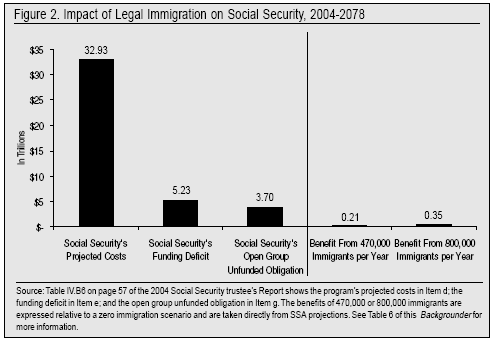
But it must be kept in mind that the present surplus, by law, must be used every year to run non-Social Security programs if the non-Social Security part of the budget is in deficit, which it has been almost every year for the last two decades. And this is what would happen to the larger surplus resulting from a Social Security tax increase.23 Also keep in mind that the 1.89 percent of payroll tax, or $3.699 trillion, is so “low” because the SSA treats the bonds in the current trust fund and the hundreds of billions in interest as being available to pay beneficiaries. If one does not treat the current trust fund as an asset, then the actual difference between the program’s projected cost of $32.928 trillion and projected tax payments of $27.699 over the next 75 years is $5.229 trillion.24 Although SSA reports this figure in the trustees report, it does not have a specific name for the dollar value of the actual deficit of taxes minus costs, but throughout this Backgrounder, I will refer to it as the program’s “funding deficit.” The funding deficit is the amount of money that must be made up either directly by paying more in Social Security taxes or indirectly by paying more in taxes other than Social Security that would then be used to cover the open group unfunded obligation plus the trust fund bonds and interest. Of course, the funding deficit could also be made up by borrowing more money. Increased revenue from taxes or borrowing are the only way to solve the problem if benefits are kept at the present level. While all of these issues do not relate directly to immigration, it is necessary to understand the Social Security system, especially the scale of the problem, in order to place the effect of immigration into its proper context.
Immigrants and Social Security
In any projection, whether the focus is on population size and composition, like the ones the Census Bureau does, or whether the focus is funding for the OASDI system, there is the question of how to treat immigrants. While their age at arrival, sex, and life expectancy can be estimated reasonably well, emigration rates are not well understood. But once one assumes different levels of immigration and emigration the biggest question for projections dealing with Social Security is earnings. Should one assume that immigrants or even their descendants will pay about as much in taxes as natives on average and use about as much in Social Security? This is important for two reasons. First, one possible reason immigration may create a benefit for the system is that immigrant workers arrive and begin paying into Social Security, and they have no parents who are currently drawing on the system. This represents an infusion of money into Social Security from these new workers without a corresponding cost to the system. However, the size of the infusion depends on the average earnings of the immigrants. The second reason that immigrant earnings and tax payments matter is that Social Security is partly redistributive in nature. That is, it pays somewhat more generous retirement benefits to lower income participants relative to their tax contributions than it does to higher wage workers. For example, a new retiree who had average earnings would receive monthly retirement benefits equal to roughly 40 percent of his working income adjusted for inflation, while a worker with half the average income receives benefits equal to more than 50 percent of his earnings. Even analysis that takes into account the longer life expectancy of higher income workers still finds that the program is redistributive.25 Therefore if immigrants are on average poorer than natives, then the small positive effect on the age structure discussed above may not result in a positive impact on Social Security.
The third reason the average earnings of legal immigrants are important is the existence of the Earned Income Tax Credit (EITC), which is specifically designed to refund all or part of Social Security taxes paid by low-wage workers, especially those with children. As the IRS states on its web site, the Credit was partly created by Congress in 1975 to “offset the burden of social security taxes” on low-wage workers.26 Of course, the EITC is not funded by the Social Security system. But since money in the Social Security trust is used to cover general expenditures like the EITC, and the Credit is designed to give back Social Security taxes, use of the EITC is certainly germane to this question.
Uncertainty Surrounding Projections
Another key point to keep in mind when thinking about OASDI is the difficulty in projecting revenue and expenditures decades into the future. The long-range projections for Social Security discussed above all must deal with demographic uncertainty about births, deaths, and immigration just as Census Bureau population projections must. But SSA projections must also make assumptions about productivity and wage growth, inflation, and unemployment rates for many decades into the future. Added to this uncertainty is the question of immigrant earnings. All this uncertainty must be considered when thinking about the impact of immigration on the system.
Incorporating Immigration in Social Security Projections
Although the overall projections are very complex, the way that SSA incorporates immigrants into its projections is methodologically very simple. It uses administrative data provided by legal immigrants when they receive their green cards to estimate the average age and sex of immigrants when they start paying into the system. It then makes different assumptions about immigration and emigration levels. (In general SSA assumes that whatever the number of new legal immigrants each year, a number equal to 25 percent of new arrivals will leave the United States annually.) After making immigration and emigration assumptions, SSA treats immigrants as being the same as natives. This approach basically assumes that individuals added to the nation’s population through legal immigration will be as likely as natives to work in jobs covered by Social Security, and most importantly, they will have average earnings, and make average tax payments from the moment that they are given legal permanent residence.
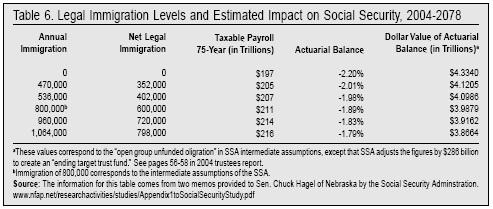
Table 6 shows how different levels of legal immigration affect the actuarial balance of Social Security over the next 75 years. As already mentioned, these figures were provided by the Social Security Administration at the request of Sen. Chuck Hagel of Nebraska.27 Column 1 shows the different possible levels of new legal immigration. Column 2 shows net legal immigration. Column 3 shows the taxable payroll, which is the total value of American workers’ earnings over the next 75 years that will be subject to Social Security taxes under the different immigration scenarios. Different levels of immigration produce different size taxable payrolls. The fourth column shows the actuarial balance as a percentage of taxable payroll, and the fifth column is the value of the balance in 2004 dollars. Legal immigration of 800,000 a year (600,000 net) is consistent with the intermediate assumptions of the 2004 trustees report.28 It should be noted that the dollar value in Column 5 for immigration of 800,000 a year does not exactly match the “open group unfunded obligation” of $3.699 trillion in SSA intermediate assumptions because SSA adjusts the figures by $286 billion to create what they call an “ending target trust fund.”29\
Different Levels of Immigration.
To see how changes in legal immigration over the next 75 years would impact Social Security one can compare the values on the right hand side of Table 6. For example, if legal immigration was zero, the actuarial deficit would be 2.20 percent of taxable payroll or $4.334 trillion. Alternatively if legal immigration was 800,000 the actuarial deficit would be 1.89 percent of payroll or $3.9879 trillion. The dollar value of the difference is $346.1 billion and this represents the benefit from 800,000 legal immigrants a year or 60 million immigrants over 75 years. This is equal to only about 1 percent of the program’s projected costs of $32.928 trillion over the next 75 years, according to the intermediate projections. Compared to the program’s funding deficit of $5.229 trillion it is just 6.6 percent. Even compared to the open group unfunded obligation of $3.699 trillion it is still just 9.4 percent.
A recent study by the National Foundation for American Policy estimated the benefit of 800,000 legal immigrants as $611 billion over 75 years, but that was a mistake. They have since revised their study and now report the correct figure of $346 billion. It should be noted that although reducing legal immigration by 800,000 a year creates a deficit that is equal to 9.4 percent of the current open group unfunded obligation, the size of the change in terms of the “actuarial deficit,” when measured as a percentage of taxable payroll, is 0.31 percentage points. This is a 17-percent relative increase, quite a bit more than 9.4 percent. Put a different way, Table 6 shows that -2.2 percent, which is the actuarial deficit under a zero legal immigration scenario, is 17 percent larger than -1.89 percent, which is the actuarial deficit under the 800,000 legal immigration scenario. This is important because the last paragraph of the memo provided to Sen. Hagel’s office by SSA, dated September 15, 2004, states that the zero legal immigration scenario increases the OASDI actuarial deficit by 17 percent over the 75-year time frame.30 But the 17 percent figure does not take into account the fact that taxable payroll is different under each scenario, producing different dollar values for the open group unfunded obligation. The actual difference in terms of dollars seems to be the more meaningful comparison, not the relative percentage point change. Nonetheless, SSA has chosen to report the effect of immigration in this way.
Since it is unlikely that legal immigration will ever be cut to zero, it makes sense to compare changes in immigration that are politically possible. Table 6 shows that a reduction in legal immigration of 330,000 (a 41-percent reduction) from 800,000 to 470,000 would increase the deficit by $132.6 billion over the 75-year period ($4.1205 - $3.9879 trillion). This comes to only 0.4 percent of the program’s 75-year projected costs, 2.5 percent of the funding deficit and 3.6 percent of the open group unfunded obligation. What might this mean for average taxpayers? The actuarial balance for the 470,000 a year immigration scenario is -2.01 percent, this is 0.12 percentage points larger than the -1.89 percent actuarial balance for the 800,000 million immigration scenario. Since taxes are split between employers and workers, this means that direct taxes on workers would have to be increased by 0.065 percentage points or about $21 a year for the average worker making $33,000 a year, or about $42 if one assume that workers bear the total costs of taxes on employers.
Reducing immigration from 800,000 to 470,000 a year would be substantial. But relative to the enormous size of the program and its projected deficits, the effect would very modest. Even if one uses the percentage-point change in the actuarial deficit discussed above, ignoring the actual dollar value of the change, the difference between the 470,000 and 800,000 immigration scenarios is still only 0.12 percentage points (2.01 percent minus 1.89 percent) creating a relative change of just 6.5 percent. Thus a substantial reduction in legal immigration of 41 percent has only a small impact on Social Security, no matter what measure is used.
To illustrate the scale of immigration’s effect on Social Security, Figure 2 compares the dollar value of immigration’s effect under different assumptions using a 75-year time frame. The benefit to the system from legal immigration is expressed relative to a zero immigration scenario. The figure makes clear that immigration has only a tiny impact on the system. Assuming SSA projections are correct, one could certainly advocate significant cuts in legal immigration secure in the knowledge that it would not have a significant impact on Social Security.
What Would Happen to Social Security if Immigration Was Doubled?
Another way to think about immigration’s effect is to imagine what would happen if there was a huge increase in legal immigration, from 800,000 to 1.6 million annually over the next 75 years. While politically such a huge increase is extremely unlikely, it is helpful to think about the long term effects of doubling legal immigration. Table 6 shows that the relationship between immigration and funding is basically linear in SSA projections. Assuming this is the case and each additional 800,000 legal immigrants have roughly the same impact as the first 800,000, the benefit from doubling legal immigration should be the same as the first 800,000 — a benefit of $346.1 billion over 75 years. It must be remembered that the intermediate projections already assume 800,000 legal immigrants a year. That is, 800,000 legal immigrants are already incorporated into the projections, which still show a $5.229 trillion funding deficit and a $3.699 trillion open group unfunded obligation. As we have seen, $346.1 comes to just 6.6 percent of the funding deficit and only 9.4 percent of the open group unfunded obligation. As we have also seen, even if one uses the percentage-point change in the actuarial deficit discussed above, ignoring the actual dollar value of the change, the difference between the zero and 800,000 immigration scenarios over 75 years is still only 0.31 percentage points, (2.2 percent minus 1.89 percent) creating a relative change of just 17 percent.
Putting aside how unlikely an increase in legal immigration of 800,000 is politically, these numbers show that it is very hard to make the case that immigration is a indispensable part of the solution to the Social Security problem in the long run.31 If a dramatic increase in legal immigration, such as doubling it, still leaves more than 90 percent of problem in place when expressed in terms of dollars, and 83 percent of the problem in place when expressed as a percentage of taxable payroll, it makes no sense to tout immigration as a significant part of the long-term solution to Social Security.
If the SSA projections are taken at face value, they tell us two things: legal immigration has a positive effect on the OASDI system; and that any decrease or increase in immigration that is possible politically would have only a small effect on the system relative to the size of the program. One simply must look elsewhere to solve the Social Security’s funding problem.
Problems with SSA Immigration Estimates
The biggest question surrounding the SSA immigration projections is that they do not incorporate how immigrants differ from natives in terms of tax payments. As a result, the small impact on the nation’s age structure that immigration creates, and the source of the small positive impact on Social Security reported above, may not even exist. Legal immigrants are poorer than natives on average, resulting in lower tax payments. There is a large body of research showing that legal immigrants take many years after arrival to close the earnings gap with natives, by which time they are on average older than natives.32 This means they have lower lifetime earnings and Social Security payments because Social Security taxes are levied as a percentage of earned income. Studies that have actually looked at legal immigrant Social Security taxes support this conclusion. A 1998 study by the Urban Institute, which is generally regarded as asupporter of high immigration, found that legal immigrants in New York State paid only 85 percent as much in Social Security taxes as natives on average.33 As already pointed out, this matters because part of the benefit from immigration is supposed to come from the arrival of immigrant workers who represent an infusion of money into Social Security, without a corresponding cost to the system until they retire. However, the size of the infusion depends on the average earnings of the immigrants. And SSA is assuming that those earnings are the same as natives from the moment of arrival, which is almost certainty incorrect. In addition, because Social Security is redistributive, the lower average income of legal immigrants means that they will tend to have a more negative long-term impact on the system that is not considered if immigrants are treated as average taxpayers from the moment they arrive.
The lower income of immigrants also has other implications for public coffers. As mentioned above, there is the EITC, which is supposed to give back Social Security taxes paid by low-wage workers. For example, a family comprised of a husband, wife, and two children with earned income of $25,000 year would received about $2,100 from the EITC in 2004 compared to their Social Security tax payment of roughly $1,600, not including the employer contributions. Because immigrants tend to be poorer than natives on average and are more likely to have children, they are much more likely to qualify for the Credit. As part of a larger study on immigrant tax payments and service use, the Center for Immigration Studies has estimated that households headed by legal immigrants received on average of $392 from the EITC in 2002 compared to $209 for native headed households.34 And the money for this program ultimately comes from the same source as for Social Security — taxpayers.
Overall, it is not at all clear that legal immigration actually does create a benefit for the Social Security system in the long run. But even if one ignores the significant differences between immigrant and native lifetime earnings, tax payments, and EITC receipt, the fact remains that SSA’s own projections show a very small impact from legal immigration on the system relative to its size. SSA projections indicate that cutting immigration by 41 percent from 800,000 to 470,000 would increase the size of the funding deficit by only 2.5 percent and the open group unfunded obligation by 3.6 percent. The kinds of changes to legal immigration policy that are politically likely have only a very small effect on the Social Security system. The debate over immigration should instead focus on areas that immigration does have a large impact.
Conclusion
There is no doubt that the aging of the nation’s population will create very real challenges for American society. One can favor more or less immigration for many reasons, but the available evidence indicates that immigration has not had, nor is it likely to have, a significant impact on this problem. Although the average age of newly arrived immigrants is much younger than that of natives, the difference is not large enough to significantly change the nation’s age structure. In fact, in 2000, the average age of an immigrant was 39 years, compared to 35 years for natives.
One of most important concerns of those worried about the aging of the country is that there will be too few workers relative to those who do not work. In 2000, 66 percent of the nation’s population was of working age — 15 to 64. If all the immigrants who arrived after 1980 and their U.S.-born children had not come to America, our findings show that the share of the population that is of working age would be virtually unchanged at 66 percent. Immigration adds to both the working-age population and to the dependent population. This is due to the aging of immigration and also because immigrants have children.
Looking to the future, the evidence is also clear that immigration will have only a very modest impact on the nation’s age structure. For the most part, the people who will live in America in this century are being born today. In 2000, the nation’s total fertility rate when immigrants are included is slightly under 2.1 children per woman. Without immigrants it would be 2.0 — the rate for natives. The much higher fertility rate in the United States compared to Europe (1.4) and Japan (1.3) is not due to the presence of immigrants. Rather, it reflects the higher fertility of native-born American women, who continue to have significantly more children on average than their counterparts in other industrialized democracies.
Census Bureau population projections show that different levels of immigration have a very modest impact on the nation’s age structure. The Census Bureau’s low immigration projections, which assume net immigration of 100,000 to 200,000 people per year show that, in 2060, 27 percent of the adult population (age 15+) would be older than 65, compared to 26 percent in their medium immigration projection, which assumes annual net immigration of about one million. The Census Bureau itself states that immigration is “a highly inefficient” means for addressing a high ratio of working-age people relative to those too young or too old to work. Even focusing on working-age people relative to only retirees and excluding those under age 15, reveals little effect from immigration. Although it has little effect on the share of the population that is of working age, immigration does make for a much larger overall population and more densely settled country. The Census Bureau’s middle immigration projections show that immigration will add 97 million people to the U.S. population over the next 60 years. But its impact on the aging of society can only be described as very modest.
As for the Social Security system, estimates from the Social Security Administration show that reducing legal immigration by 41 percent would increase the size of the program’s funding deficit by only 2.5 percent. It is not clear that even this tiny effect exists because SSA assumes that legal immigrants will have earnings and resulting tax payments as high as natives from the moment they arrive, which is contrary to a large body of research. Even if the SSA projections are correct, they indicate that the kinds of changes in immigration policy that are politically likely are almost entirely irrelevant to Social Security.
The argument that immigration can have a significant impact on the aging of our society seems plausible. Immigrants tend to arrive in America relatively young and they also tend to have more children than natives. But an evaluation of the actual data shows that the difference between immigrants and natives is not sufficiently large, nor are immigrants sufficiently numerous to be of any real help in changing the nation’s age structure. Moreover immigrants age just like everyone else. Americans will simply have to look elsewhere to deal with this problem.
Endnotes
1 See for example his most recent book, Fewer: How the New Demography of Depopulation Will Shape Our Future, 2004.
2 "Saved by Immigrants," The Washington Post, July 17, 1998; Page A21.
3 See for example "Immigration and the Graying of America" by Gary Endelman at http://www.visalaw.com/00feb2/11feb200.html
4 I use 1991 through 2000 and not 1990 through 2000 because the public use file of the 2000 Census groups individuals by year in such a way that makes it impossible to examine the entire decade of the 1990s. It is not clear why the Census Bureau chose to release the 2000 Census in this way, but one additional year of immigration makes little difference to the analysis. It should be pointed out that although there are slightly fewer post-1991 immigrants than post-1990 immigrants, the post-1991 population is a little younger on average because it does not include immigrants who arrived in 1990 and who have aged one more year by 2000.
5 The foreign-born are defined by the Census Bureau as persons living in the United States who were not U.S. citizens at birth. This includes naturalized American citizens, legal permanent residents (green card holders), illegal aliens, and people on long-term temporary visas such as students or guest workers, who respond to the decennial census or other surveys. It does not include those born abroad of American parents or those born in outlying territories of the United States such as Puerto Rico.
6 We assume that the U.S.-born children of immigrants under age 18 live with their parents. This leaves a very small number of children born in the U.S. to immigrants in 1980-82, shortly after the immigrants arrived who would be adults by 2000. Analysis of the 1990 Census indicates that there were only about 97,000 U.S.-born children of immigrants who arrived 1980-82 who could have been 18, 19 or 20 by 2000, and living on their own. The number is so modest because only a small fraction of immigrants have children shortly after arrival. In the 2000 Census 30,000 of these children stilled lived with their parents. Allowing for deaths and the returning home with their parents among these children we estimate that there were no more than 30,000 adult children of post-1980 immigrants who did not live with their parents in 2000. As for the U.S.-born children of post-1991 immigrants, we assume that all of them lived with their parents in 2000 because they were all under age 10. To estimate the number of post-1980 immigrants and their children, we employ the following method: We first use the year of entry question to identify all immigrants who came to the United States in 1980 or later. To estimate the number of children they have had, we count U.S.-born persons 20 or younger who live in households headed by immigrants who arrived between 1980 and 2000. (Alternative calculations using families instead of households yield virtually identical results.) In effect, this approach counts persons with two immigrant parents or those who have only immigrant fathers. Those with only immigrant mothers tend to be excluded from this approach unless the mother is the household head. It is necessary to exclude half of the children from mixed native/immigrant unions in this way because the presence in the United States of such persons cannot entirely be attributed to immigration. Thus, counting all children from "mixed" unions would overstate the impact of immigration. By counting only U.S.-born persons in post-1980 immigrant-headed households 20 and younger, we are counting only half of those with mixed parentage as being the result of immigration. It is important to note that the March 2000 Current Population Survey (CPS), which unlike the decennial census asks about the birthplace of respondents’ parents, shows that nearly two thirds of persons 20 and under with at least one foreign-born parent have two foreign-born parents. More importantly, the CPS also shows that those with only one immigrant parent split almost evenly between having an immigrant mother versus an immigrant father. Thus, the approach described above should not introduce any bias into the estimates. It is also worth noting that the 2000 CPS shows that 98 percent of U.S-born persons under age 20 in households headed by post-1980 immigrants have at least one immigrant parent. Using this approach, we estimate that there were 21.6 million post-1980 immigrants living in the United States and slightly more than six million U.S.-born children of post-1980 immigrants. We use the same method to estimate the impact of post-1991 immigration.
7 The former INS estimated the share of illegals in the 2000 Census. The paper is authored by Robert Warren and can be found at www.uscis.gov/graphics/shared/aboutus/statistics/Ill_Report_1211.pdf
8 Most demographics textbooks provide a discussion of TFR and an explanation of how it is calculated. See for example David Yaukey and Douglas L. Anderton, Demography: The Study of Human Population, 2001. Long Grove, Illinois: Waveland Press. Pages 193-194.
9 The Center for Health Statistics (CHS) collects administrative data on births, and when combined with Census Bureau estimates of the total population, can also be used to calculate the nation’s TFR. Unfortunately, the Census Bureau only provides mid-year estimates of the nation’s population by race and ethnicity but not by nativity. Thus it is not possible to use this administrative data to calculate native or immigrant TFR. However, since the CPS population totals are controlled to reflect administrative data such as births provided by CHS, the TFR from the CPS should reveal the same results as would result using CHS administrative data and population estimates.
10 It should be noted that TFR is designed to control for differences in age structure, so the differences in the average ages of immigrants and natives should not effect the results.
11 The 2004 trustee’s report can be found at www.socialsecurity.gov/OACT/TR/TR04/index.html
12 The memo dated September 15, 2004, provides actuarial balances under different immigration scenarios, while the memo dated Jan 6, 2005, provides the size of the effective taxable payroll under different scenarios. Both can be found at www.nfap.net/researchactivities/studies/Appendix1toSocialSecurityStudy.pdf
13 This is the ratio of those who are too young or too old to work relative to those in their prime working years. Since the vast majority of those under age 15 or over age 64 do not work, this is a reasonable measure of dependence in society and the one often used by the Census Bureau.
14 Some demographers focus on individuals in their "prime working years," usually defined as 30 to 44. These individuals are thought to be especially productive workers. But again, the available evidence makes clear that immigration does not significantly change the share of working-age people (15 to 64) who are in this age group. Based on the 2000 Census, 35.6 percent of all working-age persons were in their primary working years (30 to 44), when immigrants are counted. But when they are excluded, 34.8 percent of the population are in their primary working years– a .6 percent difference. Excluding just post-1980 immigrants produces the same result, 34.8 percent of working age people are in their prime working years. Immigration simply does not have a significant impact on the overall age structure. This is true even when one focuses on those in their prime years or all those of working age.
15 The June 2002 CPS shows native fertility of 1.9, as does the June 2004 CPS. Given sampling variability, these TFR are not significantly different that the 1.98 in the June 2000 CPS.
16 The Census Bureau’s projections can be found in "Methodology and Assumptions for the Population Projections of the United States:1999 to 2100, Population Division Working Paper No. 38." The report itself can be found at: www.census.gov/population/www/documentation/twps0038.pdf Table E on page 28 reports the different net immigration assumptions and Table F on page 29 reports the impact of these assumptions on the dependency ratio.
17 Ibid. Page 21.
18 The author would like the thank the Social Security Administration Office of the Chief Actuary, in particular Ms. Alice H. Wade, for their generous assistance in understanding the impact of immigration on Social Security.
19 The Census Bureau projections can be found at www.census.gov/population/www/documentation/twps0038.pdf Table F on page 29 reports the impact of different levels of immigration on dependency ratios.
20 SAA defines "actuarial deficit,"as a negative actuarial balance. See page 191 of Trustee’s report.
21 The 2004 trustees report can be found at www.socialsecurity.gov/OACT/TR/TR04/index.html Table IV.B6 on page 57 of the report shows the actuarial balance and the open group unfunded obligation.
22 Table II.B1 on page 4 of the trustees report shows total tax revenue and total expenses for 2004. In 2003, the program spent $479.1 trillion and generated $546.9 billion from tax revenues for a surplus of $67.8 billion. These figures do not include the $84.9 billion that the trust fund generated in interest payments.
23 It is possible that Congress could change the law and require that the surplus be set aside somehow, perhaps by investing it in equity markets. But unless non-Social Security taxes or spending are cut dramatically, putting aside the surplus would mean a much larger deficit in non-Social Security programs, which taxpayers would then have to service. Put simply, the government would be earning interest in equity markets on the Social Security surplus, but that money would be going out because of the need to make interest payments on the larger deficit that would now exist in programs other than Social Security. Thus putting the money aside, assuming that could actually be done, does not really solve the problem either.
24 Table IV.B6 on page 57 of the trustees report shows total tax payment, program costs and difference between the two over 75 years, line "e" shows the dollar amount. The report is online at www.socialsecurity.gov/OACT/TR/TR04/index.html
25 A paper by Jeffrey Liebman published by the National Bureau of Economic Research found that 5 to 9 percent of Social Security benefits are redistributed between retired workers who had different levels of earnings. See www.nber.org/papers/w8625
26 www.irs.gov/individuals/article/0,,id=96406,00.html
27 The memo dated September 15 can be found at www.nfap.net/researchactivities/studies/Appendix1toSocialSecurityStudy.pdf
28 In addition to legal immigration, the Social Security Administration assumes net "other" immigration of 300,000 a year, primarily illegal aliens. This other immigration is held constant at 300,000 in all of the scenarios listed in Table 6.
29 See pages 29-66 in 2004 trustees report for more explanation. The report is at www.socialsecurity.gov/OACT/TR/TR04/index.html
30 www.nfap.net/researchactivities/studies/Appendix1toSocialSecurityStudy.pdf
31 Ben Wattenberg has argued that immigration is the "easy solution to the Social Security crisis." Stephen Moore, formally of the Cato Institute has said that immigrants are "keeping Social Security afloat."
32 George Borjas of Harvard also discusses the issue of life time earnings in Chapter 2 of his 1999 book Heaven’s Door: Immigration Policy and the American Economy. Jasso, Massey, Rosenzweig and Smith have estimated the average earnings of legal immigrants upon arrival. Their article from Demography can be found at http://econwpa.wustl.edu/eps/lab/papers/0403/0403002.pdf Also Duleep and Regets have examined immigrant earnings over time. Their work can be found at www.findarticles.com/p/articles/mi_m6524/is_n2_v59/ai_18747327/pg_1
33 "Immigrants in New York: Their Legal Status, Incomes and Taxes" by Jeff Passel and Rebecca Clark, Urban Institute 1998. Table 3a page 109 reports Social Security Tax payments by legal status. Information about the report can be found at: http://www.urban.org/url.cfm?ID=407432
34 The report, The High Cost of Cheap Labor: Illegal Immigration and the Federal Budget can be found at www.cis.org/sites/cis.org/files/articles/2004/fiscal.html Table 1 in the appendix reports EITC use for illegal alien households and appendix Table 2 reports EITC use for legal immigrant households. To arrive at the above estimates further estimates were done by the author to estimate only program use for legal immigrants.
Steven A. Camarota is the Director of Research at the Center for Immigration Studies.