
Download this Backgrounder as a pdf
Executive Summary
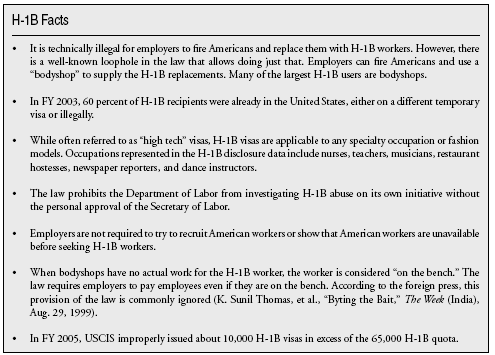
The temporary visa program known as H-1B enables U.S. employers to hire professional-level foreign workers for a period of up to six years. According to the law (8 U.S.C. § 1182(n)), employers must pay H-1B workers either the same rate as other employees with similar skills and qualifications or the "prevailing wage" for that occupation and location, whichever is higher. This is to prevent the hiring of foreign workers from depressing U.S. wages and to protect foreign workers from exploitation.
This report examines the wage data in Labor Department records for Fiscal Year 2004. It compares wages in approved Labor Condition Applications (LCAs) for H-1B workers in computer programming occupations to wage levels of U.S. workers in the same occupation and location. The analysis demonstrates that, despite the H-1B prevailing-wage requirement, actual pay rates reported by employers of H-1B workers were significantly lower than those of American workers. These findings show that the implementation of the prevailing-wage requirement in the H-1B program does not ensure that H-1B workers are paid comparably to U.S. workers. Moreover, the data suggest that, rather than helping employers meet labor shortages or bring in workers with needed skills, as is often claimed by program users, the H-1B program is instead more often used by employers to import cheaper labor.
Key Findings
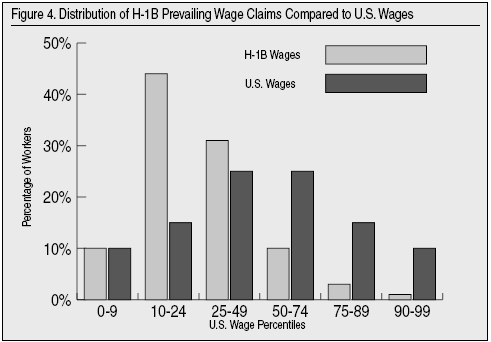
- In spite of the requirement that H-1B workers be paid the prevailing wage, H-1B workers earn significantly less than their American counterparts. On average, applications for H-1B workers in computer occupations were for wages $13,000 less than Americans in the same occupation and state.
- Wages for H-1B workers in computer programming occupations are overwhelmingly concentrated at the bottom of the U.S. pay scale. Wages on LCAs for 85 percent of H-1B workers were for less than the median U.S. wage in the same occupations and state.
- Applications for 47 percent of H-1B computer programming workers were for wages below even the prevailing wage claimed by their employers.
- Very few H-1B workers earned high wages by U.S. standards. Applications for only 4 percent of H-1B workers were among the top 25 percent of wages for U.S. workers in the same state and occupation.
- Many employers use their own salary surveys and wage surveys for entry-level workers, rather than more relevant and objective data sources, to make prevailing-wage claims when hiring H-1B workers.
- Employers of large numbers of H-1B workers tend to pay those workers less than those who hire a few. Employers making applications for more than 100 H-1B workers had wages averaging $9,000 less than employers of one to 10 H-1B workers.
- The problem of low wages for H-1B workers could be addressed with a few relatively simple changes to the law.
Purpose
The purpose of this report is to examine the effectiveness of the prevailing wage requirements in the H-1B program and to determine whether there is a difference between wages paid to H-1B workers in computer programming fields and wages for U.S. workers in the same fields. This report uses the Bureau of Labor Statistics Occupational Employment Statistics as the measurement of U.S. wages and the H-1B Labor Condition Application disclosure data as the measurement of H-1B wages.
The H-1B Visa Program
This H-1B visa program was created in 1990 as a guestworker program for specialty occupations. A specialty occupation is one that requires a college degree or equivalent professional experience. There is no specific skill requirement for an H-1B visa.
The H-1B program is technically classified as a non-immigrant program. H-1B visas are valid for up to three years and can be renewed once for an additional three years. H-1B visas are also tied to employment so that an H-1B visa becomes invalid if the worker loses his job. While employed, it is relatively easy for a worker on an H-1B visa to transfer the visa to another employer. Transfers do not extend the time limit on the original visa.
While the H-1B is a temporary, non-immigrant visa, the law allows H-1B holders to apply for permanent residency and, since H-1B workers can bring their families with them, any children born during their stay become U.S. citizens. While relatively few H-1B workers obtain permanent residency, anecdotal evidence suggests a significant percentage, perhaps the majority, of workers who come to the United States on H-1B visas come intending to stay permanently.
The challenge for H-1B workers who want to remain in the United States is to get a permanent residency application processed within the six-year maximum term of an H-1B visa. Congress has modified the H-1B program to allow workers in the final stages of a permanent residency application to remain in the United States beyond the six-year time limit. However, an H-1B worker who changes employers is unlikely to be successful in getting permanent residency.
The H-1B program was originally limited to 65,000 visas a year. As the popularity of the H-1B program grew in the late 1990s, employers started to exhaust this quota. In 1998, 2000, and 2004 Congress enacted both temporary increases and permanent increases in the program. Figure 1 shows the quota changes over time. The current limits, effective in FY 2005, divide H-1B visa into four categories with different limits:
- No limit to the number of visas issued to universities and research institutions.
- 20,000 visas reserved for those with graduate degrees from U.S. institutions.
- 6,800 visas reserved for Singapore and Chile under free trade agreements.
- 58,200 visas for all others.
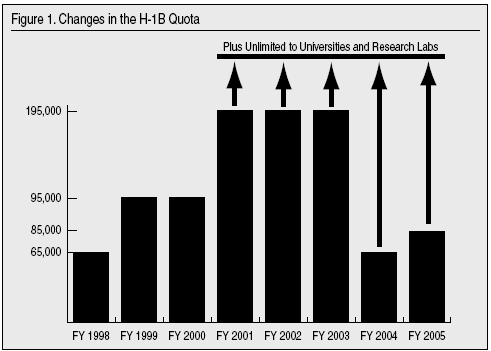
This complicated visa allocation scheme reflects the political struggles that have surrounded the H-1B program since 1994. The general H-1B quota for FY 2005 was exhausted on the first day of the fiscal year and six weeks beforehand in FY 2006. However, only about a third of the quota for U.S-educated workers was used in FY 2005 and it is unlikely to be used up in FY 2006."
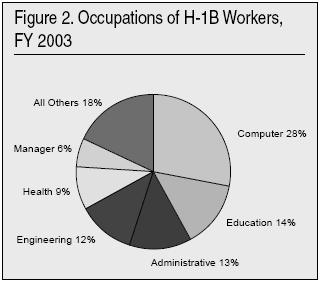
H-1B visas are often referred to as "high tech" visas since historically most have been issued to workers in computer programming, engineering, or science disciplines. In recent years, while the H-1B quota was temporarily increased, the percentage of workers in these occupations declined. Figure 2 shows the distribution of H-1B visas issued by occupation.
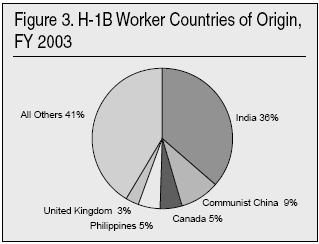
Workers from India and China dominate the H-1B program. Before the temporary increases in the H-1B visa quota, nearly half of all H-1B visas went to people born in India. During the periods of increased H-1B quotas, the percentage of H-1B visas issued to people born in these countries decreased. Figure 3 shows the distribution of H-1B visas issued by country.
The law requires employers to pay H-1B workers the prevailing wage. In theory, the H-1B program is supposed to prevent employers from bypassing U.S. workers in favor of lower-paid foreign workers.
Labor Condition Application
As part of making an application for an H-1B visa, the employer must submit a Labor Condition Application (LCA). The Labor Department is responsible for ensuring that the hiring of foreign workers will not adversely affect the wages and working conditions of U.S. workers -- or displace U.S. workers -- and the LCA is the principle tool for ascertaining this. In this, the employer certifies:
- It will be paying the H-1B worker the higher of the wages paid to other employees with similar experience and qualifications or the prevailing wage for the occupation in the location of employment.
- There is no current strike or lockout.
- The employer will provide notice to other employees of the application filing.
The federal regulations governing LCAs allow employers to select a prevailing wage from a number of different types of sources:
- Complying with the Davis-Bacon Act or Service Contract Act (SCA) on Federal Contracts.
- Union collective-bargaining agreement.
- A State Employment Security Agency (SESA) prevailing-wage determination.
- Another wage source that "reflects the weighted average wage paid to workers similarly employed in the area of intended employment" and "is reasonable and consistent with recognized standards and principles in producing a prevailing wage."
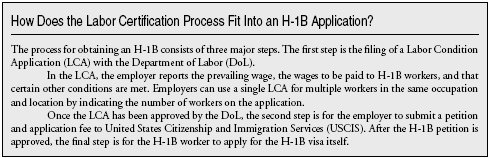
On computer programmer LCAs, SESA is the wage source for about 10 percent of LCAs and about 90 percent use some other wage source. Davis-Bacon, SCA, and union contracts are rarely encountered as wage sources.
Under the plain text of the law, the prevailing wage is supposed to be the prevailing wage for the occupation and is not supposed to take experience into account. As described in more detail later, until 2004 the Department of Labor's online wage library gave one prevailing wage for experienced workers and one for entry-level workers. The 2004 changes to the H-1B program direct the Department of Labor to make four prevailing wage levels available to employers that take into account "experience, education, and the level of supervision." This is the only authorization for a prevailing wage source to take into account anything other than occupation and location.
Unfortunately, the LCA system has been nothing more than a paper-shuffling process. The Department of Labor does not actually verify the data within an LCA or make approval judgments based upon its contents. Until FY 2006 the law expressly prohibited the Department Labor from evaluating the contents of an LCA other than to ensure the form had been filled out correctly.
The Controversy
Proponents of H-1B often argue that the program is vital to U.S. competitiveness because it allows the world's "best and brightest" to come to America and helps sustain U.S. leadership in the technology sector. Program critics cite a number of problems and apparent abuses of the H-1B program, including:
- The practice of "bodyshopping," or "contracting out" workers on H-1B visas.
- Employers using the H-1B program to replace Americans.
- H-1B's role in "offshoring" work to other countries.
- Use of the H-1B program for back-door immigration.
- The lack of employer monitoring.
- Statutory provisions intended to prevent enforcement of the law.
- Allegations that the H-1B program is used to depress wages.
Appendix G (available online at http://www.cis.org/sites/cis.org/files/articles/2005/back1305appendices.pdf ) lists the employers who are the largest users of the H-1B program. Most of these companies are known as "bodyshops." This term refers to the practice of sponsoring large numbers of H-1B workers who then perform IT or back-office tasks for U.S. companies on a contract basis. The H-1B worker will get his paycheck from the bodyshop but will work in the contracting company's facility and will have every outward sign of being an employee of the contracting company. Often the contract worker is performing tasks that were once done by a regular U.S. employee.
The increasingly common practice of bodyshopping seems to have emerged as a direct result of the availability of H-1B workers as a low-cost alternative to U.S. workers. Bodyshops may sponsor large numbers of H-1B workers who have no actual assignment when they arrive in the country. The bodyshops circulate lists of available H-1B workers to employers, placing them in direct competition with U.S. workers seeking similar jobs.
Frequently, the employer/employee relationship between the bodyshop and H-1B worker is suspect. Some companies advertise on the Internet for H-1B workers and after sponsoring them keep a percentage of the worker's earnings. In a number of cases, companies obtained H-1B visas for individuals who then disappeared upon arrival ("Ga. Co. Pleads Guilty in INS Case," Associated Press, Nov. 24, 1999). In an extreme case, a man used the H-1B program to import teenage sex slave girls from India (David Ferris & Demian Bulwa, "Berkeley Landlord Faces Sex Charge," Contra County Times, Jan. 20, 2000). In addition to creating direct competition to Americans for jobs, the H-1B program plays a critical role in the offshoring phenomenon. The largest suppliers of offshore programming services are also among the largest users of H-1B visas (See Appendix G). The offshoring companies use the H-1B program to train their employees in U.S. business practices and to provide local support for operations moved overseas.
Methodology
This report takes a conservative approach in comparing H-1B wages to U.S. wages. Initial analyses of the data clearly showed that H-1B wages were significantly less than U.S. wages. As the analysis was refined, each time a choice was identified on how to treat data, the author examined the alternatives then chose the one that minimized the H-1B/U.S. wage difference.
The data for U.S. wages came from the Bureau of Labor Statistics Occupational Employment Statistics (OES) at www.bls.gov/OES. The OES program estimates wages and employment in over 800 occupations. There are estimates for the entire nation, by state, and for metropolitan areas.
This report uses the 2003 statewide estimates for comparison with H-1B wages, the year prior to the H-1B wage data. The reason for using wage data older than the H-1B data is that this is the prevailing wage information that would have been available to the employers when making the LCA. This choice is consistent with the approach of minimizing any U.S./H-1B wage differential.
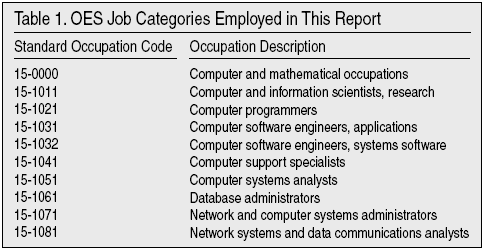
The OES data define a category of occupations called "Computer and mathematical occupations," into which programming jobs fall. This report compares U.S. wages to H-1B wages in the OES occupations from this category and its subdivisions listed in Table 1.
The data for H-1B wages came from the H-1B disclosure web site at www.flcdatacenter.com . This contains electronic versions of LCAs filed by employers where each LCA is a single row in a table. The starting point was the data for computer-related occupations. The next step was to delete all the rows for LCAs that had been rejected by the Department of Labor. All wages specified in periods of less than a year were converted to annual wages.
The most difficult process was to match the jobs in LCAs to OES codes. The only encoding of occupations in an electronic LCA row is a job code from U.S. Citizenship and Immigration Services (a bureau within the Department of Homeland Security). LCAs include a job title but these are employer job titles, not OES job titles. In addition, OES data and the USCIS differ as to what jobs are computer occupations. The result of this inconsistent usage of job titles is that there is no simple way to match up LCAs to wage data.
This report used pattern matching to associate LCAs with employer job titles. For the most part this method does not cause significant problems except where employers use unusual job titles or in a few cases where common employer titles tend to create ambiguities.
The most significant of these ambiguities is the common employer job title "Programmer/Analyst." Is this a "Programmer" or a "Systems Analyst" in the OES occupation classification system? After examining a sample of "Programmer/Analyst" LCAs that used OES as the prevailing wage source, all of those that could be traced back to the OES prevailing wage were found to be using "System Analyst" as the OES occupation. This would have justified classifying "Programmer/Analyst" as "Systems Analysts." However, this association increased the national H-1B/U.S. wage difference by about $4,000 greater than classifying these LCAs as "Programmers." So, in keeping with the conservative goals of this report, "Programmer/Analysts" are treated as "Programmers."
A similar example is variations on the job title "Software Engineer." The OES data has two such classifications, "systems software" and "applications." In some cases, it was clear which of these categories a particular job title fell into. In the end, this report classified "Software Engineer" on LCAs as OES "Computer software engineers, applications" because this creates the smaller H-1B/U.S. wage difference.
The most lengthy preparation step was cleaning up the data. The number of obvious errors in the LCA disclosure data is staggering. For example, employer names and job titles are frequently misspelled. Many wages are multiplied by a factor of 10, 100, or 1,000. This report assumed programmer salaries over $300,000 contained such an error.
Once the data are cleaned up, analysis becomes a straightforward, though often time consuming, process of querying the data.
In this report the term "H-1B workers" always means "H-1B workers in Computer Programming Professions." Likewise, "H-1B wages" always means "Employer claims of wages to be paid to H-1B workers according to Approved Labor Condition Applications." Only approved LCAs were used in this report.
Limitations
The most significant limitation in this report is that it is based on Labor Condition Applications rather than actual H-1B visas issued. The number of LCAs filed is much greater than the number of H-1B visas issued. When taking into account multiple workers on many LCAs, the disparity is even greater.
There are three major reasons for this disparity. An LCA may be approved and one or more H-1B applications based on that LCA may be rejected by USCIS; an employer may not submit an H-1B application for an LCA; or the employer may not submit H-1B applications for as many workers specified on an LCA.
While the Department of Labor makes detailed LCA information available, USCIS does not provide the analogous data for H-1B visas. Therefore, this report assumes that the salary distribution in LCAs is closely related to the distribution in approved H-1B visas. In short, it is based on what employers are asking for in H-1B visas rather than what they are necessarily getting.
The lack of standardization or encoding of occupations within the LCA data creates the other significant limitation in this report. The precision of the results here is limited by the need to match employer job titles to OES occupations. But since that the disparity between H-1B wages and U.S. wages is so great, this limitation does not affect the conclusion that significant wage difference exists. However, it does make a difference in the precision by which that size of difference can be measured. Since this report is consistent in taking the path that minimizes the H-1B/U.S. wage difference, the wage differences reported here represents the lower bound for that wage difference.
Results
This report finds the wages paid to H-1B workers in computer programming occupations for FY 2004 were significantly lower than wages paid to U.S. workers in the same occupation and state. Table 2 shows the H-1B salary ranges and the average differences between the OES Mean and OES Median.

In addition to the average salaries for H-1B workers being much lower than those of corresponding U.S. workers, the distribution of H-1B wages are overwhelmingly concentrated at the bottom end of the wage scale.
Figure 4 graphically illustrates the relationship between H-1B wages to U.S. wages. The horizontal axis shows U.S. percentile ranges and the vertical axis shows the percentage of workers with salaries falling within those ranges. H-1B salaries are concentrated in the bottom end of the scale with the largest concentration in the 10-24 percentile range. That means the largest concentration of H-1B workers make less than highest 75 percent of U.S. wage earners.
The appendices (available online at http://www.cis.org/sites/cis.org/files/articles/2005/back1305appendices.pdf ) to this report contain additional breakdowns of H-1B wage data comparing them to U.S. wages:
- Appendix A: H-1B Wages Compared to U.S. Wages by Occupation
- Appendix B: H-1B Wages Compared to U.S. Wages by State
- Appendix C: H-1B Wages Compared to U.S. Wages by State and Occupation
- Appendix D: H-1B Wages Compared to U.S. Wages by Employer
The LCA disclosure data clearly show that prevailing wage provisions in the H-1B program do not result in H-1B workers actually being paid the prevailing wage. In spite of these provisions, the overwhelming majority of H-1B computer workers are actually paid wages substantially lower than Americans in equivalent positions. This finding suggests that in most cases the motivations behind employers' use of the H-1B program is for low-wage workers rather than highly skilled workers.
Prevailing-Wage Claims
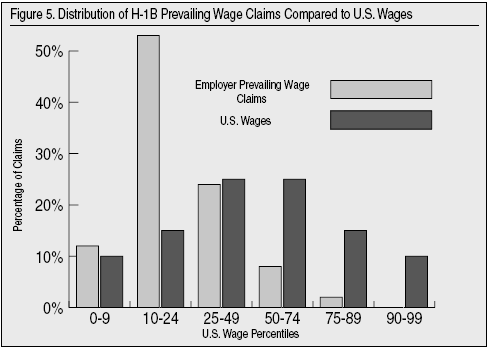
Employer prevailing wage claims tended to be even lower and more concentrated at the low end of the wage scale than H-1B wages. Table 3 shows the range of prevailing-wage claims and their average difference from U.S. wages.

The distribution of H-1B prevailing-wage claims compared to U.S. wages is shown graphically in Figure 5. This figure was created in the same manner as Figure 4 except that it compares U.S. wages to employer-claimed prevailing wages. The low prevailing-wage claims on LCAs show that most employers are understating the prevailing wage on LCAs. Clearly, employer prevailing-wage claims are in no way representative of actual wages paid to U.S. workers.
It should also be noted that the wages reported for 47 percent of H-1B workers were for less than the prevailing wage claimed by the employer on the LCA (See Appendix H). Prior to FY 2006, the law allowed employers to pay H-1B workers 95 percent of the claimed prevailing wage. A substantial number of employers took advantage of this explicitly permitted method to pay H-1B workers less than Americans, some even taking the discount to a fraction of a percent more than the law allowed.
It is also important to note that the low wages paid to H-1B workers and the low prevailing wages submitted by employers do not in themselves imply the employers are violating the law. Instead, the data illustrate how ineffective the law is at ensuring H-1B workers are paid the prevailing wage.
However, some prevailing-wage claims are so out-of-line with industry norms that they suggest violations or fraud are occurring. One key flaw in the system is that employers are allowed to use almost any source to determine the prevailing wage.
Some Specific Wage Sources
In FY 2004, employers used over 75 different sources to make approved prevailing wage claims for H-1B computer workers. Most LCAs use government wage sources with Watson Wyatt being by far the most frequently used non-government wage source. A common theme among prevailing wage sources is the use of entry-level wage surveys to determine the prevailing wage for H-1B applications. The following sections contain observations about a few of the most commonly used wage sources and wage sources employers used to produce extremely low prevailing wages.
National Association of Colleges and Employers. The wage source employers used to report the lowest prevailing wage claims is the National Association of Colleges and Employers (NACE) wage survey with wages about $27,000 less a year than the OES median. The NACE wage survey measures the wages of recent college graduates so it is a source of entry-level wages only. Of employers that used NACE as a prevailing wage source, 75 percent used no other wage source on LCAs. For these employers, either all of their H-1B hires came directly out of school or their prevailing wage claims were entirely bogus. In any case, this report asserts that a private survey of wages paid to new graduates is not a legitimate prevailing wage source under the plain meaning of the law.
Employer Wage Surveys. The H-1B program allows employers to use their own wage surveys as a prevailing wage source. The second lowest prevailing wage source was employer salary surveys. When H-1B employers used their own surveys, the prevailing wage claims were about $22,000 a year less than the OES median. The size of this difference suggests that employer wage surveys are of questionable use in measuring the prevailing wage for LCAs. Through this mechanism, employers paying low wages are simply re-affirming their own low standards, rather than providing a real comparison to industry or wider labor market standards.
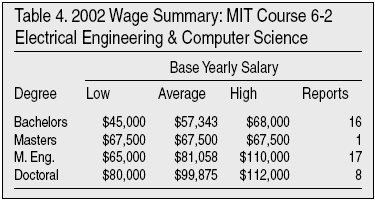
MIT Wage Survey. The third lowest wage source, and one of the most puzzling encountered in the LCA data, is the 2002 "MIT Wage Survey," used by only two employers but for over 300 H-1B workers. What was unusual about these LCAs is that every one claimed the exact same prevailing wage of $45,000.
The only "MIT Wage Survey" this report could locate is MIT's survey of wages for recent graduates. The 2002 edition contains only one value of $45,000: the lowest salary offered to an MIT graduate with a bachelors degree in electrical engineering & computer science. Should this be the case, this report questions the legitimacy of the lowest salary offer made to MIT graduates as a prevailing wage.
Occupational Employment Statistics. OES is by far the most frequently-cited prevailing wage source, used for about half of all H-1B workers. Yet LCAs using OES as the wage source claimed a prevailing wage of about $17,000 less than the median OES wage for the same state and occupation.
For those unfamiliar with the LCA system, this difference might appear incongruous. How could employers and this report be looking at the same data and coming to such different results?
The answer is in how the on-line wage library for LCA applications presents the OES data. The wage data available directly from OES provide the mean and median wages as well as the wages at various percentiles. Though based on the OES data, the on-line wage library for LCAs at www.flcdatacenter.com provides two prevailing wages based upon the OES data: the Level 1 (or entry level) prevailing wage and the Level 2 (or experienced) prevailing wage. Apparently most employers who use the on-line wage library select the entry-level wage as the prevailing wage.
It would be interesting to compare prevailing wage claims using the entry-level wage to the experienced level wage. Unfortunately, the Level 1/Level 2 wage data for 2004 are not publicly available. They will be available for the new wage levels for FY 2006, so a future report may be able to determine how the new wage levels are being used.
As mentioned previously, the recent changes to the H-1B program require the Department of Labor to make four prevailing-wage levels available to employers. This could result in employers making ever lower prevailing-wage claims.
A real-world example illustrates how this system allows employers to make lower prevailing-wage claims. The employer claims the prevailing wage for a Systems Analyst in Charlotte, N.C., according to OES in FY 2002 was $42,246. This wage is the Level 1, or entry level, wage. The Level 2 wage was $69,618. The mean OES wage was $60,150. By selecting the entry-level wage as the prevailing wage, the employer realizes about $18,000 in wage savings. As described previously, employers were allowed to pay 95 percent of the claimed prevailing wage, as this employer has done. So here, the employer is paying the H-1B workers the absolute lowest wage it can get away with. This example demonstrates how the current prevailing wage requirements of the H-1B program serve as a low-wage target for employers rather than as protection for U.S. workers.
Number of H-1B Workers Requested
There is an interesting trend in the wage data withregard to the number of H-1B workers an employer seeks. Employers of large numbers of H-1B visas pay significantly less than employers with a small number of H-1B visas. Employers making applications for one to 10 H-1B workers paid an average of $9,000 a year more than employers making applications for more than 100 H-1B workers (See Appendix F online at http://www.cis.org/sites/cis.org/files/articles/2005/back1305appendices.pdf ).
Observations
The preparation of this report involved many weeks of examining LCAs data. While outside the scope of this report, a number of patterns emerged that raise suspicions of abuse. Some of those patterns involving computer occupations are listed here in the hope that some other researchers might investigate them.
- Applications made for computer programmers by businesses that do not normally employ programmers (e.g. stores and restaurants).
- Employers with absurdly low salaries for programmers, especially those with all of their H-1B workers being paid below the 10th percentile.
- Small companies whose number of H-1B visas requests appear to be more than they could possibly employ. This might suggest H-1B workers are not actually performing work for their employer or where employers have workers idle and not being paid (illegal "benching").
- Employers requesting large numbers of H-1B workers in locations not likely to have significant numbers of programming jobs, suggesting the employer is using one location for wage certification and other locations for the actual job site.
- The grossly disproportionate number of applications for H-1B workers in New Jersey (Appendix E) suggests that many of these H-1B workers are not actually working in New Jersey.
- The LCAs for many companies show a disregard for the formalities of business associations. For example, one can find limited partnerships doing business as "corporations" and entities that have submitted LCAs under different forms of organization.
Recommendations
If there is any correlation between wages and skills, it is clear the H-1B program is rarely being used to import "highly skilled" workers. While the wage data do suggest a few employers use the H-1B program to import a small number of highly skilled workers, these are clearly exceptional cases.
Overwhelmingly, the H-1B program is used to import workers at the very bottom of the wage scale. The wide gap between wages for U.S. workers and H-1B workers helps explain why industry demand for H-1B workers is so high and why the annual visa quotas are being exhausted.
Many in industry have called for an increase in the number of H-1B visas, citing the early exhaustion of the cap as reflective of widespread need for skilled workers. However, the fact that very few H-1B workers are earning salaries as high as U.S. workers in the same profession would seem to refute that claim, and should make lawmakers wary of increasing the H-1B quota. The exhaustion of the H-1B quota may reflect employers' interest in lowering labor costs or widespread fraud rather than an insufficient number of visas.
Specifics
This report makes the following specific recommendations to correct the prevailing wage provisions of the H-1B program:
- Retain the current 65,000 cap on regular H-1B visas. With the majority of applications for H1-B computer programmers at salaries below the prevailing wage, the cap is the only real safeguard in the H-1B system.
- Limit the number of H-1B visas that an employer can obtain each year based on the number of U.S. employees the company has.
- Employers should be required to use a standard wage source produced by the federal government when making prevailing wage claims for LCAs. Allowing employers to pick from nearly any wage source is not a valid measure of the prevailing wage.
- Employers should be required to pay H-1B workers at a level higher than the mean wage, such as the 75th percentile, rather than at the prevailing wage, to prevent widespread use of H-1B workers from depressing U.S. salary levels. Lessening the H-1B salary differential may reduce pressure on the visa quota, as employers will use the program only for true industry needs and for the most highly-skilled workers, rather than the cheapest workers.
- In order to better monitor the H-1B program, employers should be required to enter a Standard Occupation Code (SOC) for each employee on the application. Most employers are looking this information up already in order to get OES prevailing wages. It would require little effort for employers to put this information on the LCA.
- In order to better monitor the H-1B program, USCIS should make wage and employer information available on H-1B visas actually issued. Researchers now must rely on Labor Department data from the LCA, which may or may not result in an actual visa issuance.
John Miano is an author and expert on the software industry. He may be contacted at [email protected]