
Download this Backgrounder as a pdf
With the newly reelected Bush Administration thinking about revising (and loosening) the immigration law, it might be helpful to look back to the late 1980s to review what happened when the government last attempted a major approach to the problem of illegal migration. In 1986 the Congress passed, and President Reagan signed, the Immigration Reform and Control Act;1 it provided for an extensive (and complex) amnesty program and established employer sanctions, i.e., penalties on employers who hired illegal aliens.
As it happened, I was able to take a very close look at IRCA as the Ford Foundation had asked me to assess the new legalization program as it unfolded. I spent most of the next 18 months talking to a wide variety of actors throughout the country and examining the statistics generated by the program. I also had a grant from a small (and no longer existing) federal agency, the Administrative Conference of the United States, to examine a narrower aspect of the program, the four centralized facilities where the actual legalization decisions were made.2
What lessons can be drawn from the IRCA experience? In the broadest of strokes, these come to mind:
A. Large numbers—often much larger than anticipated—of aliens sought legalization and the overwhelming majority of applications were accepted.
B. The compromises leading to the passage of the legislation led to an extremely complex program, full of internal inconsistencies.
C. There was a great deal of many different kinds of fraud in the program; much of the apparent fraud did not lead to the denial of applications.
D. The promised balance—of a large legalization program for currently illegal aliens joined with a strict enforcement program against the future arrival of illegal aliens—did not eventuate. Yes, there was much legalization, but there was little enforcement of the law forbidding the employment of the undocumented (employer sanctions).
E. Within the legalization process there was a built-in (if probably unconscious) bias toward Hispanics and away from other undocumented populations.
F. Demographic considerations (are there too many of us?) and equity in the labor market (are we widening the disparity between rich and poor?) were largely overlooked.
On the other hand, a matter to be discussed later, IRCA had some admirable features, which may not be repeated in the proposed Bush program.
The IRCA program of the past and the current Bush proposal (to the extent that it is known) have some features in common and some quite different characteristics.
Both seek (or sought) to grant legal status (temporary or permanent) to large numbers of aliens now in illegal status and thus both seek to expand the legal work force in the United States; both at least allege that the proposed programs will decrease the future incidence of illegal immigration.
IRCA offered a tangible benefit to the applying alien, temporary legal status in the U.S., with a fairly easy path toward permanent legal status; the Bush proposal is to grant a temporary legal status for three years, perhaps extendible for another three years, after which the alien is expected to leave the United States. There is in the Bush proposal, as there was not in IRCA, a promise of a financial benefit to the alien for returning to the home country,3 presumably a return of Social Security taxes paid by the worker while in the United States.
The total IRCA package was a complicated and detailed one. Employers were, for the first time in history, to be penalized for employing illegal aliens. Efforts to create a work-force-wide identification system, so that legal workers could be identified by a single, government-issued document were defeated and a jerry-built documentation system was erected in its place.
As for illegal aliens, there were four different legalization programs, two minor ones, and two major ones. The largest of the programs, created under Section 245A of the Act, provided legal status to those aliens who had been in the nation, more or less continuously, since Jan. 1, 1982, and who had not been convicted of serious crimes. It also provided legal status to those aliens who had done farm work for at least 90 days prior to May 1, 1986; these were special agricultural workers or SAWs. Applicants who submitted something other than a frivolous application were given temporary resident alien (TRA) status and then, later, could move onto permanent resident alien (PRA) or green card status, and from there to full citizenship. The two minor programs related to small populations of aliens: 1) those who had been in the nation, in illegal status, since Jan. 1, 1972, and 2) a subset of aliens in illegal status who had come to the United States from either Haiti or Cuba.
The Section 245A applicants were given a year to apply, from May 5, 1987, until May 4, 1988; the SAW applicants were granted 18 months, from June 1, 1987, until November 30, 1988.
So what can be learned from this? There appear to be six sets of lessons.
A. Numbers
More than three million aliens applied for one of the legalization programs, and the overwhelming majority of applications were granted.
To provide a statistical frame of reference, the 3,000,000 can be compared to the 600,000 legal immigrants who arrived yearly during the 1980s—so the IRCA legalizations equaled five years of normal, legal immigration. In addition to international migration, the other component of population growth is the excess of births over deaths; in the 1980s there were usually about 3.6 million births a year in the United States, and about 2.1 million deaths, producing an annual increase of about 1.5 million more legal residents. This is about half the number of IRCA legalizations.
Of the IRCA applicants, about 1.8 million were in the 245A program, and about 1.2 million were in the SAW program. While the numbers in the first program were somewhat lower than predicted, those in the SAW program were two and three times higher than expected.
More than two years after the filing deadline, the Immigration and Naturalization Service was still making decisions. At that time4 it issued the numbers shown in Table 1.
The approval rates among the decided cases were high: 94.4 percent for the 245A program and 93.5 percent for the SAW program; the pending cases generally wound up as approvals later.
The program may still be continuing in a minor way—in January 2005, the fiscal year 2003 Yearbook of Immigration Statistics arrived in the mail, showing that 33 245A applicants were granted green card status during 2003 as well as six former SAWs.5
The IRCA program, unlike most of the rest of the immigration law, set no limits on the number of people who could be granted a benefit; in that sense they were treated like immediate relatives of U.S. citizens. It is likely that the Bush proposals will, similarly, lack a numerical ceiling on the granting of temporary alien status.
B. Complexities
There were not only four different legalization programs, each program package had different requirements, benefits and deadlines, different forms, and often different appeals procedures; needless to say this made the program harder to understand for the applicants and the immigrant-serving agencies, and harder to administer for the government.
Generally, the SAW program was more welcoming than the other three programs. This was on purpose, a boon to agribusiness which wanted to legalize as many farmworkers as possible, to reduce any pressures toward the increase of wages for these, the least well-paid of all American workers. Among other things, SAWS were given 18 months to apply, while 245A applicants had only a year; SAWs had to claim illegal presence in the United States before 1986, while the others had to claim that they had been here since Jan. 1, 1982; the process of moving from TRA to PRA status was automatic for the SAWs, but required some exposure to English instruction on the part of the 245A applicants. Even more significantly, SAWs did not bear the burden of proof of eligibility, while other applicants did.
One of the reasons for the inconsistencies in the program related to different kinds of legislative histories regarding the two major program elements. While most of the provisions of IRCA were worked out in the normal Congressional process of hearings, mark-ups, and floor consideration, this was not true of the SAW program.
That program was, in fact, worked out in the kitchen of a townhouse on Capital Hill, where two Congressmen lived. The three players, all Democrats, were: Congressman Howard Berman, who spoke for the illegal workers and Hispanic interests: fellow Californian Congressman Leon Panetta, who spoke for the growers; and New York Congressman (now Senator) Charles Schumer, who was the deal maker. They worked out a mutually acceptable package late in the legislative process and sold it their colleagues on Capital Hill; had they not done so, it was widely reported, agricultural interests would have defeated IRCA in the Congress.
C. Fraud
The then-normal practice of INS when dealing with an application for an immigration benefit (a green card, naturalization, etc.) was to give the decision-making power to the officer interviewing the applicant. The theory was that the officer, working under the supervision of a district director, would have first-hand knowledge of the applicant’s demeanor and papers, and was in the best position to make the initial determination.
This practice, however, was regarded as better suited to programs with relatively smaller volumes of applications than were expected in the legalization program; further, the practice had led to sometimes widely-differing approval rates, officer by officer and district by district. INS decided, as it planned for IRCA, to create a different system; INS staff members would handle the legalization applications in the field, recommending approval or denial, but the final decision would be made in four Regional Processing Facilities—we called them “Decision Factories.” These were designed to resemble Internal Revenue Service processing centers, where advanced technology, centralized control and limited interference from the outside world would lead to a consistent decision-making process. (No applicants, and for a while, no immigration lawyers, ever appeared in these cloistered locations; even telephone numbers were hard to obtain for everyone other than INS insiders.)
The incidence of fraud in the two major programs was quite different; aliens seeking legalization had a choice of two programs, one in which the requirements (e.g., residence since 1982) were tough, and another, the SAW program, where standards were lower. (It is easier to document (either honestly or dishonestly) that one had worked in agriculture for 90 days than it is to prove that one was residing in the United States for five or six years.) So, people who qualified for one program or the other picked the program that worked for them, but those who qualified for neither were quickly attracted to the SAW program. Everyone in or near the legalization program recognized this situation.
Many an urban resident claimed SAW status, many without justification. There were countless anecdotes of fur-coat wearing Europeans seeking SAW status in Manhattan, applicants who contended that the cotton they harvested was purple, or that cherries were dug out of the ground, or that one used a ladder to pick strawberries. Often the temporary INS staffers handling the SAW applications were as clueless about agriculture as some of the applicants.
The application takers, when in doubt, could check that the SAW application in question should be denied, and this was usually done, strange to say, without letting the applicant know that it had happened. As a matter of fact, there were internal INS statistics that showed that 888,637 legalization applications in both programs had been marked for denials for local office staff, but on the same date (March 24, 1989) only 60,020 final denials had been issued.6
INS essentially threw up its hands and decided not to spend the time and energy needed to sort out the fraudulent SAW applications. Although substantial funds were available (applicants paid $185 when they filed) INS decided to use $50,000,000 in unspent SAW funds on a new generation of computers for the agency, rather than devoting those resources to fighting fraud. An INS Assistant Commissioner (who will remain nameless) literally screamed at me when he saw my criticism of that decision.7
D. Enforcement
IRCA had bipartisan support, being passed by a Republican-dominated Senate and a Democratic majority House; major actors were Sen. Alan Simpson (Rep. Wyo.) and Congressman Peter Rodino (Dem. N.J.), chairs, respectively of the Senate immigration subcommittee and of the House Judiciary Committee. The legislative package was sold as a grand compromise, assuring legalization for the more senior (and more rural) of the undocumented aliens while creating a new system, employer sanctions, to prevent employers from hiring illegal aliens in the future. (The latter was very much desired by the AFL-CIO at the time, then under different leadership than today.)
Prior to 1986 it had been illegal for an undocumented worker to be in the country, and it was illegal for people to “harbor” such aliens, but it had not been against the law to employ them.
Employers and the immigration bar disliked the idea, but with the agricultural interests satisfied by the SAW provisions and a stand-by Replacement Agricultural Worker8 program, the grand compromise of some legalization and some employer sanctions made it through the Congress.
But passing laws and enforcing them are two different matters. The Reagan Administration and Republicans, generally, never were very enthusiastic about the enforcement of labor laws, and relatively little money was made available for employer sanctions. The law remains on the books but has made only a very minor difference in the labor market.
In a sense, however, it does play an episodic role at the very top of the U.S. labor market, that is where Cabinet officials are hired. Several likely potential future members of the Cabinet, both Democrats and Republicans, have come to grief for hiring illegal aliens as household servants.
E. A Tilt Against Non-Hispanics
The distributions, by nation of birth, of legalization applicants, on May 9, 1989, and of legal immigrants in fiscal year 1986 are shown in Table 2.
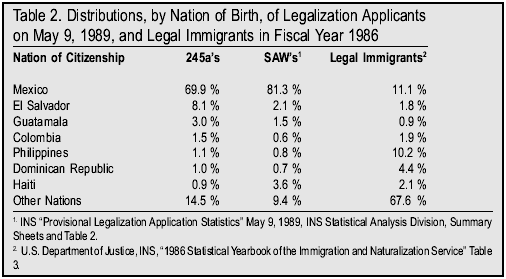
The nations listed are the ranking ones for the 245A program; all but the last-listed of these nations were once part of the Spanish Empire.
Of course, the vast majority of legalization applicants would be Hispanic, as the vast majority of illegal aliens are Hispanic. There were, however, several factors at work that many observers thought tilted the system against non-Hispanics.
The most obvious was the favoritism given by Congress to farm employers (and therefore to once-illegal farm workers) that shifted the balance toward Mexican nationals, as they do most of the nation’s seasonal farm work.
In addition, regulations were drafted by an agency that had substantially more experience with the cross-border movements from Mexico than the cross-oceans movements of other illegal aliens, so the allowable breaks in continuous presence were defined in such a way as to reflect the shorter visits to the homeland made by Mexican nationals than those made by others. If one flies back to the hometown in China, given the cost of travel, one is more likely to stay longer than if one returns to the Mexican village for Christmas.
Further, INS outreach activities to those speaking Spanish were more likely to be effective than those reaching smaller communities, such as those of Thais, Nepalese, and Turks, simply because of the economies of scale. Finally, Hispanic community organizations pitched in to support the program earlier and with more vigor than those of other ethnic groups.
F. Demographic Considerations
As noted earlier, considerations about the appropriate size of the U.S. population, or the impacts of large numbers of additional legal residents on the infrastructure and on labor markets were rarely part of the legislative dialogue, and were never mentioned in the regulatory or administrative context. This lack of concern for these matters—which is not the case in Canada and Australia—is a regular feature of how America thinks about its immigration policies.
IRCA’s Positive Features
In contrast to what we are seeing in the Bush Administrations’s so-far sketchy proposals, some elements of IRCA seem, in retrospect, to have been remarkably-well designed.
In the first place, IRCA’s objective was to offer legal status primarily to people who were in the United States at that time that they applied. There was a minor exception to that in that some 100,000 or so of the 3,000,000 applicants were allowed to file for SAW status at the southern border or at U.S. consulates in Mexico—but they had to claim that they had previously been in the United States doing a sufficient amount of farm work to qualify.
The Bush proposals, however, would make it possible for persons who do not qualify for a visa to work in the United States under current law to apply from overseas without even claiming that they had ever been in the country before.
Secondly, an IRCA applicant did not need a current U.S. employer to apply. The Bush proposal, at this stage, seems to require the consent of such an employer, which would give employers a remarkable amount of power vis-a-vis their currently illegal workers as well as creating an illicit market for fraudulent employer-created documentation.
Thirdly, the drafting of the IRCA regulations9 was a remarkably open process, much more so than in normal regulation-writing. INS went out of its way to consult various interests as it worked out the necessarily complex rules for the program.10 We do not know how this would play out if the Bush proposals become law.
Fourthly, IRCA’s offer was described as a one-off deal, never to be repeated. This was done in a probably vain attempt to discourage follow-on migration of illegal entrants hoping for the repetition of the amnesty offer. There is none of this yet visible in the Bush program.
Finally, the end-game for those who successfully moved through all of IRCA’s processes was permanent resident alien status, and a chance to apply for citizenship. IRCA was designed to bring people out of the shadows into full participation in American society. This was in keeping with our traditional notions of both equality for all and of America as a land of immigrants.
The Bush proposals seem to point to a different end-game. It is to create a second or third class of people who can participate only marginally in American life, and who are supposed to be tossed out of the country when their employers are done with them, certainly after no more than six years in the nation. If anything, such a program would create and institutionalize even more income disparity than we have at the moment.
Endnotes
1 Pub.L 99-603.
2 See David S. North and Anna Mary Portz, “The U.S. Alien Legalization Program,” TransCentury Development Associates, Washington, 1989 (written for the Ford Foundation) and North and Portz, “Decision Factories: The Role of the Regional Processing Facilities in the Alien Legalization Program,” the Administrative Conference of the United States, Washington, 1989. While Ms. Portz was a full and valued partner in these research activities, she did not participate in the drafting of this Backgrounder.
3 Bush announced the proposal on Jan. 7, 2004; see, for example, these citations that emerged from a Google search:“Inside Politics: Bush calls for changes on illegal workers” www.cnn.com/2004/ALLPOLITICS/01/07/BUSH.IMMIGRATION or, for a view from the left: “Immigrants need a real amnesty: Why Bush’s immigration ‘reform’ is a fraud” www.socialistworker.org/2004-1/482/482_12_immigration.shtml
4 U.S. Department of Justice, Immigration and Naturalization Service, “Immigration Reform and Control Act: Report on the Legalized Alien Population” Washington, 1992, Table 1. Data are for February 18, 1991.
5 U.S. Department of Homeland Security, Office of Immigration Statistics, Washington, 2004, table 4.
6 North and Portz “U.S. Alien Legalization Program,” p. 52.
7 For another account of this INS decision, see “INS Adjudications: from the 19th to the 21st Century,” Interpreter Releases, Vol. 66, No. 9, March 6, 1989, p. 249. Interpreter Releases, a weekly newsletter for the immigration bar, provided a substantial amount of reporting on legalization issues at the time.
8 The RAW program, designed to be put in place if there turned out to be a shortage of farm workers in the years following IRCA’s passage, never came to pass; the triggering mechanism, a continuing study of the supply and demand for farm workers, kept finding a surplus.
9 Federal Register, Vol. 52, No. 53, March 19, 1987, pp. 8740-8795 (proposed regulations) and Vol. 52, No. 84, May 1, 1987, pp. 16189-16228 (final regulations).
10 “...the process was, in the words of one long-time actor, ‘exemplary’... ” See Doris Meissner and Demetrios Papademetriou, “The Legalization Countdown: a Third Quarter Assessment”, The Carnegie Endowment for International Peace, Washington, DC, February 1988, pp. 22-23.
David North, a former Assistant to the U.S. Secretary of Labor, has been studying immigration policy matters since 1969.