
The recent economic slowdown represents a real-world test of the argument that immigration is largely driven by the U.S. economy. Although the economy slowed after 2000, analysis of the latest Census Bureau data shows that immigration remained at record levels. The nation’s immigrant population (legal and illegal) reached a new record of more than 34 million in March of 2004, an increase of 4.3 million just since 2000. The fact that immigration levels have remained so high even though job growth has been weak indicates that immigration does not rise and fall in close step with the economy, as some have imagined. Rather, immigration is a complex process driven by many factors.
- The 34.24 million immigrants (legal and illegal) now living in the country is the highest number ever recorded in American history and a 4.3 million increase since 2000.
- Of the 4.3 million growth, almost half, or two million, is estimated to be from illegal immigration.
- The same data also show that in the years between 2000 and 2004 nearly 6.1 million new immigrants (legal and illegal) arrived from abroad. New arrivals are offset by deaths and return migration among the existing immigrant population so that the net total increased by 4.3 million.
- Since 2000, 6.1 million new immigrants have arrived, compared to the 5.5 million who arrived between 1996 and 2000, during the economic expansion.
- The record pace of immigration is so surprising because unemployment among immigrants increased from 4.4 to 6.1 percent and the total number unemployed grew by 43 percent.
- In contrast to current immigration, evidence indicates that economic downturns in the nineteenth and early twentieth centuries did have a very significant impact on immigration levels.
- Immigrants now account for nearly 12 percent of the nation’s total population, the highest percentage in over 80 years.
- Recent immigration has had no significant impact on the nation’s age structure. If the 6.1 million immigrants who arrived after 2000 had not come, the average age in America would remain virtually unchanged at 36 years.
- The diversity of the immigrant population continues to decline, with the top country, Mexico, accounting for 31 percent of all immigrants in 2004, up from 28 percent in 2000, 22 percent in 1990, and 16 percent in 1980.
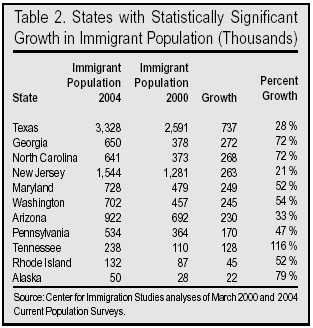
- States with the largest increase in their immigrant populations were Texas, Georgia, North Carolina, New Jersey, Maryland, Washington, Arizona, and Pennsylvania.
In contrast to past centuries, immigration levels are no longer closely tied to the business cycle. This does not mean that economic factors are entirely irrelevant. The higher standard of living in the United States compared with those in most sending-countries almost certainly plays an important role in encouraging immigration. But a much higher standard of living exists even during a recession. Moreover, people come to America for many reasons, including to join family, avoid social or legal obligations, take advantage of America’s social services, and enjoy greater personal and political freedom. Thus, even a prolonged economic downturn is unlikely to have a large impact on immigration levels. It also must be remembered that there has been no major change in the selection criteria used or numerical limits placed on legal immigration, even after the 9/11 attacks. Moreover, immigration enforcement efforts have actually become more lax in recent years.1 Lowering immigration levels would require enforcement of immigration laws and changes to the legal immigration system.
Data Source and Methods
Data Source. The information for this Backgrounder comes from the March Current Population Surveys (CPS) collected by the Census Bureau. Figures for 2000 through 2004 reflect the 2000-based population weights, which were put out by the Census Bureau after the 2000 Census revealed that the nation’s population was larger than previously thought. By using the new weights we are able to make a comparison between the years 2000 and 2004. Figures for 1996 to 1999 have been adjusted by the author to make them more comparable to the March 2000 CPS data.2 What makes the last eight years so interesting from a research point of view is that the current economic slowdown is the first in American history in which year by year data on the foreign-born population was collected. The CPS began to ask the citizenship question and related questions that allow us to identify the foreign born on a regular basis starting in 1994. Thus for the first time, it is possible to test the hypothesis that immigration is closely connected to the economy.
The March CPS data (also called the Annual Social and Economic Supplement) used in this study include an extra-large sample of minorities and are considered one of the best sources of information on the foreign born.3 The foreign-born are defined as persons living in the United States who were not U.S. citizens at birth.4 For the purposes of this report, foreign-born and immigrant are used synonymously. Because all children born in the United States to the foreign born are by definition natives, the sole reason for the dramatic increase in the foreign born population is new immigration. The immigrant population in the 2004 CPS includes roughly nine million illegal aliens and between one and two million persons on long-term temporary visas, mainly students and guest workers. The CPS does not include persons in “group quarters,” such as prisons and nursing homes.
Deaths and Out-Migration. When growth in the foreign-born population is discussed, it must be remembered that the increase over time represents a net figure and does not reflect the level of new immigration. New arrivals are offset by deaths and out-migration. Given the age, sex, and other demographic characteristics of the immigrant population, it is likely that there are about 7,500 deaths per million immigrants each year. This number does not change much from year to year, but it does increase gradually over time as the immigrant population grows. As a result, there were about 60,000 more deaths each year among immigrants in 2004 than in 1996 because the immigrant population grew by eight million. This means that a slower net increase in the immigrant population may not indicate a falling level of new immigration.
There is more debate about the size of out-migration. But the Census Bureau has estimated that about 280,000 immigrants living here return home each year.5 It should also be remembered that like any survey, there exists sampling variability in the CPS. The margin of error, using a 90-percent confidence interval, for the foreign born is between 640,000 and 700,000 for data from 1996 to 2001 and between 520,000 and 530,00 for 2002 through 2004 data. Thus one could say that in 2004 the immigrant population was 34.24 million plus or minus 530,000. Because of sampling error, even seemingly large year-to-year changes may not be meaningful. When looking for trends it is much better to compare differences over several years.
Immigration 1996 to 2004
Net Growth in Immigrant Population. Figure 1 reports the number of immigrants living in the United States based on the March CPS. The figure shows that between March 1996 and March 2000, the foreign born grew by 4.04 million, or about one million a year. Very similar to the 4.25 million growth between 2000 to 2004. These two numbers are the same statistically. Thus, it would appear that the growth in the foreign born during the economic expansion in the second half of the 1990s was the same as during the much weaker period of economic growth between 2000 and 2004. Over each four-year period the annual growth of the immigrant population averaged a little over one million.6
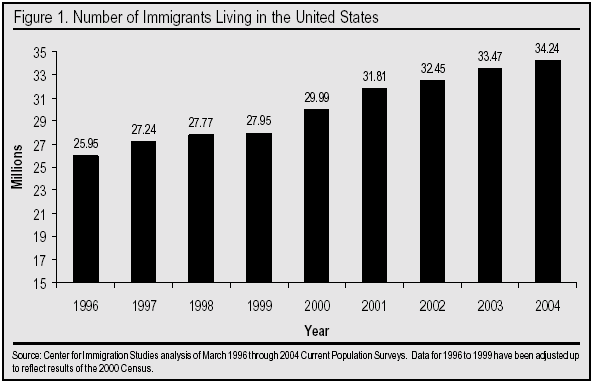
Economy Slowed, but Immigration Didn’t. What is so striking about Figure 1 is that the economic situation of the country was fundamentally different in each of the time periods. The years 1996 to 2000 were a time of dramatic job growth and a rapidly expanding economy. This could hardly be said of the period 2000 to 2004. Many commentators on immigration argue that the record setting immigration of the late 1990s simply reflected economic conditions at that time. We might call this perspective the market-driven view. But if the market-driven view is correct, we would expect to see less in-migration of new immigrants, more out-migration, or both in a period of slow economic performance and weak labor demand such as 2000 to 2004. This should have resulted in a significant slowdown in the growth of the foreign born. But the net increase in the size of the immigrant population shows no indication of being closely connected with the economy.
Immigrants Hit by Recession. In a recent report, the Center for Immigration Studies found that the number of immigrants holding jobs in the United States increased significantly between 2000 and 2004, and that immigrants received a disproportionate share of the net increase in employment.7 However, the report also found that the unemployment rates among immigrants rose significantly between 2000 and 2004. The unemployment rates for adult immigrants (18 and over) went from 4.4 to 6.1 percent. The number unemployed increased by 43 percent or nearly 400,000, from 2000 to 2004. We also found that the number of working age (18 to 64) immigrants who were not in the labor force increased by more than one million, or 18 percent, between 2000 and 2004. The rapid growth in the immigrant population makes it possible for the number working and the number unemployed to go up at the same time. But what is important is that immigrants were not immune from the recession. If the market-driven perspective is correct, a significant deterioration in the labor market situation for immigrants should have made more immigrants already here go home and convinced more of those thinking about coming to stay at home. But there is no evidence of this in Figure 1.
A Peak Around 2000? If we look at the data in greater detail, we see that the period 1999 to 2001 seems to show a faster rate of increase in the size of the foreign born population. Between 1999 and 2000, the foreign born population grew by over two million, and between 2000 and 2001 the increase was 1.8 million. This is much higher than in the years before or after. The recession began at the end of 2000 or the beginning of 2001, depending on how one dates its start, so the slowdown in immigration between 2001 and 2002 does make some sense. Moreover, the 9/11 attacks of might be expected to have had some impact on immigration levels after 2001. But it should be kept in mind that sampling variability may account for the seeming increase in the growth rate between 1999 and 2001. The margin of error for the total foreign born is between 640,000 and 700,000 for the 1996 through 2001 data (assuming a 90-percent confidence interval). Thus what appears to be a two million growth between 1999 and 2000 may be less than half that size, placing it well within the average growth rate for the eight-year period. Comparisons over a short period of time such as 1999 to 2001 can be misleading. Consider the period 1997 to 1999.
Despite a very strong economy, the immigrant population increased by only about 700,000, or 350,000 a year on average. This almost certainly reflects sampling variation rather than a slowing rate of immigration. After all, legal immigration did not fall off during the 1997 to 1999 period, and border apprehensions averaged roughly a million over this time period. Thus the very modest growth between 1997 and 1999 almost certainly reflects the sampling variability inherent in any survey. This is probably true for the 1999 to 2001 period as well.
Changes in the CPS. Also, as discussed in the data and methods section of this report, the Census Bureau changed the way it weighted data between 1999 and 2000. Although we have tried to correct for this in Figure 1, this does introduce another element of uncertainty for growth between 1999 and 2000. In addition, the Bureau changed the number of housing units interviewed after 2001; this may also have implications for the foreign-born estimates compared to earlier periods. Finally, and perhaps most importantly, the collection of the survey in 2000 and 2001 may have benefited significantly from the advertising and public outreach done by the Bureau to promote the 2000 Census, which specifically targeted hard-to-reach populations such as immigrants. All of these factors may have only a modest impact over the long run, but they certainly make year-to-year comparisons much more difficult. What we can say for sure is that, statistically speaking, the growth in the foreign born population in the four years prior to 2000 was the same as the four years after 2000. This fact calls into question the idea that immigration is primarily driven by economic conditions in the United States.
Year of Entry. Arrivals of new immigrants can also be estimated from the CPS based on responses to what is commonly referred to as the year-of-entry question. In the March 2000 CPS, 5.5 million immigrants responded that they came to America in the four years between 1996 and 2000. In comparison, in the March 2004 CPS there were 6.1 million immigrants who said they had come in the four years between 2000 and 2004. These two figures are barely statistically different, and given changes in the CPS made between 2000 and 2004, it is probably best to view these two numbers as the same. However, it does seem clear that the period 2000 to 2004 saw at least as many new immigrants arrive as between 1996 and 2000. Again, this is surprising because the economy was much stronger from 1996 to 2000 than 2000 to 2004. If immigration were largely driven by the economy, as the market-driven view argues, then one would have expected the number of new arrivals to slow. But the weakness of the economy seems to have had no discernable impact on the flow of new immigrants into the country.
Impact of Post-2000 Immigrants. The year-of-entry question is also useful because it can be used to estimate the impact of recent immigration on the aging of American society. One of the most common arguments for keeping immigration high is that it makes America a more youthful country. One simple way to measure the impact of immigration is to calculate the average in age in the United States with and without recent immigrants. If the 6.1 million immigrants who arrived between 2000 and 2004 are removed from the data, the average age in the United States is 36 years and two months. Including post-2000 immigrants does lower the average age, but only to 36 years even. Thus over the last four years, immigration had only a very small impact on the aging of American society. It could be argued that the benefit to the age structure might take more than just four years of high immigration. But if that is true, it means that the nation certainly could have done without the 6.1 million immigrants who arrived during the current economic slow down without any fear that it would have caused American society to age much more rapidly.
Illegal Immigrants
Illegals in the CPS. It is well established that illegal aliens do respond to government surveys such as the decennial census and the Current Population Survey. While the CPS does not ask the foreign-born if they are legal residents of the United States, the Urban Institute, the former INS, and the Census Bureau have all used socio-demographic characteristics in the data to estimate the size of the illegal population.8 Our preliminary estimates for the March 2004 CPS indicate that there were between nine and 9.2 million illegal aliens in the survey. It must be remembered that this estimate only includes illegal aliens captured by the March CPS, not those missed by the survey. The former INS has estimated a 10 percent undercount of illegals in the 2000 census. Assuming that is also true of the CPS, then the total illegal population stood at 10 million in March 2004. Although it should be obvious that there is no definitive means of determining whether a respondent in the survey is an illegal alien, this estimate is consistent with previous research.9 We estimate that in 2000, based on the March CPS from that year, that there were between seven and 7.2 million adult illegal aliens in the survey. This means about two million, or 46 percent, of the 4.3 million increase in immigrant population was due to illegal immigration.
Why Illegals Are Such a Large Share of Growth. The fact that illegals account for almost half of the overall growth in the immigrant population may seem surprising to some, especially since illegal aliens account for only a little over one-fourth of the total foreign-born population. There are several reasons for this. First, prior to the mid-1970s, there was little illegal immigration to the United States, thus older immigrants who entered at that time and are still here are almost all legal residents. Moreover, the United States has conducted broad amnesties for illegal aliens in the past and each year also grants legal status to tens of thousands of illegal aliens as part of the normal “legal” immigration process. For example, 2.7 million illegals were given green cards in the late 1980s and early 1990s as part of the amnesties included in the Immigration Reform and Control Act (IRCA) of 1986. Moreover, the immigration service estimated that, during just the 1990s, 1.5 million illegal aliens received green cards, outside of the IRCA amnesty.10 Because of this constant movement from illegal to legal status, the size of the existing legal population is much bigger than the existing illegal population. Finally, it must be remembered that although the number of illegal aliens entering and remaining in the country is now enormous, the level of legal immigration is still greater than the level of illegal immigration, creating a very large existing legal immigrant population.
Another way to understand why illegal immigration must account for such a large share of the growth in the foreign-born population is to focus on the Mexican immigrant population. Mexican immigrants are thought to comprise 60 to 70 percent of the illegal alien population based on work done by the Urban Institute and former INS. The CPS shows that between March of 2000 and March 2004, the Mexican immigrant population increased by 2.1 million. Over the last four years only 708,000 green cards went Mexican immigrants.11 Moreover, over the last four years some Mexicans here returned home and some also died. (Most deaths occur among the legal Mexican population, who are much older on average than the illegal aliens.) Thus even allowing for temporary visa holders from Mexico in the CPS, the number of Mexican illegal aliens in the survey must have increased by between 1.4 to 1.6 million. The scale of Mexican immigration by itself makes it clear that illegals comprise a very large share of the net increase in the overall immigrant population. And these figures only include those who responded the CPS, not those missed by the survey.
Historical Comparison
Legal Immigration and the Business Cycle. The current economic slowdown is, of course, not the first in American history. The nation has experienced many recessions and depressions over the last two centuries. While we don’t have year-by-year data on the total size of the foreign-born population before the 1990s, it is possible to use historical data to see how the level of legal immigration responded to the business cycle in the past. Since 1820, the federal government has recorded the number of newly arriving legal immigrants. Figure 2 reports those figures over the last 183 years and identifies major recessions/depressions. The arrows show the significant economic downturns. (There are also troughs in legal immigration associated with major wars.) What stands out in Figure 2 is that prior to World War II, legal immigration levels seem to have been very sensitive to the business cycle in the United States and demand for labor.
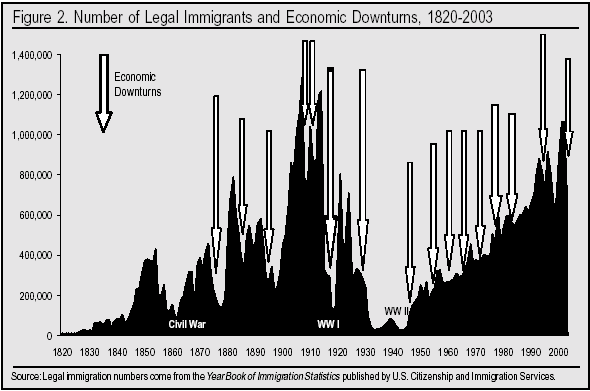
Legal immigration levels fell by between one fourth and one half during the large recession/depressions of the 19th century and during the Great Depression of the 1930s. For example, the economic panic of 1873, which was partly precipitated by the collapse of Jay Cooke and Company, the country’s preeminent investment bank, caused immigration levels to fall dramatically from 460,000 a year in 1873 to 313,000 in 1874 and reached a low of 138,000 in 1878. As the economy recovered, so did immigration levels. Consider the downturn caused by the failure of banks tied to the bankrupt Reading Railroad in 1893. That depression was not abated until 1897. Accordingly, legal immigration levels fell from 440,000 a year in 1893 to 286,000 in 1894 and remained much lower than they had been until the end of the decade. In contrast, since WWII, the business cycle seems to have had little or no discernible impact on legal immigration levels.
Of course, Figure 2 reports only legal immigration levels. Illegal immigration became a significant factor in the second half of the 1970s and has grown dramatically since then. But this does not change the basic fact that over the last 50 years legal immigration was not nearly as responsive to economic conditions in the United States as it once was. It should be pointed out that after 1924 immigration was greatly restricted by law. Perhaps this change explains why legal immigration no longer fluctuates with the economy. But the Great Depression took place after the restrictive legislation of the 1920s, and immigration levels still fell dramatically in the 1930s. Immigration was 241,000 in 1930, but only 97,000 in 1931 and the level of immigration remained very low through the great depression. This suggests that even under a more restrictive regime immigration levels were still closely linked to the economy. Moreover illegal immigration, which is included in the CPS, obviously has no numerical limit, much like legal immigration prior to the 1920s. Yet Figure 1, and analysis of the year of entry question shows no evidence of a drop off in illegal immigration after 2000.
Why Is Immigration Not Tied to the Economy? While a detailed answer to this question is beyond the scope of this analysis, part of the answer probably lies in the fact that the primary sending countries of legal immigrants today are much poorer relative to the United Stats than was true of the primary sending countries in the past. In the 19th century, countries such as Great Britain, Germany, or even Italy and Russia still enjoyed a higher standard of living relative to the United States than do today’s top sending countries such as Mexico, China, the Philippines, and India. The dramatically higher standard of living in the United States today exists even during a recession. In a very real sense, the market-driven perspective on immigration is passe. That is, it reflects yesterday’s immigration but not today’s. The primary weakness of the market-driven view of immigration is that it tends to see immigrants simply as economic beings seeking economic benefits. In fact, people come to America for many reasons, including to join family, avoid social or legal obligations in their home countries, to take advantage of America’s social services, and to enjoy the social and political freedoms found in this country.
Given the complex nature of immigration, even a prolonged economic downturn is unlikely to have a large impact on immigration levels. Seeing immigration as largely reflective of economic demand in this country is grossly simplistic and probably not even helpful in understanding the migration process. Absent a change in policy, immigration levels will remain at very high levels and may even accelerate regardless of economic conditions.
Immigrants as a Share of the Population. The 34.24 million immigrants in the country in 2004 represent 11.9 percent of the nation’s population. This is much higher than at any time in recent history, and it is certainly higher than for most of American history. But there have been periods when the immigrant share was even greater. Census and other data indicate that for the first six decades after independence the share of the U.S. population that was immigrant was below 10 percent. From 1860 to 1920 it fluctuated between 13 and almost 15 percent, hitting an all time high of 14.8 percent in 1890. Over the eight decades since 1920, every Census has recorded a foreign-born share lower than 11.9 percent. The March 2000 CPS recorded a foreign-born share of 10.8 percent, more than one percentage point lower than in 2004. If current trends continue, early in the next decade the immigrant share of the population will pass the all- time high of 14.8 percent reached in 1890.
State Data
Number of Immigrants by State. Table 1 shows the total number of immigrants in each state. It also reports the number of immigrants who indicated that they arrived in the United States between 2000 and 2004 and the share of each state’s population comprised of immigrants. In general, states with the largest overall immigrant populations tend also to have the most post-2000 arrivals. They also tend to be states where immigrants represent a large share of the total population. However, this is not true in every case. There are several small states, such as Nevada and Hawaii, where immigrants make up a large share of the total population, but because the overall state population is small, the number of immigrants is relatively modest.
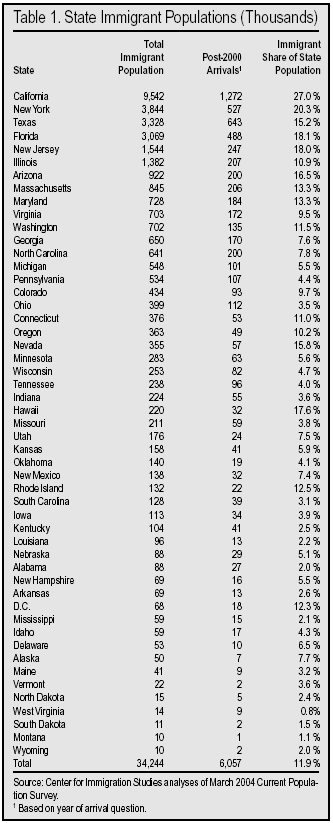
Immigrants Remain Concentrated. Although it is undeniably true that immigrants (legal and illegal) have become more dispersed over the last decade, Table 1 does show that immigrants remain relatively concentrated. In 2004, the four top states of immigrant settlement still accounted for nearly 58 percent of all immigrants, but only 32 percent of the nation’s total population. The top-10 states accounted for more than three-fourths of the immigrant population, but less than half of the nation’s total population. Turning to post-2000 arrivals, we find a somewhat different pattern. In the top four states, post-2000 arrivals accounted for 48 percent of all new arrivals, compared to the 58 percent that they represent of the nation’s total foreign-born population. This shows that even new arrivals are more spread out than is the existing immigrant population. But this argument should not be carried too far. New arrivals still tend to go to the states with the largest existing immigrant populations.
Growth by State. Table 2 compares the March 2000 and 2004 CPSs and reports the 11 states where there was a statistically significant increase in the size of the immigrant population. This does not mean that the immigrant population only grew in these states. But it does mean that, based on the CPS, we can say that the growth between 2000 and 2004 is statistically significant in those states. One of the interesting things about the table is that many of the states with the largest immigrant populations, including California, New York, Florida, Illinois, and Massachusetts did not experience statistically significant growth. Some states with large immigrant populations, such as California and Illinois, did show large growth, but it was not quite statistically significant. Other states, such as Massachusetts and New York, showed almost no growth. It must also be remembered that an increase in the size of the foreign born is the end result of deaths and out-migration on the one hand and new arrivals from abroad and from other states on the other hand. Overall Table 2 shows the increasing diffusion of immigrants, with significant growth in many states that until recently had relatively small immigrant populations.
Characteristics by State
Educational Attainment. Table 3 reports characteristics for immigrants for selected states. The first two columns report the percentage of adult immigrants and natives who lack a high school education. The table shows that in every state in the country the share of adult immigrants without a high school education is significantly higher than that of natives. The largest gap is found in western states such as California, Arizona, and Colorado, where four to five times as many immigrants as natives are high school dropouts. This huge gap has enormous implications for the social and economic integration of immigrants because there is no single better predictor of one’s economic and social status in modern America than education.
(click on table for a larger version)
Poverty/Near Poverty. The four columns after educational attainment in the table report the percentage and number of immigrants and their U.S.-born children (under age 18) who live in or near poverty compared to natives. (Near poverty is defined as having an income below 200 percent of the poverty threshold.) Nationally, 45 percent of immigrants and their young children live in or near poverty, compared to about 28 percent of natives and their children. This is important because below that amount families often do not pay income taxes and they typically become eligible for means-tested programs including cash welfare, Medicaid, and the Earned Income Tax Credit. Table 3 shows that in some cases the difference in poverty rates between immigrants and natives is very large. Moreover, immigrants and their children account for more than one-half of the poor and near poor in California and roughly one-third in New York, New Jersey, Florida, Texas, and Arizona.
Health Insurance Coverage. Turning to health insurance coverage by state, Table 3 shows a similar pattern to poverty. In the nation as a whole, 30 percent of immigrants and their children are uninsured, compared to 13 percent of natives. The impact of immigration on the overall size of the uninsured population is very significant, with immigrants and their U.S.-born children accounting for 30 percent of all those without health insurance. In comparison, they account for less than 16 percent of the total population. In California, they are 57 percent of the uninsured, and they are almost half of the uninsured in Arizona. They also represent roughly 40 percent of the uninsured in New York, New Jersey, Florida, and Texas. Perhaps even more surprisingly, they now represent 39 percent of the uninsured in Maryland, even though they account for less than 18 percent of that state’s total population. And they are 31 percent of the uninsured in Colorado and 25 percent in North Carolina. The impact of immigration on the nation’s health care system is clearly enormous.
Welfare Use. The last section of Table 3 shows the percentage of immigrant- and native-headed households using at least one major welfare program. Immigrant household use of welfare tends to be higher than that of natives nationally and in most states. As a result of their higher use rates, immigrant households account for a very significant percentage of the welfare caseloads in these states. In California, for example, immigrant households account for 50 percent of all households using at least one major welfare program; in New York it’s a third; and in Florida, Texas, New Jersey, and Arizona immigrant households account for between half and a third of those receiving welfare.
Immigrants by Metropolitan Areas
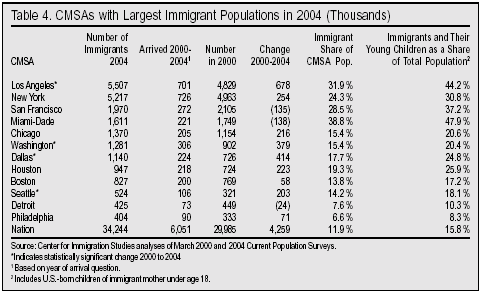
Number of Immigrants by Metropolitan Area. Table 4 shows the total number of immigrants in the nation’s Consolidated Metropolitan Statistical Areas (CMSAs) with the largest immigrant populations. It also reports the number of immigrants who indicated that they arrived in the United States between 2000 and 2004 and the share of each CMSA’s population comprised of immigrants. As was true when we examined the state data in Table 1, in general Table 4 shows that the CMSAs with the largest overall immigrant populations tend also to have the most post-2000 arrivals. They also tend to be metro areas where immigrants represent a large share of the total population. As already indicated, immigrants have become much more spread out over the last decade. However, Table 4 does show that immigrants remain relatively concentrated. Half of all immigrants live in just six CMSAs, even though these same metro areas account for only 23 percent of the nation’s total population. But evidence can also be found that immigrants are increasingly dispersed. Although the top six metro areas accounted for half of the foreign-born population, they received only 40 percent of post-2000 immigrants. Table 4 also reports growth in the immigrant population by CMSA. Those metro areas with statistically significant growth between 2000 and 2004 are shown with an asterisk. Again, this does not mean that these were the only areas with growth. Rather, it means that statistically we can say that there is a 90 percent chance that the change shown in the fourth column reflect growth in actual population. Looking at the growth figures shows evidence that immigrants have become more dispersed; the six metro areas with the largest immigrant populations accounted for only 29 percent of total increase in the immigrant population.
Characteristics by Metropolitan Area
Educational Attainment. Table 5 reports characteristics for immigrants and natives for the CMSAs with the largest immigrant populations. The metro area data show that like the state characteristics, immigrants are more likely than natives to lack a high school degree. Also similar to the state data, immigrants and their young children are much more likely to live in or near poverty and lack health insurance, and immigrant-headed households are much more likely to use major welfare programs than are native households. But there are differences between metro areas. In areas like Los Angles, San Francisco, Dallas, Houston, Miami-Dade, and New York a very large share of immigrants have low incomes, lack insurance, and need welfare. But this is not as true in the Chicago and Washington CMSAs. In those two CMSAs, the difference between immigrants and natives is not so large.
(click on table for a larger version)
Poverty/Near Poverty by Metro Area. While there are differences among cities, in all of these areas immigrant families comprise a large share of the low-income population. For example, in the Los Angles CMSA, immigrants and their young children account for about 63 percent of those living in or near poverty but 44 percent of the total population. In San Francisco, immigrants and their children accounted for 37 percent of the total population but 51 of the low income population. In the New York CMSA, immigrants and their children are 42 percent of the low-income population, but 31 percent of the total population. In the Texas CMSAs of Dallas and Houston, immigrants and their children comprise 41 and 37 percent of the low-income population respectively, but only 25 percent and 26 percent of the total population. Even in the relatively affluent Washington area, immigrants and their young children account for almost one-third of those with low incomes, but they are only one fifth of the total population.
Health Insurance Coverage by Metro Area. Turning to health insurance the picture is even starker. In every CMSA in Table 5 immigrants and their children are much more likely to lack health insurance. As a result, in many cities more than half of those without insurance are either immigrants or the young child of an immigrant. In Los Angeles and Miami, immigrants and their children are 63 percent of the uninsured; in New York they are 53 percent; in San Francisco they represent slightly more than half of the uninsured; in Dallas and Houston they are 46 and 43 percent of the uninsured; and even in Washington and Chicago they are 43 and 38 percent of the uninsured, respectively. Although generally unacknowledged, it is very difficult to overstate the impact of immigration on the size and growth of the uninsured population in America’s largest urban areas.
Social Characteristics Nationally
Table 6 reports socio-demographic characteristics for immigrants and native populations. Unlike the state tables, Table 6 reports information for immigrants by themselves as well as for their U.S.-born children under age 18. In addition, separate estimates of poverty, health insurance coverage, and welfare use are also provided for illegal aliens. It should be remembered that illegal aliens are identified in data based on their individual characteristics. Therefore estimates for illegals are subject to non-sampling error and the results should be interpreted with caution.
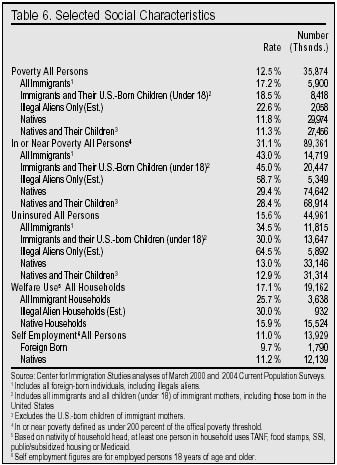
Poverty/Near Poverty. Table 6 shows that about 17 percent of immigrants and 12 percent of natives were in poverty and 43 percent and 29 percent respectively lived in or near poverty. When the U.S.-born children of immigrants (who are included in the figures for natives) are counted with their parents, the poverty rate associated with immigrants climbs somewhat to almost 19 percent and the share in or near poverty grows to 45 percent. Immigrants and their children comprise slightly less than 16 percent of the total population, but now account for 23 percent of the poor and 23 percent of those in or near poverty. Illegal aliens have the highest poverty rates, with 23 percent living in poverty and almost 59 percent being poor or near poor. As reported at the bottom of Table 3, about one-third of adult immigrants lack a high degree compared to 12 percent of natives. The very low education level of a large share of immigrants is the primary reason so many have low incomes.
Health Insurance. Table 6 also shows that immigration has had an enormous impact on the size of the uninsured population. The table shows that almost 35 percent of immigrants are uninsured compared to 13 percent of natives. Immigrants now comprise more than one-fourth of the uninsured population, even though they are only a little more than one-tenth of the total population. When their U.S.-born children are included, the rate of uninsurance is somewhat lower—30 percent. This is primarily due to the high rate of Medicaid use among the U.S.-citizen children of immigrants. Not surprisingly, immigrants and their young children comprise an even larger share of the uninsured. Even illegal aliens by themselves have a significant impact on the health insurance crisis. Illegals now comprise 13 percent of the uninsured, but are 3.2 percent of the total population. As already discussed, a large share of immigrants have very little education. Because of the limited value of their labor in an economy that increasingly demands educated workers, many immigrants hold jobs that do not offer health insurance, and their low incomes make it very difficult for them to purchase insurance on their own.
The costs to taxpayers are considerable. A report by the Kaiser Family Foundation estimated that the uninsured cost taxpayers $41 billion a year.12 There is also evidence that those with insurance pay higher premiums as health care providers pass on some of the costs of treating the uninsured. Table 6 makes clear that our immigration policy has enormous implications for the nation’s health care system.
Welfare and Self Employment. Given their higher rates of poverty and near poverty, it is not surprising that Table 6 also shows that households headed by immigrants make heavier use of welfare programs than do native households. Even though the 1996 welfare reform tried to curtail immigrant eligibility, many state governments opted to cover immigrants. In addition, immigrants often receive benefits on behalf of their U.S.-born children, who have welfare eligibility like any other U.S. citizen. Overall, about 26 percent of immigrant households use at least one major welfare program compared to 16 percent of native households. As for households headed by illegal aliens, 30 percent use one or more welfare programs. It should be pointed out that for illegals the high rate of welfare use mainly reflects heavy dependence on Medicaid among the U.S.-born children of illegal aliens. In terms of self employment, Table 6 shows that the two groups exhibited similar rates of entrepreneurship, with natives enjoying a slightly higher rate.
Immigrants by Country
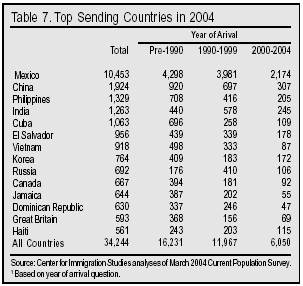
Top Sending Countries. Table 7 shows the top 14 immigrant sending countries in 2004. It also shows the year of arrival for immigrants. One of the most striking things about current U.S. immigration is the large share of immigrants from Mexico. In 2004, immigrants from just this one country accounted for 31 percent of the foreign born. In fact, the diversity of U.S. immigration has declined significantly in recent years. In the March 2000 CPS, Mexico was the top sending country as well, and accounted for 28 percent of the foreign born at that time. It was also the top country in 1990, accounting for 22 percent in that year. This was a substantial increase from 1980, when Mexico was again the top country, but accounted for only 16 percent of the foreign born. The trend of declining diversity goes back even further; in 1970 the top sending country was Italy, and it represented only 10 percent of the total immigrant population. There is some concern that as one country comes to dominate the flow of immigrants into the country it may hinder the integration and assimilation process that is so important both for immigrants and the larger society.
Conclusion
In the mid 1990s, the Census Bureau began to include a question on citizenship in its Current Population Survey, allowing us to identify immigrants. For the first time we are able to estimate the size of the immigrant population between the decennial censuses. The recession of 2000-2001 is the first to occur after this data began to be collected. Thus we can test the often-made argument that immigration levels primarily reflect demand for labor in this country. The available evidence suggests otherwise. Unemployment among both immigrants and natives increased substantially between 2000 and 2004, as did the share of immigrants and natives who withdrew entirely from the labor force. This is in stark contrast to the period from 1996 to 2000, when employment grew significantly. Yet despite the fundamentally different economic conditions, the level of immigration seems to have been as high or higher after 2000 than in the four years prior to 2000. The net increase in the size of the immigrant population was four million between 1996 to 2000 and 4.3 million between 2000 and 2004. Moreover, 6.1 million new immigrants entered in the four years after 2000, compared to 5.5 million in the four years preceding 2000.
Of course, had a different immigration policy been pursued, then immigration could have been reduced. But there has been no major change in legal immigration and no greater effort was made at enforcement of immigration laws. While visa applicants from some parts of the world may have to wait a little longer for approval and a tiny number of illegal aliens from selected countries may have been detained, this does not constitute a major change in policy and has no meaningful impact on immigration levels. Even illegal immigration has remained at record levels despite the obvious implications for national security. We estimate that, between 2000 and 2004, the number of illegal aliens living in the United States increased by two million. The fact that immigration levels have remained so high even though job growth has been very weak indicates that immigration is not primarily driven by demand for labor in the United States. Rather, it is a complex process driven by many factors. If a lower level of immigration is desired then policy itself will have to be changed.
Endnotes
1 The September 20, 2004, issue of Time magazine reported that the number or employers fined for hiring illegal aliens reached its lowest level ever in 2003, falling from over 900 in 1995 to only 13 in 2003.
2 The 1996 to 1999 data were originally weighted based on the result of the 1990 Census carried forward. This was also originally true for the March 2000 CPS. After the 2000 Census, which was conducted in April, the Census Bureau re-weighted the March 2000 CPS based on the results from the 2000 Census. This had the effect of increasing the size of the foreign born population in the March 2000 CPS by 5.659 percent—making it 1.6 million larger compared to the 1990-based weights. While the Census Bureau has not reweighted the 1996 through 1999 CPS, it is very reasonable to assume that the undercount was similar in those years. If we adjust the 1996 through 1999 March CPS by the same amount, it produces the results found in Figure 1.
3 The survey is considered such an accurate source of information on the foreign-born because, unlike the decennial census, each household in the CPS receives an in-person interview from a Census Bureau employee. The 213,000 persons in the Survey, almost 24,000 of whom are foreign born, are weighted to reflect the actual size of the total U.S. population. However, it must be remembered that some percentage of the foreign born (especially illegal aliens) are missed by government surveys of this kind, thus the actual size of this population is almost certainly larger. Of course, this was true in past years as well.
4 This includes naturalized American citizens, legal permanent residents (green card holders), illegal aliens, and people on long-term temporary visas such as students or guest workers, but not those born abroad of American parents or those born in outlying territories of the United States such as Puerto Rico.
5 Unlike deaths, out-migration may or may not rise with the size of the immigrant population. Also, unlike deaths, it can fluctuate from year to year. While the potential pool of return migrants obviously grows as the immigrant population grows, this does not necessarily mean that more will choose to go home or, in the case of illegals, be forced to do so. Put simply, out-migration usually is voluntary and can fluctuate; deaths, on the other hand are not voluntary and therefore occur at a predictable rate. This does not mean that out-migration cannot be estimated. See Census Bureau publication www.census.gov/population/documentation twps0051/twps0051.pdf.
6 If the original weights (based on the 1990 census) are used for the 1996 through 2000 data, then the foreign born grew from 24.6 million in 1996 to 28.38 million in 2000—3.82 million. This is less than the 4.04 million growth reported in Figure 1. Using the 3.82 million increase would constitute a statistically significant difference from the 4.25 million growth 2000 to 2004. This would mean that growth in the 2000 to 2004 period was larger than in the 1996 to 2000 period. However, it seems more reasonable to adjust the data to reflect the results of the 2000 census. Thus we take a more cautious approach in Figure 1 and conclude that growth in the 1996 to 2000 was about as fast as in the 2000 to 2004 period.
7 The Center’s recent study on immigrant and native employment, A Jobless Recovery? Immigrant Gains and Native Losses, can be found at http://www.cis.org/sites/cis.org/files/articles/2004/back1104.html
8 To identify legal and illegal immigrants in the survey, this report uses citizenship status, year of arrival in the United States, age, country of birth, educational attainment, sex, receipt of welfare programs, receipt of Social Security, veteran status, and marital status. We use these variables to assign probabilities to each respondent. Those individuals who have a cumulative probability of one or higher are assumed to be illegal aliens. The probabilities are assigned so that both the total number of illegal aliens and the characteristics of the illegal population closely match other research in the field, particularly the estimates developed by the Urban Institute. This method is based on some well established facts about the characteristics of the illegal population. For example, it is well known that illegals are disproportionately young, male, unmarried, under age 40, and have few years of schooling, etc. Thus, we assign probabilities to these and other factors in order to select the likely illegal population. In some cases we assume that there is no probability that an individual is an illegal alien.
9 The INS report estimating seven million illegals in 2000 with an annual increase of about 500,000 can be found at http://www.immigration.gov/graphics/aboutus/statistics/Ill_Report_1211.pdf. The Census Bureau estimate of eight million illegals in 2000 report can be found at http://www.census.gov/dmd/www/ReportRec2.htm (Appendix A of Report 1 contains the estimates). The Urban Institute is the only organization to release figures for the size of the illegal population based on the CPS. Urban estimates that in March of 2002, 8.3 million illegal aliens were counted in the CPS. Assuming continual growth in the CPS, there should be between 8.6 and 8.8 million in the March 2003 CPS and nine and 9.2 million in 2004 CPS. Urban’s estimates based on the March 2002 CPS can be found at http://www.urban.org/url.cfm?ID=1000587.
10 Table C in the report on illegal immigration shows the number of non-IRCA legalizations in the 1990s. It can be found at http://uscis.gov/graphics/shared/aboutus/statistics/Ill_Report_1211.pdf
11 These figures are for fiscal years 2000 through 2003. Fiscal year 2000 includes the last three months of 1999 and the first three months of 2000. On the other hand, data for the first six months of fiscal year 2004 are not yet available. But these facts do not change the basic fact that between March of 2000 and March of 2004 about 700,000 green cards went to Mexican immigrants.
12 The Kaiser Family Foundation report can be found at www.kff.org/uninsured/kcmu051004nr.cfm
Steven A. Camarota is the Director of Research at the Center for Immigration Studies.