
Download this Backgrounder as a pdf
In 1996, vowing to “get tough” on illegal immigration, Congress passed the Illegal Immigration Reform and Immigrant Responsibility Act (IIRAIRA). This law included a number of reforms aimed at deterring and punishing illegal immigration. One new tool in that package, now Section 212(a)(9)(B) of the Immigration and Nationality Act, for the first time sought to punish anyone who stayed in the United States illegally by barring them from future entry. Known as “the 3/10-year bar,” this provision bars from re-entry those who have accumulated more than six months of illegal presence. Illegal aliens with six to 12 months of unlawful presence are barred for three years; those here for more than a year illegally are barred for 10 years. In addition to penalizing a long period of illegal presence, the law was meant to provide an incentive for prospective immigrants to play by the rules and resist the temptation to flout immigration law en route to a green card. At the time, observers predicted that millions of illegal aliens would be affected. The numbers, however, tell a different story:
- Narrow interpretations of the law by the Immigration and Naturalization Service (INS) and repeated amnesties enacted by Congress have shielded as many as 2.5 million illegal aliens from being barred for unlawful presence. These efforts to define away illegal immigration imply that policymakers are not seriously interested in immigration law enforcement.
- As a consequence, in its first four years, the 3/10-year bar prevented fewer than 12,000 previously-illegal aliens from coming into the United States.
- Because the 3/10-year bar applies only to those aliens who leave the United States after a period of unlawful presence, it provides a powerful incentive for illegal aliens who intend to apply for a green card to remain illegally and cut in line, instead of applying in the customary way from abroad.
- Huge processing backlogs in the immigration service resulting from large-scale amnesties and over-subscribed immigration programs provide policymakers with an excuse not to enforce the
- 3/10-year bar and other penalties for illegal presence.
- Full implementation of the 3/10-year bar as originally conceived would not adversely affect the green card applications of most applicants. Most family-based applications would be completed more quickly if processed overseas by the State Department rather than the Bureau of Citizenship and Immigration Services (BCIS, formally part of the INS), and fewer than 10 percent of those adjusting annually (those in numerically-limited family categories) would be forced to depart and wait overseas, rather than remain here illegally. Shifting some of the workload to the State Department would help the BCIS reduce its processing backlogs to the benefit of all applicants.
Introduction
When the 3/10-year bar was passed, it was described by its supporters as “common sense” and “tough” and derided by its critics as “harsh,” “draconian,” and “radical.” In fact, the measure has had only a negligible impact. In its first four years, the bar prevented fewer than 12,000 people from entering the United States (See Table 1). Over the same period, the illegal population has grown from six to eight million people, and at least 600,000 illegal aliens have received green cards.1
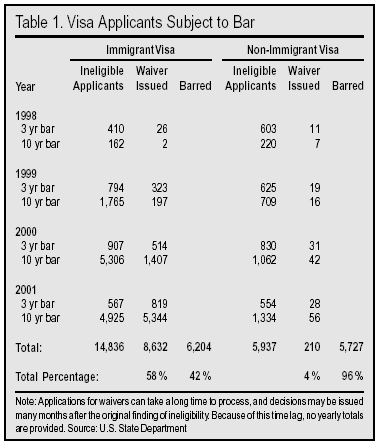
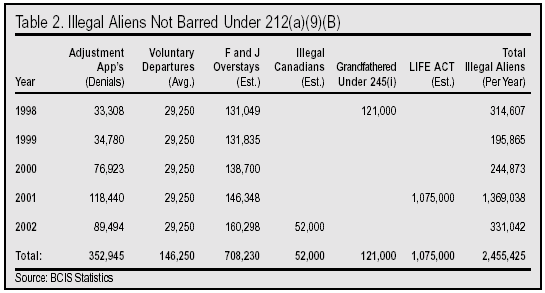
For a variety of reasons, Section 212(a)(9)(B), in practice, has not only failed to penalize or deter most illegal aliens but has actually encouraged illegal immigrants to remain here, thus contributing to the swelling of the illegal population. How did this happen? First, the original provision was gutted on the way from its debut in the House of Representatives to its adoption in a House-Senate conference committee. Next, a series of interpretations of the law issued by the INS after it went into effect severely restricted its application. Finally, the repeated extension of Section 245(i), the controversial program which expedites green card processing for certain illegal aliens, has shielded hundreds of thousands from the reach of the 3/10-year bar. Together, these evolutions have protected perhaps as many as 2.5 million illegal aliens from the 3/10-year bar between 1998 and 2002 (See Table 2).
History of the Bar
The impetus for the immigration reform effort that resulted in IIRAIRA came from lawmakers’ recognition of public concern over illegal immigration, most profoundly expressed in the passage of Proposition 187 in California in 1994 and stoked by the 1993 World Trade Center bombing and a series of other highly publicized incidents involving illegal immigrants. A growing body of research on illegal immigration provided further justification for taking action, and suggested that attention to land border control was not enough. In 1994 the INS released its first detailed estimates and analysis of the make-up of the illegal population. This report included the startling finding that 40 percent of the illegal population was believed to be visa overstayers, not land border crossers, a figure much higher than many had assumed.2
Lawmakers saw the need for a provision that would penalize illegal presence with something short of formal deportation and removal, a lengthy and resource-intensive process that ultimately results in few actual removals due to its very low priority for immigration officials. In 1995, only about 50,000 illegal immigrants were removed; today the figure is about 177,000 out of an illegal population numbering at least eight million.
Beyond the very low risk of being caught, illegal immigrants faced no penalties for illegal entry, for overstaying, or for violating the terms of a non-immigrant visa. Living here in violation of U.S. immigration laws would in no way compromise an alien’s application for permanent residency. Consuls adjudicating immigrant visa applications overseas were told to overlook the fact that an applicant was already living illegally in the United States, despite the strong likelihood that the applicant had misled U.S. officials to gain entry in the first place (an offense that is punishable under immigration law). The message that illegal presence was something to be winked at was further reinforced in 1994 when Congress enacted 245(i), making it easier for illegal immigrants to adjust to permanent residency from within the United States.3
Bar First Proposed. The bar made its first appearance as part of an omnibus immigration reform bill introduced by Rep. Lamar Smith (R-Texas) in August 1995, and passed in the House the next year.4 The bill stipulated that aliens who were found to have been unlawfully present for a total of one year would be considered inadmissible (and thus prevented from obtaining any visa or green card) for 10 years, with certain exceptions.5 Former immigration subcommittee staffers recall that this measure was considerably less harsh than the permanent bar that some lawmakers wanted to see. According to one source, “the hard-liners were insisting on something practically akin to death penalty for illegal aliens, so the 10-year bar seemed to be a reasonable compromise.” But even this gentler proposal would be virtually de-clawed before it made it out of Congress.
The companion Senate reform bill (S.1664) contained no comparable provision, so the matter had to be negotiated in the conference committee. The version that emerged from the conference and that was signed into law reads as follows:
“Any alien (other than an alien lawfully admitted for permanent residency) who —
(I) was unlawfully present in the United States for a period of more than 180 days but less than one year, voluntarily departed the United States... and who again seeks admission within three years of the date of such alien’s departure or removal, or
(II) has been unlawfully present in the United States for one year or more, and who seeks admission within 10 years of the date of such alien’s departure or removal from the United States, is inadmissible.”
At first glance, this version sounds even tougher than the original House version, adding a three-year bar to entry for anyone who stays illegally for six to 12 months. But more significantly, it also added five words — “voluntarily departed the United States” — that rendered it inapplicable to many of the illegal aliens for whom the bar was originally intended. Now the bar would apply only to illegal aliens who left the United States, thus creating a powerful incentive for them to stay. According to one account, this sleight of hand — seemingly toughening the provision while actually gutting it — was pushed through by then-Senator Spencer Abraham, chairman of the immigration subcommittee, and an avid open-borders advocate.6
Even confining application of the bar to those illegal aliens who depart the United States at first seemed quite punitive. At the time the law went into effect on April 1, 1997, it was still possible for some illegal aliens to adjust status under 245(i). However, that loophole was scheduled to sunset on September 30, 1997, meaning that soon everyone who aspired to legal status would have to leave before they accrued six months of illegal presence. The last possible day they could be in the United States without triggering the bar was September 27, 1997.
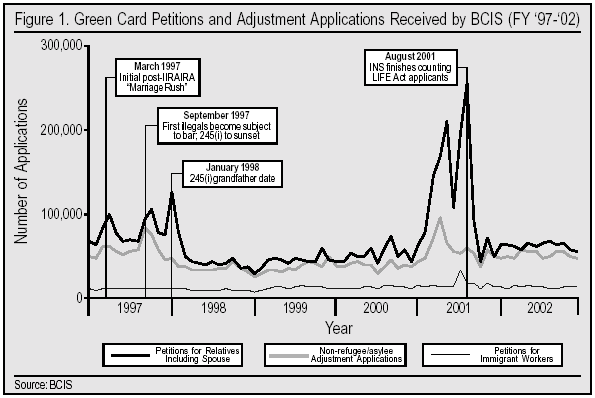
Initial news of the bar caused a degree of panic in the illegal population. Some observers estimated that potentially millions of people would be barred by the new law.7 Newspapers carried stories of thousands of hastily-arranged marriages of illegal immigrants to U.S. citizens, followed by a dash to the local INS office to file green card petitions just before April 1 (the message that the bar would not be triggered until September did not get through to many). Immigration benefits applications ebbed and flowed over this period (See Figure 1).
The INS Memos
The concept of “unlawful presence” introduced in IIRAIRA was completely new in immigration law, so advocates and practitioners watched closely to see how the INS (and State Department, which would follow the lead of the INS on this issue) would define it. Illegal alien sympathizers’ worst fears were confirmed as the INS initially adopted a strict interpretation of the law, issued in a March 31, 1997, memo signed by Acting Executive Associate Commissioner Paul W. Virtue.8 The March 31 memo said that the following categories of people were considered unlawfully present: 1) visa overstayers; 2) those who entered without inspection or parole; and 3) a new category, “status violators”, i.e., those who violated the terms of their non-immigrant visas, such as by working or committing crimes. Inclusion of the third category in the definition of unlawfully present was considered to be particularly revolutionary.
Yet this era of strict penalties for illegal presence would prove to be fleeting. Less than three months later, under pressure from immigration lawyers, the INS relaxed one key part of its interpretation. In a memo dated June 17, 1997, it said that illegal aliens who had filed an application for adjustment of status would not be considered unlawfully present, even if the application had not yet been reviewed.9
This move was an enormous leap of faith. Not only did it confer legal status prematurely on hundreds of thousands of illegal immigrants, essentially allowing them to cut in line before other applicants following the rules, it also legalized people who might eventually be denied a green card. In theory the legalization was temporary, pending the review of the application, but since removing all but criminal aliens was a very low priority for the INS, it is reasonable to assume that many of these denied applicants are probably still living here. Imagine the consequences if a department of motor vehicles operated this way, issuing temporary licenses to all who applied, and telling them to come back later for the driving test.
Large Numbers Benefit. How many people were covered by this memo? Since 1997, the INS has received between 370,000 and 630,000 non-refugee/asylee adjustment applications each year (by definition, many of these applicants are illegally present, especially when 245(i) is in effect). But for the June 17 memo, a large majority of these people would have been subject to the bar and, presumably, most would have left the country to pursue their application properly at U.S. consulates overseas rather than swell the rolls of illegal aliens here and prematurely access benefits available to residents, such as education and health care. Even more important, more than 350,000 people would not have been able to return at all, because their applications were ultimately rejected (See Table 2). Had they been required to apply from overseas, they would have removed themselves at their own expense, instead of remaining at large in the United States.
Three months after the June 17 memo, the INS yielded. In a September 19, 1997, memo, also signed by Virtue and issued eight days before the three-year bar would be triggered for the huge cohort of people present illegally on April 1, 1997, the INS further diluted its definition of unlawful presence, and said that it would consider the following people to be legally present, and thus exempt from the bar:
- Illegal aliens who had been caught and granted Voluntary Departure. Voluntary Departure is an order to leave the country by a certain date, or face harsher punishment if caught again. It is hard to tell from INS data exactly how many people have benefited from this interpretation of the law, but a reasonable estimate is 29,250 a year.10
- Students and exchange program participants. Aliens would only be considered overstayers if they were given a specific departure date by the INS at the time of entry, and then stayed past that date. This interpretation protected holders of F and J non-immigrant visas (students and exchange program participants) from being considered overstayers, because they are admitted for “duration of status” without a specific end date.11 How many in those categories overstay? No one knows for sure, but a recent report cited a foreign student advisor’s estimate of 50 percent.12 Even assuming a more conservative overstay rate of 30 percent, another 750,000 illegal aliens became exempt from the bar. A later ruling would also exempt Canadians (and Commonwealth citizens resident in Canada), as they, too, are usually admitted for duration of status. It is estimated that about 52,000 Canadians were illegally residing in the United States in 2002.13
- Those working without permission. The September 19, 1997, memo also eased up on non-immigrant visa (NIV) holders who work without permission.14 “Status Violators,” as they are known, would only be barred if their illegal employment happened to come to the attention of an immigration official in the context of a benefits application, or an immigration judge during exclusion, deportation, or removal hearings. The 180-day clock would begin to tick from the date of discovery, not from the date of illegal employment. Immigration law practitioners interviewed for this article agreed that the possibility of being caught in illegal employment is highly unlikely, and provided numerous examples of clients who should have been barred, but whose status violations escaped the attention of INS adjudicators.
- Non-immigrant criminals. The memo gave a similar break to this group: “the mere commission or conviction of a criminal offense does not trigger unlawful presence for a non-immigrant who has not remained beyond the period of stay authorized . . . ,” again, unless the individual ends up before an immigration judge. In other words, immigration officials don’t mind if an alien commits a crime while here on a temporary visa, as long as he does it while the visa is still valid.15
It is worth noting that in the above cases, only an immigration officer or judge can declare that an individual has overstayed or violated status. Consular officers are not allowed to make that determination, even though it may be obvious from the individual’s travel history or from statements made in an interview. Nor are consular officers allowed to refer cases to the immigration bureau to ask for such a finding if they encounter an applicant who appears to fit the bill.16
The State Department created additional exemptions to the bar. For example, it excluded from the definition of overstay those whose professional guestworker (H1-B) applications are refused because the annual limit on approvals has been reached.
245(i) Redux
Even in its watered down state, the 3/10-year bar still would have affected hundreds of thousands of other illegal residents who could eventually qualify for a green card through marriage or employment, but who were not yet eligible to apply due to statutory limits on the number of green cards available each year. Section 245(i), which excused their illegal presence and shielded them from the bar, was scheduled to expire on September 30, 1997, three days after the date the bar went into effect.
As one immigration subcommittee staffer pointed out, because of the 3/10-year bar, the preservation of 245(i) became “a matter of life or death” for advocates for illegal aliens and in the fall of 1997, efforts to extend it set off a bitter fight in Congress. A permanent extension was tacked on to the Senate version of the next year’s Commerce/Justice/State appropriations bill. Since the House version included no such extension, the matter was left to the appropriations conferees to resolve. After several temporary extensions and intense efforts by three congressmen (Lamar Smith of Texas, and two California Republicans, Brian Bilbray and Dana Rohrabacher), the conferees eventually compromised on a new expiration date of January 14, 1998.
Grandfathered Applications. The extension provided one important new loophole for illegal aliens — a grandfathering clause. Prior to this extension, illegal aliens were not permitted to submit their green card application until a visa became available. (Getting a green card is a two-step process. First, the U.S. sponsor files a petition. After the petition is approved, most beneficiaries are put on a waiting list. Green cards are given out in the order that the petitions are received, subject to numerical limits by category and per-country limits. Because the number of petitions has far exceeded the number of available green cards for many years, there are long waiting lists. When a green card becomes available, the application may then be submitted.17) Under the new 245(i), any illegal alien who had a petition filed for him before the January 14, 1998, expiration date, or a labor certification application with the Labor Department (the first step for an employment-based green card), would be able to remain here legally, regardless of how many years it would take before he could actually apply. The grandfathering also was extended to dependents of applicants, even if they were not yet in the country at the time the law was enacted.
Under the new rules issued by INS Executive Associate Commissioner Robert L. Bach, an illegal alien’s petition or labor certification application filed under this provision did not have to be approved; it just had to be filed. And, the applicant would not be bound to the category under which he originally applied, opening up all sorts of opportunities to game the system.
During the months of 245(i)’s legislative limbo and up until the deadline, the INS obligingly accepted thousands of these so-called “skeletal” petitions from illegal aliens. The agency took pains to reassure the public that it would not now begin to make special efforts to enforce the 3/10-year bar, and that its priority was criminal aliens, not those merely out of status.18
INS statistics indicate that a large number of illegal aliens took advantage of this opportunity to launder their status, showing a clear spike in adjustment applications just before 245(i) was set to expire in September 1997 and another spike in family-based petitions just before January 1998 (See Figure 1). From October 1997 to January 1998, more than 387,000 relative petitions were filed, which is nearly 45 percent higher than the same period in the previous year (266,000).
Meanwhile, the illegal population continued to swell. According to INS estimates, another 817,000 new illegal aliens arrived in 1998 and another 968,000 arrived in 1999.
The Biggest Amnesty Yet
By 2000, high-immigration advocates again saw the need to shield this growing illegal population from the 3/10-year bar. Sen. Orrin Hatch (R-Utah) introduced the LIFE Act, which was enacted on December 21, 2000, as part of an appropriations bill. It offered legalization to anyone present in the United States, legally or illegally, who had a petition submitted on their behalf by April 30, 2001. At the time the INS estimated that about 640,000 illegal aliens would benefit from this legislation.
Again, the INS went to great lengths to stretch the definition of what would be considered acceptable legalizing paperwork. In a January 2001 memorandum signed by Michael D. Cronin, Acting Executive Associate Commissioner, adjudicators were directed to accept even the most bare-bones petitions, without documentation of the claims made within: “Applications and petitions submitted under Section 245(i) of the Act may not be rejected prior to May 1, 2001, as long as they bear the required fee and the applicant’s signature.”
Of course, the applicant eventually does have to document his eligibility for a green card. But the processing backlogs caused by the LIFE Act guaranteed any applicant a years-long grace period of near immunity from removal before becoming subject to INS scrutiny.
The scale of the LIFE Act amnesty dwarfs all others since the Immigration Reform and Control Act (IRCA) of 1986 (see Figure 1). From January 2001 until the end of August 2001, more than 1.8 million new non-refugee/asylee applications and petitions were received by the INS, compared with 725,000 over the same period in 2000. (The application deadline for the program was April 30, but the INS did not finish counting them until the end of August.)19 This avalanche of petitions caused the already too-large processing backlogs at INS to become completely unmanageable. The Department of Homeland Security has inherited this workload; in February 2003, it reported that it had a backlog of more than 2.8 million adjustment applications and petitions.
Soon after the LIFE Act deadline passed, advocates again began pressuring members of Congress to extend the deadline or make 245(i) permanent. Congress was on the verge of doing so on September 11, 2001, but dropped the idea, as members recognized the political risk involved in adopting any measures that would encourage more illegal immigration in this new era of attention to homeland security.
Is Anyone Ever Barred?
Because the bar does not apply to illegal aliens who stay in the United States, and because so many have been defined out of unlawful status, relatively few prospective immigrants or visitors ever have been prevented from entering under 212(a)(9)(B). According to State Department data, in its first four years the bar was applied to just over 20,000 people seeking immigrant or non-immigrant visas overseas (See Table 1).20
Not even all of those applicants were actually barred. More than half (58 percent) of those green card applicants with enough illegal presence to justify being barred were able to receive a waiver of ineligibility and received permanent residence anyway. For NIV applicants subject to the bar, four percent received waivers.
The waiver was part of the original legislation creating the 3/10-year bar. It offers the opportunity for someone who is the spouse, son, or daughter of a U.S. citizen or permanent resident to avoid the bar, if the applicant can demonstrate that being barred would result in “extreme hardship” to the U.S. citizen or resident spouse or parent.
“Extreme hardship” is not defined in the statute, but there are strong precedents in immigration case law. The leading decisions explain that many factors in the alien’s and sponsor’s situation must be weighed, including ties in and out of the United States, financial and medical conditions, etc. In general, though, extreme hardship is a state well beyond the disruption of life that would be normally expected upon deportation of a family member.21
The high percentage of waivers issued suggests that the “extreme hardship” standards are not being strictly applied at the level of the BCIS field adjudicators, who process the waiver applications. Immigration court is another story; statistics show that immigration judges have generally upheld denials of waivers if they are appealed.22
Conclusion
The point of the 3/10-year bar was to punish and deter illegal immigration, a goal for which there has been consistently broad public support over the years. By every measure, the 3/10-year bar has failed to make a difference. Lawmakers gutted it before it left Congress, enabling them to sound tough without really being tough, and later passed new laws to negate the effect of the bar. INS leadership went to extreme lengths to limit the statute’s reach and shield as many illegal aliens as possible from it, demonstrating that tough laws can never be fully implemented if senior civil servants do not like them. In the end, almost no one has been punished for illegal entry, overstaying, or violating status; instead, the law has almost certainly contributed to the growth of the illegal population, because it only applies to those illegal aliens who don’t know enough not to leave. Finally, the non-enforcement of the bar further amplifies the message that immigration laws are not worth the bother, and that violators will not be punished.
When questioned about the impact of the 3/10-year bar on their clients, immigration practitioners generally agree that the impact has been negligible. “My first reaction was that it was stupid, draconian, and harsh . . . . At the time, everyone just shuddered. But it has not turned out to be all that bad, although it does create some perverse incentives,” said one immigration lawyer. When asked if he could think of a single case in which the threat of the bar caused an alien to leave the United States so as to preserve a completely legal route to permanent residency, this attorney replied, “No. I’ve never met that case.”
One positive impact of the 3/10-year bar has been that it, along with other penalties in IIRAIRA, provides an incentive for a speedy deportation and removal for those illegal aliens who are caught. Illegal aliens who are in removal proceedings are not considered to be in a period of authorized stay. To avoid triggering the bar on future admission, now immigration lawyers often are pushing for rapid deportation and removal processing for their unambiguously illegal alien clients, rather than trying to prolong the alien’s stay with appeals and other delay tactics, as was sometimes the case before IIRAIRA.
Needed Changes. If lawmakers wished to penalize illegal presence and provide an incentive to prospective immigrants to follow the rules, the bar remains an option. For it to be more effective, however, several changes would be needed. First, it should apply to all those who accrue unlawful presence, not just those who leave the United States. The various exceptions from the definition of unlawful presence created in the 1997 INS memos should be reversed.23 Complicating matters, however, is the large population of illegal immigrants who are relatives of a U.S. citizen or green card holder, and who expect to apply for a green card at some point in the future. The government’s past willingness to wink at their presence has encouraged them to stay, but also undermined the credibility of immigration laws. A responsible, but still compassionate, solution would be to offer these individuals the opportunity to maintain eligibility, not through an amnesty like 245(i), but by agreeing to wipe out their previous unlawful presence if they leave the country within a specified grace period, such as three months, and apply from overseas.
This would be no great hardship for a large share of prospective immigrants; in fact, it would mean that many applicants would get their green cards even faster. More than 40 percent of those who adjusted in 2001 were the spouses, children, or parents of U.S. citizens, a category that has no waiting list. Because the State Department has no processing backlog of petitions or immigrant visas, these cases often can be completed in the immigrant’s home country in a matter of weeks, rather than the years it is now taking for the BCIS to do them. Only about 10 percent of the adjusters are in family categories that face a long waiting list. It is difficult to make the case for allowing these illegal alien applicants to wait in the United States while others of the same priority wait overseas.
End Backlogs. The 3/10-year bar is a sound idea that could help restore credibility to U.S. immigration law if actually enforced. Yet this measure, and all others that seek to deter and punish illegal immigration, will remain politically difficult to enact and implement as long as the ridiculous, albeit self-inflicted, processing backlogs persist. Homeland Security chief Tom Ridge has pledged to make the backlog reduction a priority and to do what it takes to work through the mountains of files.24 This is a worthy goal; not only are the processing backlogs an embarrassment, they inconvenience legitimate applicants and contribute to the impression of agency incompetence. Even worse, they have become an excuse to refrain from enforcing immigration laws, and a tool for high-immigration advocates to wield in derailing recent attempts to shore up immigration law enforcement efforts.
Reviving the 3/10-year bar and giving it teeth will help in the short run by shifting some of the petition and application workload back to the State Department. Like the INS contractors at the California Service Center who eliminated their backlog by shredding the applications, Congress and senior INS management have tried to define away illegal immigration through amnesties and interpretational memos. This approach only buried the agency in more work and clogged the system for prospective immigrants and their American sponsors who are trying to follow the rules.
The backlogs are not a management problem — they are a policy problem. They do not result because field immigration officials are lazy or slow; on the contrary, the application processing centers are generally well-run and employ impressive modern work-flow management techniques. Rather, the backlogs are the predictable consequence of an immigration system that offers more benefits (i.e. visas and green cards) than it can ever hope to deliver in a reasonable time frame. The only lasting cure is a vastly simplified and reduced immigration product line, to use BCIS jargon, that can be quickly and efficiently processed to the benefit of all immigrants and their sponsors.
Endnotes
1 Office of Policy and Planning, U.S. Immigration and Naturalization Service, “Estimates of the Unauthorized Immigrant Population Residing in the United States: 1990 to 2000”, January 31, 2003. www.immigration.gov/graphics/shared/aboutus/statistics/Ill_Report_1211.pdf
2 Robert Warren, “Estimates of the Unauthorized Immigrant Population Residing in the United States,” Unpublished paper, INS, 1994.
3 Applicants for adjustment are those who receive a green card here in the United States, as opposed to those who apply for an immigrant visa overseas in the traditional manner. The law allows for certain kinds of adjustments, such as by those who are in legal status, e.g. students and temporary workers. Under 245(i) this privilege was extended to certain illegal immigrants.
4 H.R. 2202 or Public Law 104-828
5 Exceptions stated in the law are: minors; asylum applicants; spouses and children of IRCA-legalized immigrants; and battered women and children.
6 Paul Donnelly, “Strange No More: The Bishops Finally Endorse Marriage In Immigration
Law,” Immigration Daily, February 13, 2003.
www.ilw.com/lawyers/colum_article/articles/2003,0213-donnelly.shtm
7 Carl Shusterman, “How the Law Will Affect Illegal Immigrants”
www.shusterman.com/entitle.html
8 Paul W. Virtue, “Implementation of Section 212(a)(6)(A) and 212 (a)(9) ground of inadmissibility,” March 31, 1997. www.americanlaw.com/unlawfulmemo3.html
9 Paul W. Virtue, “Additional Guidance for Implementing Sections 212(a)(6) and 212(a)(9) of the Immigration and Nationality Act,” June 17, 1997. www.americanlaw.com/unlawfulmemo1.html
1 The statistics on Voluntary Departure are difficult to interpret for many reasons. Nearly all of those granted Voluntary Departure are apprehended at the border, and many are caught more than once. From 1997 to 1999 INS looked closely at the 65,000 apprehended illegal aliens who had been in the United States more than three days. Twenty-six percent had been here more than a year, and 38 percent had been here between one month and one year. The figure of 29,250 is the sum of those here more than a year (who would otherwise likely be subject to the 10-year bar) and half of those here between one month and a year (who would otherwise likely be subject to the three-year bar). See INS 2002 Statistical Yearbook:
www.immigration.gov/graphics/shared/aboutus/statistics/ybpage.htm
11 Three other categories of non-immigrant visa holders are also admitted for duration of status — diplomats, employees of international organizations, and journalists. However, these visitors are not believed to overstay in large numbers.
12 Margaret Orchowski, “The Student Visa Loophole,” The Weekly Standard, January 27, 2003. www.weeklystandard.comcheck.asp?idArticle=2138&r=auqdf
13 See endnote No. 1
14 Paul W. Virtue, “Section 212(a)(9)(B) Relating to Unlawful Presence,” September 19, 1997. www.americanlaw.com/unlawfulmemo2.html
15 Other provisions in IIRAIRA did set up separate penalties for very serious criminals.
16 State Department telegram 105097, June 1999.
17 At the time, the wait for permission to apply in the family categories ranged from nearly three years to nearly 20 years, depending on the category and the country of nationality. Today the waits range from nearly four years to more than 22 years.
18 Stephen Yale-Loehr and Stanley Mailman, “1996 immigration law impacts people out of status in the U.S.,” True, Walsh & Miller, LLP.
www.clubcyrus.com/twmlaw/site/resources/1996/19963cont.htm
19 INS “Monthly Statistical Report, September FY 2001 Year End Report.”
www.immigration.gov/graphics/shared/aboutus/statistics/msrsep01/index.htm
20 INS inspectors almost never invoke this provision at the port of entry.
21 Stephen Yale-Loehr, “Beating the Bar: Avoiding, Delaying or Remedying Unlawful Presence,” www.twmlaw.com/resources/general26cont.htm
22 Ibid.
23 The DHS has already proposed admitting F, J, and I NIV-holders for a fixed period of stay, rather than for duration of status.
24 Secretary Tom Ridge, “Border Reorganization Remarks,” January 30, 2003.
www.dhs.gov/dhspublic/display?content=419
Jessica Vaughan is a senior policy analyst at the Center for Immigration Studies and served as Chief of the Non-Immigrant Visa Section in the U.S. Embassy in Trinidad and Tobago.