
Download this Backgrounder as a pdf
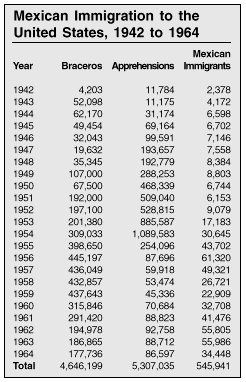
Guest or foreign worker programs aim to add workers to the labor force without adding permanent residents to the population. Between 1942 and 1964, some 4.6 million Mexicans were admitted to the United States as Braceros or guest workers to fill jobs on U.S. farms. While more Mexicans — some 5.3 million — were apprehended in the United States during these years, legal Mexican immigration increased. Between 1942 and 1944, 13,000 Mexican immigrants were admitted; between 1962 and 1964, 146,000 were admitted.
Guest worker programs tend to increase legal and illegal immigration for two major reasons: distortion and dependence. Distortion refers to the fact that economies and labor markets are flexible: They adjust to the presence or absence of foreign workers. If foreign workers are readily available, employers can plant apple and orange trees in remote areas and assume that migrant workers will be available when needed for harvesting. Dependence refers to the fact that individuals, families, and communities abroad need earnings from foreign jobs to sustain themselves, so that a policy decision to stop guest worker recruitment can increase legal and illegal immigration.
This Backgrounder focuses on two examples of guest worker programs that resulted in increased legal and illegal immigration: the Mexico-U.S. Bracero program and Germany’s recruitment of foreign workers in the 1960s and early 1970s. In both cases, employers’ "need" for guest workers lasted longer and proved to be larger than originally expected, leading to the aphorism: There is nothing more permanent than temporary foreign workers.
It is very hard for industrial democracies to avoid the distortion and dependence that accompany guest workers. However, distortion and dependence can be minimized by the use of economic mechanisms to regulate guest worker admissions. The funds employers pay for the privilege of tapping foreign labor markets can be used to develop mechanization and automation alternatives to guest workers, to train and retrain local workers, and to help cover some of the integration costs associated with migrant settlement.
U.S. Braceros
There has been Mexico-U.S. migration throughout the 20th century. However, during several "wartime emergencies" between 1917 and 1921 and again between 1942 and 1964, the U.S. government authorized the recruitment of Mexican workers to fill jobs on U.S. farms. During both of these Bracero "strong arm" programs, illegal migrants arrived alongside legal Bracero guest workers, Mexican immigration increased, and the U.S. decision to end the program led to mutual recriminations. [Between 1917 and 1921, when 81,000 Mexican workers were admitted legally, there was no Border Patrol (it was established in 1924), but there were reports of Mexicans arriving outside the program. Legal Mexican immigration rose from 17,900 in 1917 to 89,300 in 1924.]
The major U.S.-Mexico guest worker programs were the Bracero programs of 1942-64, a series of agreements that admitted Mexicans under conditions very similar to the current H-2A program, which allows U.S. farmers anticipating labor shortages to recruit temporary foreign workers. Under the Bracero and H-2A programs, farm employers must make a good-faith effort to recruit U.S. workers by offering at least a government-set minimum wage and free housing to out-of-area workers. If these recruitment efforts fail, the farm employer was and is certified by the U.S. Department of Labor to have temporary foreign workers admitted to the United States to fill the jobs. These guest workers receive as a contract the job order that the U.S. employer filed with the Employment Service to recruit U.S. workers, i.e., it spells out wages, working conditions, housing arrangements, etc.
Most U.S. employers did/do not request certification to employ foreign workers until they have identified the foreign workers they want to employ. Once they have found foreign workers, they do not want to hire any U.S. workers who might respond to their required recruitment efforts. It takes time to recruit a reliable supply of foreign workers, which explains why Bracero admissions were relatively small during World War II — a peak of 62,000 Braceros were admitted in 1944, when the United States had over four million hired farm workers.
The WWII Bracero program expired in 1947, but Mexican workers continued to migrate north, and U.S. farmers continued to employ them outside legal channels. In 1950, a presidential commission was asked to review the need for additional Mexican Braceros and, citing distortion and dependence, it recommended that none be admitted. But the Korean War was used in July 1951 to justify approval of a new Mexican Farm Labor Program, PL-78. PL-78 was deliberately limited to six months — at the request of the Mexican government — to put pressure on Congress to approve employer sanctions so that Mexicans would be encouraged to enter the United States under the program instead of illegally.
Congress did not approve employer sanctions, i.e. penalties for employing illegal aliens, and the Bracero program grew in size and lasted longer than anticipated — legal admissions of Braceros peaked at 445,000 in 1956. The most important effects of the Bracero program were indirect, and they set the stage for Mexico-U.S. migration in the 1970s and 1980s:
- U.S. farmers had to pay round-trip transportation from the Mexican workers’ homes to the United States place of employment, so farmers encouraged workers to move to the border area to limit transportation charges. The result was the growth of Mexican cities on the border, even though there were few jobs there.
- Mexican workers often had to pay fees and bribes in Mexico to be selected as Braceros, so many went north illegally. Illegal workers could be hired without penalty by U.S. farmers. If an unauthorized Mexican worker was apprehended, he was made legal in a process referred to, even in U.S. government publications, as "drying out the wetbacks" — illegal workers were taken to the Mexican border, issued work permits, and returned to the farm on which they were working.
- The availability of Braceros permitted the southwestern states to become the garden states. California fruit and nut production rose 15 percent during the 1950s, and vegetable production rose 50 percent. Average farm worker earnings, however, rose much slower than factory wages: farm workers’ wages rose from $0.85 an hour in 1950 to $1.20 in 1960, while factory workers’ wages rose from $1.60 to $2.60 an hour, i.e., farm wages fell from 53 to 46 percent of factory wages. Braceros in the fields and a booming non-farm economy encouraged Mexican-Americans to change from a predominantly rural to a mostly urban population.
One of the most important lessons of the Bracero program occurred at its end, and showed that those closest to agriculture were most wrong about what would happen without Braceros. As Congress debated whether to end the Bracero program in the early 1960s, farmers argued that Americans would not do farm work and that, without Braceros, crops would rot in the fields and food prices would rise. The California Farmer, on July 6, 1963, said that growers and canners "agree the state will never reach the 100,000 to 175,000 acres planted when there was a guaranteed supplemental labor force in the form of the bracero." (Don Razee, "Without Braceros, Tomato Growers will Slash Acreage in ’64," California Farmer, July 6, 1963, p. 5).
These predictions were wrong. Take the case of processing tomatoes. In 1960, 80 percent of the 45,000 peak harvest workers used to pick 2.2 million tons of the tomatoes used to make catsup in California were Braceros, and growers testified that "the use of Braceros is absolutely essential to the survival of the tomato industry." In 1999, about 5,000 workers were employed to ride machines to sort 12 million tons of tomatoes harvested by machine on 300,000 acres. In the tomato case, the end of the Bracero program led to the mechanization of the tomato harvest, expanding production, and a reduction in the price of processed tomato products, which helped to fuel the fast-food boom.
The second important effect of ending the Bracero program occurred near Delano in the San Joaquin Valley of California. Cesar Chavez and his fledgling United Farm Workers union were able to win a 40 percent wage increase from table grape growers, raising wages from $1.25 to $1.75 an hour in 1966, in part because Bracero workers were not available to break a grape-pickers’ strike. During the 1970s, when the UFW had its maximum number of contracts and members, the UFW urged the INS to aggressively enforce immigration laws, and urged restrictions on "green-card commuters," U.S. immigrants who lived in Mexico and commuted seasonally to U.S. farm jobs.
German Guest Workers
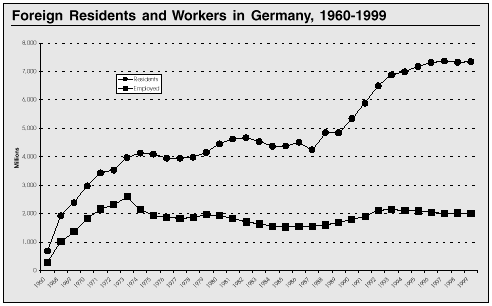
Germany had 7.3 million foreign residents in 2000, over 10-times more than the 686,000 foreigners in 1960, when guest worker recruitment began in earnest. The German experience with guest workers settling is neatly captured in the aphorism of Max Frisch: "We asked for workers, and we got people," people on whom German employers came to rely, and who formed attachments to Germany.
Germany became a reluctant land of immigration because it was slow to realize that workers cannot be rotated in and out of assembly-line jobs. Germany was primarily a country of emigration until the 1950s; Germany remains the number-one source of legal immigrants to the United States, sending over seven million immigrants since 1820, compared to six million from Mexico. Germany recovered quickly from World War II and by 1960 there were more job vacancies registered with the Employment Service than there were unemployed workers. Employers asked for permission to recruit guest workers, and the government complied, reasoning that the guests would work for one or two years in Germany, and then return to Italy, Yugoslavia, or Turkey with their savings and skills in a mutually beneficial labor exchange.
Guest workers trickled in — it took time to develop recruitment networks in southern Europe. By 1970, there were three million foreigners in Germany, and two million or 65 percent were in the German work force, helping to fuel the Wirtschaftswunder that was sending "Made in Germany" goods such as Volkswagens to the United States and around the world. The number of guest workers peaked at 2.6 million in 1973, when 65 percent of the four million foreigners in Germany were at work, and economists emphasized that the presence of guest workers held down wages and kept German industries competitive in the global economy.
The oil crisis of 1973 prompted Germany and most other northern European countries to stop recruiting guest workers. According to the rotation principle, the unemployed guest workers should return to their countries of origin, where their savings would go further. But most did not, since they knew that the prospects of landing a job at home were bleak, and the social safety net was less generous. Instead, the guest workers exercised the rights they had acquired by living several years in Germany and had their families join them, despite efforts by German authorities to discourage family unification.
The result of the German guest worker experience is apparent in the figure on page 4: the number of foreigners in Germany increased 82 percent between 1973 and 1999, while the number of foreign workers fell by 23 percent. Instead of guest workers being in Germany to work, foreigners in Germany today are associated with unemployment rates at least twice the 10 percent average rate. Forty years after the start of guest worker recruitment, there are far more stories expressing fears that the children of guest workers will not be successfully integrated into the German labor market than there are stories about foreign workers sustaining the German economic miracle.
Germany’s guest workers accelerated south-to-north labor immigration, and may have slowed Germany’s willingness to accept new nations that are potential sources of migrants into the European Union. A cornerstone of the European Union is freedom of movement, which means that an E.U. national such as a Frenchman may travel to Germany and seek private sector jobs on an equal basis with German workers. If Poland or Turkey were admitted as E.U. members, this might result in additional Polish or Turkish workers in Germany, encouraging Germany to urge that nationals of newly admitted E.U. nations wait at least seven years for freedom of movement. Instead of guest workers hastening economic integration, they may slow E.U. enlargement.
Guest Worker Alternatives
Guest workers everywhere are associated with distortion and dependence that lead to larger and longer-lasting labor imports than were anticipated. Whether in U.S. agriculture in the 1940s and 1950s, in Western Europe in the 1960s and 1970s, or the Middle East and Asia since the 1970s, importing foreign workers to cope with "temporary" labor shortages inevitably distorts the economy and increases the dependence of some employers on foreign workers, while some workers, families, and regions come to rely on jobs and wages abroad.
Most guest worker programs begin with employers in the immigration country requesting foreign workers. Before governments agree to open the border gates to foreign workers, they should consider the alternatives to foreign workers. That consideration might begin with the fact that labor shortages reflect a demand for labor that exceeds the supply of labor. In a market economy, demand-supply imbalances are brought into balance by changing prices and wages, i.e., labor shortages are eliminated by raising wages, which increases the supply of labor and reduces the demand for labor.
In agriculture and other labor markets offering mostly unskilled jobs, most of the flexibility is on the demand side of the labor market, meaning that rising wages tend to reduce the demand or need for labor more than they increase the supply of workers. This is how the United States went from 90 percent of the work force employed in agriculture to two percent over the past 200 years, and why one shorthand indicator of a country’s development is the percentage of the work force employed in agriculture.
How would rising wages bring labor supply and demand into balance in the U.S. labor market without guest workers? There are many ways, some of which are hard to anticipate. Who would have anticipated in the 1960s, when teenagers pumped gas and washed windows, that a few decades later most motorists would pump their own gas?
There are alternatives to guest workers. Take the case of harvesting raisins, the single most labor-intensive activity in North America. Some 40,000 to 50,000 workers are hired each August-September to cut bunches of green grapes and lay them on paper trays to dry in the sun, producing sun-dried raisins. There is a labor shortage every year, as farmers wait as long as possible to raise the sugar content of their grapes, and then worry that the grapes will be rained on while they lie in the sun to dry.
What is the alternative to paying workers, most of whom are unauthorized, 20 to 22 cents for each 25 pounds of grapes that are cut and laid on trays to dry? The cooperative that handles about one-third of the U.S. raisin crop, Sun Maid, has developed a dried-on-the-vine harvesting system that eliminates the need for an army of harvest workers. The grapes are trained to grow on the south or sunny side of vineyards that are planed in an east-west direction, the canes on which bunches of grapes are grown are cut by machine, the grapes dry into raisins while attached to the vine, and then the raisins are harvested by machine.
New raisin-grape plantings are designed for machine harvesting. But there are few new raisin plantings, largely because Turkey and other countries have greatly increased raisin production and because they can produce raisins more cheaply than California growers. Thus, one way to think about importing guest workers for the raisin industry is that, faced with low prices brought about by increased world competition, guest workers allow employers to maximize their variable costs — if prices drop too low, raisins are simply not harvested. Many raisin grapes were not harvested in 2000 and growers will be paid to bulldoze or prune to eliminate about one-fourth of the 2001 crop because of low prices. Importing guest workers — some of whom will settle — in such a situation is analogous to importing mine workers just before the ore runs out.
Conclusions
People, as Adam Smith observed, are the most difficult baggage to transport over borders. Importing labor is not simple, and managing guest workers is even more difficult. In many countries, under many types of governments, and in many time periods, the guest-worker experience has led to the conclusion that there is nothing more permanent than temporary workers. Whether in the United States with Mexican farm workers or in Germany with Turks, the need for guest workers lasts longer and grows larger than anticipated.
There is no way to eliminate the distortion and dependence that accompanies guest workers. However, distortion and dependence can be minimized with economic incentives — fees paid by employers for the privilege of hiring guest workers. Employer-paid fees — with the amount perhaps equivalent to what employers would have to pay in social security and unemployment insurance taxes for guest workers who are not supposed to remain and benefit from these programs — have the advantage of encouraging employers to honestly search for local workers and generate funds for mechanization and retraining.
Philip Martin is a professor of agricultural and resource economics at the University of California, Davis.