Contact: Steven Camarota
[email protected]
202-466-8185
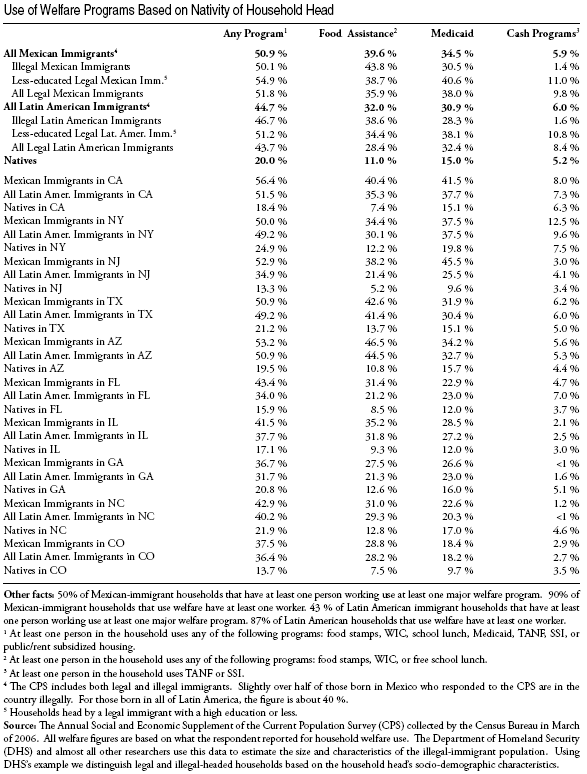
WASHINGTON (June 6, 2007) -- As they debate legalization for illegal immigrants, Senators would do well to keep in mind the most recent data on welfare use by the people in question. According to the Department of Homeland Security, nearly 60% of illegal aliens are from Mexico and 80% of the total are from Latin America as a whole. A Center for Immigration Studies analysis of 2006 Census Bureau data, which includes legal and illegal immigrants, shows use of welfare by households headed by Mexican and Latin American immigrants is more than double that of native households. Among the findings:
- 51% of all Mexican immigrant households use at least one major welfare program and 28% use more than one program.
- 40% use food assistance, 35% use Medicaid, 6% use cash assistance. - 45% of all Latin American immigrant households use at least one welfare program and 24% use more than one program.
- 32% use food assistance, 31% use Medicaid, 6% use cash assistance. - 20% of native households use at least one welfare program and 11% multiple programs.
- 11% use food assistance, 15% use Medicaid, 5% use cash assistance. - Among Mexican and Latin American households, welfare use is somewhat higher for households headed by legal, as opposed to illegal, immigrants. Thus legalization will likely increase welfare costs still further.
- 90% of Mexican and Latin American households have at least one worker. Their heavy welfare use reflects their low education levels and resulting low incomes - and not an unwillingness work.
- 61% of all Mexican immigrants have not graduated high school.
- 48% of all Latin American immigrants have not graduated high school. - There is a common but mistaken belief that welfare programs are only for those who don't work. Actually, the welfare system is designed to provide low-wage workers, or more often their children, things like food assistance and health care.
- It is the presence of their U.S.-born children coupled with their low education levels that explains why so many immigrant households use the welfare system.
- Most recently arrived immigrants are barred from using welfare programs and this would likely apply to those legalized by the Senate bill - however this is not true in every state, nor does not apply to all programs. Most important, the bar does not apply to the U.S.-born children of immigrants, who are immediately eligible.
- There are an estimated 1.4 million households headed by illegal aliens using at least one major welfare program. If even half these families returned to their home countries, the savings for taxpayers could be substantial.
- If we do not wish to make a large share of illegals return to their home countries, then the United States has to accept the welfare costs. There is no other option.
- Programs examined in the analysis are food stamps, WIC, school lunch, Medicaid, TANF, SSI, and public/rent-subsidized housing.
If Illegals Stay, So Will Welfare Costs: The heavy use of welfare by immigrants from those parts of the world that send the most illegals is relevant to the question of whether to allow illegal immigrants to stay or, alternatively, to enforce the law and cause them to return home. The figures reported above are drawn directly from the best government data available, and show that allowing illegals to stay creates significant welfare costs. Many of the welfare costs described above are due to the presence of U.S.-born children, who are awarded U.S. citizenship at birth. Thus, the prohibition on new immigrants using some welfare programs makes little difference because their U.S.-citizen children will continue to be eligible. We estimate that nearly 400,000 children are born to illegal aliens each year.
Welfare Use by Working Immigrant Families: Most immigrants from Mexico and Latin America hold jobs. Their heavy use of the welfare system is due to the fact that a very large share have little education and as a result are able to earn only low incomes in the modern American economy, even though they work. The welfare system is geared toward helping low-income workers, especially those with children. Their education levels and the presence of U.S.-born children means welfare use will be extensive.
Tax Payments: Of course, immigrants, including illegal aliens, also pay taxes. However, because of the education level and resulting incomes levels of Mexican and Latin American immigrants, their tax payments are much less than natives on average. The same is true for illegal aliens. In a 2004 study, the Center for Immigration Studies estimated that illegal alien households used about $2,700 more services than they paid in taxes at the federal level only. We also found that households headed by a legal Mexican immigrant created a net fiscal drain at the federal level of roughly $15,000, and for those with only a high school degree the drain was a little over $3,700. However, those with more education were a fiscal benefit. A new Heritage Foundation study estimated the net fiscal drain at all levels of government created by households headed by high school dropout immigrants at about $20,000 a year. A 1997 National Research Council study found the same pattern - less-educated immigrants create a net fiscal drain and educated immigrants create a net fiscal benefit.
Data Source: The data for this analysis come from the Annual Social and Economic Supplement of the Current Population Survey (CPS) collected by the Census Bureau in March of 2006. It includes legal immigrants and most illegal immigrants. Like the Department of Homeland Security, we distinguish legal from illegal immigrants based on the socio-demographic characteristics of those who responded to the survey. By design our estimates of illegal immigration closely match those of DHS.
Results are also broken out for the following states: Arizona, California, Colorado, Florida, Georgia, Illinois, New Jersey, New York, North Carolina, and Texas.