
Download this Backgrounder as a pdf
Coverage in The Washington Times
This study employs a new approach to examine the impact of immigration on the U.S. economy. Unlike earlier studies, we do not treat the movement of immigrant labor into this country in isolation.
Older studies assumed that abundant resources and demand for labor was the primary reason for immigration, assumptions more appropriate to the 19th century. We start by assuming that the technological superiority of the modern American economy and resulting high standard of living is the primary factor motivating immigration. The study also takes into account the new global economy, including the movement of capital as well as trade. Our findings show that immigration creates a net loss for natives of nearly $70 billion annually.
Among the report’s findings:
- In 2002, the net loss to U.S. natives from immigration was $68 billion.
- This $68 billion annual loss represents a $14 billion increase just since 1998. As the size of the immigrant population has continued to increase, so has the loss.
- The decline in wages is relative to the price of goods and services, so the study takes into account any change in consumer prices brought about by immigration.
- The negative effect comes from increases in the supply of labor and not the legal status of immigrants.
- While natives lose from immigration, the findings show that immigrants themselves benefit substantially by coming to America.
- Those who remain behind in their home countries also benefit from the migration of their countrymen.
The model used in this study can be summarized as follows: High U.S. productivity motivates the entry of foreign workers and capital. As a consequence, the movement of foreign labor and capital into the United States expands U.S. exports and reduces exports by foreign countries who now have fewer workers and less capital. This depresses the prices of U.S. exports while raising the price of its imports, which is bad for U.S. natives. While the addition of immigrant workers makes the overall U.S. economy larger, natives in the United States are worse off because immigrants take not just the increase in income, but other income as well. This is because American workers are now competing with foreign workers who, because they have entered the United States, now have access to superior American technology, which is the primary source of American workers’ competitive advantage in the international economy. In other words, American workers are better off competing with foreigners if the foreign workers stay in their own countries and don’t have access to American technology. By allowing the foreign workers into the United States, Americans face competition with foreigners equipped with American technology.
The Economic Costs of Immigration
America is often described as a nation of immigrants. And so it is. One reason for immigration has been the promise of liberty. However, even from the start, a second very powerful reason has been the opportunity America provides for prosperity. Waves of immigrants have come, particularly from Europe, Asia, and the Americas (especially Mexico) to enjoy the high wages available here and escape the relative penury of their native lands. Through the end of the 19th century and into the 20th century, a prime advantage of America that allowed it to deliver these high wages was its great abundance of land and natural resources. Increasingly, though, in the last half of the 20th century, the principal advantage of America has not been its resources, but rather its leadership of the world in technology or productivity.
Economists have long been interested in the consequences of immigration. A large and highly varied theoretical literature has developed that considers potential sources of gains and losses for a country experiencing immigration. Surprisingly, these theoretical models almost never have a word to say about the role of technological advantage as a motive for migration—even though this is surely the most important reason for the wage advantage in America that is the proximate reason for most migration. The empirical literature on immigration has considered a wide variety of questions regarding the impact of immigration on America. In recent years, an important strand of this has considered the overall impact of this immigration on the American economy.1 Here, again, the analysis has treated immigration as if it were motivated principally by an abundance of resources, as would have been appropriate in the 17th, 18th, 19th, or even early 20th centuries, but that is not appropriate to 21st century America.
The choice of an intellectual framework within which to examine the consequences of immigration is not a purely academic squabble. By choosing the traditional framework, where immigration is motivated by relative labor scarcity, one has also pre-determined in qualitative terms the outcome of any empirical study. Such studies necessarily conclude that the principal national consequence of immigration is the redistribution of income between natives similar to the immigrants and other factors of production. Likewise, as a matter of theory, the traditional framework concludes that the economic consequences for the receiving country as a whole are positive, though negligible. Empirical work in this conventional tradition cannot alter these conclusions, only quantify them.
In this essay, we summarize the conclusions of a paper that provides a new approach to studying the economic consequences of immigration.2 The starting point for the analysis is that immigration to America is ultimately motivated by American technological superiority. Once we accept this as a starting point, though, it is no longer appropriate to study the movement of labor in isolation. High American productivity does provide a motive for the immigration of labor. But it also provides an incentive for the inflow of productive capital. That is, high productivity yields high returns for all factors of production, which suggests that these inflows should be studied jointly. This is precisely what our study does.
The theoretical model that we work with predicts that high productivity in America will lead to large inflows of both capital and labor. Indeed, this is exactly the pattern we have seen in recent decades. We calculate that the foreign born in 2002 are 14.3 percent of the U.S. labor force and that inflows of foreign capital account for (a surprisingly similar) 16.5 percent of the domestic capital stock.3 Taken together, the inflows of capital and labor have expanded the size of the U.S. economy by nearly one-sixth. However, theory teaches us that this may not be a good thing. As a consequence, the United States needs to find foreign markets for its expanded production and to buy scarcer foreign products at higher prices.
Indeed, our study finds that these costs gave rise to a net loss of $136 billion for American natives in 2002, or about 1.3 percent of U.S. GDP. These are big numbers. They are equivalent in magnitude to standard measures of the loss from all U.S. trade barriers and three to four times larger than recent calculations of the cost of the U.S. business cycle.
It is important to place these numbers in context. Our framework, like the conventional approach, implies that such flows of productive factors increase world economic efficiency. The divergence between the conventional results and ours is that the conventional approach, based on relative factor abundance, concludes that migration is like trade in the sense that there are aggregate benefits for natives of both countries (sending and receiving). In our approach, there are aggregate income gains for the world as a whole. However, more than all of these gains accrue to natives of the sending countries. Receiving country natives (here the United States) experience losses.
There is, no doubt, more research that needs to be done in this area. Immigrants may bring U.S. natives direct and indirect economic benefits in ways not captured by our model. The challenge for those who believe this is so is to show that one can actually identify these effects and that the magnitude of these benefits is sizable. In addition, it is important to recognize that showing that there are economic costs of immigration for U.S. natives need not imply that immigration is bad. The benefits to the immigrants themselves, which likely are a multiple of the costs to U.S. natives, may be sufficient justification. There may be non-economic benefits to U.S. natives. Our aim here is not to pronounce a judgment on immigration per se, but to consider and quantify a new approach to measuring the economic costs and benefits of immigration.
In the remainder of this essay, we will sketch out the main ideas underlying the conventional approach and our own approach to analyzing the impact of immigration. We will follow this by sketching our methods for applying our approach to the data.
Theory
The Conventional Approach to Immigration. The essential insights underlying the conventional measurement of the economic impact of immigration can be outlined simply. Suppose that the United States produces its output with land and labor. For a fixed amount of land, total income in the United States depends on the amount of labor employed. Figure 1 illustrates this with a declining marginal product of labor curve with the height of the curve showing how much extra income is generated as each additional worker is added to a fixed amount of land. In this figure, the wage before immigration flows is determined by the intersection of the fixed U.S. native labor supply with the marginal product of labor curve (at the level w0).
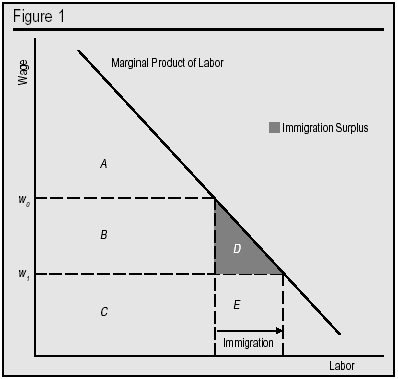
The consequences of immigration are easily illustrated. Immigrants shift the domestic supply of labor to the right by the amount of immigration. The new equilibrium is determined as before, but with respect to the new (larger) total labor supply. The immigration has several consequences. With land fixed and a larger total labor supply, the marginal product of labor—and so the wage—falls to w1. The immigration causes the total income in the United States to rise by the area under the marginal product curve over the interval of immigration (the sum of areas D and E). Of this, only part (area E) is paid as wages to the immigrants themselves. The remainder (area D) accrues as an “immigration surplus” for U.S. natives.
Several points in the conventional approach need emphasis. The first is that the existence of an “immigration surplus” arises purely from theory, even before one has looked at the data. This emphasizes the importance of thinking carefully about the appropriateness of the underlying analytic framework. The second point is that, even subject to this caveat, the immigration surplus is economically small. This is particularly true when considered relative to the redistribution that immigration occasions from labor to other factors of production in the economy receiving immigration (area B). Finally (although we have not spelled out the details here), when the immigration arises due to differences in relative labor availability, the natives of both sending and receiving countries benefit in terms of aggregate income.
A New Approach to Immigration and Factor Flows. The starting point for our approach is to recognize that while wage gains are the proximate reason for immigration, the ultimate source for the high wages is the technological superiority of the United States. This suggests the value of using a Ricardian approach to studying immigration, since this traditional trade model features precisely the technological differences of interest. While our empirical applications will consider data based on capital flows, and immigration of both skilled and unskilled labor, it is easiest to grasp the basic idea by working with a model with a single factor of production that we can for now call “labor.”
We can develop a very simple statement of this in the case of the standard Ricardian textbook trade model. Consider a world of two countries, the United States and Foreign. Assume that there are two goods that can be produced, aircraft and textiles. For definiteness, assume that the United States has an absolute productivity advantage in both goods, although this advantage is relatively stronger in aircraft. The higher U.S. productivity in both goods will give it a higher wage even in autarky, before trade.
If the countries now open to free trade, the standard Ricardian model tells us that specialization will be according to comparative advantage, that is according to relative productivities. The United States will tend to specialize in and export aircraft while Foreign will tend to specialize in and export textiles. As is standard in this type of model, with sufficient specialization both Foreign and the United States enjoy gains from trade.
We can now move on to consider the consequences of immigration. Even with free trade, the United States continues to enjoy a higher real wage than Foreign, which derives from the superior U.S. technology. If we took this to an extreme and removed all barriers to migration, all Foreign workers would move to the United States, lured by the higher wage available there; Foreign would essentially cease to exist. However, with all labor now in the United States, the prices of goods would return to their level in autarky, prior to the opening of trade. That is, perfectly free migration entirely eliminates the gains from trade that U.S. natives had enjoyed. World income rose with the migration, but the natives of Foreign in this case received more than all of this rise, since the income of U.S. natives declined.
This has been a special case based on perfectly free migration. However, the story doesn’t differ in its essentials when only some of the Foreign natives can migrate. This can be looked at in two different ways. The entry of Foreign workers into the United States expands output of U.S. exports and contracts that of Foreign. This depresses the prices of U.S. exports while raising the price of its imports. This is bad for U.S. natives. Alternatively, one can think of part of the income that U.S. natives enjoy as being based on their monopoly of access to the superior technology. Immigration erodes this monopoly, leading to gains for immigrants and losses for U.S. natives.
In short, this model shows that when migration is driven by technological differences we need to revise—indeed reverse—our prior conclusions. In the conventional framework, immigration gives rise to small gains for U.S. natives. In the more realistic Ricardian framework, immigration gives rise to large losses for U.S. natives. The remainder of this essay will seek to establish the magnitude of those losses.
Quantifying Losses from Immigration
In this section, we have three tasks. The first is to discuss the reasonableness of our use of the Ricardian (technology difference) model for studying immigration. The second is to establish a baseline empirical estimate of the economic costs of immigration. Finally, we need to consider a variety of extensions or objections that might be raised regarding the analysis.
Reasonableness of the Analytic Framework. The framework for our analysis is the Ricardian model, a standard model for analysis of trade, yet one that is rarely applied to the question of immigration (and never previously in an empirical study). There are two features of the simplest Ricardian model that are distinctive, and so verifying that these features are reasonable approximations to reality will likewise suggest this is a reasonable framework for studying the consequences of immigration. The first distinctive feature is that in the complete model trade (and migration) is based on cross-country technological differences. The second distinctive feature is that the standard presentation of the model is based on the existence of a single productive factor.
That the United States is one of the highest productivity countries in the world is indisputable. This is confirmed directly in studies by Islam (1995, 2001) and Hall and Jones (1996). U.S. total factor productivity (TFP) is frequently two, five, even 20 times that of many developing countries that are important sources of U.S. immigration. And there is no question that this high TFP also translates into high wages for workers in the United States—hence as a key motive for immigration. This point has been addressed more directly by Hendricks (2002). He notes that if the cross-country wage differences were a result of quality differences then, even after immigration, there should be large wage gaps between immigrants and natives of a magnitude not observed. He concludes that productivity (TFP) differences are very important for the wage gains enjoyed by immigrants to the United States. In short, the data strongly confirm the Ricardian model’s assumption that productivity differences are an important reason for immigration.
The high TFP of the United States should make location here attractive for all mobile factors of production. Labor should want to come for the high wages. Capital should seek to enter for the high returns. Our simple model above presumes that there is only a single productive factor (we loosely termed “labor”) rather than the multiple factors of the real world. This need not be an unreasonable simplification, as a first pass at analysis, if the factors entered the United States in similar proportions (hence as if a composite factor). As it turns out, this is very close to the reality. In 2002, our calculations show that 14.3 percent of the U.S. labor force and 16.5 percent of the U.S. capital stock were due to immigration and net capital inflows respectively.4 These are surprisingly close and confirm again the reasonableness of our employment of the Ricardian model for analyzing immigration.
Magnitude of the Losses. A first calculation of the economic costs of the inflow of factors (immigration and capital flows taken together) for U.S. natives is very simple in this framework. We need to calculate how this changes the relative supplies of the United States (expanding) and the rest of the world (contracting) goods in the world and then to see how these changes in relative supplies translate into deterioration in the U.S. terms of trade. In this first approach, the calculation of the impact on outputs is very simple given that both labor and capital in the United States expanded by around 15 percent. For the impact on the terms of trade, we rely on a study by Acemoglu and Ventura (2002), which studies precisely this question of how a rise in output (for whatever reason) translates into deterioration in terms of trade. Our calculations show these costs of factor inflows were $136 billion in 2002, or approximately 1.3 percent of GDP. This is very large in absolute terms and huge compared to the previous calculations of what were thought to be gains from immigration.
We also consider the robustness of this calculation. Although we do not have space to discuss the detailed methodology here, in order to obtain the estimates discussed above, we disaggregate labor into skill types and allow for the possibility that actual inflows may expand import competing sectors, and as a consequence improve U.S. terms of trade. However, our calculations show that the skill structure of immigrants tends to worsen the terms of trade even more than one might expect given the aggregate inflow. We conclude that our analysis is robust to such questions. Secondly, our analysis is driven by both the inflows of capital and labor. We therefore repeat our analysis assuming that U.S. investment is unaffected by foreign capital flows. This produces a loss to natives from immigration alone of $68 billion or 0.6 percent of GDP.
Extensions, Objections. It is possible and useful to raise additional questions about the analysis. On the analytic side one could ask, for example, whether it matters that many immigrants are employed in non-traded sectors. The answer is “no.” We have understood for a long while that high productivity in traded goods can give rise to price and wage differences in non-traded sectors (the so-called Balassa-Samuelson effect). It is straightforward to write down models in which the essential features of our approach are preserved and in which substantial employment of immigrants in non-traded sectors arises. Similar adjustments could be made that would allow for differences in factor quality between natives and immigrants, yet which would preserve the substantive conclusions of the study.
Conclusions
The conventional approach to studying the economic consequences of immigration suggests that immigration is like trade—there are benefits for natives of both countries. We have amended this framework to take account of the idea that in the modern world, the wage differences that are the proximate cause of immigration are ultimately the consequence of cross-country productivity differentials. In this new, more realistic framework, the conclusions of the analysis are quite different. Just as in the conventional analysis, cross-country flows of factors raise world income. However, not everyone shares in this rise in world income. Indeed, natives of the country receiving the factor inflows lose in real terms. We have calculated the cost of this to U.S. natives in 2002 as $136 billion, or 1.3 percent of U.S. GDP.
There may be economic consequences of factor inflows to the United States beyond those considered in this study. The challenge to economists is to quantify these other influences and to see whether they may offset the direct costs we have calculated. Further research is clearly desirable. At the same time, it is important to be clear that even a conclusion that there are economic costs to U.S. natives need not imply that immigration is bad. That should be reckoned on a wider range of questions, including the large benefits to the immigrants themselves, other measurable economic benefits that may arise from their presence, and any non-economic benefits that come from a society enriched by immigrants.
References
Acemoglu, Daron; Ventura, Jaume. “The World Income Distribution,” Quarterly Journal of Economics, May 2002.
Alvarez, Fernando and Urban Jermann. 2000. “Using Asset Prices to Measure the Cost of Business Cycles,” University of Chicago, mimeo.
Baily, Martin Neil; Hulten, Charles; Campbell, David. 1992. “Productivity Dynamics in Manufacturing Plants,” Brookings Papers on Economic Activity, Microeconomics, pp. 187-249.
Basu, Susanto; Fernald, John G. 1997. “Returns to Scale in U.S. Production: Estimates and Implications,” Journal of Political Economy, vol. 105, no. 2, pp. 249-83.
Bhagwati, Jagdish. 1958. “Immiserizing Growth: A Geometrical Note,” Review of Economic Studies 25, (June), pp. 201-205.
Bhagwati, Jagdish; Brecher, Richard A. 1981. “Foreign Ownership and the Theory of Trade and Welfare,” Journal of Political Economy, 89:3, pp. 497-511.
Borjas, George J. 2001. “Does Immigration Grease the Wheels of the Labor Market?” Brookings Papers on Economic Activity, 2001, pp. 69-119.
Borjas, George J. 1999. Heaven’s Door: Immigration Policy and the American Economy, Princeton: Princeton University Press.
Borjas, George J. 1995. “The Economic Benefits from Immigration,” Journal of Economic Perspectives, vol. 9, no. 2, Spring 1995, pp. 3-22.
Borjas, George J. 1995. “The Economic Analysis of Immigration,” in The New Economics of Human Behavior, edited by Mariano Tommasi and Kathryn Ierulli, Cambridge University Press, 1995, pp. 27-39.
Borjas, George J. 1994. “The Economics of Immigration,” Journal of Economic Literature, vol. 32, no. 4, December 1994, pp. 1667-1717.
Borjas, George J. 1999. “The Economic Analysis of Immigration,” in The Handbook of Labor Economics, Volume 3A, edited by Orley Ashenfelter and David Card, North-Holland, pp. 1697-1760.
Borjas, George J., Richard B. Freeman and Lawrence F. Katz. 1997. “How Much Do Immigration and Trade Affect Labor Market Outcomes? Brookings Papers on Economic Activity, pp. 1-67.
Borjas, George J. 1985. “Assimilation, Changes in Cohort Quality, and the Earnings of Immigrants,” Journal of Labor Economics, vol. 3, no. 4, October 1985, pp. 463-89.
Bowen, Harry P., Leamer, Edward E., Sveikauskas, Leo. 1987. “Multicountry, Multifactor Tests of the Factor Abundance Theory,” American Economic Review, vol. 77, no. 5, pp. 791-809.
Chiswick, Barry R. 1978. “The Effect of Americanization on the Earnings of Foreign-born Men,” Journal of Political Economy, vol. 86, no. 5, pp. 897-921
Davis, Donald R., Weinstein, David E. 2002. “Technological Superiority and the Losses From Migration,” National Bureau of Economic Research Working Paper #8971, June.
Davis, Donald R., Weinstein, David E. 2002. “What Role for Empirics in International Trade?” in Ronald Findlay, Lars Jonung, Mats Lundahl, eds., Bertil Ohlin: A Centennial Celebration, 1899-1999, Cambridge: MIT Press.
Deardorff, Alan V. and Stern, Robert. 1986. The Michigan Model of World Production and Trade: Theory and Applications, Cambridge: MIT Press.
Domowitz, Ian, Hubbard, R. Glenn, Petersen, Bruce C. 1988. “Market Structure and Cyclical Fluctuations in U.S. Manufacturing,” Review of Economics and Statistics, vol. 70, no. 1, pp. 55-66.
Dornbusch, Rudiger, Fischer, Stanley, Samuelson, Paul A. 1977. “Comparative Advantage, Trade, and Payments in a Ricardian Model with a Continuum of Goods,” American Economic Review, vol. 67, no. 5, pp. 823-39.
Feenstra. 1992. “How Costly is Protection?” Journal of Economic Perspectives, vol. 6, no. 32, pp. 159-178.
Findlay, Ronald. 1982. “International Distributive Justice: A Trade Theoretic Approach,” Journal of International Economics, vol. 13, no. 1-2, August 1982, pp. 1-14.
Friedberg, Rachel M., Hunt, Jennifer. 1995. “The Impact of Immigrants on Host Country Wages, Employment and Growth,” Journal of Economic Perspectives, vol. 9, no. 2, pp. 23-44.
Grossman, Gene M. 1984. “The Gains from International Factor Movements,” Journal of International Economics, vol. 17, no. 1-2, pp. 73-83.
Hall, Robert E. 1990. “Invariance Properties of Solow’s Productivity Residual,” in Diamond, Peter ed. Growth/Productivity/Unemployment: Essays to Celebrate Bob Solow’s Birthday, Cambridge: The MIT Press.
Hall, Robert E. and Charles I. Jones. 1996. “The Productivity of Nations,” NBER Working Paper #5812.
Hamilton, Bob, and Whalley, John. 1984. “Efficiency and Distributional Implications of Global Restrictions on Labour Mobility: Calculations and Policy Implications,” Journal of Development Economics, vol. 14, no. 1-2, January-February 1984, pp. 61-75.
Harrigan, James, “Technology, Factor Supplies, and International Specialization: Estimating the Neoclassical Model,” American Economic Review, vol. 87, no. 4, September 1997, pp. 475-94.
Hendricks, Lutz. 2002. “How Important is Human Capital for Development? Evidence From Immigrant Earnings,” American Economic Review, vol. 92, no. 1, March 2002, pp. 198-219.
Immigration and Naturalization Service. 2002. Statistical Yearbook of the Immigration and Naturalization Service, 1999, Washington D.C.: US Government Printing Office.
International Monetary Fund. 2000. International Financial Statistics (CD ROM), Washington: Publishing Services International Monetary Fund.
Islam, Nazrul. 1995. “Growth Empirics: A Panel Data Approach,” Quarterly Journal of Economics 110, pp. 1127-70.
Islam, Nazrul. 2001. “Different Approaches to International Comparison of Total Factor Productivity,” in Hulten, Charles R., Edwin R. Dean, and Michael J. Harper, eds. New Developments in Productivity Analysis, Chicago: University of Chicago Press, pp. 465-508.
Jorgenson, Dale W., and Masahiro Kuroda. 1990. “Bilateral Models of Production for Japanese and US Industries,” in Hulten, Charles ed. Productivity Growth in Japan and the United States, Chicago: University of Chicago Press.
Lalonde, Robert J., Topel, Robert H. 1997. “Economic Impact of International Migration and the Economic Performance of Migrants,” in Rosenzweig, Mark R; Stark, Oded, eds. Handbook of population and family economics. Volume 1B. 1997, pp. 799-850, New York: Elsevier Science, North-Holland.
Lucas, Robert E. 1987. Models of Business Cycles, New York: Basil Blackwell.
MacDougall, G.D.A. 1960. “The Benefits and Costs of Private Investment From Abroad,” Economic Record 36: 13-35.
Organization of Economic Cooperation and Development. 2001. Trends in International Migration, Paris: OECD Publication Service.
Razin, Assaf and Sadka, Efraim. 2001. Labor, Capital and Finance: International Flows, New York: Cambridge University Press.
Trefler, Daniel. 1997. “Natives and Immigrants in General Equilibrium,” NBER Working Papers #6209, October.
Wong, Kar-Yiu (1995) International Trade in Goods and Factor Mobility, Cambridge, MA: MIT Press.
World Bank (1999) The World Development Report 1999, Oxford: Oxford University Press.
Endnotes
1 See, for example, the seminal study of Borjas (1995).
2 Davis and Weinstein (2002).
3 We wish to thank Steve Camarota for providing us with the immigrant share data.
4 See Davis and Weinstein (2002) for details on the calculations.
Donald R. Davis and David E. Weinstein are both professors of economics at Columbia University and Research Associates at the National Bureau of Economic Research (NBER). Both authors are recognized as among the nation’s leading experts in international economics. This paper updates a June 2002 National Bureau of Economic Research (NBER) working paper entitled “Technological Superiority and the Losses from Migration.” NBER is one of the nation’s leading economic research institutions. For those wishing a much more detailed and technical explanation than the one presented here please see the NBER paper at: http://www.columbia.edu/~drd28/Migration.pdf