
Related Publications: Video, Transcript, Articles
Download this Backgrounder as a pdf
Table of Contents
Executive Summary
A Complex Fiscal Picture
Policy Implications
Summary Methodology
Introduction
Why Study the Fiscal Impact of Illegals?
Methodology
Data Source and General Principles
Estimated Tax Payments
Assigning Costs by Household
Adjustment for Under-Reporting in the CPS
Findings
Demographic Overview
Estimated Tax Payments
Costs by Household
Balance of Tax and Cost
The Fiscal Implications of Amnesty
Comparisons to Other Studies
About the Author
Steven A. Camarota is Director of Research at the Center for Immigration Studies in Washington, D.C. He holds a master's degree in political science from the University of Pennsylvania and a Ph.D. in public policy analysis from the University of Virginia. Dr. Camarota often testifies before Congress and has published widely on the political and economic effects of immigration on the United States. His articles on the impact of immigration have appeared in both academic publications and the popular press including Social Science Quarterly, The Washington Post, The Chicago Tribune, Campaigns and Elections, and The Public Interest. His most recent work published by the Center for Immigration Studies includes: Immigration in a Time of Recession: An Examination of Trends Since 2000; Where Immigrants Live: An Examination of State Residency of the Foreign-Born; Back Where We Started: An Examination of Trends in Immigrant Welfare Use Since Welfare Reform; and The Open Door: How Militant Islamic Terrorists Entered and Remained in the United States, 1993-2001.
Executive Summary

This study is one of the first to estimate the total impact of illegal immigration on the federal budget. Most previous studies have focused on the state and local level and have examined only costs or tax payments, but not both. Based on Census Bureau data, this study finds that, when all taxes paid (direct and indirect) and all costs are considered, illegal households created a net fiscal deficit at the federal level of more than $10 billion in 2002. We also estimate that, if there was an amnesty for illegal aliens, the net fiscal deficit would grow to nearly $29 billion.
Among the findings:
- Households headed by illegal aliens imposed more than $26.3 billion in costs on the federal government in 2002 and paid only $16 billion in taxes, creating a net fiscal deficit of almost $10.4 billion, or $2,700 per illegal household.
- Among the largest costs are Medicaid ($2.5 billion); treatment for the uninsured ($2.2 billion); food assistance programs such as food stamps, WIC, and free school lunches ($1.9 billion); the federal prison and court systems ($1.6 billion); and federal aid to schools ($1.4 billion).
- With nearly two-thirds of illegal aliens lacking a high school degree, the primary reason they create a fiscal deficit is their low education levels and resulting low incomes and tax payments, not their legal status or heavy use of most social services.
- On average, the costs that illegal households impose on federal coffers are less than half that of other households, but their tax payments are only one-fourth that of other households.
- Many of the costs associated with illegals are due to their American-born children, who are awarded U.S. citizenship at birth. Thus, greater efforts at barring illegals from federal programs will not reduce costs because their citizen children can continue to access them.
- If illegal aliens were given amnesty and began to pay taxes and use services like households headed by legal immigrants with the same education levels, the estimated annual net fiscal deficit would increase from $2,700 per household to nearly $7,700, for a total net cost of $29 billion.
- Costs increase dramatically because unskilled immigrants with legal status -- what most illegal aliens would become -- can access government programs, but still tend to make very modest tax payments.
- Although legalization would increase average tax payments by 77 percent, average costs would rise by 118 percent.
- The fact that legal immigrants with few years of schooling are a large fiscal drain does not mean that legal immigrants overall are a net drain -- many legal immigrants are highly skilled.
- The vast majority of illegals hold jobs. Thus the fiscal deficit they create for the federal government is not the result of an unwillingness to work.
- The results of this study are consistent with a 1997 study by the National Research Council, which also found that immigrants' education level is a key determinant of their fiscal impact.
A Complex Fiscal Picture
Welfare use. Our findings show that many of the preconceived notions about the fiscal impact of illegal households turn out to be inaccurate. In terms of welfare use, receipt of cash assistance programs tends to be very low, while Medicaid use, though significant, is still less than for other households. Only use of food assistance programs is significantly higher than that of the rest of the population. Also, contrary to the perceptions that illegal aliens don't pay payroll taxes, we estimate that more than half of illegals work "on the books." On average, illegal households pay more than $4,200 a year in all forms of federal taxes. Unfortunately, they impose costs of $6,950 per household.
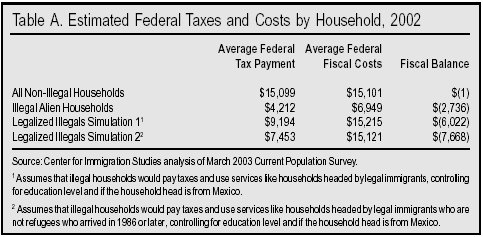
Social Security and Medicare. Although we find that the net effect of illegal households is negative at the federal level, the same is not true for Social Security and Medicare. We estimate that illegal households create a combined net benefit for these two programs in excess of $7 billion a year, accounting for about 4 percent of the total annual surplus in these two programs. However, they create a net deficit of $17.4 billion in the rest of the budget, for a total net loss of $10.4 billion. Nonetheless, their impact on Social Security and Medicare is unambiguously positive. Of course, if the Social Security totalization agreement with Mexico signed in June goes into effect, allowing illegals to collect Social Security, these calculations would change.
The Impact of Amnesty. Finally, our estimates show that amnesty would significantly increase tax revenue. Because both their income and tax compliance would rise, we estimate that under the most likely scenario the average illegal alien household would pay 77 percent ($3,200) more a year in federal taxes once legalized. While not enough to offset the 118 percent ($8,200) per household increase in costs that would come with legalization, amnesty would significantly increase both the average income and tax payments of illegal aliens.
What's Different About Today's Immigration. Many native-born Americans observe that their ancestors came to America and did not place great demands on government services. Perhaps this is true, but the size and scope of government were dramatically smaller during the last great wave of immigration. Not just means-tested programs, but expenditures on everything from public schools to roads were only a fraction of what they are today. Thus, the arrival of unskilled immigrants in the past did not have the negative fiscal implications that it does today. Moreover, the American economy has changed profoundly since the last great wave of immigration, with education now the key determinant of economic success. The costs that unskilled immigrants impose simply reflect the nature of the modern American economy and welfare state. It is doubtful that the fiscal costs can be avoided if our immigration policies remain unchanged.
Policy Implications
The negative impact on the federal budget need not be the only or even the primary consideration when deciding what to do about illegal immigration. But assuming that the fiscal status quo is unacceptable, there are three main changes in policy that might reduce or eliminate the fiscal costs of illegal immigration. One set of options is to allow illegal aliens to remain in the country, but attempt to reduce the costs they impose. A second set of options would be to grant them legal status as a way of increasing the taxes they pay. A third option would be to enforce the law and reduce the size of the illegal population and with it the costs of illegal immigration.
Reducing the Cost Side of the Equation. Reducing the costs illegals impose would probably be the most difficult of the three options because illegal households already impose only about 46 percent as much in costs on the federal government as other households. Thus, the amount of money that can be saved by curtailing their use of public services even further is probably quite limited. Moreover, the fact that benefits are often received on behalf of their U.S.-citizen children means that it is very difficult to prevent illegal households from accessing the programs they do. And many of the programs illegals use most extensively are likely to be politically very difficult to cut, such as the Women Infants and Children (WIC) nutrition program. Other costs, such as incarcerating illegals who have been convicted of crimes are unavoidable. It seems almost certain that if illegals are allowed to remain in the country, the fiscal deficit will persist.
Increasing Tax Revenue by Granting Amnesty. As discussed above, our research shows that granting illegal aliens amnesty would dramatically increase tax revenue. Unfortunately, we find that costs would increase even more. Costs would rise dramatically because illegals would be able to access many programs that are currently off limits to them. Moreover, even if legalized illegal aliens continued to be barred from using some means-tested programs, they would still be much more likely to sign their U.S.-citizen children up for them because they would lose whatever fear they had of the government. We know this because immigrants with legal status, who have the same education levels and resulting low incomes as illegal aliens, sign their U.S.-citizen children up for programs like Medicaid at higher rates than illegal aliens with U.S.-citizen children. In addition, direct costs for programs like the Earned Income Tax Credit would also grow dramatically with legalization. Right now, illegals need a Social Security number and have to file a tax return to get the credit. As a result, relatively few actually get it. We estimate that once legalized, payments to illegals under this program would grow more than ten-fold.
From a purely fiscal point of view, the main problem with legalization is that illegals would, for the most part, become unskilled legal immigrants. And unskilled legal immigrants create much larger fiscal costs than unskilled illegal aliens. Legalization will not change the low education levels of illegal aliens or the fact that the American labor market offers very limited opportunities to such workers, whatever their legal status. Nor will it change the basic fact that the United States, like all industrialized democracies, has a well-developed welfare state that provides assistance to low-income workers. Large fiscal costs are simply an unavoidable outcome of unskilled immigration given the economic and fiscal realities of America today.
Enforcing Immigration Laws. If we are serious about avoiding the fiscal costs of illegal immigration, the only real option is to enforce the law and reduce the number of illegal aliens in the country. First, this would entail much greater efforts to police the nation's land and sea borders. At present, less than 2,000 agents are on duty at any one time on the Mexican and Canadian borders. Second, much greater effort must be made to ensure that those allowed into the country on a temporary basis, such as tourists and guest workers, are not likely to stay in the country permanently. Third, the centerpiece of any enforcement effort would be to enforce the ban on hiring illegal aliens. At present, the law is completely unenforced. Enforcement would require using existing databases to ensure that all new hires are authorized to work in the United States and levying heavy fines on businesses that knowingly employ illegal aliens. Finally, a clear message from policymakers, especially senior members of the administration, that enforcement of the law is valued and vitally important to the nation, would dramatically increase the extremely low morale of those who enforce immigration laws.
Policing the border, enforcing the ban on hiring illegal aliens, denying temporary visas to those likely to remain permanently, and all the other things necessary to reduce illegal immigration will take time and cost money. However, since the cost of illegal immigration to the federal government alone is estimated at over $10 billion a year, significant resources could be devoted to enforcement efforts and still leave taxpayers with significant net savings. Enforcement not only has the advantage of reducing the costs of illegal immigration, it also is very popular with the general public. Nonetheless, policymakers can expect strong opposition from special interest groups, especially ethnic advocacy groups and those elements of the business community that do not want to invest in labor-saving devices and techniques or pay better salaries, but instead want access to large numbers of cheap, unskilled workers. If we choose to continue to not enforce the law or to grant illegals amnesty, both the public and policymakers have to understand that there will be significant long-term costs for taxpayers.
Summary Methodology
Overall Approach. To estimate the impact of households headed by illegal aliens, we rely heavily on the National Research Council's (NRC) 1997 study, "The New Americans." Like that study, we use the March Current Population Survey (CPS) and the decennial Census, both collected by the Census Bureau. We use the March 2003 CPS, which asks questions about income, household structure, and use of public services in the calendar year prior to the survey. We control total federal expenditures and tax receipts by category to reflect actual expenditures and tax payments. Like the NRC, we assume that immigrants have no impact on defense-related expenditures and therefore assign those costs only to native-headed households. Like the NRC, we define a household as persons living together who are related. Individuals living alone or with persons to whom they are unrelated are treated as their own households. As the NRC study points out, a "household is the primary unit through which public services are consumed and taxes paid." Following the NRC's example of using households, many of which include U.S.-citizen children, as the unit of analysis makes sense because the presence of these children and the costs they create are a direct result of their parents having been allowed to enter and remain in country. Thus, counting services used by these children allows for a full accounting of the costs of illegal immigration.
Identifying Illegal Aliens in Census Bureau Data. While the CPS does not ask respondents if they are illegal aliens, the Urban Institute, the former Immigration and Naturalization Service (INS), and the Census Bureau have used socio-demographic characteristics in the data to estimate the size and characteristics of the illegal population. To identify illegal aliens in the survey, we used citizenship status, year of arrival in the United States, age, country of birth, educational attainment, sex, receipt of welfare programs, receipt of Social Security, veteran status, and marital status. This method is based on some very well-established facts about the characteristics of the illegal population. In some cases, we assume that individuals have zero chance of being an illegal alien, such as naturalized citizens, veterans, and individuals who report that they personally receive Social Security benefits or cash assistance from a welfare program or those who are enrolled in Medicaid. However, other members of a household, mainly the U.S.-born children of illegal aliens, can and do receive these programs. We estimate that there were 8.7 million illegal aliens included in the March 2003 CPS. By design, our estimates for the size and characteristics of the illegal population are very similar to those prepared by the Census Bureau, the INS, and the Urban Institute.
Estimating the Impact of Amnesty. We assume that any amnesty that passes Congress will have Lawful Permanent Residence (LPR) as a component. Even though the President's amnesty proposal in January seems to envision "temporary" worker status, every major legalization bill in Congress, including those sponsored by Republican legislators, provides illegal aliens with LPR status at some point in the process. Moreover, Democratic presidential nominee John Kerry has indicated his strong desire to give LPR status to illegal aliens.
To estimate the likely impact of legalization, we run two different simulations. In our first simulation, we assume that legalized illegal aliens would use services and pay taxes like all households headed by legal immigrants with the same characteristics. In this simulation, we control for the education level of the household head and whether the head is from Mexico. The first simulation shows that the net fiscal deficit grows from about $2,700 to more than $6,000 per household. In the second simulation, we again control for education and whether the household head is Mexican and also assume that illegals would become like post-1986 legal immigrants, excluding refugees. Because illegals are much more like recently arrived non-refugees than legal immigrants in general, the second simulation is the more plausible. The second simulation shows that the net fiscal deficit per household would climb to $7,700.
Results Similar to Other Studies. Our overall conclusion that education level is the primary determinant of tax payments made and services used is very similar to the conclusion of the 1997 National Research Council report, "The New Americans." The results of our study also closely match the findings of a 1998 Urban Institute study, which examined tax payments by illegal aliens in New York State. In order to test our results we ran separate estimates for federal taxes and found that, when adjusted for inflation, our estimated federal taxes are almost identical to those of the Urban Institute. The results of this study are also buttressed by an analysis of illegal alien tax returns done by the Inspector General's Office of the Department of Treasury in 2004, which found that about half of illegals had no federal income tax liability, very similar to our finding of 45 percent.
Introduction
As illegal immigration has increased dramatically over the last two decades, so has concern about its impact on American taxpayers. While other consequences are clearly important, the fiscal impact of illegal immigration is at the center of the ongoing debate. Surprisingly, few studies have attempted to measure the total fiscal effect of illegal immigration on the United States. Several studies have focused on all immigrants, making no distinction by legal status, and other researchers have examined either the costs imposed by illegals or the tax payments they make, but not both together. Most of this work has focused on the state and local level, giving little or no attention to the federal government. Focusing on the federal government, this study attempts to answer two related questions: First, what effect do illegal aliens have on the fiscal balance (all taxes paid minus all services used)? Second, what would happen to the fiscal balance if illegal aliens were legalized?
Why Study the Fiscal Impact of Illegals?
Concern over illegal immigration ranges from national security and the rule of law to the risk would-be illegals take to enter the country and their well-being once here. But the fiscal effects are a key part of the issue. In fact, much of the public's anger over illegal immigration stems from the belief that illegals are a drain on taxpayers. Past policy responses to illegal aliens, such as barring them from welfare programs, were also driven by the desire to minimize fiscal costs. Thus, determining the actual fiscal impact of illegal immigration is critically important to formulating a policy response to illegal immigration.
The Fiscal Equation. Simply by living in the United States, illegals unavoidably impose some costs on government. Like all people, illegal aliens enroll their children in public schools, drive on the roads, and engage in a host of other activities that necessarily cost government money. They also unavoidably pay taxes. Even when they are paid "off the books," they still pay excise and other types of taxes to the government. So the fact that illegal aliens cost public coffers money does not necessarily mean they are a net drain. Conversely, the fact that illegals pay taxes does not necessarily mean that they are a fiscal benefit. At least with regard to fiscal considerations, the key question is the balance between the taxes they pay and the services they use. This study attempts to estimate both their tax payments and costs in order to determine their net fiscal impact at the federal level.
Importance of Current Fiscal Impact. Almost all observers agree that illegal immigration is a problem. The fiscal impact of illegal immigration has enormous bearings on the question of what to do about illegal immigration. While employers may want access to immigrant labor, the fiscal costs to taxpayers must be considered. Understandably, employers can be counted on to ignore these costs because they are diffuse, borne by all taxpayers, while the benefit to businesses is obvious. Policy makers, however, must be sensitive to fiscal considerations. If there are net costs, then this could have a significant impact on the availability of public services or the tax burden on Americans. If the costs are very large, then the problem is certainly more urgent. And devoting significant resources to reducing illegal immigration may be justified because doing so would leave taxpayers with a significant net savings. On the other hand, if illegals impose little or no costs on taxpayers, this too should play some role in shaping policy.
Legalizing Illegals. Many politicians have indicated their strong desire to give illegal aliens legal status, but the fiscal implications of amnesty are almost never addressed. Since legalization should significantly change both the amount of taxes illegals pay and the level of services they use, it is absolutely essential to determine how amnesty might change the fiscal balance. If an amnesty would increase the net fiscal costs, then policymakers may want to consider other solutions. If amnesty creates a net fiscal benefit, then legalization might make sense. While factors other than the impact on federal coffers have to be taken into account, by estimating both the current fiscal impact of illegal immigration and the impact of amnesty, this report should provide at least part of an answer to the questions surrounding illegal immigration. Of course, it must be noted that this report does not address the fiscal impact at the state and local level and any complete accounting should examine those areas as well.
Methodology
Probably the most important study on the fiscal effects of immigration was conducted by the National Research Council (NRC) in 1997.1 Our analysis relies heavily on the approach used in the NRC study as the basis for estimating the fiscal impact of immigration. The NRC actually reported two different estimates for the fiscal impact of immigration, a household-level analysis of the current fiscal impact and an intergenerational analysis looking at immigrants and their descendents over a 300-year period. Our analysis primarily follows the example of the NRC's household level analysis because we are interested in estimating the current fiscal impact of illegals on the federal budget. However, we also report separate estimates for immigrants by education level as was done in the NRC's intergenerational analysis.
Another important study was conducted in 1998 by the Urban Institute. That study only estimated tax payments in New York State, including some federal taxes. But unlike the NRC study, the Urban Institute New York study estimated tax payments for legal and illegal immigrants separately, though it did not consider service use. This is one of the only studies today that has examined tax payments by illegal aliens, and so we rely on some of that study's approach as well.2 Other important studies that have examined the fiscal impact of immigration include a 2001 study of Florida, a 1997 study of New Jersey (which was included in the NRC study), and one in 1994 by the Center for Immigration Studies.3
Almost all fiscal studies of immigration attempt to measure the taxes paid by immigrant households and the services they use. This study follows the same approach. We also make the same implicit assumption of almost all fiscal studies, including the NRC's: that if immigrants create a fiscal deficit, then taxes simply rise to cover the added expenses while services remain the same rather than taxes staying the same and services being reduced. Whether natives have to pay more to retain the same level of services or receive less in services for the same price, the outcome is still bad for them. Conversely, if illegal immigrants pay more in taxes than they use in services then this would be a clear benefit for natives because they could receive the same level of services but pay less in taxes.
Data Source and General Principles
Data Source. This report relies on the March 2003 Current Population Survey (CPS) collected by the U.S. Census Bureau. The March data, also called the Annual Social and Economic Supplement, includes an extra-large sample of minorities and is considered one of the best sources of information on the foreign-born.4 The foreign-born are defined as persons living in the United States who were not U.S. citizens at birth.5 For the purposes of this report, foreign-born and immigrant are used synonymously. The Survey includes most legal immigrants and is thought to capture roughly 90 percent of the illegal alien population. We use the term illegal alien or illegal immigrant to mean those who responded to the survey who are in the United States without authorization. All other foreign-born persons are referred to as legal immigrants, including those with Permanent Residence, those who are naturalized American citizens, and those living in the United States on long-term temporary visas, mainly guest workers and foreign students.
The CPS asks respondents about their income and program use in the calendar year prior to the Survey, so all fiscal estimates in the study are for 2002.6 Almost all past research on the fiscal impact of immigrants has relied on CPS or Decennial Census data, including the NRC and the Urban Institute studies. Information about actual taxes collected by the federal government by source comes from the Office of Management and Budget.7 Information on actual federal expenditures on means-tested programs comes from the Congressional Research Service.8 Information on other expenditures comes from a variety of government publications.9
Identifying Illegal Aliens. The CPS does not ask the foreign-born if they are legal residents of the United States. However, the Urban Institute, the former INS, and the Census Bureau have used socio-demographic characteristics in the data to estimate the size of the illegal population. To determine who are legal and illegal immigrants in the survey, this report uses citizenship status, year of arrival in the United States, age, country of birth, educational attainment, sex, receipt of welfare programs, receipt of Social Security, veteran status, and marital status. We use these variables to assign probabilities to each respondent. Those individuals who have a cumulative probability of one or higher are assumed to be illegal aliens. The probabilities are assigned so that both the total number of illegal aliens and the characteristics of the illegal population closely match other research in the field, particularly the estimates developed by the Urban Institute.
This method is based on some well-established facts about the characteristics of the illegal population. For example, it is well known that illegals are disproportionately male, unmarried, under age 40, have few years of schooling, etc. Thus, we assign probabilities to these and other factors in order to select the likely illegal population. In some cases we assume that there is no probability that an individual is an illegal alien. If an individual reports that he is U.S.-born or a naturalized citizen of the United States, then he is assumed not to be an illegal alien. Someone who reports that he is veteran or receives veteran benefits is also assumed not to be an illegal alien. Those individuals who report that they personally receive Social Security benefits, cash assistance under Temporary Assistance to Needy Families (TANF), Supplemental Security benefits (SSI), or who are enrolled in Medicaid are also assumed not to be illegal aliens. However, other members of a household headed by an illegal alien can receive these programs, mostly the U.S.-born children of illegals. It is worth noting that our findings show that only a tiny fraction of households headed by illegals receive cash welfare programs or Social Security benefits. However, a large share of children in illegal alien households use the school lunch program or are enrolled in Medicaid. Our methodology allows for such a possibility.
We estimate that there were 8.7 million illegal aliens in the March 2003 CPS. It must be remembered that this estimate only includes illegal aliens captured by the March CPS, not those missed by the survey.10 By design this estimate is very similar to those prepared by the Census Bureau, the former Immigration and Naturalization Service (INS), and the Urban Institute.11 Although it should be obvious that there is no definitive means of determining whether a respondent in the survey is an illegal alien, the findings in this study are consistent with previous research. For example, the Urban Institute estimated that in 2002 Mexicans accounted for 57 percent of the illegal population; our method finds 58 percent in 2003. Using 2003 data, we estimate that 88 percent of illegals arrived after 1990; the Urban Institute estimated 85 percent using 2002 data.12 Our results also produce estimates that are similar in other areas, such as age and workforce participation.
Unit of Analysis. We divide households between those headed by illegal aliens and all others. In reference to its fiscal estimates, the NRC states, "Since the household is the primary unit through which public services are consumed and taxes paid, it is the most appropriate unit as a general rule and is recommended for static analysis."13 Because our study is also focused on "static analysis," or current fiscal effects of illegal aliens, we also examine taxes paid and services used by households based on the nativity and legal status of the household head. Like the NRC study, we define households as all persons living together who are related. Persons living with individuals to whom they are unrelated or who live alone are considered their own household. This definition could also be referred to as a "family," but following the NRC's example, we call it a household.
In their study of New Jersey, Deborah Garvey and Thomas Espenshade also used households as the unit of analysis because "households come closer to approximating a functioning socioeconomic unit of mutual exchange and support."14 Another reason for using households is that Census Bureau surveys are collected by household, making households the most appropriate use of the survey. Even so, it must be remembered that grouping by household, even the modified definition of household used in the NRC study and this report, means that many children born in the United States to illegal aliens are included in illegal alien-headed households even though these children are U.S. citizens by virtue of being born here. This seems perfectly reasonable since the presence of these children in the United States is a direct result of their parents having been allowed to enter and remain in the United States. Thus, counting services used by these children allows for a full accounting of the costs of illegal immigration.
Marginal vs. Average Costs. Like the NRC, we assume that average costs equal marginal costs. That is, an additional person or household using a program or service costs the same as those already using the service. This, of course, is not always the case. For example, the addition of a few new students to a half empty school costs relatively little because the school is already built and so no additional funding is needed for school construction. In such a situation the marginal costs of the new students are much less than average costs for the students already in the school. On the other hand, an additional group of students added to an already overcrowded school may require a whole new school to be built, thus making the marginal costs of the additional students much greater than the average cost. The NRC and others assume that marginal and average costs are equal and that these two tendencies should balance each other out over time.
Private vs. Public Goods. Some goods provided by government are pure public goods; that is, everyone living in the country benefits from receiving them. At the same time, the cost of providing them does not rise as the number of people living in the country increases. The most important example of this type of program is national defense. Like the NRC study, we assume that defense is a pure public good at the federal level, therefore no costs for providing defense are assigned to immigrant households. We further assume that, with the exception of means-tested programs for veterans, which illegals cannot use, all non-means-tested veterans programs are also pure public good. This means that the nearly $388 billion spent on defense and veterans programs in 2002 is assigned only to native households.
Interest on the National Debt and Federal Deficits. Following the example of the NRC, we do not include interest payments on the national debt in our calculations of costs because it is impossible to determine what share of the debt was incurred due to illegals. Obviously, illegal aliens who just arrived in the country have not contributed at all to past deficits or to the cumulative total of those deficits -- the national debt. On the other hand, if immigrant households created a net fiscal burden in past years then they might account for a disproportionate share of the current national debt. Thus, like most previous studies, including the NRC, we do not count interest on the national debt as a cost for either immigrant or native households. This means that the study measures only the fiscal impact of illegal alien households on what the NRC calls the "primary" budget. The primary budget is comprised of all tax payments and all federal expenditures other than interest payments on the national debt.
Because debt interest payments ($170.95 billion) were slightly larger in size than the federal deficit ($157.80 billion) in 2002, the primary budget had a $13.15 billion surplus in 2002. However, we exclude from our analysis the $23.7 billion that the Federal Reserve earned from interest on federal reserve deposits, which come from investing in U.S. government securities. These monies are in effect the federal government paying itself and, although these monies are officially considered revenue, we do not count them as such in this report because we do not include the interest the federal government pays on the national debt as an expense. As a consequence, there was a $10.5 billion deficit ($85 per household) in the primary budget when interest earned on federal reserve deposits is excluded.
Economic Impact of Illegal Aliens. Like most studies of this kind, including the NRC's, ours does not consider how illegal immigration or immigration more generally might affect public coffers indirectly by its impact on the economy. There simply is no consensus on the economic impact of immigration. To the extent that the issue has been studied, the impact on the nation's economy is generally thought to be trivial relative to the size of the economy. In addition to its fiscal estimates, the National Research Council estimated that immigration created a net economic benefit to natives of between $1 billion to $10 billion in the mid-1990s, or an amount equal to one or two-tenths of 1 percent of the nation's economy at that time. And these figures are for all immigrants, not specially for the one-fourth of the foreign-born who are illegal aliens. Moreover, the same study found that immigration reduced the wages of native-born workers who lack a high school education by about 5 percent. Not only would this reduction lower the tax payments of unskilled natives, but it would almost certainly result in higher use of means-tested programs by these workers, who roughly correspond to the poorest 10 percent of the workforce. Thus it is not clear that the economic impact of illegal immigration would have even a tiny net positive effect on the public coffers. A more recent study from the National Bureau of Economic Research suggests that immigration, legal and illegal, has a decidedly negative impact on the income of all Americans.15 If that study is correct and there is a net loss for native-born Americans, then the tax payments of immigrants are much lower, while their use of services is higher as result of their lower incomes. Because the actual economic impact is probably modest relative to the overall size of the U.S. economy and there is little agreement on whether the effect is positive or negative, we follow the example of almost all other studies and focus on the direct taxes and services illegals pay and use.
Estimated Tax Payments
All studies of this kind involve estimating payroll and other taxes paid by households based on their characteristics: primarily income, number of dependents, and home ownership. In this study, all taxes collected by the federal government are assigned to households. There is general agreement that excise taxes and payroll taxes, including those paid by employers such as unemployment, are ultimately borne by households. However, there is some debate about who actually pays coporate income tax--consumers or owners of capital. In this study we follow the example of the Office of Management and Budget and assume that owners of capital pay corporate income tax. All tax payments are adjusted to reflect actual total taxes collected by the federal government from each source for the year.16 We assign all taxes to U.S. residents and ignore the small share of persons living outside of the United States who pay federal taxes.
Payroll Taxes. There are four main payroll taxes collected by the federal government: income, Social Security, Medicare, and Unemployment Compensation. The Current Population Survey contains income tax and Social Security tax liabilities calculated by the Census Bureau for all tax-paying units in the Survey. In short, the Census Bureau uses data from the American Housing Survey, the Income Survey Development Program, and the Internal Revenue Service and combines this information with CPS data to create simulations of tax liabilities for all persons reporting income.17 We use the tax liability estimates from the Census Bureau to calculate federal income and Social Security tax liability for each household.18 We calculate both Medicare and Unemployment tax as a share of earning. Again, both the employee and employer share are assigned to households because previous research indicates that even the employer share of payroll taxes is ultimately borne by workers.
Corporate Income Tax. There is some debate about who actually pays corporate income taxes--owners of capital or consumers. The Office of Management and Budget in its estimates of the tax burden on American households distributes corporate income taxes based on each household's share of capital income, and we do the same in this study. We calculate corporate income tax as a share of interest and dividend income as reported in the CPS.
Excise and Estate Taxes. In addition to payroll taxes, the federal government collects taxes on a number of goods, mainly tobacco, alcohol, transportation fuels, and tires. We follow the NRC study's approach and allocate tobacco and alcohol taxes based on the number of people of drinking and smoking age in each household. Excise taxes, mainly the telephone tax and those collected for the highway and airport trust funds, are allocated as a share of household income. All tariffs collected on foreign goods are also assumed to be borne by consumers and are therefore allocated as a share of household income. Like the NRC study, we also allocated estate taxes to native households and to immigrant households that have been in the country for more than 20 years. Since the methodology we use to identify illegal aliens assumes that the vast majority of illegal aliens have been in the country for less than 20 years, the contributions of illegal aliens are very small.
Tax Compliance. While illegal aliens are assumed to pay their share of non-payroll taxes, payroll taxes collected by employers or income and other taxes paid by the self employed are a different matter. There is some research to indicate that only about half of illegal aliens are "paid on the books."19 That is, income and other taxes are withheld from their pay. In their study of New York State, Jeffrey Passel and Rebecca Clark assumed 60 percent compliance. In their study of New Jersey, Clark and Zimmermann assumed a 56 percent compliance rate.20 New York and New Jersey are somewhat unusual because a smaller fraction of each state's illegal population is employed in agriculture than is true nationally, a sector where being paid off the books is very common. However, we follow the same basic approach and assume that 55 percent of illegal aliens are paid on the books. We implement this by reducing the Income Tax and Social Security, Medicare, and Unemployment Tax of illegal households to 55 percent of their estimated tax liability.
Assigning Costs by Household
The CPS asks respondents a host of questions about their use of means-tested and non-means-tested federal programs. Like the NRC study and virtually all other studies on this topic, we use these results to estimate immigrant and native use of federal programs. Because the CPS began asking many more questions about use of public services in 2001, we are able to make specific estimates for a larger number of programs than was possible at the time of the NRC study, which relied on the 1995 CPS and 1990 Census. It should be remembered that the March 2003 CPS, the data source used in this study, asks questions about use of federal programs in the calendar year prior to the Survey, therefore all estimates reported here are for 2002. In that year expenditures in the primary federal budget totaled $1.84 trillion.
Social Insurance. We use the results in the CPS to estimate household receipt of Social Security, Medicare, and Unemployment Compensation. We assume that illegals receive no federal disability because these payments primarily go to federal workers or coal miners with black lung. For Social Security, we use responses in the CPS on the amount received. The same is true of Unemployment Compensation. The Survey also asks about receipt of Medicare. (Contrary to the common perception, persons under age 65 can qualify for Medicare, mainly those with end-stage renal disease.) For Medicare, we assigned average costs of the program to those who indicated they received it. As already indicated, we assume that persons getting Social Security cannot be illegal aliens. However, in a few cases members of their family can use these programs. As a result, costs for these two programs for illegals are extremely low relative to the rest of the population, but not zero.
Food Stamps and Cash Assistance. The CPS asks respondents the size of the payment they receive from the following programs: Supplemental Security Income, Temporary Assistance to Needy Families (TANF), cash assistance for low-income veterans, food stamps, low-income energy assistance, and higher education assistance. We use the payments respondents report to directly estimate average cost by household. Because food stamp values are reported in the CPS using the standard definition of household, and because we use a modified definition of household, food stamp values received by households with multiple families are divided based on the size of the each family in the household.
Other Non-Cash Means-Tested Programs. The Survey also asks about receipt of the Women Infants and Children program (WIC) and Free School Lunch program21 and whether someone lives in public housing or receives a rent subsidy. For WIC, public housing, and rent subsidies we assigned average costs of each program to households receiving it. For Medicaid, the Census provides estimates by disability status for all beneficiaries in the CPS. Again, it should be remembered that only federal costs of the program are considered in this study. For social services provided by the TANF program, we assigned costs evenly to households based on receipt of TANF. For government subsidized daycare, which relatively few illegals use, we assign average costs for households that indicated in the CPS that they receive child care services. College students in non-illegal households are assumed to be getting Stafford student loans if the household income is less than $75,000 a year. For illegal households, student loans are assumed only if the college student himself is an American citizen. Thus, while there are a few college students from illegal alien households receiving student loans, the number is extremely small. Illegal alien households are assumed to impose no costs on programs designed only for refugees. The same is true for programs for low-income veterans because our methodology assumes that all persons who indicate they are veterans cannot be illegal aliens.
The Earned Income Tax Credit. Based on income and other family characteristics, the Census Bureau provides estimated payments for the Earned Income Tax Credit (EITC), which it includes in the public use files of the CPS. We assume that natives and legal immigrants receive their EITC payments, but for illegal aliens we assume that only the 55 percent who are paid "on the books" can receive the program. Furthermore, we assume that one-fourth of those who are paid on the books and who also qualify for the program actually get it. To implement this, we reduce the Census Bureau's estimated EITC payments by 86 percent for illegal alien households. It should be noted that, officially, a valid Social Security number is required to collect the EITC. However, a Treasury Department Inspector General for Tax Administration report found that a small number of illegals without valid Social Security numbers did receive the EITC.22 Using this approach we estimate that illegal households only account for 1.5 percent of the total costs of the EITC. However, if they received the payments they qualify for based on their income and number of dependents they would account for more than 10 percent of the program's total costs.23
The ACTC. In addition to the EITC, there is the Additional Child Tax Credit (ACTC), also called the refundable portion of the Child Tax Credit, which pays out a total of $5 billion a year to low-income workers with children. To estimate the cost of this program, we assign benefits to all native and legal immigrant households that have earnings over $10,000 and no federal income tax liability, based on the number of children under age 16 in the household. For illegals, we further assume that only 40 percent of those households that qualify based on our analysis of the CPS actually get the ACTC. This is much higher than for the EITC because illegals are explicitly allowed by law to get the credit. Thus they can receive the credit even if they do not have a stolen identity and Social Security number. If they don't have a valid SSN, they can still get the credit by obtaining an Individual Taxpayer Identification Number (ITIN) from the IRS, which is not difficult, and filing a return using the ITIN. The 2004 report by the Treasury Department Inspector General for Tax Administration mentioned above found that, in 2001, 203,000 tax forms filed by illegals got a cash payment from the Child Tax Credit using an ITIN. These illegals received a total payment of $161 million in that year--even if the SSNs on their W-2 forms were not valid.
This amount indicates that about 30 percent of illegals we identified in the CPS receive benefits from the program. We adjust this up to 40 percent because the Inspector General's report did not attempt to estimate receipt of the program by illegals who use stolen identities and Social Security numbers to file their returns; only use of the ITIN was considered. This adjustment has the effect of increasing the total cost of the program for illegals to $216 million in 2002.
Primary and Secondary Education. We allocate almost all of the federal funds for public education by household based on the number of school-age children in each household. The only exceptions are programs designed to assist schools that have a large number of children whose parents are migrants and those funds that specifically go to children with limited English. For programs designed specifically to improve the education of low-income children whose parents work in agriculture--mainly the Chapter I Migration Education Program -- we assign costs based on whether the household head works in agriculture and the number of school age children in the household. To allocate federal funds for children with limited English, we use the 2000 Census to calculate the share of school-age children who reported that they spoke English less than very well. The 2000 Census showed that 29.2 percent of school-age children in immigrant households (legal and illegal) spoke English less than very well, compared to 2 percent of those in native households. We assume the same percentages existed in 2002 and assigned costs accordingly.
Uninsured. Research by Jack Hadley and John Holahan indicates that federal expenditures for the uninsured totaled $21.03 billion in 2002.24 We exclude from this total the $3.98 billion estimated to have been spent by the Department of Veterans Affairs on those without health insurance. (Illegals cannot receive health care from the VA and veteran benefits of this kind are treated as a pure public good in this analysis, so they are assigned only to native households). This means that $17.05 billion was spent by the federal government on the uninsured, not counting treatment from the VA. We then allocate these costs to households based on the number of uninsured persons per household.
INS, Federal Prisons, and Courts. We assign the net costs of the Immigration and Naturalization Service (expenditures minus fees the service collected), by household based on the distribution of immigrants (legal or illegal) who indicated they arrived after 1980.25 It should be noted that not all of the net costs of the INS are attributable to immigrant-headed households because some post-1980 immigrants live in native households. We estimate that about 8 percent of post-1980 immigrants live in households headed by natives and as such, native households account for 8 percent of the net costs of the INS.26 We do not include costs for running the immigration functions of the Department of State because this system is paid for by fees. As for the the federal prison system, it keeps track of whether inmates are citizens of the United States or not. In 2002, nearly 29 percent, or 39,000 inmates in the federal prison system were non-citizens. Based on prior research, we estimated that 59 percent of this total are illegal aliens.27 This translates into 17 percent of the federal prison population and thus 17 percent of the $4.1 billion prison budget can be attributed to illegal alien households. For the cost of administering the federal court system, we again assume that 17 percent of the costs are attributable to illegal households. This estimate is probably too low because non-citizens in 2001, the last year for which data is available, accounted for 38 percent of those arrested by federal agencies and 34 percent of those actually convicted in federal courts.28 This is significantly higher than the 29 percent of the prison population they represent. Nonetheless, we assign only 17 percent of the $4.7 billion federal court system budget to illegals in order to make our estimates more conservative.29 As is the case for the federal prison system, when later in this report we estimate costs for households headed by legal immigrants we assume that 16 percent of the costs of the federal courts are due to households headed by legal immigrants (naturalized and unnaturalized).
All Other Expenditures. Using the results from the methodology described above, we are able to estimate almost $1.1 trillion in federal spending, or 58 percent of the primary budget. In addition to specific programs, we account for $388.1 billion, or another 21 percent of the primary 2002 federal budget, that went to spending on defense and non-means-tested veterans programs. As already noted, only native households are assigned costs for defense and veterans programs because they are assumed to be pure public goods and as such legal and illegal immigrants impose no costs on these programs. The remaining $386 billion, or 21 percent of the primary budget, is assigned to all households equally. This totals $3,115 per household. These expenditures include highway and infrastructure maintenance, parts of the criminal justice system not accounted for already, subsidies to business, state aid, and all other services provided by the federal government. This is the same approach used by the NRC and almost all studies of this kind. It should be noted that allocating costs equally to all households may tend to underestimate the costs of illegals because illegal households are 17 percent larger on average than other households. All other things being equal, more people per household should mean higher average expenses. But we ignore this and assign costs equally to all households.
Adjustment for Under-Reporting in the CPS
Under-Reporting of Program Use. It is well established that respondents tend to understate both their income and use of social services in the CPS. This problem is well known by the Census Bureau and has been studied for some time.30 To correct for this problem, we adjust all social programs to reflect actual federal expenditure. This is based on the assumption that immigrants and natives are equally likely to under-report their use of social services. The NRC study also seems to have controlled for this problem.31 Adjustments of this kind may tend to understate program use by immigrants because they may be more reluctant to report use of means-tested programs in a government survey than other members of society out of a fear that this might constitute grounds for deportation. But we ignore this problem and assume that under-reporting rates are the same for all persons. As mentioned earlier, controlling all costs to actual expenditures has the added advantage of allowing us to estimate the costs of illegals not counted in the CPS. In effect, those who are counted are assigned costs for those who are missed by the survey. The same is true for non-illegal aliens who are missed by the survey. This means our cost estimates are for all illegals, even those the survey misses.
Under-Reporting of Income and Taxes. For tax payments, we adjust upward the income tax estimates calculated by the Census Bureau to reflect actual tax receipts. However, following the example of the Urban Institute in its study of New York State, we do so only for households with incomes of over $200,000 a year. This adjustment is based on the assumption that it is high-income households who under-report their income. While the Urban Institute first adjusted income for those with high income and then recalculated taxes, by adjusting tax receipts our approach has the same effect. For Social Security, we adjust payments for all taxpayers, not just those with high incomes, because only the first $84,900 of earnings was subject to the tax in 2002. Thus, under-reporting by high income earners does not matter. As is the case with costs, controlling all tax payments to the actual tax totals received by the federal government allows us to estimate the tax payments of illegals not counted in the CPS. In effect, those who are counted are assigned costs for those who are missed by the survey. The same is true for non-illegal aliens who are missed by the survey. This means that our tax estimates for all illegal and non-illegal households reflect the total taxes these populations pay, even those not counted by survey.
Findings
Demographic Overview
Characteristics of Illegal Households. Table 1 reports demographic information for households headed by illegal immigrants and all other households. Not surprisingly, it shows that on average households headed by illegal aliens have much lower average incomes and are somewhat larger in size than the average household in America. The lower income reflects not simply their legal status, but more importantly the fact that such a large share of illegals have little formal education. An estimated two-thirds of illegals who are household heads lack a high school diploma. This is important because it means that even if the illegal aliens were legal residents, their income still would be dramatically lower than the rest of the population. There is no single better predictor of income in the modern American economy than one's education level. As a result, a large share of illegals are likely to remain poor even if given legal status. Table 1 also shows the share of households in which at least one person works. A much larger share of illegal households had at least one person working in 2002 than non-illegal households. Thus, any costs associated with illegal aliens do not reflect low rates of employment.
Illegal Household Use of Services. The lower portion of Table 1 shows the percentage of illegal households receiving Social Security and means-tested programs. There are very large differences in program usage between illegals and the rest of the population. Just as important, illegals' use of different types of programs vary enormously. Only a tiny fraction of illegal households use Social Security or cash welfare programs compared to other households. One source of public dissatisfaction with illegal immigration is that some Americans believe that many illegal aliens are getting cash welfare payments. Table 1 shows that this is not the case. However, the share using Medicaid and food assistance welfare programs is quite high and substantially more than the share of non-illegal households.
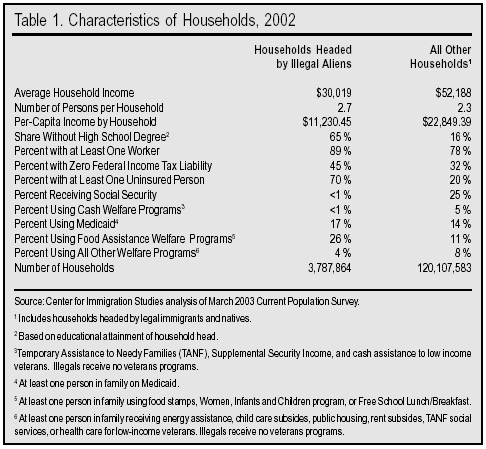
It must be remembered that, for the most part, illegal households using programs like free school lunch or Medicaid are receiving these benefits on behalf of U.S.-born children, who under current law are awarded citizenship at birth. Of course, the costs of providing services to these children are very real for taxpayers and result from illegals having been allowed to enter and stay in the country. And having the federal government feed or provide medical care to their children is an enormous benefit to illegal aliens. Thus, in considering the consequences for public coffers, counting the costs of these programs is necessary, otherwise one would gain a very false sense of illegal immigration's present costs. Nonetheless, the fact that it is the U.S.-born children receiving the benefits is still important, because it means that barring illegals from using programs would not significantly reduce costs. Their citizen children would continue to receive them. On the other hand, if the illegal families were made to return home, the costs would be eliminated.
Estimated Tax Payments
Payroll Taxes. Table 2 shows a breakdown of the estimated tax payments and services used by illegal alien-headed households. (More details about illegals' payment of specific taxes and use of specific programs use can be found in the Appendix on p. 39.) In terms of tax payments, the table shows very large differences between illegal households and other residents. The largest difference is in federal income taxes. Illegal households pay only about one-fifth as much as other households. This is not surprising given their much lower incomes and larger family size. By design, households with modest incomes and large size are supposed to pay relatively little in taxes. This, coupled with the fact that only a little over half of illegals make payroll contributions, is the reason their payments are very low relative to other taxpayers. For taxes other than income tax, the difference between illegal households and all others is not quite as large. Because Medicare and unemployment are more regressive in nature than federal income tax, the contribution of illegals for these two taxes is about 37 percent that of other households' contributions. And for Social Security, which is even more regressive, illegals pay 40 percent of the average household's contribution.
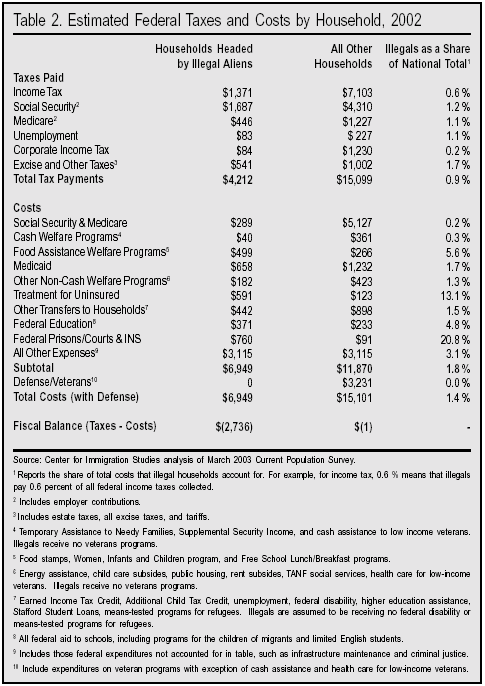
It must be remembered that tax payments in the table are based on the assumption that only 55 percent of illegals pay payroll taxes, comprised of income tax, Social Security, Medicare, and unemployment insurance. If all of their income were subjected to taxation, illegals' tax payments would rise significantly. Of course, if they paid all of their payroll tax liability, this would imply that they have legal status, which would also dramatically increase use of public services. This issue will be discussed later in this report.
Excise and Other Taxes. For excise and estate taxes, which are the most regressive, illegals pay 55 percent as much as other tax payers. In Table 2, estate and excise taxes are grouped together. Because illegals are very young on average, they pay very little in estate taxes. If only excise taxes are considered, the average tax payment of illegal households is 69 percent that of all households. Thus, there are significant differences in the relative size of payments illegals make to the various programs. The more regressive the tax, the closer the relative payments of illegal households are to the rest of the population. While the tax payments made by illegal aliens are much smaller on average than those of other households, illegals still do pay billions of dollars in taxes to Washington. In 2002, illegal households paid a total of nearly $16 billion to the federal government. The far right column in Table 2 shows that illegal alien tax payments constitute about 0.9 percent of all taxes collected. Because persons in illegal households constitute 3.6 percent of the nation's total population, their tax payments are clearly less than their representation in the population as a whole. This fact by itself does not mean that they create a fiscal deficit, because the net effect of illegal households on public coffers also depends on their use of public services, which is discussed below.
Costs by Household
Social Security and Medicare. The lower half of Table 2 reports the estimated costs illegals impose on public coffers. The table shows that, in general, illegal households use much less in almost every type of service. In the case of Social Security and Medicare, illegal households use about one-twentieth as much as other households. And they account for less than two-tenths of 1 percent of the total cost of these very large programs. Moreover, it is also clear that illegals pay substantially more in Social Security and Medicare than they use, creating a net benefit for these two programs of over $1,800 a year per illegal alien household. This calculation actually understates the benefit illegals create for the trust funds of these two programs because Table 2 includes costs for Medicare part B, which is paid for by general funds. If only Medicare part A (the part of Medicare covered by the trust fund) and Social Security are considered, illegal households create a net benefit well in excess of $7 billion dollars a year for the trust funds of these two programs.
Welfare Programs. Table 2 shows that illegal households receive much less in cash assistance welfare programs. As already discussed, persons in illegal households comprise 3.6 percent of the total population, but their use of cash welfare accounts for 0.3 percent of costs for these programs. For food assistance programs, however, illegal households actually receive more of this type of program than non-illegal households, accounting for 5.6 percent of federal costs for these programs. This is mainly due to heavy use of the WIC and school lunch programs. For Medicaid, illegals receive less than other households, but their use of this very expensive program is still significant. It's worth noting that although Table 1 showed a larger share of illegal households using Medicaid, figures in Table 2 show that on average they receive a lower payment. This mainly reflects the fact that it is typically only the U.S.-born children in the illegal households who are on Medicaid, while in other households with low incomes both parents and children can qualify for the program. Table 2 also shows that illegal use is much lower for all other welfare programs. But the table still shows that illegal households do use these programs to some extent.
Other Transfers to Households. For other transfers to households, the $442 illegal households are estimated to receive is about half of what non-illegal households get and certainly much less than their share of the total population. The programs included under this category are listed at the bottom of the table. Eligibility and use vary a great deal. For example, illegal aliens who work in the United States illegally are explicitly allowed to receive the Additional Child Tax Credit, which pays out a total of $5 billion a year to low-income workers with children. On the other hand, programs such as student loans can only be used by the tiny number of citizen children in illegal households who are enrolled in college. As is the case with most means-tested programs, illegals use considerably less than other households, but their use is not zero. Overall, illegal households account for less than 2 percent of the costs of these programs.
Prisons, Schools, the Uninsured, and Immigration. There are four areas where the estimated costs illegal households impose are much larger than for other households--treatment for the uninsured, federal aid to schools, federal prisons/courts, and the immigration system. Figures for the uninsured simply reflect the fact that such a large share of illegal aliens and their children lack health insurance. With more than half of persons in illegal households lacking health coverage, illegal households account for a very large share of the costs of treating the uninsured. As for schools, although they are primarily paid for by state and local governments, the federal government now provides more than $28 billion for primary and secondary education. Moreover, Washington gives schools some assistance in paying for children with limited English and for the children of agricultural workers. Not surprisingly, illegal households account for a disproportionate share of these programs. Illegal households impose very significant costs on the federal education budget, however, mainly because illegal households have more school-age children on average. The costs for the federal prison and court system are also significant because, although persons in illegal households account for about 3.6 percent of the nation's total population, illegals now account for almost one-fifth of those in federal prison and others processed by the federal courts. Thus, they impose costs on that system that are disproportionally high relative to their share of the total population. This is also true for the immigration system. As indicated in the methodology section, the costs of the immigration system are assigned based on the distribution by household of post-1980 non-citizens. This probably understates the costs of illegals to the immigration system because enforcement alone, which is directed specifically at illegal aliens, accounts for two-thirds of the immigration budget. Nonetheless, it is certainly not surprising that illegal aliens account for a large share of the costs of the immigration system because so much of that system is focused specifically on them.
Balance of Tax and Cost
Illegals Create Large Net Costs. The bottom portion of Table 2 adds together the total tax payments and costs illegals impose on the federal budget. When defense spending is not considered, illegal households are estimated to impose costs on the federal treasury of $6,949 a year or 58 percent of what other households received. When defense spending is included, their costs are only 46 percent those of other households. However, they pay only 28 percent as much in taxes as non-illegal households. As a result, the estimated net cost per illegal household was $2,736. Whether one sees this fiscal deficit as resulting from low tax payments or heavy use of services is a matter of perspective. As already discussed, illegal households comprise 3.6 percent of the total population, but as Table 2 shows they account for an estimated 0.9 percent of taxes paid and 1.4 percent of costs. Thus, both their payments and costs are significantly less than their share of the total population. Since they use so much less in federal services than other households, it probably makes the most sense to see the fiscal deficit as resulting from low tax payments rather than heavy use of public services.
Total Deficit Created by Illegals. If the estimated net fiscal drain of $2,736 a year that each illegal household imposes on the federal treasury is multiplied by the nearly three million illegal households, the total cost comes to $10.4 billion a year. Whether one considers this to be a large sum or not is, of course, a matter of perspective. But, this figure is unambiguously negative and certainly not trivial. It is also worth remembering that these figures are only for the federal government and do not include any costs at the state or local level, where the impact is likely to be significant.
The Fiscal Implications of Amnesty
So far we have only considered the current fiscal impact of illegal alien households. In the following section we run two different simulations to estimate what would happen if illegal aliens in the United States were legalized. We assume that any amnesty that passes Congress will have Legal Permanent Residence (LPR, colloquilly known as a "green card") as a component. It is true that President Bush's amnesty proposal in January 2004 envisioned temporary worker status for illegal aliens. At present, however, every major legalization bill in Congress provides illegals with LPR status at some point in the process. Moreover, because Republicans are divided between those favoring enforcement of immigration laws and those who want an amnesty, any legalization must have significant Democratic support to pass. But Democrats have made clear than they can only support an amnesty that gives permanent residence. While a two-step legalization -- one that grants temporary status before permanent residence -- is certainly possible, such a system would still result in permanent residence. Politically, it seems almost certain that any amnesty that actually passes Congress will award LPR status to illegals. But even if one makes the very unlikely assumption that an amnesty will be a pure guestworker program, the net fiscal deficit imposed by illegals indicates that unskilled workers who are not permanent residents still create large fiscal costs. As we have seen, this is partly because of their U.S.-born children, partly because like all people they necessarily place some demands on government, and partly because their low-income results in very low tax payments. All these things would still be true of unskilled guest workers.
General Impact of Amnesty. It is important to consider the likely outcomes of any amnesty: First, there should be a significant increase in tax compliance. (In the simulations below we assume that compliance rises from 55 percent to 100 percent.) Second, the average income of illegals should rise, as they would be freer to make decisions about employment and less likely to be exploited by employers. Third, use of public services will increase as the now-legal immigrants are eligible for many services from which they were barred as illegals. The actual size of these changes and their impact on the fiscal bottom line are explored below. It is also very important to realize that, if legalized, illegal aliens would not simply become just like legal immigrants in general because illegals are much less educated on average than legal immigrants. To run our legalization simulations we use the characteristics of illegals who are household heads and then assume that if they were legalized, they would pay taxes and use services like legal immigrant households headed by persons with the same characteristics.
Simulation One. We first report the education levels and country of birth of illegal households based on the education and country of the household head. Figure 1 reports the Mexican and non-Mexican share by education level of the illegal alien population. We divide illegals by their education level because, as already discussed, the single most important determinant of one's income, and thus service use and tax payments, is education. This was one of the most important conclusions of the aforementioned NRC study. We further divide them by whether they are Mexican because all research, including this report, indicates that about 60 percent of illegals are from that country. Moreover, the NRC study found significant differences between households headed by Latin American immigrants and those from the rest of the world. Figure 1 reports the distribution of illegal alien household heads by their educational attainment and if they are Mexican. We then assume that if illegals were legalized they would use services and pay taxes like all legal immigrants with the same characteristics.32
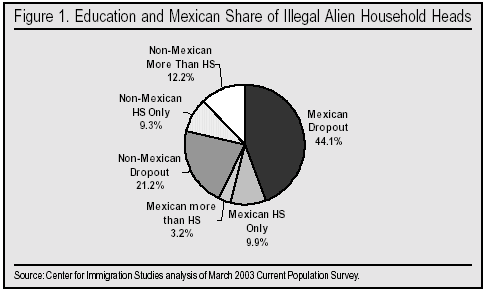
Simulation Two. In the second simulation we again divide the illegal population by education and whether they are Mexican, but this time we assume that they would pay taxes and use services like legal immigrants who arrived in 1986 or after. That is, we again use the results from Figure 1 and assume that if legalized, they would use services and pay taxes like legal immigrants who have the same characteristics, but have arrived since 1986. The reason we assume that they would be like post-1986 legal immigrants is that illegals themselves are almost all post-1986 arrivals, the year the last amnesty for illegals was passed. Illegals are much more like recently arrived legal immigrants then they are like legal immigrants in general, who are older and have higher income but also use programs like Social Security. In addition, we exclude persons from the main refugee-sending countries because it is well established that refugees have the highest rates of public benefit receipt of any group of immigrants. These countries include: Poland, the former Yugoslavia, the Former Soviet Union, Afghanistan, Cambodia, Iraq, Laos, Vietnam, Nicaragua, Cuba, and Ethiopia. This second simulation is probably the most plausible.
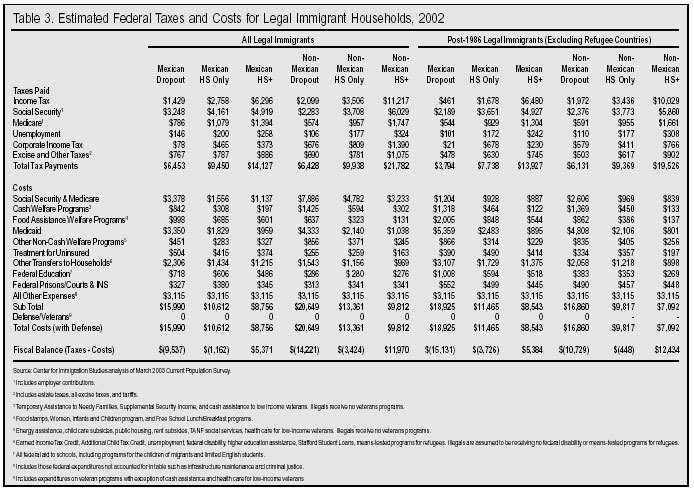
Fiscal Impact of Legal Immigrants. Table 3 shows estimated federal taxes paid and services used in 2002 for legal immigrant households by education level and whether a person is from Mexico. The left side of the table is the basis for Simulation 1 and shows all legal immigrants regardless of when they arrived; the right side of the table shows the same figures for post-1986 non-refugees. One interesting finding of the table is that estimated tax payments are higher for all categories of legal immigrant households than the roughly $4,200 paid by illegal households in Table 2. The only exception is for post-1986 Mexicans without a high school education. Thus, those who contend that legalization would increase tax revenues are probably correct. Almost every category of legal immigrant pays more in taxes than do illegal households. Unfortunately, the table also shows that, in every case, total federal costs are also higher than the roughly $6,900 a year reported for illegal households in Table 2. Thus, those who are concerned that legalization would increase costs are also almost certainly correct.
(Click on Table for a larger version)
As expected, Table 3 shows that there is very wide variation in public service use and tax payments between groups. Overall service use and tax payments by household closely correlates with education levels of household heads. In both simulations, those with more than a high school degree are a large net fiscal benefit to the federal government, while those with only a high school education or less are a net fiscal drain. This is true whether the legal immigrant is from Mexico or not. It is also true whether one considers all legal immigrants or only post-1986 non-refugees. The difference between immigrants by education is truly enormous. For example, looking at households headed by post-1986 non-refugees, a legal immigrant without a high school degree creates a fiscal deficit on the federal government of more than $15,000 a year if he is Mexican and almost $11,000 if he is from the rest of the world. Conversely, for those with more than a high school degree, the benefit is over $5,000 a year if they are Mexican and more than $12,000 for non-Mexicans. The same pattern holds when all immigrant households are considered, regardless of year of arrival. Without question, the education level of legal immigrants is a key determinant of their fiscal impact. However, being from Mexico seems to matter as well.
Legalization Would Dramatically Increase Costs. Using the education levels and the share that is Mexican found in Figure 1 and combining them with the results from Table 3, we can then estimate the likely impact of legalization. Table 4 reports the estimated federal taxes paid and services used by legalized illegal alien households assuming they would pay taxes and use services like households headed by legal immigrants with the same characteristics. The first simulation assumes that illegals would pay federal taxes and use services like all legal immigrants with the same education level, regardless of when they arrived, while the second simulation assumes that they would have the impact of post-1986 legal non-refugee immigrants. Both simulations show that legalization would increase the net fiscal costs dramatically. Simulation 1 shows that the net fiscal costs to the federal government would increase from $2,736 to $6,022 per household. Simulation 2 shows the net fiscal cost would be even larger, increasing to $7,668 per household. Although net costs rise, estimated tax payments increase dramatically with legalization. They more than double in Simulation 1 and increase by 77 percent in Simulation 2. However, costs rise significantly as well. In both cases costs more than double, creating an average net fiscal deficit per household that is significantly more than that estimated for illegal alien households.
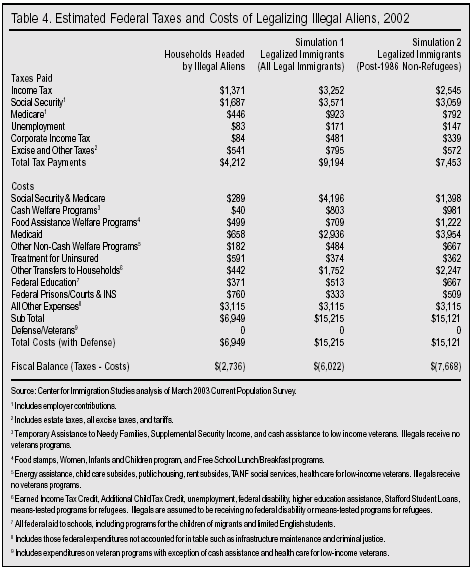
Interestingly, total costs per household are roughly the same in both simulations. In Simulation 1, legal immigrants are making significantly more use of Social Security and Medicare, while in Simulation 2 use of welfare, education, and other transfers to households are much higher. This reflects the different age structure of post-1986 immigrants compared to all immigrants. In effect, one can see Simulation 2 as the more immediate impact of a legalization, while Simulation 1 reflects the likely fiscal impact of legalized aliens in the long term. Either way, the results indicate that legalization would cause the net fiscal burden on taxpayers to increase substantially. It should be noted that, although legalization would substantially increase costs, this does not mean that legal immigrants overall are net drain on the federal government. It also worth noting that if only the relatively small share of illegal aliens with more than a high school degree were legalized, then there would be no fiscal deficit. But since so many illegals have only a high school degree or less, legalizing all illegals would create a large fiscal deficit.
Would Welfare Reform Hold Down Amnesty Costs? In 1996, Congress passed the Personal Responsibility and Work Opportunity Reconciliation Act (PRWORA), which barred some legal immigrants who arrived after 1996 from using certain welfare programs. Since many legal immigrants used in Simulation 2 to estimate the costs of amnesty arrived before 1996, perhaps our estimates overstate the costs, at least with regard to welfare programs. Table 5 provides a detailed breakdown by program for all of the costs estimated in this study. The table shows that legalization under Simulation 2 would increase costs by a total of $8,173 per household. (The same total found in Table 4) Of that increase, $5,588, or about 68 percent, is the result of increased costs due to cash payments from TANF, SSI, and in-kind benefits received from food stamps and Medicaid, the four main programs covered by PRWORA. While certainly a large share of the costs, it still leaves an increase of $2,585 per household in non-PRWORA covered programs.
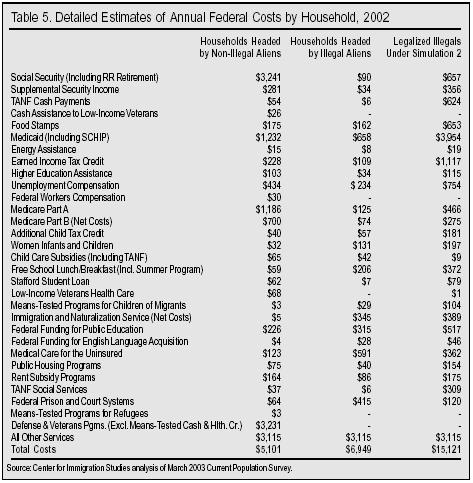
More importantly, analysis of the CPS shows that households headed by recently arrived legal immigrants actually do make significant use of these welfare programs. Table 6 reports estimated use of these four programs for households headed by legal immigrants from Mexico and the rest of the world, excluding refugee countries. The table shows that, in 2002, households headed by a legal immigrant from Mexico who arrived in 1996 or later and who lacks a high degree received $7,900 on average from these four programs and those with only a high school degree received $3,817.33 For post-1996 households headed by legal non-refugees from countries other than Mexico without a high school degree, the figure is $5,464 per household, and for those with only a high school degree the figure is $2,462. By contrast, the figure for illegal aliens is only $860 per household.
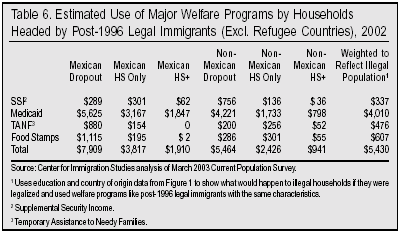
Table 6 also shows that if we assume that illegal households, once legalized, would use welfare like non-refugee legal immigrants who arrived in 1996 or later with the same education, then welfare costs would be $5,430 per household, very similar to the $5,588 in Simulation 2. It must be remembered that, as originally shown in Table 3, legal immigrants with little education make very extensive use of welfare programs because their incomes are very low and because they receive these programs on behalf of their U.S.-born children. This is especially true for Medicaid, by far the costliest program. Welfare reform has not changed these basic facts. Given this reality, it is very difficult to see how a dramatic rise in welfare costs could be avoided if there was a legalization.
Amnesty Would Increase Incomes. Although the net fiscal burden would increase dramatically as a result of a legalization, this does not mean that the income of illegals would remain unchanged. Table 4 shows a dramatic increase in payroll taxes and this partly reflects increases in household income that would occur if illegals were legalized. In fact, analysis shows that whether they are Mexican or not and no matter what their educational attainment, legalization would significantly increase the income of illegal aliens. Figure 2 reports the estimated income of legalized illegal households under Simulations 1 and 2. Like the estimates in Table 4, they are based on the assumption that, if legalized, illegal households would have average incomes like their legal counterparts controlling for whether the household head is Mexican and for education levels. Under Simulation 1, their income would be 29 percent higher, and under Simulation 2 incomes are 15 percent higher. Of course, the much higher incomes in Simulation 1 partly reflect the longer time that all immigrants have lived in the United States and not simply the fact that they have legal status. But Simulation 2 shows that even when analysis is confined to more recent arrivals, incomes still increase substantially. While our overall conclusion indicates that legalization would increase fiscal costs, perhaps the improvement in the income and economic well being of illegal households could be used to justify legalization. Certainly, Figure 2 indicates illegals would likely benefit significantly from obtaining legal status.
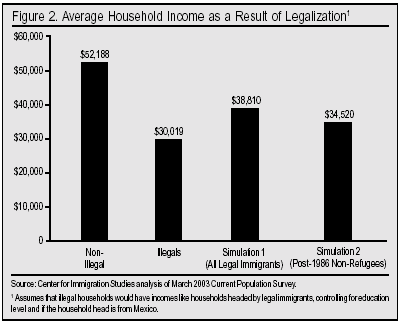
Comparisons to Other Studies
There is always some uncertainty associated with any fiscal estimate of immigrants, especially illegal aliens. However, the overall results of this study are consistent with other work that has looked at this question.
NRC Study. As mentioned at the beginning of this report, the 1997 study by the National Research Council (NRC) is probably the most sophisticated report ever to examine the impact of immigration on public coffers in the United States. While that report did not consider the legal status of immigrants, it did divide immigrants by education. The overall findings of that report showed that the education level of immigrants was critically important in determining their income, tax payments, service use, and resulting net fiscal impact. They found that during his lifetime an immigrant without a high school education imposed a net fiscal drain on taxpayers of $89,000; for those with only a high school degree it was $31,000. The NRC study also found that for those immigrants with more than a high school degree the fiscal benefit was $105,000. While we report estimates for only legal immigrants for a single year, our analysis by education found in Table 3 is strongly supported by the NRC's findings.
Urban Institute Study of New York State. One of the few studies to specifically estimate illegal immigrant tax payments at the federal level by household was done by the Urban Institute in 1998. That study used the CPS to estimate 1994 tax payments for illegal households in New York State, including some federal taxes. Although our study is designed to measure the fiscal impact of immigration at the national level, we ran separate estimates for federal tax payments for illegal-headed households in New York State so we could compare them to those of the Urban Institute. The Urban Institute only examined federal income tax, Social Security, and unemployment insurance, and we did the same. We estimated that the average illegal household in New York State paid $5,538 in these three taxes in 2002, compared to $4,568 estimated for tax year 1994 by the Urban Institute. Adjusted for inflation between 1994 and 2002, this is $5,463 or only 1.4 percent less than our estimate for 2002.34 Of course, illegal immigration to New York State and the federal tax code has changed since 1994. Nonetheless, our average estimates are very similar to those developed by the Urban Institute when adjusted for inflation.
Treasury Department Report. The results of our study are also buttressed by an analysis of illegal alien tax returns done by the Inspector General's Office of the Department of Treasury in 2004.35 That study found that 55 percent of illegal aliens who filed income tax returns using tax identification numbers had no federal income tax liability. While higher than the 45 percent estimated in this study, it must be remembered that this figure was only for those who filed tax returns using a tax identification number. These are all individuals who expected refunds, otherwise they would not have gone to the trouble of getting tax identification numbers and filing a return. But like our estimates, the Inspector General's report indicates that roughly half of illegals have no tax liability, reflecting their very low incomes and large number of dependents.
Conclusion
It is often suggested that "matching a willing worker with a willing employer" is all that matters when it comes to immigration policy. The fiscal costs of illegal immigration indicate that focusing only on workers and employers is grossly inadequate. If the presence of large numbers of unskilled workers lowers prices for some goods and services, but at the same time increases the burden on taxpayers, then this may not be a good deal for the country. Put simply, the mere fact that employers want more workers, and foreigners wish to work in this country, does not mean that Americans necessarily benefit from their coming. This fact must be considered when formulating policy.
Low Levels of Education Create Deficit. The findings of this study show that the primary reason illegal households create a fiscal deficit at the federal level is that their much lower levels of education result in low incomes and tax payments that are only 28 percent that of other households. Thus, even though the costs they impose are estimated to be only 46 percent those of other households on average, there remains a significant net deficit. Whether one considers their use of services low is a matter of perspective. Because illegals are not even supposed to be in the country, many Americans are angered by the fact that they receive any services at all. This is especially true of transfers to households like food stamps or cash payments from the Child Tax Credit. Although many Americans are upset about their use of public services, there is little evidence that illegals come to America to take advantage of public benefits. Most illegal aliens come for jobs, and the vast majority are in fact employed. But low levels of education mean they unavoidably create large costs for taxpayers.
As Long as Illegals Remain, So Will Costs. The relatively low receipt of services by illegals is important from a policy perspective because it means that the amount of money that can be saved by further efforts to curtail their use of public services is probably very limited. As already discussed, the average illegal household is estimated to receives less than half as much in services from the federal government as do other households, even though their households are 17 percent larger on average. This, coupled with the fact that benefits are often received on behalf of their U.S.-born children who are awarded citizenship at birth under current law, means that it is very difficult to avoid many of the costs as long as the illegal aliens remain in the country. In addition, if they are allowed to stay, most of the costs they impose will be for programs whose use is difficult to prevent politically or as a practical matter. For example, denying illegals benefits such as the Women, Infants, and Children nutrition program might encounter significant political opposition. And incarcerating illegals who have been convicted of crimes is an unavoidable cost of having a large illegal population. Thus, if we want to avoid the costs, we must look to alternatives other than trying to cut them off from public services.
Amnesty Would Dramatically Increase Costs. One of the key findings of this report is that legalization would dramatically increase the costs of illegal immigration. If illegals were given green cards and began to pay taxes and use services like legal immigrants with the same education levels, the net annual fiscal deficit at the federal level would likely increase from $2,736 to $7,668 per household under the most likely scenario. Total costs could grow from $10.4 billion a year to $28.8 billion. The costs increase dramatically because unskilled immigrants with legal status, which is what most illegal aliens would become, can access government programs but still tend to make very modest tax payments. This is because the modern American economy offers very limited opportunities to those with little education, regardless of legal status. Though we estimate that household income might rise by 15 percent with legalization and average tax payments would increase by 77 percent as more illegals would be paid off the books, their average household incomes would still remain one-third below that of other households. At the same time, service use would rise dramatically because legal immigrants are eligible for most programs, and they typically have much less fear about using them than illegal aliens. This does not mean that low-income legal immigrants use more in services than low-income native-born Americans. The fiscal deficit is created by the fact that so many illegal aliens are unskilled and thus have low income.
What's Different About Today's Immigration. Many native-born Americans observe that their ancestors came to America and did not place great demands on government services. Perhaps this is true, but the size and scope of government was dramatically smaller during the last great wave of immigration -- not just means-tested programs, but expenditures on public schools and roads were only a fraction what they are today. Thus the arrival of unskilled immigrants in the past did not have the negative fiscal implications that it has today. Moreover, the American economy has changed profoundly since the last great wave of immigration, with education now the key determinant of economic success. The costs that unskilled immigrants, or unskilled natives for that matter, impose should not be seen so much as a failings on their part, but instead as a reflection of the nature of the modern American economy. Put simply, large-scale unskilled immigration is incompatible with current economic conditions and an extensive welfare state. If the fiscal costs are to be avoided, then our immigration policies need to reflect current fiscal and economic realities and the number of unskilled immigrants, legal or illegal, should be reduced.
The Bottom Line. This report has focused on only the fiscal impact of illegal aliens at the federal level. It is almost certain that they also create a large fiscal deficit at the state and local levels.36 Thus, the results in this report only deal with part of the costs of illegal immigration. On the other hand, it must be remembered that this report says nothing about the overall fiscal impact of households headed by legal immigrants. The fact that unskilled immigrants who are legal residents impose large fiscal costs on federal coffers does not mean that legal immigrants overall are a drain on federal coffers. Many legal immigrants are highly skilled. That having been said, we find strong and convincing evidence that the costs of illegal immigration are significant at the federal level and those costs would grow dramatically if illegals were legalized. Of course, there are many other issues to consider when deciding what do to about illegal immigration. But given the costs of illegal aliens and of any amnesty, it would probably make more sense to enforce immigration laws and reduce illegal immigration. Reducing the supply of unskilled labor would force employers to increase wages and invest in labor-saving devices in order to meet their labor needs.
If we instead chose to increase the number of unskilled workers in the country through immigration, then we at least have to understand that such a policy has negative fiscal consequences. Perhaps legalizing illegal aliens may be justified on humanitarian grounds, or as a way to improve relations with other countries. Conversely, enforcement might make more sense because it reduces job competition for unskilled Americans, or for national security reasons. But this analysis shows that, at least with regard to the federal budget, there is a high cost to unskilled illegal alien labor and this must be part of any policy discussion.
Appendix
Appendix Table 1 Appendix Table 5
Appendix Table 2 Appendix Table 6
Appendix Table 3 Appendix Table 7
Appendix Table 4
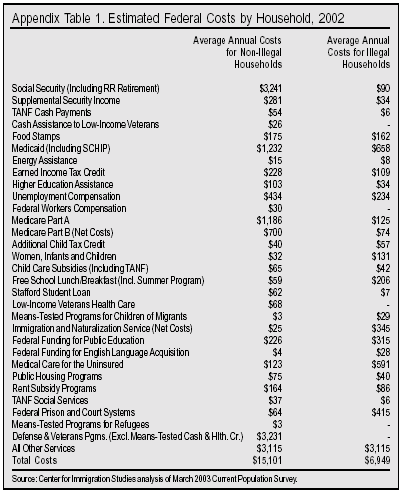
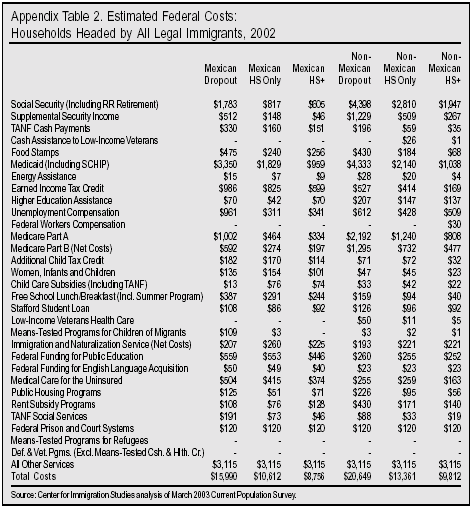
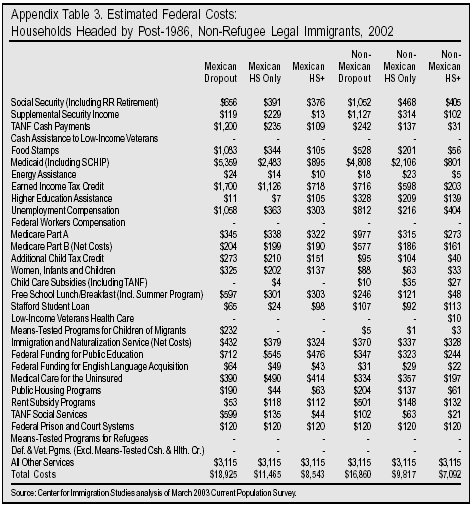
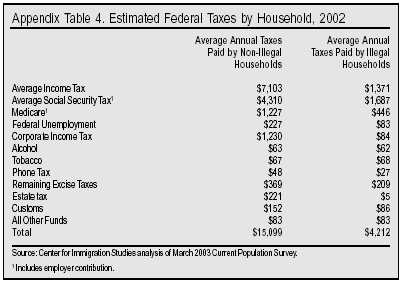
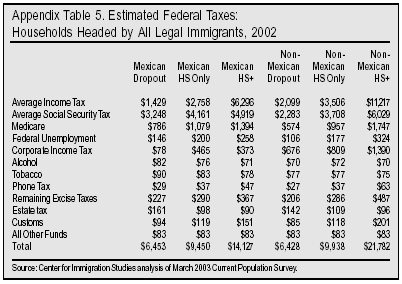
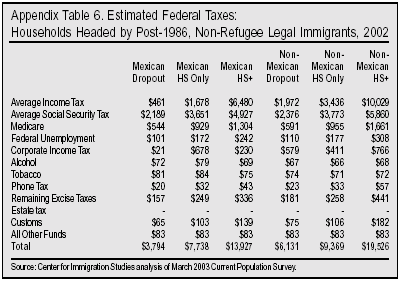
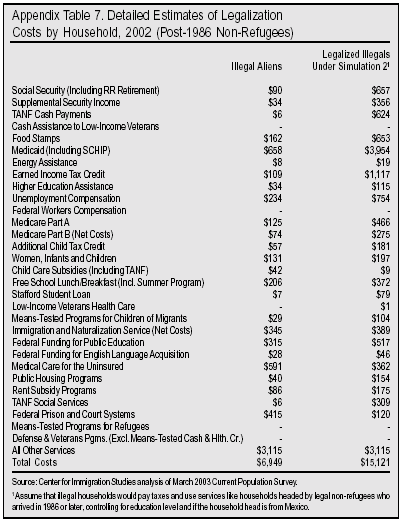
End Notes
1 The National Research Council report entitled, "The New Americans: Economic, Demographic, and Fiscal Effects of Immigration" can be ordered or read online at http://www.nap.edu/books/0309063566/html
2The Urban Institute study is entitled "Immigrants in New York: Their Legal Status, Incomes, and Taxes," by Jeffrey S. Passel and Rebecca L. Clark. A summary of the report can be found at http://www.urban.org/url.cfm?ID=407432
3The Florida study was conducted by the University of Florida and is entitled, "Facts about Immigration and Asking Six Big Questions for Florida and Miami-Dade." Information about the study can be found at http://www.bebr.ufl.edu/Articles/bosmig.pdf. The 1997 study of New Jersey is entitled "State and Local Fiscal Impacts of New Jersey's Immigrant and Native Households," and can be found in the edited volume "Keys to Successful Immigration: Implications of the New Jersey Experience," edited by Thomas J. Espenshade, Urban Institute Press. Washington DC. The Center for Immigration Studies study is entitled "The Costs of Immigration: Assessing a Conflicted Issue," by David Simcox, John Martin, and Rosemary Jenks.
4The survey is considered such an accurate source of information on the foreign-born because, unlike the decennial census, each household in the CPS receives an in-person interview from a Census Bureau employee. The 217,000 persons in the Survey, 23,000 of whom are foreign born, are weighted to reflect the actual size of the total U.S. population. However, it must be remembered that some percentage of the foreign born (especially illegal aliens) are missed by government surveys of this kind, thus the actual size of this population is almost certainly larger. The CPS data used in this study was provided by Unicon Research. www.unicon.com
5This includes naturalized American citizens, legal permanent residents (green card holders), illegal aliens, and people on long-term temporary visas such as students or guest workers, but not those born abroad of American parents.
6We supplement this data, where needed, with estimates derived from the 2000 Census because the Census contains several important pieces of information not found in the CPS, such as if a person speaks English well. We use this data to apportion the costs of providing for students who have limited English. The CPS, in contrast, does not ask a question about language.
7 Tables from the OMB showing taxes collected by source and year can be found at
http://www.whitehouse.gov/omb/budget/fy2004/hist.html
8 "Cash and Noncash Benefits for Persons with Limited Income: Eligibility Rules, Recipient and Expenditure Data, FY2000-FY2002," November 25, 2003. RL32233. Complied by Vee Burke.
9 Federal expenditures on primary and secondary education programs come from the Census Bureau report, "Federal Aid to States for Fiscal Year 2002," which can be found at http://www.census.gov/prod/2003pubs/fas02.pdf. Expenditures on Social Insurance Programs (Social Security, Medicare, and Unemployment Compensation) come from the OMB's web site, http://www.whitehouse.gov/omb. Figures for non-citizens in federal prisons come from the Federal Bureau of Prisons web site, http://www.bop.gov/fact0598.html#Population. The INS 2002 budget comes from the Department of Justice web site and can be found at: www.usdoj.gov/jmd/budgetsummary/btd/1975_2002/2002/html/page104-108.htm
10 Since all of the costs are controlled to the actual total taxes collected and total expenditures, our method has the effect of controlling for the undercount of illegal aliens, legal immigrants, and even natives.
11 The INS report that estimated seven million illegals in 2000, with an annual increase of about 500,000, can be found at http://uscis.gov/graphics/shared/aboutus/statistics/Illegals.htm. The Census Bureau report with an estimate of eight million illegals in 2000 can be found at www.census.gov/dmd/www/ReportRec2.htm (Appendix A of Report 1 contains the estimates). The Urban Institute is the only organization to release figures for the size of the illegal population based on the CPS. Urban estimates that, in March of 2002, 8.3 million illegal aliens were counted in the CPS, with an additional one million being missed. Assuming continual growth in the CPS, there were between 8.6 and 8.8 million in the March 2003 CPS. Urban's estimates based on the March 2002 CPS can be found at http://www.urban.org/url.cfm?ID=1000587. Additional information was provided by Jeffery Passel of the Urban Institute in a May 24, 2004, telephone interview.
12 The fact that our results match those from the Urban Institute is not an accident because the probabilities assigned to variables such as citizenship status, year of arrival in the United States, country of birth, or any of the other variables discussed above, are designed to match the results of previous research in this area.
13 "The New Americans," pp. 255-256.
14 "Keys to Successful Immigration: Implications of the New Jersey
Experience," p. 143.
15 The NBER paper, authored by David E. Weinstein and Donald R. Davis, can be found at www.columbia.edu/~drd28/Migration.pdf.
16Actual taxes collected by source can be found at OMB's web site,
http://www.whitehouse.gov/omb
17 A detailed discussion of how the Census Bureau estimates tax payment can be found in Census paper P60-186RD, "Measuring the Effect of Benefits and Taxes on Income and Poverty: 1992."
18 In the case of Social Security, estimated tax payments from the Census Bureau are roughly doubled to reflect employer contributions.
19 See David North and Marion F. Houstoun, "Characteristics and Role of Illegal Aliens in the U.S. Labor Market," 1976, Washington, D.C.: Linton and Co.; and Louis Rea and Richard Parker, "Illegal Immigration in San Diego Country: An Analysis of Costs and Revenues," 1992. Report to the California State Senate Special Committee on Border
Issues.
20 "Immigrants in New York: Their Legal Status, Incomes, and Taxes;" "Undocumented Immigrants in New Jersey: Numbers, Impacts and Policies" in "Keys to Successful Immigration: Implications of the New Jersey Experience." Edited by Thomas Espenshade, 1997, Washington, D.C.: Urban Institute Press.
21 Although the CPS does not specifically ask about the breakfast program, we assign costs for this program to households based on use of the lunch program.
22 The Treasury Department Inspector General for Tax Administration report, # 2004-30-023, can be found at http://www.treas.gov/tigta/2004reports/200430023fr-redacted.html
23 There are two ways an illegal alien could have a Social Security number that allows him to file a return and get the EITC: First, a stolen or otherwise aquired number and matching name from someone authorized to work in the United States. Second, some illegal aliens have been issued Social Security numbers. This can include illegal aliens who have an application pending with the immigration service, such as asylum applicants. Even thought the individual is illegally in the country and the application has only a small chance of ever being approved, some are still given work authorization. As IRS publication 596 states (page 6), Social Security numbers that are "Valid for Work only with INS authorization" can receive the EITC. The person need not be a legal resident of the United States. While it is unknown how many illegal immigrants have illegally acquired Social Security numbers, the number is likely to be significant. If roughly half of the 5.7 million illegals in the 2003 CPS who hold jobs are paid on the books, then this means that roughly three million illegals have provided employers with a SSN or perhaps an Individual Taxpayer Identification Number (ITIN) that was accepted. The ITIN is not supposed to be used by employers to pay payroll taxes, but this restriction may not be completely enforced.
24 In a February 2003 study in Health Affairs, which can be found at http://www.healthaffairs.org, Hadley and Holahan estimated that the federal government spent $19.9 billion for the uninsured in 2001. An updated study for the Kaiser Family Foundation, which can be found at http://www.kff.org, estimated the figure was $23.5 billion in 2004. To estimate costs in 2002, we assume a constant rate of growth of 5.7 percent between 2001 and 2004, meaning that federal expenditures totaled $21.03 billion in 2002. Hadley and Holahan's two studies indicate that care provided directly by the federal government, such as the VA, increased at an annual rate of 2.4 percent. As a result, we estimate that veterans expenditures in 2002 were $3.98 billion.
25 This is based on the assumption that the costs of administering the INS in 2002 were due to the presence of immigrants in the country either as legal immigrants who need a variety of services or as illegal aliens who are the subject of enforcement.
26 We also use statistics for the Coast Guard interdiction program which can be found at http://www.uscg.mil/CG_2004_html/goals.html#migrant
27 According to the Justice Department, non-citizens comprised 28.8 percent of the federal prison population in 2002. Figures can be found at http://www.bop.gov/fact0598.html#Citizenship. An unpublished paper by Rebecca Clark and Scott Anderson from the Urban Institute, entitled "Illegal Aliens in Federal, State, and Local Criminal Justice Systems," indicated that 57 percent of non-citizens in 1996 were illegal aliens and the share was increasing by 0.4 percentage points a year in the mid-1990s. Thus, by 2002, about 59 percent of non-citizens were likely illegal aliens. This means that 23,000 (22,978), or 17 percent, of the federal prison population were illegals. When later in this report we estimate costs for households headed by legal immigrants we assume that 11.8 percent (28.8 percent - 17 percent) of non-citizens in federal prisons are legal immigrants, and 4.5 percent of the federal prison population are naturalized U.S. citizens, which is their share of the nation's total population. This means that 16 percent of federal prisoners are legal immigrants (naturalized and unnaturalized).
28 Information on those in federal courts can be found in the Compendium of Federal Justice Statistics: http://www.ojp.usdoj.gov/bjs/abstract/cfjs01.htm
29 The costs of the federal court system can be found at
http://www.uscourts.gov/ttb/mar03ttb/budget.html
30 See Appendix F in "Measuring the Effect of Benefits and Taxes on Income and Poverty: 1992" from the U.S. Census Bureau for a discussion of under-reporting of income and receipt of redistribution programs.
31 Footnote 32 on page 278 of the NRC report indicates that households that received redistribution programs like Social Security are identified in the CPS and then assigned the average benefit level. This would seem to control for under-reporting.
32 Although we included them in the costs for non-illegal households in Table 2, we exclude costs for the small number of federal programs that specifically aid refugees because if legalized, illegals should not access these programs.
33 These recently arrived unskilled legal immigrants are relatively small in number and so the survey should be interpreted with some caution, but in the case of both Mexicans and non-Mexicans, use of welfare programs by recently arrived unskilled immigrants (excluding refugees) is quite high.
34 Table 6 on page 103 of the Urban Institute study has the estimates by type of tax.
35 The Inspector General's Office of the Department of the Treasury report # 2004-30-023 can be found at http://www.treas.gov/tigta/2004reports/200430023fr-redacted.html
36 Although they did not look at illegals separately, the NRC study found that in California and New Jersey (the two states they examined) immigrants from Latin America and the Caribbean, where the vast majority of illegals come from, were a significant fiscal drain. By using Census Bureau data that include both illegals and legals, their fiscal analysis is really a combined estimate of the entire foreign-born population both legal and illegal.