
Download this Backgrounder as a pdf
Read panel discussion transcript
One of the most controversial provisions of the 1996 welfare reform law barred many legal immigrants from using certain welfare programs. This report evaluates that effort by examining trends in immigrant and native use of the four major welfare programs that constitute the core of the nation’s welfare system: Temporary Assistance to Needy Families (TANF), food stamps, Supplemental Security Income (SSI), and Medicaid. The findings show that use of TANF and food stamps has declined significantly for both immigrant and native households and also that the gap has narrowed between the two groups. However, considering all four programs together shows that the gap between immigrant and native households has not narrowed, and in fact has widened slightly. Moreover immigrant households comprise a growing share of all households using the welfare system. Our analysis finds that:
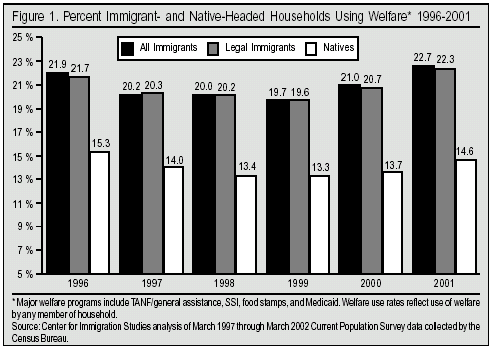
- In 1996, 22 percent of immigrant-headed households used at least one major welfare program, compared to 15 percent of native households. After declining in the late 1990s, welfare use returned to 1996 levels by 2001, with 23 percent of immigrant households using welfare compared to 15 percent of native households. (Figure 1)
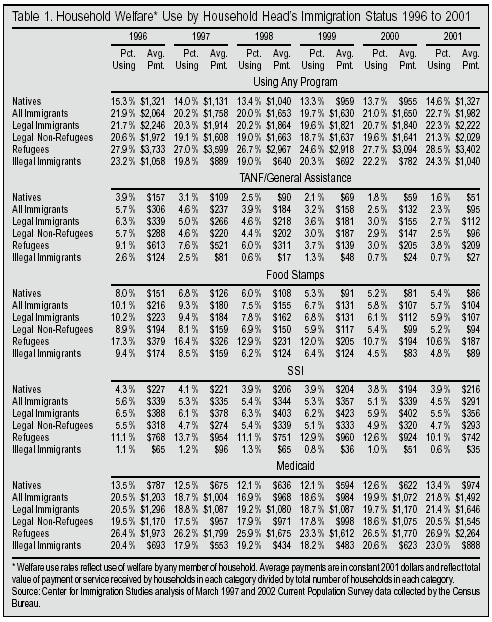
- The persistently high rate of welfare use by immigrant households is almost entirely explained by their heavy reliance on Medicaid, use of which has actually risen modestly. In contrast, their use of TANF has fallen significantly, from a little under 6 percent in 1996 to slightly over 2 percent in 2001. Food stamp use has also declined significantly, from about 10 percent to 6 percent. These rates are now only modestly above those of natives. (Table 1)
- The decline in immigrant TANF and food stamp use has not resulted in a significant savings for taxpayers because it has been almost entirely offset by increases in the costs of providing Medicaid to immigrant households.
- The total combined value of benefits and payments received by immigrant households from welfare programs is almost unchanged in inflation-adjusted dollars, averaging almost $2,000 in 2001, about 50 percent higher than natives. (Figure 2)
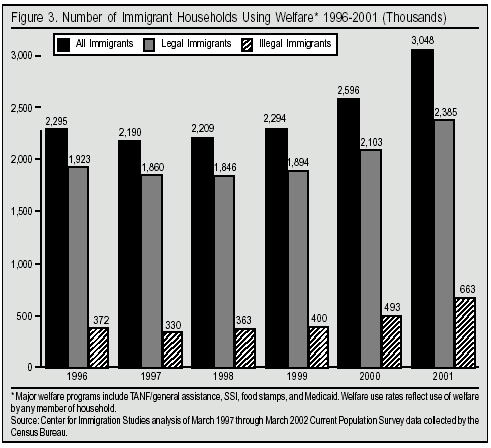
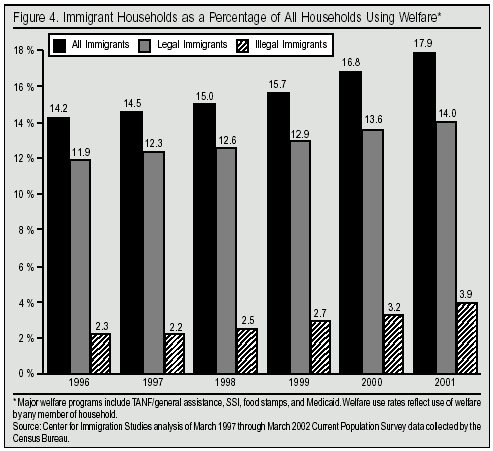
- Continuing high rates of immigrant welfare use, coupled with the rapidly growing immigrant population has meant that the number of immigrant households using welfare has increased by 750,000 since 1996, with immigrant households now accounting for 18 percent of all households using a major welfare program, up from 14 percent in 1996. (Figure 3)
- Estimating welfare use for only households headed by legal immigrants also shows a significant decline in TANF and food stamps use. However, continued heavy reliance on Medicaid has meant that the percentage of legal immigrant household using welfare remained constant at about 22 percent in the 1996-2001 time period and the average value of payments and benefits received by legal immigrants also remained constant at roughly $2,200 a year. (Table 1)
- Households headed by illegal aliens receive welfare, primarily Medicaid, on behalf of their U.S.-born children. In 2001, for example, the value of benefits and payments received by illegal alien households averaged over $1,000. This is considerably less than the $2,200 received by legal immigrant households on average, so one unintended consequence of legalizing illegal aliens would be a significant increase in welfare costs. (Table 1)
- Although refugees do make extensive use of welfare programs, they do not account for a large enough share of the legal immigrant population to explain continued heavy use of welfare by legal immigrants. Excluding households headed by refugees, 21 percent of non-refugee legal immigrant households used at least one major welfare program in 2001, compared to 15 percent of natives. (Table 1)
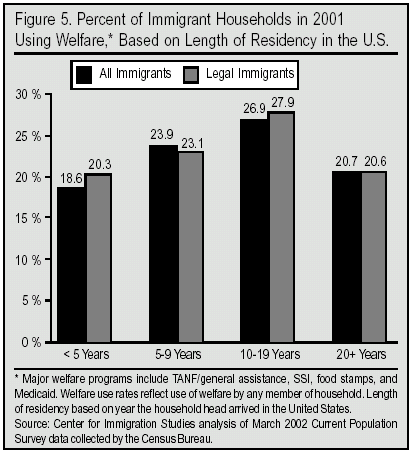
- Consistent with previous research, this study finds that use of welfare programs does not decline significantly the longer immigrants live in the country. In 2001, households headed by immigrants who had been in the country for more than 20 years continued to use the welfare system at significantly higher rates than natives. (Figure 5)
- The high rate of welfare use associated with immigrants is not explained by their unwillingness to work. In 2001, almost 80 percent of immigrant households using welfare had at least one person working.
- One of the main reasons for the heavy reliance of immigrants on welfare programs is that a very large share have little education. The American economy offers very limited opportunities to such workers, and as a result many immigrants who work are still eligible for welfare because of their low incomes.
- Use of the welfare system varies significantly by country. In 2001, immigrants from Mexico, the Caribbean, and Central and South America had the highest use rates, while those from South Asia, Western Europe, Sub-Saharan Africa, and Canada had the lowest. (Table 4)
- Immigrant households make extensive use of the welfare system in almost every state and metropolitan area with a large immigrant population. The highest use rates for immigrants are found in California, New York, Texas, and Massachusetts. (Table 5)
The overall findings of this study indicate that if the goal of welfare reform was to reduce immigrant use only of TANF and food stamps, then it has been a success. Use of these two programs has declined significantly, both in absolute terms and relative to native households. However, if the goal was to save taxpayers money and reduce dependence on government, then that goal remains unmet. This is primarily due to immigrant households’ continued heavy use of Medicaid, by far the most expensive welfare program. Because of the large and growing costs of Medicaid, the average value of payments and benefits received by immigrant households has changed very little since 1996. Another important finding in the report is that, contrary to popular belief, most immigrant households using welfare have at least one person who works. However, the large share of immigrants with relatively little education means that many working households are still able to qualify to receive welfare programs. Educational attainment is not the only factor contributing to the heavy use of welfare associated with the foreign-born. It appears that even households headed by skilled immigrants make much more extensive use of the welfare system than do similarly skilled natives. Welfare use simply appears more attractive to immigrant households than to native households. (In this report, the term immigrant and foreign-born are used synonymously.)
Provisions of Welfare Reform
Policy makers and the public have long been concerned about the possibility of immigrants becoming a burden to taxpayers. Partly because there was strong evidence that immigrant welfare use had been on the rise for at least a decade, Congress included several provisions in the Personal Responsibility and Work Opportunity Reconciliation Act (PRWORA) designed specifically to reduce immigrant eligibility for most welfare programs. The legislation denies most types of means-tested assistance to immigrants who arrived after August of 1996 until they have lived in the country for a certain number of years. Use of welfare programs was also limited for many non-citizen immigrants already living in the country. An important part of the immigrant provisions of PRWORA was an attempt to make sponsors provide assistance if immigrants were unable to support themselves. A number of excellent studies exist summarizing the immigrant provisions of PRWORA.1 The key point here is that the changes were intended to reduce the high rates of welfare use associated with immigrants, with the intent of saving taxpayers money and avoiding immigrant dependence on government.
Welfare Reform May Have Had Little Effect. From the outset, several factors were likely to limit the impact of the immigrant provisions of PRWORA. First, states were given a great deal of latitude to cover otherwise ineligible immigrants with their own resources, and many have done just that. Moreover, many immigrants could avoid the new restrictions by becoming citizens; there is strong evidence that citizenship rates increased most significantly in the late 1990s among those immigrant groups with the highest welfare use rates.2 In addition, Congress repealed some restrictions on immigrant use of welfare in 1997, such as the ban on SSI and Food Stamp use by immigrants who arrived prior to August 1996. The mandated waiting period for post-enactment immigrants, however, remained on the books. Perhaps the most important factor mitigating the immigrant provisions of welfare reform was that the U.S.-born children of immigrants retained the same eligibility as any other American citizen. Thus many immigrants were able to continue to receive benefits on behalf of their U.S.-citizen children. This is important because the majority of children in immigrant households were born in the United States. This, coupled with the fact that the welfare system is primarily geared to providing assistance to low-income families with children, means that the overall impact of PRWORA on welfare use by immigrant households was much less than might have been expected by those who championed the changes with regard to immigrants.
In April of 2002, Dan Griswald of the Cato Institute, a proponent of both high immigration and the welfare cutoff to immigrants, said in an op-ed in the Witchita Eagle that “Since passage of the Welfare Reform Act of 1996, welfare use by immigrant households has plunged.” But does the available evidence support such a conclusion? An examination of welfare use by immigrant households between 1994 and 1998 by Harvard economist George Borjas indicates that welfare reform may not have had a significant impact on overall use of the welfare system, especially outside of California. The purpose of this study is to update the work of Dr. Borjas by examining trends in immigrant welfare use since welfare reform using the latest data available. With Congress poised to re-authorize the changes made in the welfare system sometime this year, it is our hope that this study will provide additional information to better inform the upcoming debate.
Methodology
A number of Census Bureau reports and academic studies have examined immigrant reliance on cash and non-cash assistance programs. Like the Census Bureau, and other academic work that has examined this question, this report looks at welfare use by immigrant and native households.3 Households are defined as immigrant or native based on the nativity of the household head. As already indicated, this report uses the terms immigrant and foreign-born synonymously.4 Immigrant households are primarily comprised of immigrants and their young children. In 2001 for example, 91 percent of persons in immigrant households were either immigrants themselves or the child of an immigrant parent (under age 21). This study, like those cited above, therefore can be seen as an examination of welfare use for immigrants and their children.
Use of four major welfare programs are examined: Temporary Assistance to Needy Families (TANF)5, food stamps, Supplemental Security Income6 (SSI), and Medicaid. These programs represent the core of America’s welfare system. Households are considered to be using welfare if at least one person in the household is enrolled in one or more of these programs. While the report focuses on the percentage using welfare, we also calculated the average value of payments and benefits received by immigrant and native households. This is a relatively simple calculation because the survey used in this study asks respondents the value of the cash or food stamp payments they receive. For persons on Medicaid, the Census Bureau provides an estimate of the insurance value for each individual using the program. One limitation of relying on respondents for information about the size of the payment they receive is that, with the exception of Medicaid, it does not include the administrative costs of the program. A second potential problem is that respondents may understate the value of the benefits they actually received. This problem, however, does not prevent comparisons with natives because there is no evidence that immigrants are more or less likely than natives to under-report welfare use or the size of the payments they receive.7 Moreover, the problem of under-reporting does not prevent an examination of change over time in the use rates of immigrants relative to natives, unless the tendency to under-report changed more for one group than the other.
Data Source. While some administrative data exist on the number of people using welfare programs, such information is often limited. For example, in most instances no information is publicly available on whether the recipient of the program is foreign-born. Therefore this study, like almost all studies of its kind, relies on an analysis of survey data collected by the Census Bureau: the March Current Population Survey (CPS). The CPS is one of the largest surveys collected by the government and includes 217,000 persons, 23,000 of whom are foreign-born.8 Each household in the CPS is interviewed by a Census Bureau employee. Participants are asked a series of socio-economic questions, including whether they are immigrants and about use of welfare for each person in their households during the previous calendar year. Thus data collected in March 1997 provides information about welfare use in 1996, data collected in March 1998 provides information about welfare use in 1997, and so on. Although the survey is collected each month, the March CPS is considered the best source for persons born outside of the United States because it includes an extra-large sample of minorities.
Of course, no data source is perfect, and as already mentioned, there is the well-known problem of under-reporting of welfare use in all surveys of this kind. However, there is no evidence that there is a significant difference between immigrant and native rates of under-reporting. Another limitation in the data is that there is almost certainly some undercount of immigrants, especially those in the country illegally. Nonetheless, the CPS is still the best source of information on the American population, including the foreign-born. For this reason, both government and non-government researchers have made extensive use of the survey for many purposes including examinations of income, unemployment, poverty, health insurance coverage, and welfare.
Legal Versus Illegal Immigrants. In this report we concentrate on the results for immigrant headed-households overall. However, in several parts of the study we further divide immigrant-headed households based on the immigration status of the household head. These divisions include separate analysis of households headed by all legal immigrants, those headed by refugees, those headed by legal non-refugees, and those headed by illegal aliens. These divisions are helpful in understanding immigrant welfare use because eligibility for programs is often linked to immigration status. In fact, the immigrant provisions of welfare reform only applied to legal immigrants who were not yet citizens. Illegal aliens were supposed to be ineligible for welfare programs even prior to welfare reform. As discussed above, all children born to immigrants in the United States, including those born to illegal aliens, are automatically American citizens, and thus have the same welfare eligibility as any other citizen. Thus it is important to see how welfare use varies for different types of immigrant households. For example, it is sometimes suggested that only refugees make extensive use of the welfare system. Other observers point to illegal aliens as the primary problem. By dividing immigrant households based on immigration status we hope to answer some of these questions.
Determining Immigration Status. The CPS does not ask the foreign-born if they are legal residents of the United States. However, the INS, Census Bureau, and others have used socio-demographic characteristics in the data to estimate the size of the illegal population by picking out respondents who have a high probability of being in the country illegally. To determine who is legal and illegal in the survey, this report uses citizenship status, year of arrival in the United States, age, country of birth, educational attainment, sex, welfare receipt, and marital status. We estimate that in the March 2002 CPS there were 7.9 million illegal aliens. (This estimate only includes illegal aliens captured by the March CPS, not those missed by the survey.) This estimate is similar to those prepared by the Census Bureau, the Immigration and Nationalization Service (INS), and the Urban Institute9. It should be obvious that there is no definitive means of determining whether a respondent in the survey is an illegal alien. Even estimates prepared by government agencies are at best highly educated guesses about illegal immigration. Different assumptions will, of course, lead to somewhat different results. In fact, the Census Bureau and the INS have arrived at somewhat different estimates for the overall size of the illegal population. Despite the inherent problems in identifying illegal aliens, the analysis of illegal aliens in this study is consistent with previous research and should provide a good idea of the difference between households based on the immigration status of the household head.
Findings
Little Decline in Welfare Use Rates Overall. Figure 1 reports the percentage of households headed by immigrants and natives using at least one major welfare program. It also shows an estimate for legal immigrants only. Figure 1 shows that in 1996, 21.9 percent of households headed by a foreign-born individual used at least one major welfare program, compared to 15.3 percent of native households. Rates for the foreign-born and natives declined somewhat to 19.7 percent and 13.3 percent respectively by 1999 before rising again to 22.7 percent for immigrants and 14.6 percent for natives in 2001. A very similar pattern exists for legal immigrants. After a modest decline in the late 1990s, use of welfare by legal immigrant-headed households returned to 1996 levels. Overall, Figure 1 shows that after a modest decline, welfare use rates for immigrants and natives are essentially back to where they were in 1996 when welfare reform was passed. This is true both for total use rates and those relative to native-headed households. At least in terms of overall welfare use of the four major welfare programs by immigrant households, welfare reform seems to have had only a modest short-term effect.
Significant Decline in TANF and food stamp Use. While the share of immigrant households using at least one welfare program has changed little since 1996, this is not the case for two programs in particular — Temporary Assistance to Needy Families10 (TANF) and food stamps. Table 1 provides detailed estimates of welfare use for the four major welfare programs by native and immigrant households based on the immigration status of the household head. (Average payment figures are also included in the table and will be discussed later in the report.) The table shows that use of TANF and food stamps by immigrant-headed households declined significantly. Use of TANF among immigrant households fell from 5.7 percent in 1996 to 2.3 percent in 2001, and food stamp use has also declined significantly, from 10.1 percent to 5.7 percent. By itself the decline in TANF and food stamp use would be important, but perhaps even more important for policy makers concerned about immigrant use of welfare, the gap between immigrant and native use of these two programs has also narrowed. Whereas in 1996 immigrant use of TANF was 1.8 percentage points higher than that of natives, in 2001 it was 0.7 percentage point higher. For food stamps, immigrant use was 2.1 percentage points higher than that of natives in 1996, but by 2001 only 0.3 percentage points separated immigrant households from native households. Turning to use of TANF by legal immigrants, the gap fell from 2.4 percentage points to 1.1 percentage points. The table also shows there was a 2.2 percentage point gap between legal immigrant households and natives in food stamp use in 1996, but by 2001 it had shrunk to 0.5 percent points. While use of these two programs is still somewhat higher among immigrant households, the gap with native households has narrowed considerably.
No Savings for Taxpayers. The fiscal costs associated with welfare use are not, of course, simply a matter of the percentage of the foreign-born and natives using welfare programs; there is also the question of the size of the benefit households receive. As already discussed in the methodology section, households participating in the Current Population Survey who use welfare programs are asked the dollar value of the benefits they received.11 Thus, it is a relatively simple calculation to add together the value of payments and benefits received by both types of households and then average them over all immigrant and native households. Figure 2 reports the average welfare payment, in constant 2001 dollars, received by households headed by all immigrants, by legal immigrants only, and by natives. The dollar values are for the total amount in payments and benefits received for immigrant and native households divided by each type of household. (In addition to all immigrant and legal immigrant households, Table 1 reports payments for refugee, non-refugee, and illegal-alien households.) Figure 2 shows that, as is the case with the percentage using welfare, there was a decline in the average payment received by both immigrant and native households through 1999. However, since 1999 the size of the payment has increased so that in 2001 the average payment was very similar, in inflation-adjusted dollars, to what it was the year of welfare reform. This is true for immigrant households overall, legal immigrant households, and native households.
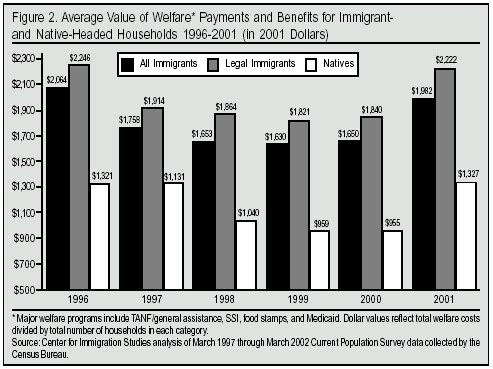
Again, the reason this situation exists is that the costs of providing Medicaid rose significantly over this time period, offsetting the substantial declines in use of TANF and Food Stamps by the foreign-born found in Table 1. Figure 2 is important because it shows that households headed by the foreign-born are more likely to use welfare programs, and that the size of the average payment they receive is also larger than that of natives. It could be that the higher average welfare use rates in Figure 1 and Table 1 do not translate into higher welfare costs, because the average payment immigrant households receive when averaged across all households is no higher than the average payment received by native households. This could result if immigrant households that are on welfare receive, on average, a much smaller payment than native households that are on welfare. But this does not seem to be the case. For average costs to look as they do, the value of payments and benefits received by immigrant households on welfare must be very similar to that of native households on welfare. The higher average payments in 1996 and 2001 therefore result from higher use rates among the foreign-born.
Payments for Only Those on Welfare. It should be remembered that the payment figures in Figure 2 and Table 1 are for all native and immigrant households, including those who do not receive any of the four major welfare programs studied here. Confining our analysis to only those households that receive payments indicates that in 1996 the value of payments and benefits received for immigrant households on welfare was $9,403, compared to $8,640 for native households (in 2001 dollars). By 2001, the average value of the payment and benefits received by immigrant households on welfare was $8,726, compared to $9,079 for native households on welfare. Thus, in 1996 immigrant households on welfare received an average payment that was about 4 percent more than that of native households on welfare, but by 2001 they received an average payment that was about 4 percent less than natives on welfare. The fact that immigrants on welfare now receive a payment that is slightly less than natives on welfare suggests that one possible effect of welfare reform was to reduce the average payment and benefit received by immigrant households on welfare. Of course, it should be noted that this decline is somewhat offset by the slight increase, from 21.9 to 22.7 percent, in the share of immigrant households using at least one major welfare program.
Turning to legal immigrants, we find that in 1996 legal immigrants on welfare received payments and benefits totaling $10,342, compared to $8,640 for native-headed households using welfare. By 2001 the average payment for legal immigrant households on welfare was $9,963, compared to $9,079 for native headed households on welfare. Thus, in 1996 households headed by legal immigrants received a payment that was about 20 percent higher than that of natives, but by 2001 it was about 10 percent higher than that of natives. While a significant gap still exists, the gap in payments for legal immigrants and natives on welfare has clearly narrowed. Moreover, as already shown, legal immigrants are more likely to use at least one major welfare program in the first place. Put simply, legal immigrants are more likely to use welfare, and they continue to receive larger payments when they are on welfare, though that size of the payment has declined since 1996.
Immigrant Households Account for Growing Share of Welfare Case Load. Another way of thinking about trends in welfare use is to examine the number of immigrant households using the welfare system. If welfare reform had solved the problem of heavy immigrant reliance on welfare programs, then we might expect to see a decline or at least very little growth in the number of immigrant households using the welfare system. Figure 3 shows this is not the case. The number of immigrants using at least one major welfare program has steadily increased, with the exception of a small drop in 1997. The figure shows that in 1996, 2.3 million immigrant households used the welfare system and that this number grew by 750,000, to over three million by 2001. Figure 3 also shows that about 60 percent of the 750,000 increase was accounted for by legal immigrants. Figure 4 examines trends from a slightly different point of view, the immigrant share of all households on welfare. In 2001, immigrant-headed households accounted for almost 18 percent of all households on welfare, up from a little over 14 percent in 1996. It is important to realize that the immigrant population has grown substantially since 1996. Of course, this did not necessarily have to result in an increase in the number using welfare. It could have been the case that the increase in the total number of immigrant households was offset by a decline in the percentage using welfare. However, as Figure 1 and Table 1 show, the share of immigrant households using welfare has not declined. This fact coupled with the very high level of new immigration since 1996 has meant that immigrant households account for a growing share of the welfare caseload. Thus, in a very important sense, the goals of the immigrant provisions of welfare reform have failed. Immigrants account for a growing share of the welfare caseload. This was certainly not the intent of welfare reform.
Most Immigrant Households on Welfare Work. Some of the political motivation for reducing immigrant eligibility for welfare in 1996 was due to a belief that welfare use by immigrants is an indication of laziness or an unwillingness to work. However, such observations are misplaced in some important respects. The nation’s welfare system primarily goes to working households. Those who are employed, or their children, are often still eligible for welfare programs if their income is low enough. Moreover, many people who are unemployed for part of the year can also use welfare programs. In 2001, 67 percent of households that used at least one major welfare program during the year had at least one person working. In fact, more than half of these households had two or more people working during the year. For households headed by immigrants, 79 percent using welfare had at least one person working during the year. These households still used the welfare system because even though there was at least one worker present, their incomes were still low enough to qualify for welfare. Among native households, 65 percent had at least one person who worked.
Table 2 considers this question from the reverse perspective. Instead of looking at the percentage of households on welfare with at least one worker, the table examines the percent of working households on welfare. The table shows that 20.3 percent of households headed by an immigrant where at least one person worked used welfare in 2001. For native households 12.1 percent used welfare, and for legal immigrants 19.6 percent used welfare. Table 2 shows that the presence of someone who works is no guarantee that the household will not use welfare programs. In fact, the difference between use rates for all households and those that work is small. This is true for immigrants in general, legal immigrants, and native households. Overall, the table confirms the basic findings found in Figure 1 and Table 1: Immigrant households are significantly more likely to use the welfare system than are native households regardless of whether someone in the household works. This is true for both 1996 and 2001.
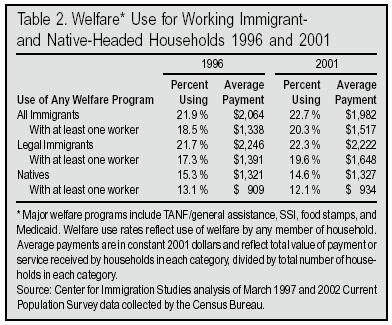
Most Immigrant Households Work. It should also be noted that in 2001, 86 percent of all households headed by a foreign-born person had at least one person working, compared to 78 percent of native-headed households. Thus, if holding a job resulted in no welfare use, then the foreign-born should have somewhat lower use rates than natives, instead of the higher use rates they actually have. The key is not simply having a job, but rather having a job that pays enough to avoid using the welfare system. This points to an important issue surrounding the immigration debate. Many employers argue for high levels of immigration on the grounds that they have jobs, and filling those jobs with immigrants really does not concern anyone else. However, the findings in Table 2 indicate that cheap labor often comes with a very high cost. Allowing in large numbers of legal immigrants may hold down costs for employers by increasing the supply of labor, but the policy can also create significant costs for taxpayers. These costs go unnoticed by employers because they are borne by all taxpayers. It may make far more sense, therefore, for the United States to have less immigration, thereby increasing wages for American workers and reducing welfare costs. Employers, of course, may not wish to increase what they pay their workers or to invest in labor-saving devices, but given the fiscal implications of immigration, the nation as whole may well be much better off with less immigration. At the very least, the fiscal costs associated with immigrant workers needs to become an integral part of the immigration debate. Simply looking at their impact on the workforce is not sufficient.
Low Educational Attainment Only One Reason. Consistent with previous research, the findings of this report show that immigrant use of the welfare system remains well above that of natives. Since unwillingness to work is clearly not the explanation, we must look elsewhere. Table 3 reports welfare use in 2001 based on the immigration status and educational attainment of the household head. Not surprisingly, the higher the education level of the household head, the lower the welfare use rate. Less than 10 percent of immigrant households headed by a college graduates, for example, used a welfare program in 2001. In contrast, 36 percent of immigrant households headed by someone who has not completed high school used welfare. The same pattern exists for legal immigrants, with almost 42 percent of households headed by a legal immigrant without a high school education using the welfare system, compared to slightly less than 10 percent of legal immigrants with a college degree. For natives, almost one-third of households headed by a high school dropout used welfare, compared to less than 5 percent of households headed by a college graduate.
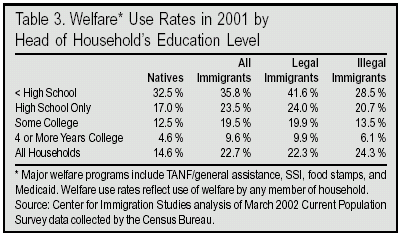
Table 3 also shows that even after controlling for education, a very sizable gap exists between immigrant and native use of the welfare system. One way to measure the extent to which differences in educational attainment explain differences in welfare use is to compare what immigrant welfare use would be if they had the same educational attainment as natives but retain their use rates by educational level. In other words, what would immigrant welfare use be if immigrants were as educated as natives, but their use of welfare remained the same by educational category as shown in Table 3? This calculation shows that the overall welfare use for immigrant households would be 20.4 percent rather than 22.7 percent. This suggests that about 30 percent of the gap between immigrant and native households in welfare use is explained by the lower educational attainment of immigrants. Most of the phenomenon, however, seems to be explained by other factors. One possible explanation for this situation is that more immigrant households have children and the nation’s welfare system is primarily designed to help families with children. It may also be that receiving welfare is seen as more socially acceptable in some immigrant communities than among natives. While some research on this question already exists, this is clearly an area in need of further study.
Welfare Use Over Time. Figure 5 shows the percentage of immigrant households using at least one major welfare program, based on how long the household head has lived here. Consistent with previous research, welfare use actually increases significantly with duration of stay in the United States for at least 20 years after arrival. Even immigrant households headed by someone who came to the country more than 20 years ago use welfare programs at a significantly higher rate than natives. In 2001, almost 21 percent of these long-time residents used welfare, compared to less than 15 percent of natives. This is true even though immigrants who arrived more than 20 years ago are on average much older than the average native. To some extent, assimilation for many immigrants means assimilation into the welfare system. This is the case both for immigrants in general and for legal immigrants.
Welfare Use by Region of Birth. Table 4 shows welfare use rates for households headed by immigrants from different parts of the world. The table shows that welfare use varies considerably based on where immigrants are from. In 2001, immigrants from Mexico, the Caribbean, Central America, and South America had the highest use rates, while those from South Asia, Western Europe, Sub-Saharan Africa, and Canada had the lowest. This is of particular interest because the administration and Democrats in Congress had pushed for some kind of amnesty for illegals from Mexico prior to the September 11th attacks. While those proposals have moved to the back burner, at some point they may reemerge. We estimate that in 2001, 37 percent of households headed by legal Mexican immigrants used at least one welfare program compared to 31 percent of those headed by illegal aliens. Clearly one unintended consequence of an amnesty for Mexican illegals would be a significant rise in welfare costs, with serious consequences for public coffers.
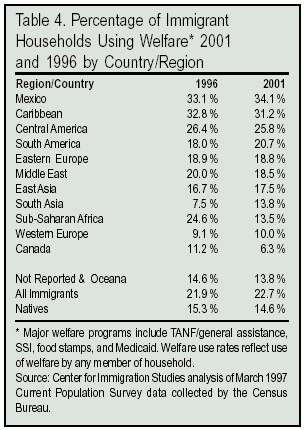
Returning to Table 4, comparisons of 1996 with 2001 show that for immigrants from almost every part of the world there was very little change over time in use of the welfare system, with the exception of Sub-Saharan Africa. Overall, Table 4 indicates that high rates of welfare use are common among immigrants from many different parts of the world. In 2001, only households headed by immigrants from South Asia, Sub-Saharan Africa, Western Europe, and Canada had lower welfare use rates than natives. These four regions account for only about 17 percent of all immigrants in the United States. So heavy dependency on the welfare system appears to be a widespread problem among diverse immigrant communities.
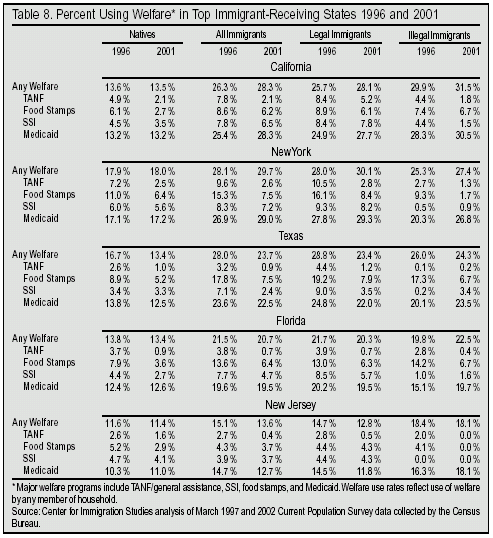
Welfare Use by State. Welfare use is not simply a national issue. Although the federal government provides most of the funding for these programs, state governments do bear a significant share of the cost of the welfare system. Medicaid, for example, has become one of the most costly items in most state budgets. Table 5 shows the percentage of immigrant and native households using the welfare system in 1996 and 2001. In general, welfare use rates have changed little in most states, both for immigrant- and native-headed households; however, there are some exceptions. In Texas and Arizona welfare use among the foreign-born has fallen significantly, and in Arizona this is true not only in absolute terms but also relative to natives. In contrast, in Colorado and Massachusetts there has been a substantial increase in immigrant welfare use. Overall, Table 5 indicates that in most of the nation’s top immigrant-receiving states, welfare use by immigrant households remains much higher than of native households.
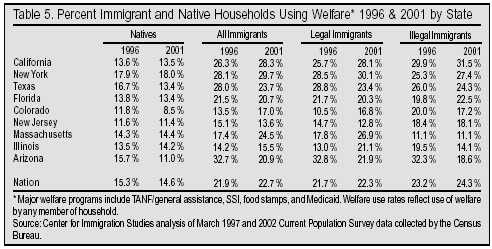
Table 6 reports the number of immigrant households receiving welfare by state. In every state but Arizona, the number of immigrant households using the welfare system increased significantly from 1996 to 2001. In some states there has been what can only be described as an explosion in the number of immigrant households accessing the welfare system. In almost every state, the number of immigrant households on welfare has increased by more than 20 percent, and in five, the number has increased by more than 25 percent. In contrast, Table 6 shows that the number of native households using welfare has been relatively stable since 1996 in most states. Nationally, while the number of immigrant households using welfare has increased by 753,000 (33 percent), the number of native headed households on welfare increased by 176,000 (a little over one percent). One of the more interesting findings in Table 6 is that a significant number of households headed by illegal aliens use the welfare system. There are four states in which there are more than 50,000 households headed by illegal immigrants using at least one major welfare program. Of course, as already indicated, this is not so surprising since the U.S.-born children of illegal immigrants have the same welfare eligibility of any other American citizen.
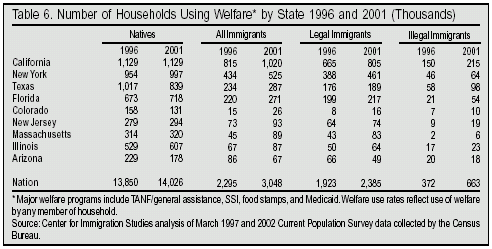
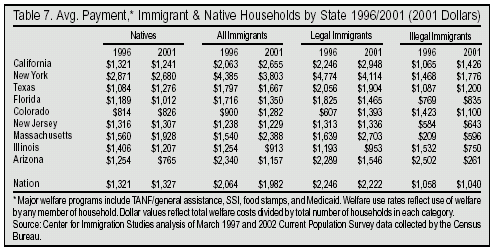
Table 7 shows the average payment received by immigrant and native households. Table 8 shows welfare use by program and immigration status for the top-four immigrant receiving states. As is the case nationally, Table 8 shows that for immigrant households in every state, even those headed by illegals, Medicaid is by far the most commonly used welfare program. This is certainly very bad news for the states because Medicaid is not only the costliest welfare program, it is also the program for which states must shoulder the largest share of the costs. The very rapid increase in the number of immigrant households using the welfare system, especially Medicaid, has almost certainly strained state coffers across the country and played some role in the current budget crisis of many states.
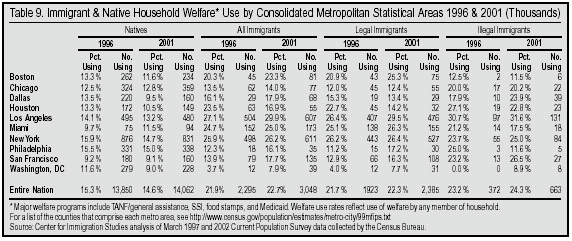
Welfare Use by Metro Area. Table 9 shows the percentage and number of households using welfare for the nation’s largest immigrant-receiving metropolitan areas. With the exception of Houston, the number and percentage of immigrant households using at least one major welfare program increased between 1996 and 2001 in every Consolidated Metropolitan Statistical Area (CMSA) in the country, with the largest numerical increases in New York, Los Angles, San Francisco, Dallas, and Boston. While local governments bear only a modest share of the cost for welfare programs, it is certainly not good news for jurisdictions in these areas that immigration is significantly increasing the welfare case load.
Conclusion
The primary finding of this report is that welfare use by immigrant households remains much higher than that of natives. However, the mix of programs used by immigrants, and natives for that matter, has changed significantly since 1996. Use of TANF and food stamps has declined significantly among the foreign-born since 1996, while Medicaid use has risen somewhat. The enormous and growing cost of Medicaid means that there has likely been little or no savings for taxpayers. This is especially true when one considers the increase of 750,000 additional immigrant households using welfare programs. Immigrant households account for 18 percent of all households using the welfare system, up from just 14 percent in 1996. Thus in the most important sense, welfare reform with regard to immigrants seems to have failed. Or at the least, it has not generated the kind of savings for taxpayers that its proponents hoped it would. Immigrant welfare use remains high and they comprise a growing share of the welfare case load, mainly because a very large share have little education and the American economy offers very limited opportunities to such workers.
Factors Other than Welfare Reform to Consider. There are many issues to consider when evaluating the trends in immigrant welfare use explored in this analysis. For example, there was a strong economy over this time period, and this moved many people from welfare to work, as have all previous expansions. Of course, the economy affected both immigrants and natives and so examinations of immigrant and native use of the welfare system should still yield useful comparisons. There is also evidence that Proposition 187 passed in 1994 in California, which targeted illegal aliens using welfare, might have had what some have called a “chilling effect” on immigrants’ willingness to access welfare programs, even legal immigrants. In terms of immigrants’ persistently high rate of Medicaid use, one must also keep in mind that Congress significantly expanded eligibility for Medicaid through the State Children’s Health Insurance Program (SCHIP) in 1997. Finally, there is the question of whether native use of welfare is the proper yardstick by which to measure immigrants. Some may reasonably argue that because immigration is supposed to benefit the United States, our admission criteria should, with the exception of refugees, select only those immigrants who are likely to be self-sufficient. Table 1 showed that even non-refugee legal immigrants use a good deal more welfare than natives. None of these observations change the fact that immigrant households are significantly more likely to use welfare programs than native households, but they do mean that when trying to determine the reasons for the changes in immigrant welfare use since 1996, many factors must be considered
Immigrants Tend to Pay Less Taxes Than Natives. While not the focus of this study, it should be obvious that while immigrants do use welfare, they also pay taxes. However, because immigrants tend to have lower incomes and larger families, they tend to pay less in taxes. The CPS includes figures for the average federal income tax liability for all individuals in the survey. In 2001, the average immigrant household should have paid about $5,800 to the federal government; the average native household should have paid over $7,000. These estimates probably understate the difference between immigrant and native households because many immigrants are in the country illegally and are therefore more likely to avoid paying taxes by working off the books. On the other hand, there are certainly taxes other than federal income tax. States often get a large share of their revenue from sales and real estate taxes. But again, since immigrants have significantly lower incomes than natives, they typically purchase less and rent or buy more modest housing, thereby generating lower average tax payments. Moreover, welfare programs are primarily funded through the federal income tax. The bottom line is that it does not appear that the tax contributions by immigrants offset their heavy use of the welfare system.
Curbing Eligibility. The attempt to reduce immigrant use of the welfare system in 1996 represents a real-world social experiment, one that has largely failed. In fact, because the number of immigrants has been allowed to grow substantially since 1996, the total cost of providing immigrant households with welfare programs has risen significantly. Some may still argue that if only we made further changes to the welfare system in general or in regard to immigrants specifically, that this problem could be solved. But such proposals are grossly unrealistic. Political realities make it very difficult to exclude people from accessing social services once they are in the country. For example, Congress repealed some restrictions on immigrant use of welfare in 1997, not long after they had passed welfare reform. State governments used the latitude they were given to cover otherwise ineligible immigrants with their own resources, and most did so. It is very doubtful that states with significant immigrant populations would ever exclude large segments of their populations from programs like Medicaid. Moreover, as already noted, becoming a citizen is a way to avoid any restrictions on immigrant use of welfare. Perhaps the most important factor mitigating the immigrant provisions of welfare reform was that the U.S.-born children of immigrants retained the same eligibility as any other American citizen. Thus many families receive a host of benefits on behalf of their citizen children. There is no possibility that welfare would be cut off to these American citizens. If we wish to reduce welfare use associated with the foreign-born, we are going to have to look at policy options other than denying access to welfare programs.
Welfare Is Often a Subsidy for Employers. From the point of view of the nation as a whole, it might make a lot more sense to reduce immigration (legal and illegal) and thereby the supply of labor, especially in unskilled jobs where immigrants are heavily concentrated. This would not only reduce the number of immigrants entering each year who access the welfare system, it would also cause wages and benefits to rise for unskilled workers. This would make it possible for many natives and legal immigrants already here to avoid using the welfare system. Less immigration would also induce employers to invest in labor-saving devices, and this too would have the benefit of making for a more productive economy. Some may argue that there are businesses that simply cannot afford to pay workers any more and still stay in business. If this is the case, perhaps we should reduce immigration and let such businesses fold. If such businesses can only survive by paying poverty-level wages, creating huge costs for taxpayers in the form of welfare payments to their workers, then maintaining such an industry makes little sense. Welfare payments to low-wage workers represent a large subsidy to business. For example, if taxpayers provide health care in the form of Medicaid, then employers do not have to provide health care. Of course, employers find this a very desirable situation. Employers do not see the costs of Medicaid because they are diffuse, borne by all taxpayers, while employers have a very strong incentive to keep down their labor costs by keeping immigration high. By providing workers with welfare and other means-tested programs, taxpayers are in effect paying part of the salary for these workers. Like any business receiving subsidies, those who use unskilled labor will try very hard to retain them. The fact that some businesses wish to retain this subsidy cannot, however, justify the costs to taxpayers, or the reduction in wages for the poorest American workers.
Change Immigration, Not Welfare. The failure of the immigrant provisions of welfare reform to address the very real problem of high rates of immigrant use indicates that another approach is needed. Trying to cut immigrant families from welfare after they are here is simply not working. Moreover, there is a very important question of fairness. After all, while they may make smaller tax contributions on average, immigrants still typically pay taxes from the moment they arrive, so they should be able to access the programs they need. But even more profoundly, allowing them into the country and then denying access to programs everyone else is allowed to use sends the message that they may come, but are not going to be treated like one of us. The decision in 1996 to leave the level of immigration at record levels and instead cut immigrants off from welfare programs can be described as a high immigration/anti-immigrant policy. But there is another set of policies that would almost certainly make more sense. This approach may be described as apro-immigrant policy of low immigration. That is, the United States could reduce the level of legal and illegal immigration, moving to a system that selects immigrants based primarily on skills and not whether they have a relative already in the country, which is the basis of the current system. As far as illegal immigration, better policing of the border, monitoring temporary visitors, and penalizing employers who hire illegals could significantly reduce illegal immigration. At the same time, the nation could embrace a policy of treating immigrants as the future Americans that they are, including extending them the same welfare benefits as native-born Americans.
If we do not restructure our immigration policy, then the costs of providing welfare to immigrant families will continue to increase. Politicians can only ignore this problem for so long. At some point, they will have to confront this issue and either try yet again to restrict immigrant access to the welfare system, which has not worked, or change immigration policy, admitting fewer immigrants likely to need welfare in the first place.
End Notes
1 See the introduction of “The Impact of Welfare Reform on Immigrant Welfare Use” by George J. Borjas, 2002, Center for Immigration Studies. http://www.cis.org/sites/cis.org/files/articles/2002/borjaspr.html. The Urban Institute as also done a number of studies looking at changes in immigrant welfare eligibility which are at its Web site www.urban.org.
2 See Borjas, 2002.
3 In their bi-annual reports on the immigrant population, the Census Bureau reports welfare use by household based on the nativity of the household head. See for example, Figures 20-1, 20-2 and 21-3 in “Profile of the Foreign-Born Population: 2000.” P23-206, U.S. Census Bureau, December 2001. http://www.census.gov/prod/2002pubs/p23-206.pdf.
Borjas, George J. and Lynette Hilton. “Immigration and the Welfare State: Immigrant Participation in Means-Tested Entitlement Programs,” Quarterly Journal of Economics, May 1996.
Also see Borjas, 2002.
4 The definition of foreign-born in this study is the same as that used by the Census Bureau. The foreign-born are persons living in the United States who were not U.S. citizens at birth. This includes persons who are naturalized American citizens, legal permanent residents (green card holders), illegal aliens, and a modest number of people living in the United States on long-term temporary visas such as students or guest workers. It does not include those born abroad of American citizen parents.
5 The name of this program was changed in 1996 from Aid to Families with Dependent Children (AFDC) to TANF. Throughout this report we use the term TANF, even for 1996 when the program was still called AFDC. Figures for TANF also include a small number of people receiving cash assistance from state governments through general assistance programs.
6 Supplemental Security Income is a means-tested cash assistance program for the blind, disabled, and indigent elderly.
7 Camarota, Steven A. “Assessing the Accuracy of Data on the Foreign-Born From The American Community Survey: Task 4.” February 2001. This report was prepared for the Census Bureau under contract and has not yet been released to the public. The report details results of extensive focus groups with Census Bureau employees who conduct survey interviews, almost all of whom worked on the CPS as well as the American Community Survey. The interviewer felt strongly that the foreign were not more reluctant to provide information about welfare use.
8 These figures are for the March 2002 CPS; samples from earlier years were smaller but still typically included 15,000 immigrants.
9 The INS estimate of 7 million illegals in 2000 can be found at www.immigration.gov/graphics/aboutus/statistics/Ill_Report_1211.pdf
The Census Bureau estimate of 8 million illegals in 2000 report can be found at www.census.gov/dmd/www/ReportRec2.htm (Appendix A of Report 1 contains the estimates).
A summary of the Urban Institute’s estimate of 8.5 can be found at http://www.migrationinformation.org/Feature/display.cfm?ID=19.
10 Figures for TANF also include a modest number of people receiving state sponsored general assistance programs.
11 The only exception is that persons on Medicaid are not asked the value of their insurance. The Census Bureau has calculated the costs of Medicaid for each person using the program.
Steven A. Camarota is the Center for Immigration Studies' Director of Research.