
Related: Video, Transcript
Download this Backgrounder as a .pdf
In the aftermath of September 11, there has been heightened interest in the Middle Eastern immigrant population living in the United States. Their integration and incorporation into American society has come to be seen as increasingly important.
Based on an analysis by the Center for Immigration Studies of just-released data from the Census Bureau, this Backgrounder is one of the first to examine the socio-demographic characteristics of Middle Eastern immigrants in a systematic way. For the purposes of this study, the Middle East is defined as Pakistan, Bangladesh, Afghanistan, Turkey, the Levant, the Arabian peninsula, and Arab North Africa.1
Among the report's findings:
- Middle Easterners are one of the fastest growing immigrant groups in America. While the size of the overall immigrant population (legal and illegal) has tripled since 1970, the number of immigrants from the Middle East has grown more than seven-fold, from fewer than 200,000 in 1970 to nearly 1.5 million in 2000.
- The INS last estimated that 150,000, or about 10 percent, of Middle Eastern immigrants are illegal aliens. Preliminary Census Bureau estimates show a similar number.
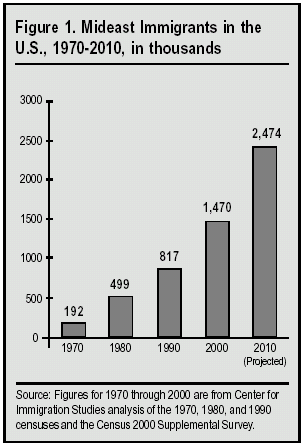
- Assuming no change in U.S. immigration policy, 1.1 million new immigrants (legal and illegal) from the Middle East are projected to settle in the United States by 2010, and the total Middle Eastern immigrant population will grow to about 2.5 million.
- These figures do not include the 570,000 U.S.-born children (under age 18) who have at least one parent born in the Middle East, a number expected to grow to 950,000 by 2010.
- The religious composition of Middle Eastern immigrants has changed dramatically over the past thirty years. In 1970, an estimated 15 percent (29,000) of immigrants from the region were Muslim; the rest were mostly Christians from Lebanon or Christian ethnic minorities such as Armenians fleeing predominately Muslim countries. By 2000, an estimated 73 percent (1.1 million) of all Middle Eastern immigrants were Muslim.
- Interest in coming to America remains very strong in the Middle East even after September 11. In October 2001, the Department of State received approximately 1.5 million applications from the Middle East (not including Pakistan) for the visa lottery, a program which awards 50,000 green cards each year to randomly selected applicants.
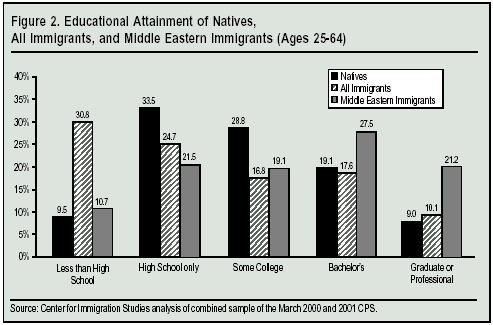
- Middle Eastern immigrants are one of the most educated immigrant groups in America. In 2000, 49 percent had at least a bachelor's degree, compared to 28 percent of natives.
- There is little evidence of discrimination in the job market against the group. Median earnings in 2000 for Middle Eastern men were $39,000, slightly higher than the $38,000 average for native workers.
- Citizenship rates are relatively high among Middle Easterners, with 55 percent holding American citizenship, compared to 38 percent of immigrants overall.
- Given their high citizenship rates, relative affluence, and strong interest in Middle East politics, absent a change in U.S. immigration policy, continued Middle Eastern immigration appears likely to lead to changes in U.S. policy toward the Arab-Israeli conflict as elected officials respond to this population's growing electoral importance.
- While many Middle Easterners are well-educated and prosperous, a significant share are poor and make use of America's welfare system. In 2000, nearly one in five Middle Eastern immigrants and their young children lived in poverty, compared to about one in 10 natives; 23 percent used at least one major welfare program, compared to only 15 percent of natives.
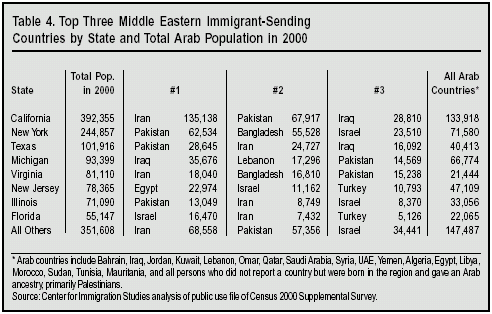
- California has the largest Middle Eastern immigrant population, with nearly 400,000. Of states with the most Middle Eastern immigrants, Virginia has the fastest growing population, followed by Texas, Michigan, and New York.
- While only 10 percent of immigrants are self-employed compared to 11 percent of natives, 19 percent of Middle Eastern immigrants own their own businesses.
Because all children born in the United States to immigrants are by definition natives, the sole reason for the dramatic increase in the Middle Eastern immigrant population is new immigration. While some immigrants die and others return home, the issuance of permanent residency visas and the settlement of illegal aliens greatly exceed deaths and out-migration, so the immigrant population continues to grow.
In any discussion of immigration's effect on the country, it is important to keep in mind that the number of legal immigrants allowed in each year, the selection criteria used, and the level of resources devoted to controlling illegal immigration are all discretionary policies of the federal government and can be increased, decreased, or left unchanged. It should be noted that sampling and non-sampling errors exist in any survey, and the results for relatively small groups should be interpreted with caution.
In this Backgrounder, the terms "immigrant" and "foreign-born" are used synonymously. The definition of foreign-born is the same as that used by the Census Bureau — persons living in the United States who were not U.S. citizens at birth. This includes persons who are naturalized U.S. citizens, legal permanent residents (green card holders), illegal aliens, and people living in the United States on long-term temporary visas such as students or guestworkers. It does not include those born abroad of U.S. citizen parents. The data are from an analysis by the Center for Immigration Studies of the public use files of the decennial censuses (1970, 1980, and 1990), the just-released Census 2000 Supplemental Survey (C2SS), and a combined sample of the March 2000 and 2001 Current Population Survey.2
Historical Perspective
Immigrants from the Middle East have come to the United States for at least 100 years. In the late 1800s, Maronite Christians from Lebanon and Armenians and other Christian minorities from the Ottoman Empire began settling in the United States in significant numbers. This report, however, focuses on immigration from the region only in the last 30 years. Figure 1 reports the number of Middle Eastern immigrants living in the United States from 1970 to 2000.
The figure shows very dramatic growth in this population over the last 30 years. In 1970, fewer than 200,000 Middle Easterners lived in the United States — by 2000 the number had grown 650 percent to nearly 1.5 million. Over the same period, the total foreign-born population grew at half the rate of the Middle Eastern population. Just since 1990, the Middle Eastern population has grown by 80 percent. As a share of the total foreign-born, those from the Middle East now account for about 5 percent, compared to 2 percent of the total immigrant population in 1970.
These figures do not include the 570,000 U.S.-born children (under 18) who have at least one parent born in the Middle East.3 Nor do they include the grandchildren, great grandchildren, or even longer descendants of immigrants from that part of the world. There are well over one million native-born Americans (including children mentioned above) who trace their ancestry back a few generations to the Middle East.
These U.S.-born adults of Mideast origin are overwhelming the descendants of groups such as Maronites, Armenians, and other Christian groups who entered the country in the late 19th century or first half of the 20th century. They include prominent Americans such as Ralph Nader, Donna Shalala, Jamie Farr, John Sununu, George Deukmejian, Casey Kasem, Frank Zappa, and William Peter Blatty.
A Growing Muslim Share
Immigrants from the Middle East are not a homogenous group. One of the most important aspects of this diversity is in the area of religion. While the Mideast itself is overwhelmingly Muslim (approximately 98 percent), historically this has not been true of immigrants to the United States from that part of the world. For much of this century, the vast majority of Middle Easterners in the United States were Christians, mostly Maronites from Lebanon, or Armenians, Assyrians, Greeks, Chaldeans, and a small number of Jews fleeing predominately Muslim countries. In recent decades this situation has changed significantly.
While the Census Bureau does not ask respondents about their religion, it is possible to use the ancestry and language questions found in the Census and the C2SS to roughly estimate the likely religious affiliation of Mideast immigrants. Based on a methodology summarized in the appendix to this paper, we estimate that 15 percent of the Middle Eastern immigrant population in 1970 was Muslim, but that by 2000 it was 73 percent Muslim. Thus, as the Middle Eastern immigrant population has grown over the last three decades, it has become far more Muslim.
The fact that Mideast immigrants are overwhelmingly Muslim does not mean that Muslims have replaced non-Muslim immigrants. The number of non-Muslims has grown as well, just not as fast. In 1970 there were approximately 160,000 non-Muslim immigrants from the Mideast in the United States and by 2000 there were almost 400,000. The non-Muslim immigrant population from the region, therefore, grew two and one-half times over the last 30 years. By contrast, the Muslim immigrant population increased 38-fold — from less the 29,000 to 1.1 million. This dramatic shift in the religious affiliation of immigrants from the region shows how our immigration system — which allows people into the country primarily based on whether they have a relative here or have won the visa lottery — has a logic all its own, creating social forces and trends not expected a generation ago.
Mideast Immigration Projections
Projecting immigration trends into the future is a difficult task because socioeconomic conditions in both the sending countries as well as in the United States can change significantly over time. Moreover, U.S. immigration laws can and have been changed in the past, and efforts to control illegal immigration could become more vigorous or perhaps even more lax than they already are. However, shorter term projections are much easier because conditions are less likely to change in the course of five or 10 years than over the course of several decades. In the projections below we only focus on the next 10 years. Moreover, we assume no change in U.S. immigration policy.
New immigration (legal and illegal) is primarily driven by the size of the existing immigrant population because it is the relatives and friends of people already living in the United States who provide information about conditions and opportunities here to prospective immigrants. And in many cases it is the relatives who then provide sponsorship. Thus the larger the existing immigrant population from a country the larger the potential flow of new immigrants. Conditions in the Middle East indicate that out-migration is likely to continue to be attractive to a significant share of the population. In October 2001, the Department of State received approximately 1.5 million applications from the region for the visa lottery, a program which awards 50,000 green cards each year to randomly selected applicants. These figures do not include Pakistan, which is not part of the lottery. This is strong evidence that even after September 11, interest in coming to the United States remains high in the Middle East.4
The economies of the Middle East have also not performed well in recent years. Political oppression and corruption are common and religious minorities and dissenters are likely to continue to leave the region. Also, Middle Eastern countries have found it exceedingly difficult to provide gainful employment for the large number of young people reaching working-age each year. Thus, out-migration pressures over the next decade are likely to be at least as high as they were in the 1990s.
In 1990 there were 817,000 Mideast immigrants in the United States. The 2000 data in Table 1 show that 692,000 new immigrants came to the United States in the 1990s from the Middle East. We know this because the C2SS, like the Census, asks individuals what year they came to the United States to live.5 This translates into a ratio of 0.86 new immigrants to old immigrants. That is, almost 700,000 new immigrants in the 1990s joined the 817,000 who were already here in 1990. However, counting all Middle Eastern immigrants who arrived between 1990 and 2000 would be a 10.5 year time period because the C2SS is a midyear survey for 2000.6 Therefore we exclude half (27,000) of the 54,000 people who said they arrived in 1990.
This means that 665,000 Middle Eastern immigrants arrived between mid-1990 and mid-2000, creating a ratio of 0.81 new immigrants to old. We further adjust this ratio downward because of the possibility that the C2SS, like the 2000 Census, more completely enumerated the foreign-born population than did the 1990 census.7 If this is the case, then the Middle Eastern-born population may have been larger in 1990 than what was recorded by the 1990 census.
Unfortunately, the Census Bureau has not specifically estimated the undercount of Middle Eastern immigrants from 1990. Thus, there is no way to know what share, if any, might have been missed in the 1990 Census. However, if we make the reasonable assumption that perhaps 3 percent of the Middle Eastern population was missed in 1990, then the total population was really 841,421 in 1990. This then creates a ratio of new to old immigrants of 665,000 to 841,421 or 0.79. If we then apply this ratio to the existing Middle Eastern immigrant population of 1,469,847 it translates into 1,161,663 new immigrants from the Middle East over the next decade.
The events of September 11, however, have led to somewhat higher scrutiny for applicants from that part of the world; and some prospective immigrants in the Middle East may be more reluctant to emigrate to the United States out of fear of a possible rise in anti-Middle Eastern sentiment in America. However, this is unlikely to have a large impact on the total flow of immigrants from the region over the course of the decade, because many individuals have been waiting years to join family members already here, and the political freedoms and economic opportunities in United States remain very attractive to a significant share of the world's population, including those in the Middle East.
Moreover, the largest effect on immigration from the region will likely be on those seeking short-term or "nonimmigrant" visas, such as tourists and students who may be less likely to come. To reflect the possibility that fewer people from the region will wish to settle in the United States, we adjust the 1,161,663 down by 4 percent to 1,115,197.
The 1.1 million new Mideast immigrants (legal and illegal) projected to arrive in the next decade, while certainly large, is in no way a break with the past. If anything, it suggests slower growth in the population than has been the case for the last 30 years.8 Moreover, it represents no more than 9 percent of the 13 to 15 million immigrants (legal and illegal) from all countries likely to settle in the United States over the next decade, absent a change in immigration policy.9
The total Mideast immigrant population will not grow by the 1.1 million projected to arrive over the next decade because some Mideast immigrants here in 2000 will die or go home by 2010. The C2SS shows that by 2000 there were 777,689 pre-1990 immigrants still living in the United States of the 817,000 who were recorded in 1990, meaning that 95 percent of those here in 1990 were still here in 2000. This partly reflects the low death rate of this relatively youthful population10 and also a very low rate of return-migration. As already mentioned, these seemingly low death and return migration rates may also partly reflect the fact that the C2SS, like the 2000 census, more completely enumerated the foreign-born population than did the 1990 census.
If we again make the assumption that 3 percent of the Middle Eastern population was missed in 1990, and again assume that this was not the case in 2000, then the total population was really 841,421 in 1990. Because 777,689 pre-1990 Middle Easterners were still in the country in 2000, this would indicate that 92.4 percent of the total Mideast population was still in the United States in 1990.
If we project that 92.4 percent of the 1,469,847 Middle Easterners residing in the country in 2000 will still be in the country in 2010 and add this to the 1,115,197 who are projected to arrive over then next decade, we get a total Middle Eastern immigrant population in 2010 of 2,473,712, or an increase of 68 percent over 2000. While this is a dramatic increase, it is still less than the 80 percent growth rate during the 1990s and only somewhat more than the 64 percent growth in the 1980s. Of course, different assumptions will yield different projections; however, experience suggests that projecting future immigration from developing regions, such as the Middle East, based on past trends often yields estimates that turn out to be too low. Thus, if there is a bias in these projections, it is that they understate the number of Mideast immigrants who will actually come. to the United States.
It is important to note that the above estimates do not include the U.S.-born children (under 18) who will be living in Middle Eastern immigrant families by 2010. In 2000, there were 567,000 U.S.-born children under the age of 18 who had at least one parent born in the Middle East.11 Assuming a similar growth rate in this population as for the Middle East Immigrant population overall, then the number of young children in Middle Eastern families is likely to grow to roughly 950,000 over the next decade.
If these children are included, by 2010 the total number of Middle Eastern immigrants and their young children will almost certainly reach 3.4 million. Of course, it is also important to realize that all of these estimates are based on the assumption that there will be no change in U.S. immigration policy over the next decade. However, legal immigration could be changed, and efforts to enforce immigration laws could have a significant impact on illegal settlement.
Countries
Table 1 reports the number of Middle Eastern immigrants living in the United States for selected countries. The left side of the table shows the total population and the right side shows the year of entry for each country. It indicates that Middle Eastern immigration is very diverse, and that no one country accounts for more than 19 percent of all immigrants from the region. It also shows that the Middle Eastern immigrant population is very recent in origin, with almost three-fourths indicating that they came to the United States since 1980, and nearly half since just 1990.
One of the most interesting results in Table 1 is that many of the leading Middle Eastern countries of immigration to the United States are non-Arab. Of the top eight Middle Eastern sending countries in 2000, five — Iran, Pakistan, Israel, Bangladesh, and Turkey — are not majority-Arab countries. (The reader should note that the non-Arab countries in the study are Pakistan, Afghanistan, Bangladesh, Iran, Turkey, and Israel.) This is not to say that Arabs do not make up a sizable share of Middle Eastern immigration.
The table shows that 40 percent of all immigrants from that part of the world are from Arab countries, but no Arab country sends as many immigrants to the United States as Iran, Pakistan, or Israel. Of course, it should be kept in mind that many immigrants from Arab countries are not Arabs, such as Armenians, Greeks, Chaldeans, Assyrians, and Jews. However, at least one-fourth of immigrants from Israel are Arabs. Overall, the table shows that Arabs do make up a large share of the Middle Eastern immigrant population in the United States.
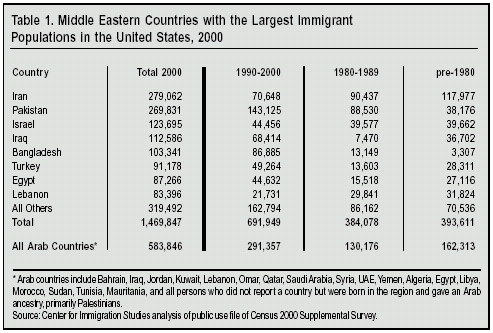
Turning to the year of entry, we find that 691,949 Mideast immigrants indicated that they arrived in the United States over the last decade. The leading countries of immigration during the 1990s were Pakistan, Bangladesh, Iran, Iraq, and Turkey. In fact, one-fifth of all immigrants from the region in the last decade came from Pakistan. The year of entry data also show that Bangladesh, Iran, and Iraq each accounted for one in 10 Mideast immigrants who indicated they arrived during the 1990s.
The table shows that although Israel had the third largest number of immigrants in the country, it no longer sends as many. It ranks seventh in terms of the number of immigrants it sent over the last decade. Thus Israeli immigrants will progressively become a smaller share of the total Mideast population in the United States. While non-Arab countries tend to dominate the list of top sending countries in the 1990s, immigrants from Arab nations accounted for 42 percent of all Mideast immigration during the 1990s.
Illegal Immigration from the Middle East
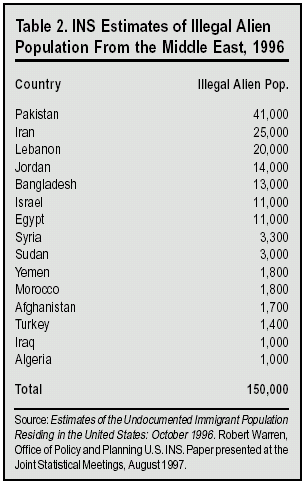
Estimating the size of the illegal alien population residing in the United States is a difficult task. It is even more difficult to determine the illegal population from only one group of countries, such as the Middle East, which does not send as many immigrants (legal or illegal) as do other parts of the world. The INS and Census Bureau have attempted to estimate the number of illegal aliens in the country, including those from the Mideast. INS estimates were prepared in 1998 of the illegal population residing in the country in 1996.
Table 2 reports the INS estimates of the size of the illegal Middle Eastern population in the United States by country. It shows that approximately 150,000 people from the Middle East resided in the United States illegally in 1996. It is reasonable to assume that this population has grown since that time, but assuming it has not, then about 10 percent of the total Middle Eastern immigrants were illegally in the country in 2000.
The Census Bureau has also attempted to estimate illegal immigration from the Middle East, but its estimates are still in the development phase. However, they have published preliminary results, which are available at the Bureau's website.12 The Bureau estimates that perhaps 114,818 illegal aliens from the region were captured by the 2000 census. Three important caveats about the census numbers should be noted. First, their estimates include some people who probably were legal residents. Other figures in the report suggest this might reduce the figures by perhaps 15 or 20 percent.
On the other hand, the Bureau defined the Middle East as only Iran, the Arabian Peninsula, and the Levant. They did not include Arab North Africa, Afghanistan, Bangladesh, or Pakistan in their estimates of illegal aliens from the Middle East, and no specific estimates for these countries have been published by the Bureau. If these countries were added to the Census Bureau's estimates for the Middle East then it would almost certainly create a total very similar to the INS estimates reported in Table 2. The third caveat is that the Census Bureau estimates include only the illegal aliens enumerated by the 2000 Census. Although there must be some undercount of illegals from that region, they are not included in the Bureau's numbers.
While the INS estimates are several years old and those from the Census Bureau are still preliminary, where comparisons are possible the results are similar. The Census Bureau estimated 30,823 illegal aliens from Iran, and the INS estimated 25,000. While there is uncertainty in estimating illegal immigration, it seems likely that 100,000-200,000 illegal aliens from the Middle East (as defined in this study) now reside in the United States. This is certainly a large number, but probably represents no more than 2 percent of the total illegal population in the United States.
How have these illegal aliens from the Middle East entered the country? The INS last estimated that 40 percent of all illegal aliens in the United States were persons who arrived on temporary visas — such as tourists or students — and never went home. The other 60 percent are thought to be those who snuck into the country illegally. One would suspect that since the Middle East does not share a land border with the United States that most illegals from that region are visa overstayers. However, significant smuggling of illegal aliens from the Middle East across our land borders has taken place. For example, in October 2001 Iraqi-born smuggler George Tajirian pled guilty to forging an alliance with a corrupt Mexican immigration officer, Angel Molina Paramo, to smuggle "Palestinian, Jordanian, Syrian, Iraqi, Yemeni, and other illegal aliens through Mexico and into the United States."13
While persons from the Middle East may stand out more in Mexico than in Canada, which has a large Middle Eastern community, widespread official corruption in Mexico makes that country a useful transit point for those trying to sneak into the United States from other countries, including those from the Middle East. Neither the northern nor southern borders are well defended so it seems likely that while most Mideast illegals are visa overstayers, some portion of illegal aliens from the Middle East entered the United States by crossing the border illegally.
Middle Eastern Immigrants by State
Table 3 shows the states with the largest Middle Eastern immigrant populations in the country. California and New York are by far the leading states. Together, those two states account for 43 percent of the total foreign-born population from the Middle East in the United States. This is less than the 49 percent they accounted for in 1990, an indication that the Middle Eastern-born population is perhaps becoming more dispersed in the United States. However, the table shows that the top eight states accounted for 76 percent of the total Mideast population in 2000, which is virtually unchanged since 1990.
The table also shows that Middle Eastern immigrants live in all major regions of the country. In the West they are found mostly in California. In the Southwest, Texas has a substantial population, and Virginia and Florida are the leading states in the Southeast. In the Northeast, New York and New Jersey are the states with the largest Mideast populations, and in the Midwest, Michigan and Illinois both have a significant number of immigrants from the Middle East.
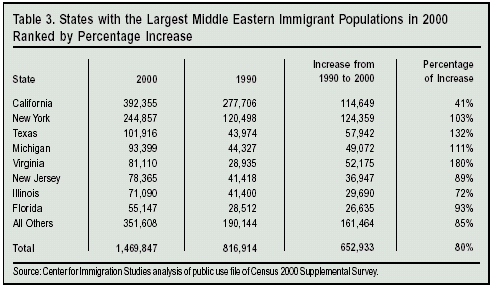
Table 4 again lists the states with the largest number of Middle Eastern immigrants, but it also shows the top three Middle Eastern sending countries for each state. Also, the table denotes the total number of persons from Arab countries in each state and lists the Arab countries included in the study. (Non-Arab countries included in the study are Pakistan, Afghanistan, Bangladesh, Iran, Turkey, and Israel.) Pakistan and Iran are the leading Middle Eastern countries in a number of states. In only two states are Arab countries the leading source of immigrants, New Jersey and Michigan. In most states, the top three immigrant-sending countries account for roughly 60 to 70 percent of the total Mideast immigrant population. This is not true for Illinois, which has the most diverse foreign-born population from the Middle East. In that state, the top three countries account for only 42 percent of the total Mideast immigrant population.
Although most of the top countries are non-Arab, immigrants from Arab countries still make up a large share of the Middle Eastern population in most states. The highest percentage can be found in Michigan, where more than 70 percent of Middle Eastern immigrants are from Arab countries. The state with the lowest percentage is Virginia, where only about a fourth of the foreign-born from the Middle East are from Arab countries.
Education
Figure 2 reports the educational attainment for adult immigrants from the Middle East in comparison to all immigrants and to natives. Education levels are important because there is no better single predictor of how someone will do in the labor market than their education level. In fact, this has become even truer in recent years with an ever-widening gap between educated and less-educated workers.
Figure 2 shows that in contrast to immigrants in general, those from the Middle East tend to be more educated than natives. While a very large share of immigrants overall are high school dropouts, those from the Middle East are only slightly more likely to be dropouts than natives. At the higher end of the education distribution, almost 49 percent of Middle Eastern immigrants have at least a bachelor's degree compared to only 28 percent of natives; and at the highest end, 21 percent have a graduate or professional degree, more than twice the percentage of natives. Overall, the figure shows that immigrants from the Middle East are better educated than other immigrants and natives.
Socio-Economic Status
While the education figures found in Figure 2 provide some insight into the social and economic standing of Middle Easterners, Table 5 provides a more complete picture by examining several key measures of economic well being. The table reports the percentage of Mideast immigrants with at least a bachelor's degree, their median income, and their self employment, home ownership, poverty and welfare use, including separate figures for selected countries and for immigrants from all Arab countries. Overall, the table indicates that in many ways immigrants from the Mideast are doing well. As we have seen, their education levels are high and as a result the table shows their median income is somewhat higher than that of natives.
More detailed analysis of earnings shows little evidence of discrimination against Middle Eastern immigrants. If we examine earnings in the middle age ranges, where sample sizes are large enough to make comparisons, we find that the median earnings for Middle Eastern men in their 30s who have a college education is the same as natives of the same age who have a college degree: $50,000 a year. The median income figures for college educated men, Middle Eastern and natives, in their 40s are also the same at $60,000 a year. Systematic discrimination in the labor market does not appear to be a problem; moreover, their rates of self employment are also significantly higher than that of natives and immigrants in general.
While discrimination does not appear to be a significant problem overall, as we move across the table from left to right, a more complex picture emerges of the economic status of Middle Eastern immigrants. The table shows that home ownership among the foreign-born from the Middle East somewhat lags behind that of natives. More strikingly, poverty rates and use of welfare are significantly higher than that of natives. In 2000, nearly one in five Middle Eastern immigrants and their U.S.-born children (under 18) lived in poverty, compared to about one in 10 natives. Moreover, almost 23 percent of households headed by a Middle Eastern immigrant used at least one major welfare program, compared to 15 percent of natives.
This is a surprising finding given the group's overall education and income levels. Analysis of individual welfare programs indicates that in most cases Middle Eastern households have higher use rates than natives.14 One possible reason for their relatively high poverty and welfare use rates is the presence of refugees who tend to have the most difficulty adapting to life in their new country. However, this is unlikely to account for the results in Table 5 because only 11 percent of legal immigrants from the region in the 1990s were admitted as refugees or asylees. In earlier decades the figure is even smaller.
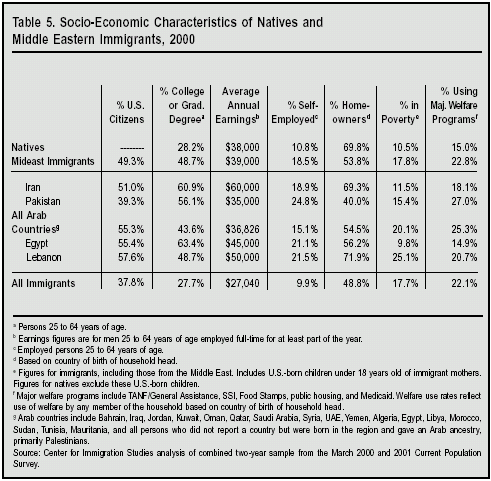
While it is not possible to definitively identify refugees and asylees in the data, if we exclude the three primary refugee-sending countries of Afghanistan, Iraq, and Sudan, we still find that poverty and welfare use remain significantly higher than natives. In 2000, excluding these countries, 18.4 percent of Middle Eastern immigrants and their U.S.-born children lived in poverty, indicating that poverty is at least as high among the non-refugee population as among refugees.
If we exclude the refugees we find that 21.4 percent of households headed by non-refugees from the region used welfare.15 Thus, the high rates of poverty and welfare use do not seem to be the result of those allowed into the country for humanitarian reasons. Overall, Table 5 presents a mixed picture of the socio-economic status of Middle Eastern immigrants. While most Middle Eastern immigrants seem to have integrated economically into their new country, a significant share are not doing as well and are finding it difficult to succeed in America.
Policy Discussion
With a total illegal alien population estimated at eight to nine million (150,000 from the Middle East) living in the United States, violations of immigration laws are certainly very common, but there is no evidence that Middle Easterners violate U.S. immigration law at rates higher than other immigrant groups. The expected settlement of more than one million new immigrants from that region over the next decade will overwhelmingly be the result of legal immigration. Of course, legal immigration is a discretionary policy of the federal government.
The number of immigrants allowed into the country can be increased, decreased, or maintained. The selection criteria can also be changed. For example, recently proposed legislation to eliminate the visa lottery would reduce Mideast immigration because a significant number of immigrants from that region have used it to receive their green cards in the past. Alternatively, an amnesty for illegal aliens, which had been gaining political momentum prior to September 11, would increase Mideast immigration by creating more legal immigrants who could then sponsor their relatives.
The effect of immigration on the United States continues to be a subject of intense debate, and immigration policy is clearly in a state of flux. Reducing immigration makes sense for many reasons, but it should be applied fairly to all groups. The same goes for efforts to deal with illegal immigration. Given limited resources in a time of war, it may make sense to more vigorously pursue Middle Easterners who violate immigration laws in the short-term.
As a long-term policy, however, this would be both unfair and perhaps even unconstitutional. The law should be enforced for all, not just those from one part of the world. Whatever immigration policies are adopted in the future, we must avoid calls to single out Mideast immigrants.
Conclusion
While it does not send as many immigrants to the United States as Latin America, the Caribbean, or East Asia, the Middle East has become a significant source of immigrants to the United States. Based on past trends and assuming no change in U.S. immigration policy, 1.1 million new legal and illegal immigrants from the region will settle in the United States in the next decade. The overall size of the Middle Eastern immigrant population is expected to grow to nearly 2.5 million. These figures do not include the 950,000 or so U.S.-born children who will be living in Middle Eastern immigrant families by 2010. Thus, in less than 10 years the number of Middle Eastern immigrants and their young children will grow to 3.4 million. This means that the successful incorporation and assimilation of these immigrants and their children will be of increasing importance to the United States. As their numbers grow, their impact will increase, especially in such areas as U.S. foreign policy toward the Arab-Israeli conflict where many have keen interest.
The successful integration of Middle Eastern immigrants into American society can only be partly measured by a study such as this, which only examines socio-demographic variables such as education or income or welfare use. Assimilation and incorporation is, of course, much more than holding a job, buying a house, or driving on the right side of the road. In terms of economic status, these immigrants tend to be well-educated with median incomes at least as high as those of natives. The findings also show that high rates of poverty and welfare use are common among the Middle Eastern immigrant population.
But on the question of what one scholar has described as "patriotic assimilation," this report is entirely silent. Do these immigrants and their children view themselves as Americans first and Pakistanis, Iranians, and Egyptians second? Are Middle Eastern immigrants or immigrants in general coming to see America's history as their history? We cannot say from these data. Moreover, assimilation is a two-way street. Do native-born Americans view Middle Easterners as their fellow countrymen? Although these questions are as important as the questions explored in this study, Census Bureau data do not provide answers to them. Despite its limitations, the analysis found in this Backgrounder is intended to inform discussion about this growing segment of immigration to the United States.
End Notes
1 We include Bangladesh in our estimates because in 1970 it was part of Pakistan, and thus it is unavoidably included in our Mideast estimates for that year. The entire list of Middle Eastern countries included in the study are: Afghanistan, Bangladesh, Pakistan, Iran, Iraq, Israel, Jordan, Kuwait, Lebanon, Syria, Turkey, Oman, Qatar, Bahrain, Saudi Arabia, United Arab Emirates, Yemen, Algeria, Egypt, Libya, Morocco, Sudan, Tunisia, West Sahara, and Mauritania.
We do not include Somalia in our study even though it is officially part of the Arab League. We also included all persons who said they were born in Gaza, Palestine, or the West Bank, as well as persons who indicated they were born in "North Africa" or generally the "Middle East." In addition, we also include a small number of people who were reported as having been born in "Africa" or Southwest or South Central Asia and who gave a Middle Eastern ancestry, primarily "Arab," "Palestinian," "Pakistani," and "Lebanese."
2 We use the decennial censuses for 1970 through 1990 because these are the only sources available that include questions on country of birth, citizenship, language, and ancestry. Because the public use file of the 2000 Census is not yet available, we use two different data sources for 2000. The total number of immigrants, year of entry, state of residence, and countries reported in the study for 2000 are from analysis of the Census 2000 Supplemental Survey (C2SS) done by the Center for Immigration Studies. The survey collected data on the non-institutionalized population and was conducted over the course of 2000 and includes 372,000 individuals in the public-use file, 1,645 of whom indicated they were foreign-born and from the Middle East.
We also use these data to estimate the share of the Middle Eastern population that is Muslim because the C2SS includes questions on ancestry and language that are the same as the census. For questions on income, welfare use, and educational attainment we use the combined two-year 2000-2001 Current Population Survey (CPS) because it includes more detailed questions on these subjects than does the C2SS.
3 Based on analysis of a combined sample of the March 2000-2001 CPS by the Center for Immigration Studies.
4 In October of 2001, a total of 8.7 million applications for the lottery were received. While the State Department does not published the number of applicants received from each country, we do know that 17.1 percent of those selected were from the Middle East. Since the lottery is random, it is reasonable to assume that 17.1 percent of all applicants were from the Mideast. This means that almost 1.5 million people from the Middle East sent in applications.
Information concerning the lottery can be found at the State Department's web site at: http://travel.state.gov/DV-2003results.html..
5 Because it is based on data collected in 2000, this figure does not include persons who settled in the United States in the 1990s and died before the end of the decade. They were, therefore, not included in the 2000 count.
6 The C2SS is actually taken every month of the year, and as a result, it is supposed to generate midyear estimates of the nation's population.
<7 The population controls or weighting of the C2SS are derived from the 2000 census results.
8 In the 1990 census, 429,536 immigrants from the region indicated that they arrived in the 1980s, a ratio of 0.86 to the 1980 Mideast immigrant population and in 1980, 338,569 Mideast immigrants indicated they arrived in the 1970s, a ratio of 1.75 to the 1970 population.
9 While there is no way to know for sure how many legal and illegal immigrants will come to America in the next decade, the C2SS (and the 2000 Census) indicated that more than 13 million new immigrants settled in the United States from all countries during the 1990s. For at least the last 40 years, the number of new immigrants each decade has significantly exceeded that in the previous 10 years. Thus, it seems almost certain that without a change in U.S. immigration policy, at least 13 million (but probably 15 million or more) legal and illegal immigrants will arrive in this decade.
10 Most deaths in any population occur at the end of the age distribution spectrum. In 1990, 22 percent of natives were under age five or over age 65, in contrast to only 8 percent of Middle Eastern immigrants. Part of the reason for this is that there are relatively few young children among the Middle Eastern-born population (this is also true for immigrants in general) because even though the group tends to have larger families than natives, most of the births occur within the United States, making the children automatically natives and not immigrants. This, in turn, creates a lower death rate among the foreign-born.
11 These figures are based on an analysis of the combined sample of the March 2000-2001 Current Population Survey.
12 The entire Census Bureau report containing estimates of the illegal population by country of origin can be found at: http://www.census.gov/population/www/documentation/twps0061.html. (See Table A-6.)
13 "Iraqi Accused of Smuggling Hundreds in Mideast to U.S.," The New York Times, October 26, 2001.
14 The CPS shows that 19.7 percent of households headed by a Middle Eastern immigrant have at least one person who uses Medicaid, compared to 12.3 percent for natives. For food stamps the figures were 5.5 percent for Mideast immigrants and 5.2 percent for natives; for SSI it was 6 percent for Mideast immigrants and 3.8 percent for natives; for TANF it was 3.4 percent for Mideast immigrants and 2 percent for natives; and for public housing/rent subsidy it was 3.9 percent for Mideast immigrants and 4.2 percent for natives.
15 In the March 2002-2001 combined CPS file used to calculate welfare use it is only possible to identify two of the main refugee-sending countries, Iraq and Afghanistan, but not Sudan. However, the C2SS indicates that only 1.7 percent of all immigrants from the region come from Sudan; thus, even if a large share of Sudanese households use welfare, it could not have an enormous impact on welfare use rates.
Appendix:
Determining Religious Affiliation of Middle Eastern Immigrants, 1970 and 2000
Muslim population in 1970. While the Census does not ask individuals about their religion, it is possible to use questions in the 1970 census and C2SS to estimate roughly the likely religious affiliation of immigrants from the Middle East. For the 1970s we employ the following methodology: The 1980 census contains a year-of-entry question, so we selected out only those persons who indicated that they arrived in the United States prior to 1971 and thus were living in the United States at the time of the 1970 census. We use the 1980 census because it contains two ancestry questions, which were not asked in the 1970 census.
Persons were asked their ancestry and they could give up to two responses. 160,251 people in the 1980 census indicated that they were born in the Middle East and arrived prior to 1971. We then exclude all individuals who did not answer the ancestry question. This leaves 136,575 of the 160,251 pre-1971 immigrants in the 1980 census. Of the 136,575 we find that 59,246 gave a response in one of the two ancestry questions which lead us to believe they were non-Muslim. (Primarily Greeks, Armenians, Assyrians, or other Christians, mostly from Turkey, Syria, Lebanon, and Egypt.) Subtracting 59,246 from 136,575 leaves 77,329 possible Muslim immigrants from the Mideast in the 1980 census who arrived prior to 1971.
We then use the language question to further select out non-Muslims. Of the remaining 77,329 possible Muslims we find that another 25,371 indicated they spoke a language at home such as Armenian, Greek, or Ladino, which indicated they were likely non-Muslims. This leaves 51,958 pre-1971 possible Muslims in the 1980 Census. This represents 38 percent of the 136,575 pre-1971 Middle Eastern-born population in the 1980. This 38 percent can be seen as the upper bound of the possible share of Muslims in the 1970 census.
Based on anecdotal and other evidence, we then adjusted downward the remaining number of possible Muslims from selected countries using the following ratio: 0.33 for Iran, 0.33 for Egypt, 0.5 for Israel, 0.5 for Syria, 0.5 Turkey, 0.66 for Lebanon. That is, we reduce the number of possible Muslim immigrants by the aforementioned ratio, while other Middle Eastern countries are left unchanged. This translates into a reduction in the Muslim immigrant population of 19,280. This means that 76 percent of the pre-1971 population in the 1980 census is assumed to be non-Muslim. Because the year of entry data indicate that the older cohorts are much less Muslim, we adjust upward the 76 percent nine percentage points to 85 percent based on the assumption that a larger share of persons born in the Middle East who died between 1970 and 1980 were non-Muslim.
Our final estimate is that in 1970, 85 percent of the Middle Eastern-born population was non-Muslim. If Pakistan and Afghanistan are excluded, then roughly 90 percent of immigrants from the region were non-Muslim. This estimate, while very rough, is consistent with other antidotal information.
Muslim population in 2000. The C2SS contains both ancestry and language questions so it is possible to employ the same approach as above to estimate the Muslim share of the Middle Eastern population. We find that 1,469,847 individuals gave a Middle Eastern country as their place of birth. We then exclude 111,269 individuals who did not report an ancestry or were coded as "other groups," leaving 1,365,087 persons.
Of the 1,365,087, we find that 226,300 gave a response in one of the two ancestry questions, which lead us to believe that they were non-Muslim. (Primarily Greeks, Armenians, Assyrians, Chaldeans, and French, mostly from Turkey, Syria, Lebanon, Iraq and Egypt, and Sephardic Jews.) Subtracting 226,300 from 1,365,087 leaves 1,138,787. We then excluded 59,937 individuals who indicated they spoke a language that is spoken by non-Muslims such as Armenian, Greek, or Ladino.
This leaves a possible Muslim population of 1,078,850. This represents 79 percent of the 1,365,087 of the Middle Eastern-born population in the 2000 C2SS who reported at least one ancestry. This 79 percent can be seen as the upper bound of the possible share of Muslims in 2000. Based on anecdotal and other evidence we then adjusted downward the remaining number of possible Muslim from selected countries using the following ratio: 0.1 for Iran, .05 for Jordan, 0.2 for Egypt, 0.1 for Israel, 0.2 for Syria, 0.2 for Turkey, 0.33 for Lebanon, 0.1 for Iraq, 0.1 for Sudan, and 0.15 each for those foreign-born individuals who gave "Arab" or "Palestinian" as their ancestry but no country of birth was reported. That is, we reduced the number of possible Muslim immigrants by the aforementioned ratios, while other Middle Eastern countries are left unchanged. This translated into a reduction in the Muslim immigrant population of 87,362. This left 991,488 Muslim Middle Eastern immigrants in the C2SS. Using as the denominator the 1,365,087 individuals who reported an ancestry created a final estimate for the Muslim share of the Middle Eastern population of 73 percent in 2000.
It should be clear that estimates for both 1970 and 2000 contain a good deal of uncertainty. It should also be kept in mind that the above estimates are only for Muslim immigrants from the Middle East. They do not include their U.S.-born children, nor do they include Muslim immigrants or the children of those immigrants from outside the Middle East, including such majority Muslim countries such as Malaysia, Indonesia, and Somalia.
Nor do they include Muslim immigrants from counties with significant Muslim minorities, such as India and China. In total, there are probably between 1.2 and 1.5 million Muslims immigrants in the United States.
Steven A. Camarota is Director of Research at the Center for Immigration Studies.