
Moderators:
Mark Krikorian,
Executive Director, Center for Immigration Studies
Steven A. Camarota,
Director of Research, Center for Immigration Studies
Panelists:
Vernon Briggs, Jr. Ph.D., Professor of Labor Economics, Cornell University, is the author of Immigration and American Unionism
,Mass Immigration and the National Interest, as well as the recent Backgrounder "American Unionism and U.S. Immigration Policy."
Thomas Palley, Ph.D., Assistant Director of Public Policy, AFL-CIO
Jared Bernstein, Ph.D., Economist, Economic Policy Institute
DR. CAMAROTA: Well, I think we should get started here. Maybe I need a microphone, though my wife tells me I don't. I want to thank everyone for coming to I think what will be a fascinating and interesting discussion from diverse perspectives on an important issue.
I'm Steven Camarota and I'm Director of Research at the Center for Immigration Studies here in Washington, D.C. The Center is a nonprofit, nonpartisan think tank. It's actually the only one in the United States devoted exclusively to studying the impact of immigration on America.
Now, as many of you are aware, next week at its biannual convention in Las Vegas the AFL-CIO will take up the question of immigration. In particular, it will decide whether to endorse the decision made by its leadership over the course of the year calling for an amnesty for illegal aliens currently in the country, as well as an end to a ban on hiring illegals in the future. So this represents an important change in its thinking, or evolution perhaps in its thinking.
Joining us to discuss this issue as well as generally American unions and immigration is Dr. Vernon Briggs. Dr. Briggs is seated to my far right. Dr. Briggs is a Professor of Labor Economics at the New York State School of Industrial and Labor Relations at Cornell University. His new book and sort of the focus of our discussion is "Immigration and American Unionism," and it's from Cornell University Press.
In any event, the book examines the historic position taken by American unions over the years towards immigration policy, and he talks also about how this issue might change.
Dr. Briggs is also the author, now in its second edition, of "Mass Immigration and the National Interest." In addition to writing extensively on the subject of immigration and being a full-time professor, he is also a member of the Center for Immigration Studies Board of Directors, and we're delighted to have him.
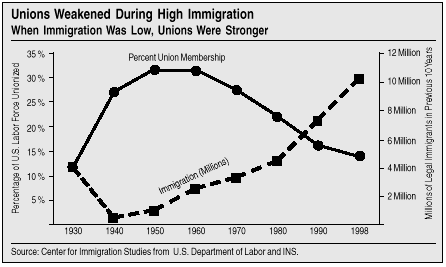
Now, in your packet you have an excerpt of Dr. Briggs' new book. As I said, the book explores American immigration and unions. In general, Dr. Briggs finds that immigration tends to weaken unions. He shows that historically unions have generally done best when immigration was low and have generally done worst when immigration was high.
We see one graphic representation of that in the first figure over here, looking at immigration over roughly the last 70 years, as well as the share of the work force that is unionized. One would seem to be the two appear to be inversely related. In other words, immigration is bad for the union movement. At least that seems to be the historical trend.
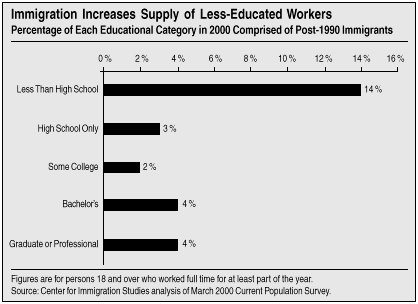
In addition, we have another figure here, also to my left, that shows how immigration increases the supply of labor disproportionately at the bottom end of the labor market. That 14 percent increase in the supply of labor over the last 10 years is in the supply of people with less than a high school education. Its impact on other educational categories these are individuals in the labor market is of course much more modest. This is an issue Dr. Briggs talks about as well in his book.
Also joining our discussion is Dr. Tom Palley and we're delighted to have Tom. He is Assistant Director of Public Policy at the AFL-CIO in Washington, D.C. He holds a B.A. degree from Oxford University and an M.A. degree in international relations and a Ph.D. in economics, both from Yale University. He has published extensively in numerous academic journals, focusing on monetary policy, the relationship between inflation and unemployment, and other issues affecting American workers.
Dr. Palley has published two books: One, Post-Keynesianism, Debt Distribution and the Macro Economy; and I have in front of me Plenty of Nothing: The Down- Sizing of the American Dream and the case for Structural Keynesianism. This is now available in paperback form.
In addition to Dr. Palley, we have Jared Bernstein to my left. He is an economist at the Economic Policy Institute, also here in Washington. He holds a Ph.D. in social welfare policy from Columbia University. He has published extensively in popular and academic journals on income and wage inequality, as well as technology's impact on wages and employment and low-wage labor markets, as well as issues surrounding poverty.
Between 1995 and '96 he held the post of Deputy Chief Economist at the U.S. Department of Labor. Also, he has co-authored five editions of the book State of Working America, put out by the Economic Policy Institute, and, most interestingly, according to the International Economy in 2000, Dr. Bernstein was one of the most-cited economists in the world.
So, after that nice introduction, why don't we go with Dr. Briggs.
PRESENTATION OF VERNON M. BRIGGS, JR., PH.D.
DR. BRIGGS: Thank you very much, Steve. It's a pleasure to be here to speak to you this morning.
This topic, Immigration and American Labor, is one that I feel very closely since I first started you career back in the 1960's. As a young professor, my first exposure was going to teach at the University of Texas in Austin and being invited to go down to the border with a group of students. We were involved with the efforts of Caesar Chavez to organize farm workers in south Texas. I went there. I was educated in Michigan, actually born here in Washington, grew up in this area. I had never seen the border before.
Once I was there, it was clear that this strike was a lost cause. I spoke with Caesar Chavez later when he came to Austin, particularly about the situation at the border. He was optimistic that it could be overcome, the march to Austin, what have you.
The big issue at the time the AFL-CIO was fighting was border commuters. I didn't even know what border commuters were or how they evolved until I went down one morning at 5:00 o'clock in the morning to watch the crossing, people being picked up by bus and driven right through the picket lines to the farms in the grape strike. It was at that moment it was clear there was something about the border I didn't understand.
So for the next 30 years I've tried to understand various facets of immigration policy and how it impinges on the labor market. By the way, those workers are still not organized and they never will be as long as the border immigration policy continues to be as it is, and the poorest workers in terms of income level in the United States are in that county, one of the most impoverished counties of the United States.
The broader issue which I have spent most of my life working on, and coming back to the union issue, I find that there's no issue that's caused the American labor movement more agony than immigration from its very beginning, because immigration can affect the size, the distribution, the composition of the labor force, local labor supplies, wages. It can have impact on especially local labor markets that are significant to the labor movement. It also supplies strikebreakers, as it did in south Texas and continues to do to this day if there are a sufficient number of people willing to do the work in low-skilled work, and quite often that's possible.
The irony, of course, is that the labor movement has had to face the immigration issue, because most immigrants come in as workers. Relatively few come in as employers, and so it's a direct labor issue. For the long run, most immigrants will work all their lives and be part of the labor movement, and the labor movement has got to have interest in it.
It's interesting that as you study the history of American labor and immigration together, that the labor movement up through the mid-1980's is basically responsible for every immigration policy we have, that its fingerprints are on every piece of immigration legislation without exception, the good and the bad, involved in all the history of the immigration policy. They were a key player, not the only one, but a key, key factor.
It's interesting that right from the beginning, when Samuel Gompers, the most influential labor leader in American history, president of the AFL for 38 years, noted after becoming president in 1886 of the Federation, in 1892 the Supreme Court for the first time made it clear that the Federal Government has responsibility for immigration policy, not the states and local governments, it's purely a federal responsibility, that in his autobiography he wrote that: "The labor movement was among the first organizations to urge that immigration policy obtain limits and be accountable for its consequences."
As he put it so boldly: "We immediately realized that immigration is in its fundamental aspects a labor issue."
That fundamentally, that's what immigration is all about. You can cast it in a lot of other things and there are a lot of other dimensions of immigration policy, but fundamentally it's a labor issue. Most immigrants work and it's what they do by their presence themselves or how others are affected by their presence that has been of importance to labor.
So labor right from the beginning has sensed that there was some inverse relationship. I'll put this chart up here. This is up here already. This was passed out. It's from the book, showing basically the segment of the labor force that's foreign-born, which is roughly the percent of the population that's foreign born, and I've used the foreign-born from the census data because every 10 years you get the best count of immigration and of the foreign-born population.
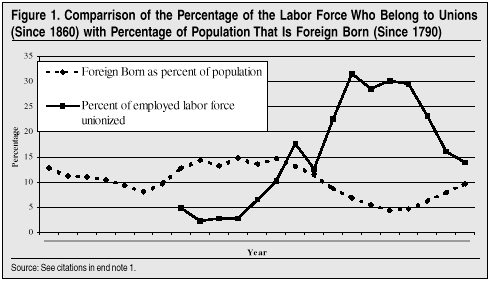
This is the percent of the labor force that is unionized. They have tended there are some exceptions back here that are covered in the book, but by and large they've tended to move inversely.
I think it's especially interesting to note that in 1965 and we'll get to the present or let me say, from 1924 through 1965 when immigration was finally restricted we forget that immigration has not been a continual pattern. We've had growth of immigration, but for a good part of the twentieth century immigration was in decline, from the twenties through to the 60s.
In 1965 when the Immigration Act of 1965 led to the renewal of mass immigration again, only 4.4 percent of the population was foreign-born. That was the lowest in all of American history in 1965. That same year, the percentage of the labor movement, of the labor force, who were union was over 30 percent, one out of every three workers, just about the time I was entering my career, one of the most dominant, influential movements in the American labor market, the union movement.
These were, as you see it, quite opposite pictures on the spectrum. Since then the labor movement has gone into a tail spin and immigration has taken off, and we're now in the midst of the largest immigration in American history. We know that since 1965 the foreign-born population of the United States has increased by 231 percent, from 8 million to about 28 million. That's conservative. The civilian labor force has grown by 86 percent, from 74 million to 139 million. But union membership has fallen by 10 percent, from 18 million to roughly 16 million.
So that there has certainly been an enormous change in the picture in the fate of labor since the revival of mass immigration in 1965, which the labor movement played an influential role in passing the Immigration Act of 1965. I am old enough to have supported the passage of that legislation, too, to get rid of the national origin system. But all the rhetoric, all the political language, used to support, to package that legislation, promised that immigration was not going to increase, that that was not the whole purpose.
That was the exact year that the post-war baby boom hit the labor market. There was no shortage of labor in 1965. What we were trying to do, everyone was trying to do, including the labor movement, was to end the national origin system. That was the assumption of what we had done. No one realized we had opened up a new era of massive immigration which we now continue to be a part of.
Every study that I know of that has looked at the effect of immigration on the labor market has shown that the impact is the most severe on low skilled workers; low skilled workers bear most of the impact, and they have borne most of it. We can talk about some of that perhaps later, but every study that I know of has shown that the increase of immigration is disproportionately low skilled workers, as it has always been.
The difference is that the labor market today is much different than it was at the turn of the century, when we desperately needed low skilled workers, as opposed to today, when the low skilled labor market is increasing slightly, but not very much that is, the number of jobs for low skilled workers and the supply, however, of low skilled workers is increasing dramatically, due largely to immigration, since about 40 percent of the adult foreign-born population do not have a high school diploma and pretty close to 60 percent have a high school diploma or less. That is, they're heavily concentrated in the low skilled labor market.
Unfortunately, there are large numbers of other citizen workers in the low skilled labor markets, too. They've not all gone away, especially minority workers chicano workers, Puerto Rican workers, black workers, and certainly white workers in those low wage labor markets.
The stock answer is that they're actually taking jobs that no one else will do. We can talk about that a little bit later.
But the labor movement has always been the strongest advocate of immigration policy that we have had up through the 1986 Immigration Reform Control Act, which they supported enthusiastically, but after that began to change their position and are now poised to radically change their position. The question to me basically is why would they want to do this?
I think it's partly this is speculative partly, but most of it is based on historical reality, economic studies of who wins and what loses in the immigration battle. But as you get to why would they want to change their position, it seems to me it's partly an effort to try to become part of a rainbow coalition with progressive forces, and that rainbow coalition on immigration issues has had some tough times. That is, the rainbow coalition as I see it is a way in which basically groups join together knowing that they're going to have to give up on some things that they favor in order to get other things that they want, and hopefully they'll come out better off by joining with other forces and won't be hurt too much.
I think, with respect to immigration, this is a real gamble because I think it is likely to affect desperately a citizen work force who has to compete, especially in the low skilled labor markets, with the growing immigrant work force. Especially as we relax the restrictions on illegal immigration, they're going to bear the costs.
I think when the AFL-CIO Executive Council says that they stand firmly on the side of immigrants now that's what the declaration of February 2000 said who's on the other side? The other side has to be the native-born. So there's an old labor song, "Which Side Are You On?" If you're going to take the side of immigrants, it defies basically the history of all the earlier labor leaders of this country, what were immigrants themselves, many of them, but always understood that you cannot be for the American worker and be for immigration simultaneously. You can be for one or the other. That doesn't mean you're anti-immigrant. It just means you're interested in your policies, but you're interested in the American worker first.
The interest of the American worker can't possibly be in increasing surges of unskilled workers into the bottom of the labor market. There are people who do benefit from that in business, and that's part of the strange coalition, people who enthusiastically welcome the change in position of the AFL-CIO. You may begin to wonder why, why would such friends who are otherwise your enemies be so enthusiastic about what you're trying to do?
I think this is part of the danger, that you're going to alienate the workers and many other citizens who are beginning to realize that the labor movement is shifting its position on this issue, who are harmed by the labor movement. Also, I think more seriously, if you really take this policy to its logical conclusion and you abolish employer sanctions and endorse mass amnesties, which means amnesties forever after this, you're basically going to swell even more the low skilled labor market of the United States, which means you're going to find yourself in a situation where, even if you get them into the unions and you get your numbers up and the numbers look like you're doing a lot, you're not going to be able to do anything at the bargaining table because you're going to swell the supply of workers in those low skilled labor markets and it's going to make it more difficult, I think, to actually show gains.
Well, there was a lot more I was going to say, but I think I'd rather share it with the others. Thank you.
DR. CAMAROTA: Thank you, Vernon.
Next will be Tom Palley of the AFL-CIO.
PRESENTATION OF THOMAS PALLEY, PH.D.
DR. PALLEY: Thanks very much, Vernon. A couple of points.
To start with, what you're going to hear from me today are my views and not those of the AFL-CIO. I have brought along, though, with me unfortunately, following the announcement I got some calls from people thinking that we had reversed policy as it currently stands. I want to emphasize that that is not the case and there is indeed a resolution at our upcoming convention that is going to further solidify the position that we currently hold.
I brought along 50 copies of our very good resolution passed by our Executive Council in July of this year. It's available at the table outside, so please do pick it up out there and then you can really read what AFL-CIO policy is about.
I've called my talk "Making Labor Whole Again," which is what I think this issue is all about. It's about solidarity.
I would say, first of all, immigration is just an enormously complex and difficult issue. There are underlying economic complexities, which in fact I think are what most of today's panel will be about. There are huge political complexities in all of this. Sort of into the mix, there is always a danger of political opportunism that can really poison the debate and take the rationality out of it. I don't believe there's any of that in this room today.
My own job is to talk about the economic complexities and that's what the focus of this talk is going to be.
We've got to begin with an assessment of today's policy, and I believe today's policy can be best described as a lose-lose situation. The policy is broken. The bottom line is American workers, citizen workers, are losing because they're threatened by increased employment competition, which is having a negative impact on wages, and undocumented workers are losing because they are prone and subject to really terrible exploitation. That is the condition that we as public policy people have to address and try and remedy.
I think it's useful to sort of dig below: Why are we even interested in immigration? By the way, this is a slide that is taken a little bit, borrowed from a EPI's own economic data, and you can find this slide in slightly different form in this book. There are two books I say you should always carry around if you want to know the economy. One is "The State of Working America." Of course, the other is "Plenty of Nothing" because it gives an interpretation of what's in "The State of America."
The bottom line we're interested in this problem is that there has been tremendous wage stagnation over the last 25 years, and productivity growth and compensation have just broken apart. Abby Stern, president of SCIU, calls this diagram "the snake." The top line is productivity growth not growth; productivity, index 100 in 1973 and growing steadily through time, a steady increase in productivity in the American economy. The middle line here is the median compensation for all workers, men, women, the whole labor force. Then the bottom line there is the median wage for a male worker, which is actually now below what it was in 1973.
If you can break it out, if you broke it out by skill levels, it might be even worse. But a complete disjunction beginning basically early 80s, late 70s, between productivity and compensation. That is the reason why immigration is such a huge problematic issue. I believe if this wasn't here we wouldn't be talking about immigration in these kinds of poisonous terms. That is out there. We have to solve this problem.
I want to confirm again - I picked out some data from "The State of Working America" and put it into table form. That kind of confirms that slide we just saw. Everyone is losing, or at least most are losing. Those at the bottom are losing most.
You can really see it by educational attainment. This is folks with less than a high school education, very severe erosion in the decade '79 to '89, continued erosion in the decade '89 to '99. Even those with high school, some erosion, at least in the first decade. They didn't get any of the productivity gain of the new economy in this last expansion, and over the 20-year period negative. Those with some college, they actually lost in '79-'89 and they again didn't participate in a great new economy of this last decade.
Then finally, those with college and advanced degree groups, and those are the people, us in this room, who have done pretty well. This is related to the immigration issue and it goes to show why immigration is such an important issue.
I'm an economist. I have to bring in a supply and demand curve. What I want to say here is that the type of policy if you want to understand today's failed policy, you have to understand the framework that is generating an interpretation of the world.
Here we have on the vertical axis wages and the horizontal employment, the labor demand schedule. As wages command more, there'll be more demand from employers as the supply schedule. This is the citizen labor supply. The wage in the economy is determined by the intersection of supply and demand.
What immigration is supposed to be doing is pull down the labor supply curve, shift it down, and therefore wages are falling even as employment is growing. That's the interpretation that this framework has. Of course, to the extent that the increase in supply is concentrated at the bottom end of the labor market, low wage, low skill, those groups have suffered more.
Now, this model has a clear policy prescription. What you want to do is try and drag this supply curve back. So what do you do? You try and reduce the supply of undocumented workers. You have penalties on them. You make it difficult for them to find jobs. You drive them underground. You do everything you can, and hopefully that will provide the incentive for them not to come, for them not to be in the labor market, and pull this supply schedule to the right.
Well, I'm going to say that that framework has failed. There are millions of undocumented workers in America. Wages have been driven down. It hasn't worked. But it hasn't worked and basically it leads you to the wrong type of policy prescription.
The supply and demand framework is appropriate if you're looking at the market for currencies. If you want to understand the euro-dollar exchange rate, that would be the right model to use to understand that phenomenon. But it's not the right model for understanding labor markets, and that is what's absolutely key.
The critical thing that is important in labor markets is bargaining power. We all know that. Vernon knows that, too. The interesting thing about the supply and demand model is that there is absolutely no bargaining power. That is the core assumption of that model. It's called the price-taker assumption. Both buyers and sellers in the market are price-takers and have no bargaining power. This is a model that therefore cannot possibly represent what is going on in labor markets. It is completely absent.
So what do you need? You need an alternative analysis. The way that I see this and we'll talk about it is that the wage settles somewhere between there is indeed a maximum wage that firms will pay based on productivities, and that's why productivities are important, and there's also a wage floor, and that wage floor is determined by such things as the minimum wage, by pay norms, by social norms, whatever.
Then that leaves us a bargaining zone between the maximum amount a firm will pay and the wage floor. The actual wage then depends on bargaining power, where it settles in between in that bargaining zone.
I think that sort of framework again, very sort of framework, your policy prescription is going to come out of your policy framework. That framework comes up with a completely different policy description.
The diagnosis is that the problem is coming from the impact of immigration, which is supposedly having an impact on the bargaining power because it is exposing domestic workers to a pool, creating with this policy of driving workers underground, you're creating a pool of workers, a very large pool of workers that are open to exploitation.
In a sense, you have split labor. Labor is no longer whole. You have domestic workers and you have these undocumented workers who are apparently, because of the legal policy framework, at odds with each other.
If you want to understand what's going on, see the movie "Bread and Roses." It's quite clear the filmmakers understand the labor market better than our Nobel Prize-winning economists from Chicago. This tells you exactly what the problem in labor markets is about.
The prescription is to make labor whole. We need to take away employers' ability to exploit this pool of workers. That involves, among other things, legalization, possibly trying to give safe harbor to undocumented workers where they are employed in for employer violations of labor law. So if you're trying to form a union and the employer brings up the INS and says, you're an undocumented worker, you've got to give that undocumented worker safe harbor. That is the type of thinking that is behind the AFL-CIO's policy.
That leads us to the next question: Will legalization create a flood of new undocumented workers? This is the kind of great scare tactic that's thrown out there. I want to point out a couple of things. First of all, we already know the current policy is not working. I want to point out that the existing system of immigration controls we're not going to get rid of the Border Patrol, we're not going to get rid of the procedures for applying for immigration and coming into the country. But we will be dealing with legalization and we will be giving undocumented workers now and in the future this kind of safe harbor from exploitation.
Finally, behind the sort of scare tactics, some economists would call it a moral hazard. You're changing the rules and giving people an incentive to come into this country. I know of no evidence that immigration is drawn by a chancy prospect of legalization at some future distant time.
Again, if you want to see a great movie from the 80s, "El Norte." That's the sort of issues that are driving immigration. It's not that they're making some kind of calculation that we're going to get legalized 10 years from now. Again, the film makers understand the issue better than do our economists.
We want to get also in this debate, we need to get the immigration and wages debate in perspective. Just what is the role of immigration in causing these problems, this dysjunction between productivity and wages and compensation? How much is immigration really contributing to falling compensation? Well, I think most studies show that it only in total explains a small part. Again, I refer to some studies that the NBER put out, a couple of papers, Milan and Topol and then Altoni and Cart, an important volume in '91 looking at it.
Empirically, the effect is quite small. A one percent increase in the share of non-native-born workers results in somewhere between a one percent decline and a 0.3 percent decline in wages. So it's only a small piece of what's going on.
Secondly, it cannot explain why wages are disconnected from productivity growth for everyone. You saw that chart that shows with high school degrees, those with some college, and even more recently those with college are not getting much of a raise. There is a disconnection. That has nothing to do therefore with immigration. That really is the real causes.
If you have this bargaining zone model, what's clearly going on is something has changed about bargaining power and something has changed about the wage floor that sets the bottom for the size of the bargaining zone. Those things are the erosion of the minimum wage, we have a slashing of the safety net that takes away alternatives from people, therefore making them more vulnerable to threats of being dismissed. We have a complete Swiss cheese UI system that is currently part of the debate in the stimulus package, trying to make our UI system whole. And we have a decline in union density.
I think those are the factors, if you want to look at it, what is going on. These are the factors to concentrate. This is the basis of the problem, and if labor's not whole you can't fix these types of problems. If this is where the action's at, we've got to make labor whole again.
That then brings me to Vernon's hypothesis about immigration being bad for unions. My view is, after reading the book, that his argument simply doesn't stack up. The first point, unionization density peaked in 1953 at 32.5 percent and then started steadily, slowly declining throughout the 50s and the early 60s. So way before the so-called 1965 cutoff and even then it was gradual; immigration didn't accelerate very much in the late 60s we had already a declining union density.
A major factor for me is shift away from manufacturing. Look at these numbers. There's an interesting correlation here. Manufacturing share of employment in 1950, 33.6 percent; union density, 31.6 percent. Manufacturing share of employment in 2000, 14 percent; union density, 13.5 percent. That is an absolutely key factor, the changing composition of the U.S. economy, the move away from manufacturing where unions were concentrated.
Then let's go to the next point. Unions under the current arrangements are blocked from organizing at the new places of employment. That's critical. Our labor laws are inadequate. Where a union shop exists today, it can basically sustain itself. Employers can't break it. What they can do, though unless they close the factory down and move the work away completely. Very little in the way of decertification elections, very few in number, affecting a very small number of workers.
But the labor law is so weak that employers can stop unions and workers from exercising their right to organize. That's key. Labor law reform is key. Taft-Hartley and right to work is a problem. We have the runaway shop problem and employment moving South to right to work states to try and escape unions.
Then I think there's a more general issue. I think the unions are partly responsible here, but it plays into a very much bigger picture about U.S. sort of intellectual understandings. I think there's been a failure to educate about the mission, function, and contribution of the unions, particularly for middle class folks. I really am very critical of economists. Economists always describe unions as a market distortion and obviously that's the public perception that's out there. More and more people go to college, 50 percent of high school folks, 18 year olds, now end up at college, get some college exposure, get this type of poison about what unions do. We really haven't been able to counter that. That is a huge issue.
This is the sort of thing that we should be discussing, the press should be discussing: Why is the public mind so poisoned against it? In "Plenty of Nothing" again, I talk about some of these issues: the postwar history, we thought we had solved the economic problem through Keynesianism, that unions were part of the past, a fundamental misrepresentation of the economy to people that then informs the public understanding, the public debate.
Immigrants and unions. I believe there's no evidence that immigrants have a lower desire for union representation. Here again, we see it: the percent of union membership by Hispanics. They don't cut things out by native-born and not born and I don't do the sort of micro analysis that Steve does, but in 1985 6.9 percent of Hispanics are union members and in 2000 9.6 percent are. This is not surprising. Unions have always had the most appeal for those who are most exploited and these are the most exploited workers in the economy.
So in conclusion, I think Vernon's book is indeed a useful summary of history of U.S. immigration policy and labor's relation to that history. So the historical piece of the book is kind of useful. I think it is a fundamentally flawed account of the relation between immigration and declining union density. Declining union density has nothing to do with immigration. It has everything to do with much more sub-structural, foundational factors.
Then finally, I think there's absolutely no foundation to the charge that the AFL-CIO position is a betrayal of citizen American workers. Far from it, making labor whole will correct the problems that they have had to confront these last two decades.
Thanks.
DR. CAMAROTA: Thank you, Tom.
Now we'll hear from Jared Bernstein of the Economic Policy Institute.
PRESENTATION OF JARED BERNSTEIN, PH.D.
DR. BERNSTEIN: I'm really going to try to talk for 10 or so minutes, because I'm very interested in what the audience has to say. As Tom correctly pointed out, I think Vernon as well, you can step into a lot of mud puddles pretty quickly on this issue, and I would love to mix it up with the folks here. So let me try to be brief.
Also, I think my views fall somewhere in between the two approaches, so maybe I can skip over some of the points that I wanted to make.
Vernon presented his argument, Tom presented kind of a counterargument. I'd like to focus on the book a little bit more and suggest where I think Vernon has it right and some areas where I think it's questionable. Then I want to finish by talking about the strategy that the AFL is talking about pursuing as, in Vernon's phrase, a real gamble, but a real gamble that's maybe worth taking.
I think the message of the book is a little more subtle than it probably will be interpreted. This is not a book that's anti-union. This is not a book that doesn't think unions should organize immigrants, and Vernon's very clear about that, and I would initially put that on the table.
When I heard about the union leadership changing its view on this point and it's one that, as Vernon points out, it's a really fairly important and significant change to me it was interesting, it was understandable, and it was positive, in the following way. As Vernon takes you through in great, excruciating detail, there's an ugly history here and there's a great deal of racism and there's a great deal of stuff going on between unions and foreign people in this country that I think many of us would find distasteful.
Secondly, the view struck me as understandable that, if you can't beat them, organize them. Here I think Tom Palley makes really a point that you just can't get away from. If they're already here and we've organized them, that can only raise wages. If they're already here and they're putting downward pressure on wages because they're undocumented and because they're exploited, that's clearly, as Vernon points out, lowering wages.
I think Tom overestimates the importance of studies that let me take a few negatives out of that. I think it's very clear that increased immigration lowers wages, that the increased supply effect of his diagram actually plays into the lowering of wages. I think there's a few studies that you mentioned that go the other way that are outliers. The vast majority of the research shows that immigration, especially at the low end, does lower wages.
But these folks are already here and they're having that impact already. If we organize them, if we make sure that labor standards and perhaps union power applies to them, their wages are going to go up and low wages will be higher, wages will be higher in the low wage sector. So I think that comes out of Tom's analysis and I think it's really key.
The question is, and Tom and Vernon both spoke to this, is what effect does that have on bringing more folks here, if you give amnesty? I think one of the big questions about amnesty that really isn't picked up in the boom and Tom dismissed it and I don't know enough about it to know if that's correct if you give amnesty to those immigrants who are currently here illegally, what does that do to the flows of immigration into this country?
I agree with Tom that there's not much evidence on it, but I can't believe it would go to zero. But even if it goes to zero, that doesn't mean it's a mistake. You need to know the magnitude of that particular effect.
Thirdly, I thought it was a good idea because it would strengthen the low wage labor market in the way that I just mentioned.
So those are the reasons that I thought the change in the union's position is important and positive. But of course, I also have some concerns. It's the amnesty effect, which I just mentioned, is worsened to me. If amnesty increases the flow of illegal immigration, we've got to be mindful of that because that reduces wages in the low wage sector just like Vernon says it does.
However and here's something that hasn't come into the discussion yet the 1990's and I have a couple of my own slides, but I won't show them in the interest of time. The 1990's saw a couple of very important trends relative to this debate: a significant increase and even an acceleration in the rate at which immigrants were entering the labor force; and a significant increase in the wages of low wage workers. So any correlation that says increases immigration equals lower wages was broken in the 1990's. Here you have me saying that correlation is true historically.
Well, the reason it was broken in the latter 90s is because labor demand increased far more than labor supply. Labor demand for low wage workers was really strong in the latter 90s. We got to full employment and that drove up the bargaining power and wages of low wage workers.
So the demand side of the story is also really important. It's not just supply. it's not just bargaining power, although I think both of those are important. it's also labor demand. So this lockstep view between supply and wages has to be filtered through that observation.
The other concern I had about this is the alliance with pro-immigration groups that are also anti-union groups, and Vernon documents just who those groups are in the book. But I think Vernon makes an excellent point: You do have to be concerned about who's on the other side of this debate if labor joins forces with the National Association of Manufacturers and the Americans for Tax Justice and some other groups that are not really happy about unions.
Lots of times politics makes strange bedfellows in this town, and every time it does I think you need to look at it and try to see what it smells like.
Now, Vernon's concerns about more immigration and less unions, this kind of correlation, I share Tom's view that that correlation is not really much evidence of causation. Another way to look at it is, to think about it, if you look at the statistical relationship between state-level union shares and state-level immigration, and Steve Camarota is just the kind of guy who could do that, because I have done it. But I suspect you wouldn't find that great correlation at the state level, because you've got lots of states with high levels of immigration and high levels of unions. I'm thinking of New York and L.A. and places like that.
You've also got states with very low levels of unions and low levels of immigration Oklahoma, Arkansas. These are some right to work states. Oklahoma is now. These are states with right the work laws and so they tend to have fewer unions. They also tend to have fewer immigrants.
The only point is that this relationship, whileI disagree with Tom that it's nonexistent, there are lots of other factors playing a role, and Vernon takes us through some of those in the book.
This brings me to the question: So, what's the union's rationale for this? It's kind of a Willie Sutton approach. He's the guy who said: Why do I rob banks? Because that's where the money is. Well, why do you organize services? Because that's where the workers are.
The Willie Sutton approach: that's where the workers are. Tom made that case. If unions are going to be viable, they have to organize workers and services. Some unions, thankfully, the SEI unions, have really been aggressive about that and really successful about that.
By the way, one of the things you see in that graph is that the rate of union density actually continues to decelerate, but to decelerate at a slower rate, in the 90s than it did in the earlier decades, partially because of this initiative taken by labor. Meanwhile, that deceleration coincided with an acceleration in immigration. So another point, that the correlation between those two lines is not as strong as I think Vernon might make it out to be. But unions have to organize workers in low wage services.
I'm going to wind down here. I have lots of reasons why I think that's difficult. I am sure some of the organizers who may be in the audience can tell us more about that than I could, but in the interest of time I'm not going to go through that.
I think I'll actually kind of wind down by pointing out that I think one of the points that Vernon makes really kind of struck me as compelling towards the end of his book. He points out that he's not against immigration or against unions organizing immigrants; he's against unions promoting immigration, especially illegal immigration. He says let's leave the promotion of immigration to others, and others whose interests don't typically coincide with unions. I think that's a point that we who are very supportive of union movements, very supportive of Tom's point of making labor whole, need to take seriously.
Why then are unions doing this? Well, it's a strategy that, in Vernon's words, is a real gamble. Unions are trying to appeal to new members, many of whom are immigrants and many of whom work in the low wage sector where they're being exploited on a daily basis, and unions can do something about that. Vernon's right, it's a real gamble.
But is immigration bad for the union movement, as he said? I don't see. There may be some evidence for that historically, but the world has changed. Particularly the industrial structure has changed and it's far from clear to me that immigration and the unions' approach to immigration is bad for the union movement. It seems to me in a "Bread and Roses" sense that a rainbow coalition could be exactly the kind of strategy for moving forward such that we apply union power and union standards to everybody.
That said, I think the key thing that you need to worry about here is the extent to which amnesty brings more illegal immigrants into this country. I said it before and I'll say it again because I think it's the key of the debate that isn't emphasized. At least I didn't if it's in the book, I didn't see it. I paid more attention to the 11-page summary actually of the book, but I did try to read some of the book as well. I didn't see this taken up in the book.
If one can make a case and I'm interested in the panel's discussion to this point. If one can make a case that amnesty leads to a sharp and I would say a sharp, not just an increase, but a sharp increase - and we can talk about what that means influx of more illegals, then I think the unions need to think more carefully about the implications of being pro-amnesty and joining some typically strange alliances to do so.
I'll stop there.
Question and Answer Session
DR. CAMAROTA: Thank you, Jared. Thank all our panelists. We're running tight on time, so I kind of would like to open up, unless somebody has something very specific they want to say quickly.
Let me also make one point. There actually has been a fair amount of research done, primarily by Robert Warren at the INS as well as Hans Johnson at the Public Policy Institute of California, looking at the question of whether the last amnesty caused a surge in illegal immigration. I would say there's a consensus that it did cause a significant jump, maybe a 50 percent increase. But it also doesn't appear that that lasted for an extremely long period of time.
So in other words, it just remained at a very high level there after. So the number of new illegals entering may have gone up after the last amnesty by 50 percent or maybe more, 75 percent, and then it dropped down and then it stayed higher than it previously was. But whether that higher level was associated with the amnesty is a matter of debate. I think it is, but that's open to question.
But there is consensus among immigration researchers that the last amnesty did cause a surge. Maybe a million, a million and a half extra people came in associated with that amnesty. Of course, how could it be otherwise, as all the family and friends and relatives and so forth of the newly legalized coming in to join them. So it's not really a surprise. People talked about it and I think there's a consensus on that point.
Now, I want to take questions from the audience. In the back there.
Q: Yes. For Dr. Palley: You said initially that you didn't feel as though this policy of the union, of AFL-CIO supporting amnesty, was a new policy. I don't know where you're coming from with that because it seems to me that AFL-CIO until just recently has always taken the position that illegal aliens take jobs away from Americans, so therefore the government should try to keep them out.
DR. PALLEY: I didn't say that. I said there is a policy I place and that policy is not being reversed now. I was just answering. Some folks called me up and said they had read this announcement of policy reversal. They had misinterpreted what Vernon meant by it. They thought that there was some change regarding the January, the February and July resolutions, and those are in place and unchanged.
Q: Okay, but that does represent a reversal from previous years?
DR. PALLEY: Yes.
Q: Okay, fine.
Q: First, I want to thank the CIS and the panelists for what I think has been an excellent presentation of the opposing views on this. I think it's just marvelous to have this kind of opportunity.
But I also want to when we're talking about why the unions have changed their position, one of the things that you can't ignore about how the unions have changed in the last 40 years is that the composition of the unions has become increasingly dominated by the public sector. I think it's like 43 percent of the unions today are government unions. It strikes me that one of the things, when you think about the interests of government unions, since immigrants and illegal immigrants when they are legalized would fall into this category are disproportionately high consumers of government services, that part of the reason for the shift inside the AFL-CIO has been the rising influence of the public sector unions that see this increase as an increase of growth or an increase of their potential market for their services, as opposed to the manufacturing unions and the private sector unions who are damaged and hurt by this thing.
So I'd like the perspective particularly of Dr. Bernstein and also the other panelists on this question, if this might also be an explanation for this shift of the AFL-CIO.
DR. BERNSTEIN: You mean that the AFL may be shifting its position because the largest group of unionized workers are providing services to more and more immigrants?
Q: Immigrants are disproportionately consumers, according to national research, of government services. We begin with school teachers.
DR. BERNSTEIN: I'll tell you, it's a reasonable hypothesis and you might be right. I don't know that there's any evidence for that. It doesn't resonate with me right off the bat, though, because I've seen most of the activities around immigration as organizing although I do think AFSCME is interested in organizing immigrants as well, I think that the organizing tends to be more in the private sector services. I'm thinking of Justice for Janitors, by the way.
So I don't know that you're right. I think it has more to do with a kind of a solidarity with the low-wage labor market, as Tom was discussing.
Can I just say one thing about this Justice for Janitors? There's a case study in here of Justice for Janitors and people in the room like John Hallen might know a lot more about this than me, so John, please correct me if I misspeak. Vernon talks about how what you had here was a movement wherein a group of workers who were in a low skilled job unionized and were making wages closer to middle class wages than those jobs paid now, were displaced by immigrants and wages tanked in that industry.
Justice for Janitors comes along and organizes these immigrants who are really being exploited and their wages go up, and that's great. They go up to around half the level that they were before, and that's a problem.
Now, you can do the mental processing as to where you go with that, but I thought that was a great example of the costs and benefits of this strategy.
DR. PALLEY: I would say that's way too Machiavellian an idea of what's driving this thing. I've never heard anyone talk about how we've got to increase demand by increasing the clientele for government services. It's making labor whole. It's a solidarity issue. You can't put a wage floor in place, you can't have bargaining power, when labor is divided with itself, as current law has it.
DR. BRIGGS: I tried to find out something about that question because I wondered about it, too. I couldn't in this particular book, but it is interesting to note that the public sector is one of the most difficult ones for immigrants to get into. Theoretically, if that were the case, because in most cases you must be a U.S. citizen we're even seeing it now with the inspectors at the airports; they're now talking about federal employees and it's one in which even legal immigrants, if you're not a U.S. citizen, not naturalized, you can't be employed in many, many, federal government offices.
Q: They're protected in the government.
DR. BRIGGS: That's right, they're protected. In New York State where I am, you can't teach in the public school system if you're not a U.S. citizen. So if it is the case, it is Machiavellian, but I'm hoping that's not the case.
DR. CAMAROTA: Mark.
MR. KRIKORIAN: I have a question about the two components of what the AFL-CIO called for, because this isn't sort of an all or nothing. There's two parts to what the AFL-CIO called for. I have a question about some of the moral implications. The AFL-CIO called for legalization, amnesty for all the illegal aliens who are here, but also an end to the ban on hiring illegals, in other words making it legal again to hire illegal aliens, so that employers would not suffer any penalty if they hired illegal aliens. Those are the two parts of the policy change.
Now, assuming Jared raised the question about whether amnesties bring in more illegal aliens. Let's assume that the level of illegal immigration doesn't change, just for the sake of argument. But if border enforcement remains in place as you've suggested and as the AFL-CIO statement suggests in other words, it's not open borders; we still have border controls, but we now have essentially an invitation for workers to come across the border and get legalized or work legally isn't there a moral problem with that in that we force these workers to run a gauntlet of enforcement, to pass through the desert, to risk their lives, to get past the border enforcement which the AFL-CIO has not called for ending, in order to get the legal job they can now receive?
My point is isn't there a problem there, and isn't the AFL-CIO wouldn't it be more appropriate for it to embrace fully the Cato Institute, National Association of Manufacturers position and call for open borders altogether? The analogy I use here is Samuel Gompers statue downtown is on Massachusetts Avenue across the street from the Cato Institute. Isn't it more appropriate for Samuel Gompers just to cross the street and embrace entirely the open borders position, because without doing so you create an immoral situation where workers have to risk their lives before they can get here and join the union?
DR. PALLEY: Well, civil penalties would remain in place on employers who knowingly hire undocumented workers. I think it's sort of a sophistic argument that you're putting up there. We have in place added to the moral, the fact is under the current law, under the type of arrangements that Vernon would propose continuing with, that same problem is going to have to be. You're going to have to cross a dangerous border. That border is not going away.
MR. KRIKORIAN: I understood quite explicitly from the Executive Council's statement that employer sanctions altogether were to be erased. There are only civil sanctions now. You only get criminal sanctions if you have a pattern, if you're an employer and you hire them all the time.
The employer sanctions, which is the ban on hiring illegals, is now the civil fine. It's sort of a big traffic ticket. I understood the Executive Council statement in February specifically called for the repeal of those.
DR. BRIGGS: It did.
DR. PALLEY: As I understand our position, it's a new law bringing penalties for employers who seek to violate labor laws based on an employee's immigration status.
MR. KRIKORIAN: That's different from fining someone because they're hiring illegals.
DR. PALLEY: And providing swift penalties for smuggling, document fraud, and for those employers who break labor laws as a matter of business practice. I think that's the same. You still have if you have an undocumented worker and you knowingly hire them, I think you're subject to civil penalties.
DR. CAMAROTA: I think what they're saying is that we're going to enforce the labor laws, but we're not going to enforce the immigration laws any more. Isn't that the position?
DR. PALLEY: You have to look at the statement there. I think the principles are laid out there. It's a statement of principle.
DR. CAMAROTA: Go ahead, in the back.
Q: I wonder whether any of the panelists could speak to the global aspect of migration, because migrant flows have increased all over the world. Desperate people are moving across the border from the poorest countries to the slightly richer countries in Africa, in Asia, in Latin America. Everybody's not just going to Europe and to the United States.
So has anyone looked at the economic impact of migration in these other countries, where there are also unions and plenty of low wage workers?
DR. BRIGGS: Let me just say that's a big, big issue beyond what this panel is really concerned with. But the United Nations Population Council, I think correctly, two years ago, three years ago, said that immigration is the crisis issue of the 21st century. There's no doubt that, despite the fact that neither of our political parties will discuss immigration, we cannot have a frank discussion of it in the political economy. That is the issue for exactly the reason you said before. As you pointed out, we now have boundaries everywhere. It used to be if you didn't get along, you had a fight, you could move off to someplace else. Today you're stuck where you are unless you begin to force yourself into other areas.
It is the crisis issue. That's the real issue that bothers me most about this issue, is that immigration does not get discussed by either of the political parties.
Some of the issues that were just raised a moment ago, I just want to respond to one of them, the idea that immigration doesn't affect wages. The National Research Council did find that in the aggregate, but that's the aggregate. When you look at low wage workers, where most of the immigrants came, they found a massive effect. They said that 44 percent of the suppression of wages of the low skilled workers in the United States since 1978 up until the time of the report in 1997 was due to immigration not racism, not family structure, not human capital deficiency, but immigration.
It is a major force affecting low skilled workers, the wages of low skilled workers in this country, is oversupply. Yes, if you throw in a big model of the whole economy immigration doesn't look so big. It doesn't affect my wage at all. It's probably not going to affect your wage. If you're a low skill worker today, it affects it a lot. This is what we should discuss.
The point I'm trying to get to your question here is immigration can't, however, be the answer to every question: If people are starving to death, a riot here, a civil war, come to the United States. We've got to take the immigration policy to the next level, but we're still stuck back here on the kindergarten issue about whether or not people coming into the United States illegally, violating our laws maybe we should just do away with the laws and let them come.
Until we get an immigration policy in place, which every country has, then we can move to the next step about how we can deal with what's pushing people out, what's pushing people into these things population issues, corruption issues, human rights violations, these things which all in my sense can be linked together, and we'll get to that next level.
But we can't simply let the labor market be the escape valve in which everybody who's suffering on the planet comes to the United States and say there's not going to be some kind of impact on the low skilled labor market. So that's part of what I would say.
Q: I just wanted to reiterate, my point is everybody's not coming to the United States. Lots of people are going to just the next nearest place.
DR. BRIGGS: Two-thirds of all people coming for permanent settlement anywhere in the world, permanent settlement, are coming to the United States. It is a movement everywhere. It's going to get bigger everywhere else.
DR. PALLEY: I agree with Vernon. I would say this is a tremendously important issue. It ties in also with our international agenda, why things like labor standards are needed, why a development agenda rather than a trade agenda, dealing with income inequality within and between countries. Those are the issues that are our international agenda, that are completely not part of the sort of trade promotion type of agenda that we have.
So we do see this thing globally in exactly those sort of terms. There's a U.S. piece to it and there's a global piece to it and policy has to be integrated seamlessly across those pieces.
DR. CAMAROTA: Here.
Q: It seems that there's an agreement on the panel that everyone thinks that illegal immigration is harmful, and there seems to be also a concession that it cannot be controlled. Am I right? Is there just surrender here to illegal immigration? What should we do about it?
DR. CAMAROTA: One thing you do hear often is that we have tried employer sanctions and we failed, but I think any fair look at that same we didn't try and fail. Now, they might fail if we try. That's a fair point. It does seem, though, in the position for an amnesty and an end to employer sanctions there's a sense that we tried and failed. But I don't think anyone involved in enforcement as you know, there are only 300 INS inspectors devoted full-time to work on illegal immigration, just a little tiny group of people. They don't even work full-time on it, but that's if you put them all on full-time.
In addition to that, we don't have the kind of employer database system that will be critical to identifying employers who hire illegals. So we never tried and failed, and maybe if we tried we would fail. But it would appear that the argument for it suggests that we just can't do it.
You're right, there is sort of a sense the amnesty argument and the end of employer sanctions sort of takes as a supposition, that I think is undemonstrated certainly, that we tried and failed. But I think that's true.
DR. BERNSTEIN: I maybe didn't totally understand your question. I thought you were saying we're all against illegal immigration, but what's our position on legal immigration?
Q: No, illegal. It would appear to me that you're saying, that you're throwing up your hands and saying, we can't control it.
DR. BERNSTEIN: No, I'm closer to Steve on that. I'm closer to Steve on that. I don't know as much as he does about how hard we've tried or not tried, but my position, and I think probably shared by the panel, is that the thing wrong with illegal immigration is that it's illegal and I don't see anybody arguing that we should support illegal immigration.
I think the amnesty question doesn't say, as Steve pointed out, that we should open up the borders. It's just saying that they're here already, so let's join with them.
Q: It's just that I don't hear any proposal for controlling illegal immigration.
DR. BRIGGS: This is part of the issue. There's a lot of things we don't discuss today. I'm worried about the change in the position of the AFL-CIO on a whole range of immigration issues dealing with legal immigration and with illegal immigration, but we got off on the issue of illegal immigration.
The AFL and I strongly supported it supported in 1986 an amnesty and employer sanctions together, a one-time amnesty and never, ever again. That was supposedly ground rules, because our laws were not clear in 1986. It was not illegal for an employer to hire an illegal alien in the United States. It was really hard for us to say we didn't want them to come.
As of 1986 we have said that, they're not supposed to be here. There should never be the expectation of another amnesty again under any circumstances. That was part of the understanding.
The second understanding was employer sanctions would go into effect and hereafter we're going to demagnetize the labor market. They're not going to have the attraction. There's no sense coming here; you're not going to get a job. So then we deal with the question you were raising about what can we do with the people who stay in the country.
But because the employer sanctions were found to have an enormous loophole that is, the verification loophole, which the Jordan Commission recommended we try to stop, and the AFL-CIO supported a lot of these movements in the Immigration Act of 1986, that stripped away all those efforts to make the immigration laws enforceable, and it means that we never really tried to stop illegal immigration. We thought we were. It turns out we didn't, and in fact we did not make employer sanctions meaningful and that means you're not dealing with the verification issue.
The big hangup with the verification issue is it's a form of national identification. As long as it was us people talking about it, no one was talking about it. I heard Alan Dershowitz last night talking on television; he's all for a national ID card, not because of immigration but because of all these other things now that have taken place, and we now understand in the electronic age people are stealing people's identification records, all these other things. We're going to have to have some sort of national identification card, which by the way could be used to verify the authenticity of who you are when you apply for a job as a little ancillary thing to national security and the security of all your personal possessions.
It's going to come. It's going to have to. It's the age we live in. This is the kind of step we've got to take to stop illegal immigration.
In my view, when you say you're doing employer sanctions and you're going to keep giving amnesties, you're encouraging more people to come here and being supported by the worst elements of American society. I think it's the seamier side of American society today which would seem to tolerate this idea that we've got the immigrant labor force, we know they're down there, we know they're being exploited, and we just sort of turn our face away and say, oh, we don't want employer sanctions or enforcement on the borders or to make our employer sanctions strong enough with the proper verification.
There's a lot more to say on this, but understand that I want to stop illegal immigration. I think it's the key litmus test for people who are concerned about low skilled workers in this country, is immigration, and that's supported in the Bureau of Labor Statistics study, the Department of Labor. The Department of Justice triennial study says it's in this paper here; you ought to read it immigration is affecting unionism. That's the conclusion.
The Council of Economic Advisers has made it clear. It's all in here in the document. You can read it yourself. It is affecting the distribution of income. It's the reason a lot of the things that Tom talks about here, why the income redistribution is taking place, the infusion of low skilled workers, of which immigration is part.
Is immigration the only issue? No. Is it one of the issues? Absolutely, that's making poor people poorer in this country.
DR. CAMAROTA: Another question?
: Yes. A terrific panel discussion. As a former union organizer, I would have to challenge the idea that immigration, large flows of unskilled workers, is bad for unions. If you look at the turn of the century when the unions enjoyed their biggest surge of growth, that was the period of very high immigration.
I think the reasons for unions are a whole huge variety of factors. It has to do with what unions brought with them in ethnic solidarity, European history, and unionism, density of employment, but particularly the way that unions function, and it had much less to do with whatever position AFL was taking at the time on paper, a lot more to do with the fact that unions were perceived as effective advocates of immigrant workers.
However, I do agree with the point, the rather subtle point made by Dr. Briggs, in that if the AFL-CIO becomes perceived as a promoter of immigration rather than a champion of immigrant workers or trying to regularize employment and therefore prevent exploitation, that would be bad, because my experience living in a community in Arlington which is very, very high immigrant, and I think there is a valid point that those working in the public schools are exposed to this every day. They know the kids are here. You have to work with it, and I think that's what the AFL-CIO is saying.
But the immigrants themselves, those who are getting green cards, those who aren't, tend to be very much against further flows because they believe that people take advantage of the system and making the pull too hard is hurting their interests. So the Camarota study on that that's in the package I think is right on.
I have a question about amnesty, to any of the panelists. What chance do you really think there would be an amnesty in the present climate, post 9-11? Nobody has commented on that. I'll just comment related to the questions on the Cato Institute that the coyotes are not sending people across the border. Immigration has stopped, and it's not stopped there because of the perceived view this very much supports Dr. Palley's position a perceived view that amnesty is going to come the next day or it's going to come next month or not, because we know it's going to be pretty hard.
It's stopped because of the border controls and because the job pull is not there. They know what's happening in the economy.
Thank you.
DR. CAMAROTA:. But that would also sort of suggest that you could stop illegal immigration if you want. It's not like the weather. Just the Border Patrol, without any sort of interior enforcement, which we all sort of think, those of us who want to control illegal immigration, think that's the key. If illegal immigration is dramatically down since September 11th, it probably has a heck of a lot to do with how much greater effort we're doing at the border. It may also be a pull factor of jobs in the United States, but that certainly suggests that it is controllable, at least at some level.
Let me run through a couple of quick numbers on this control question. The latest INS estimates as well as stuff Census has done suggests that something like 700 or 800,000 new illegal aliens settle in the United States each year. However, this number is offset by roughly 150,000, at least through the 90s, they think go back on their own each year, roughly 50,000 being deported by the INS each year these are criminal aliens primarily and then about 200,000 who get green cards every year as part of the normal legal labor immigration process. Kind of a two-step process. You come in illegally and then some time down in the future you get your green card.
So there is an outmigration of roughly 400,000 a year through deaths and return migration and legalization. So that we think that the illegal population is growing by somewhere around 400 or 500,000 a year. So in other words, 8 or maybe a little more come in and then there's this group of somewhere around 450, that's sort of the latest numbers.
But what that does suggest is that if you could dramatically reduce the numbers coming in and only modestly increase the number going home over time, because there's this enormous outmigration, you might be able to take care of the problem itself. So it might be a manageable problem or maybe not. It's a debate.
DR. BRIGGS: On the amnesty question, I hope that amnesty will not happen, but I'm afraid it's going to happen because, obviously, before September 11th we were very close to having it, with Mr. Fox up here and the rest of the talks. I understand there's a lot of pressure still to go back to that agenda once things cool down on the terrorist issue.
So I'm afraid there's a lot of political because there's political gains. Unfortunately, immigration has become a political football. That's the whole story of all my books on immigration. It's basically a political policy. It has enormous economic consequences. You can't have 28 million people, 13 percent of your labor force, 10 percent of your population, and not say immigration doesn't have economic impact. It has enormous impact, and when it's skewed to low income, low skilled persons, it's going to disproportionately affect those labor markets, or else economics is nonsense and I don't believe that.
But when you talk about numbers like this, immigration policy is going to have enormous impact. It's just we don't want to discuss it except in political terms, who can we bid off, who can we buy off, and what have you for political gain in the next election. Rather, what is the economic impact, which is not only on the labor movement but, more importantly, on the labor force in the United States itself.
I think immigration policy is totally out of step. That does not mean I'm anti-immigrant. I'm simply talking about the immigration policy, that we should have some control. The Jordan Commission
DR. CAMAROTA: Vernon, can I just get one more question in, because Tom's got to run.
Go ahead.
Q: Dr. Briggs, if as you suggest union interest is working against the interests of its own members, why then has there been no apparent revolt against that leadership?
DR. BRIGGS: I can't answer that question. I did not say they're working against the interests of their own membership. I think they're working against the interests of the American workers. I think they see political gain here. This is the part of what the rainbow coalition is basically about.
My book argues strongly for labor law reform. It argues for fair labor standards and all these other things. I think you need to have all those things. I think the labor movement's view is the only way you're going to get that is to try to get part of a broad political coalition with other groups who don't see labor reform as part of their number one agenda, and they will support it if we support them on immigration.
I see it as a political tactic, and I don't think most of the labor movement is basically aware of what the impact of immigration is on our population, just like most of the nation. You cannot get a discussion on immigration policy.
DR. CAMAROTA: I should also point out, in your packet is a poll on amnesty and it does ask union members who they think about amnesty. Some interesting results there. You can see how union households break out.
I want to wrap it up here. Thank you very much to our panelists I thought it was excellent as well as our audience. Please come up and ask. Some of our panelists have to go, but some can stay and answer questions for a while. Thank you.