
Related: Press Release, Panel Transcript
Table of Contents
So What? Some Basic Questions About Dual Citizenship
The Domestic Context of Dual Citizenship
Dual Citizenship and the Integration of Immigrants
Dual Citizenship and Conflict: The War of 1812 Redux?
Mexico's Dual Citizenship Decision: A Mix of Self-Interested Motivations
Appendix: Countries/Territories Allowing Dual Citizenship in Some Form
Introduction
In 1916, writing against what he saw as the excesses of the Americanization program for new immigrants, the journalist and cultural essayist Randolph Bourne called for a "Trans-national America." He envisioned us as a country populated by nationals with strong emotional ties to their countries of origin or, for immigrants, their home countries. In this new world, we would be united as Americans primarily by the fact that we were "international citizens."
In recent decades, Bourne's vision appears to be on the verge of being realized. The number of countries allowing, and for many immigrant-sending countries, encouraging, their nationals to hold multiple citizenships has exploded. Before 1991, only four Latin American countries that opted to recognize dual citizenship existed: Uruguay (1919), Panama (1972), Peru, (1980), and El Salvador (1983). Between 1991 and 1997 alone, an additional six South American countries have done so (Jones-Correa, 2000, 2). Once a relatively rare phenomenon, there are now at least 93 countries that recognize dual citizenship (see Appendix).1 No doubt others will soon be added to that list.
Moreover, as Richard W. Fox and James T. Kloppenberg (1995, 85) point out in their recent biographical essay on Bourne, some modern theorists, "have seized upon Bourne's 1916 essay 'Trans-national America,' as a multicultural manifesto for a new American national identity." T. Alexander Aleinikoff (1998b; see also Spiro, 1997) for example, specifically embraces Bourne's vision for the United States, while another advocate has called on dual or multiple citizenship to become a basic human right enforced by the United Nations General Assembly (McGarvey-Rosendahl, 1985, 305, 321-325). The question I want to raise in this essay is whether Bourne's vision represents a dream to which we should give our support, or whether it is a utopian fantasy whose serious and potentially harmful implications for this country Bourne, and his contemporary advocates, did not seriously think through.
The need to do such thinking is all the more critical given the enormous number of new immigrants arriving in the United States, both legally and illegally, as well as President Bush's stated interest (cf., Schmitt 2001; Eggen and Fears, 2001) in regularizing the status for some number of illegal immigrants. Surprisingly, given the role that porous borders and lax immigration enforcement (Brown and Connolly 2001, A17) played in allowing terrorists to enter the United States, President Bush is reported (Associated Press, 2001) to have told Mexican President Vicente Fox after the September 11 attack, that he "hasn't forgotten that we have commitments to work to regularize the situation of immigrants." In other words, he is still considering some form of amnesty for illegal immigrants.
That group is now estimated at between 8.5 million (Porter, 2001) and nine million (Cohn, 2001) and rising, with no signs of abatement. Mr. Bush's statements have been vague, but it seems clear that he wishes to regularize and exert some further control over a very porous border with Mexico's promise to help, and the price of that help is some form of regularization (Jordan and Sheridan, 2001). Others have suggested it is part of his longer-term political strategy with Hispanics (Gigot, 2001). While others (Skerry, 2001) have noted that it is responsive to the business wing of the Republican Party, which favors a steady supply of labor.
While labor, political, and control issues have appeared to take center stage in the president's proposal, there is a much more important and rarely discussed set of issues — those dealing with cultural cohesion and integration. Put bluntly, a new regularization may make, with Mexico's real help, control of the border easier to maintain. It may also be helpful to Mr. Bush politically, although that is debated (Gimpel and Kaufmann, 2001). And it might help some labor-intensive industries.
However, the real question that needs to be addressed is whether it benefits the country's cultural and political fabric to focus narrowly on immigration control, economics, or the future of Hispanics in the GOP. What really needs to be frankly discussed is the relationship of immigration policy to our policies concerning maintaining and improving the quality of civic mindedness, and cultural and political integration, combined with a concern for strengthening the individual traits and outlook that support them.
These issues have not been superceded by the return to patriotism in the aftermath of the September 11 terrorist attacks in New York and Washington. On the contrary, those events underscore the critical necessity of having a public that takes the idea of "One America" seriously, and in doing so is able to persist in putting national interests before ethnic, racial, and religious interests. How to sustain and strengthen the forces of national integration is, if anything, now even more crucial to our country's well being.
It is within that set of concerns that questions about dual and multiple citizenships arise.
What Is Dual Citizenship and Why Does It Matter?
At its most basic level, dual citizenship involves the simultaneous holding of more than one citizenship or nationality.2 That is, a person can have all, or many, of the rights and responsibilities that adhere to a citizen in each of the several countries in which he or she is a citizen regardless of length of time in or actual residence in a country, geographical proximity of the two countries, or the nature of their economic, cultural, or political ties. My concern here, however, is not with dual citizenship as an element of international migration issues. Rather, it is with its impact on American national identity and culture.
A person in the United States may acquire multiple citizenships in any one of five ways. (Aleinikoff, 1998a, 26, 27; see also O'Brien, 1999, 575) He or she may be born in the United States to immigrant parents. All children born in the United States are U.S. citizens regardless of the status of their parents (jus soli). Second, a person may be born outside the United States to one parent who is a U.S. citizen and another who is not (jus sanguinis). A child born to an American citizen and British citizen in the United Kingdom for example, would be a citizen of both countries. Third, a person becomes a naturalized citizen in the United States and that act is ignored by his or her country of origin.3 This is true even if the country of naturalization requires, as the United States does, those naturalizing to "renounce" former citizenship/nationality ties. In the case of the United States, failure to take action consistent with the renunciation carries no penalties, and others countries can, and often do, simply ignore that oath of allegiance. Fourth, a person can become a naturalized citizen of the United States and in doing so lose her citizenship in her country of origin, but can regain it at any time, and still retain her U.S. citizenship.4
There is also a fifth and in some ways newly emerging vehicle for developing multiple citizenships unremarked upon by either Aleinikoff or O'Brien. Citizens of a country like the United States that does not formally recognize dual citizenship, but does not discourage it either, may have citizens whose countries of origin have dual citizenship agreements with third, fourth, and even fifth countries. For example, a number of Latin American countries recognize dual nationality with Spain, as Guatemala does with other Central American nations (Jones-Correa, 2000, 2). The common citizenship status towards which the European Union is moving is an another example of what might be called block multiple citizenships.
The United States does not formally recognize dual citizenship, but neither does it take any stand, politically or legally, against it. No American citizen can lose their citizenship by undertaking the responsibilities of citizenship in one or more other countries. This is true even if those responsibilities include obtaining a second or even a third citizenship, swearing allegiance to a foreign state, voting in another country's election, serving in the armed forces (even in combat positions, and even if the state is a "hostile" one), running for office, and if successful, serving.5 Informed constitutional judgment suggests Congress could legislatively address any of these, or other, issues arising out of these multiple, perhaps conflicting responsibilities.6 Yet, to date, it has chosen not to do so.
Is dual citizenship and multiple nationality really an issue for the United States? An examination of the numbers suggests it is. The latest official estimates (1999) of the number of foreign-born persons, of whatever legal status, living in the United States is almost 26 million (26.4).7 This is the largest foreign-born population in our history and represents a thirty percent rise (six million) over the 1990 figures. The number of immigrants for the last few years of the decade stretching from 1990, coupled with the total number of immigrants in the previous decade (1980-90) add up to the largest consecutive two-decade influx of immigrants in the country's history.8
Immigration Service official figures for 1994-1998 show that 17 of these "top-20"9 immigrant-sending countries (85 percent) allow some form of multiple citizenship. Of the more than 2.6 million immigrants from the top-20 sending countries, 1994-1998, over 2.2 million (86 percent) are multiple-citizenship immigrants.
Keep in mind that while 17 of the "top-20" immigrant-sending countries are multiple-citizenship- allowing countries, that number (17) represents only a small percentage of the total number (92, not including the United States) of such countries. And, of course, many of these remaining 75 countries send the United States many thousands of immigrants. Adding those countries to these figures suggests that almost 90 percent of all immigrants come from countries that allow or encourage multiple citizenship.
Historically, of the 22 million-plus immigrants legally admitted into this country between 1961-1997, 16 and a third million, or almost 75 percent are from dual/multiple citizenship-allowing countries.
The basic data are indisputable: American immigration policy is resulting in the admission of large numbers of persons from countries that have taken legislative steps (for economic, political, and cultural reasons) to maintain and foster their ties with countries from which they emigrated. One may disagree about the importance or the implications of these facts, but not with their existence.
So What? Some Basic Questions About Dual Citizenship
These figures raise critical questions for the United States. In this essay, I would like to address some of them. My stance is balanced somewhere between the enthusiastic, determined, and I believe, naive embrace of massive dual-citizenship immigration as a matter of little consequence to us (Spiro, 1997), and the premature, but not unrealistic, concern of our possible evolution into a country where separate psychological, cultural, and political loyalties trump a coherent national identity (Geyer, 1996).
The psychological implications and political consequences of having large groups of Americans holding multiple citizenships are rarely, if ever, seriously considered. Yet the issues raised by these facts go to the very heart of what it means to be an American and a citizen. It also holds enormous implications for the integrity of American civic and cultural traditions. Among the questions I would like to address in this essay are the following: Is it possible to be fully engaged and knowledgeable citizens of several countries? Is it possible to follow two or more very different cultural traditions? Is it possible to have two, possibly conflicting, core identifications and attachments? And, assuming such things are possible, are they desirable?
Theory vs. Advocacy
The basis for either endorsing or advocating the development of multiple national attachments is ordinarily based on narrow legal analysis wherein anything possibly permitted is acceptable, or on the "post modern" advocates' highly abstract theoretical musings, wherein anything imaginable is suitable. It has been carried out by a small group of law school professors and political theorists, many of whom are enthusiastic advocates of dual citizenship.
Generally, they are of two types. The first are those who emphasize America's liberal tradition and our continued failure to live up to it. They see an America indelibly stained by its treatment of Indian tribes, Americans with darker skins or accents, women — and anyone else who has a quarrel with America's distribution of wealth, influence, and public attention and their share of them. The response to any disparity for these theorists is more liberalism, which is to say, more emphasis on rights — group-based if necessary (Kymlica, 1995) — more emphasis on government guarantees of outcomes such advocates prefer, and more mandated measures to ensure that "recognition" (Taylor, 1992). They welcome multiple citizenship because it represents a long step in the direction of ensuring "more democracy," defined as parity for diverse cultural traditions regardless of their degree of fit with already existing ones. (Habermas, 1992; for a cautionary note see Smith, 1987.)
The second group of theorists are the post-modernists. Their single, partially correct insight is that social organization is a by-product of intent and is thus, to use their term, "constructed." From this they conclude that no social form has much intrinsic or functional value, except those they advocate. They have little, if any, regard for America's cultural and political traditions which they see as inherently racist, xenophobic, and anachronistically nationalistic. Their remedy is to welcome, and where possible to further, the demise of American national culture and substitute "larger loyalties" which, in their view, are more "democratic" and conducive to strong "multicultural" identifications (Isbister, 1996, 1998; Maharidge, 1996). They welcome multiple citizenships because they believe that it weakens the ties to "hegemonic" capitalism, of which the United States is the chief exemplar.
There is much to be said of the dangers of assuming that democracy unbalanced by a concern with the public culture and psychology that make it possible is a virtue. Or, that a preference for proven traditional cultural forms is a vice. One of the many ironies of these discussions is that those who would never dream of imposing America's so-called "dominant" cultural values on any group they feel worthy of cultural self-determination are incapable of applying the same standards to the culture which makes their own complaints possible.
Unlimited Identities — a Narcissistic Conceit
The problems with the narrow basis of most theoretical discussions of multiple citizenship go beyond issues of solid substantive or theoretical grounding, or personal political views masquerading as political theory. Consider the question of multiple loyalties and national identity. Most advocates subscribe to the "Why not one more?" theory. We are reminded that we are, as in my own case, sons, husbands, and fathers.10 We are labeled as Caucasian and western. We are working class by background, and upper-middle class by Socio-Economic Status (SES) categories. We are Jewish and reformed; New Yorkers, Manhattanites and Upper West Siders. We are professors, scholar/writers, psychologists, psychoanalysts, and neo-Freudians. We are economically progressive, politically moderate and culturally conservative. And we are American, Northerners, and Jewish-American.
Postmodern theorists see us as comprising a virtually unlimited and replaceable set of selves that can be enacted or abandoned at will (Gergen, 1998). Liberal political theorists and their allies count up all the categories by which we may be understood and conclude that adding one more, say Mexican or Indian nationality, will make little, if any, difference (Martin 1999, 8-9).
The first basic fallacy of these arguments is that core identity elements are infinitely malleable. They are not. The second is that all identifications have equal weight. They do not.
Psychologically diffused, dysfunctional, or incoherent identities are matters for clinical and therapeutic concern (Erikson, 1956). Politically, therefore, they should not be our country's aspiration. Moreover, the fact that we can have many elements in our complex modern identities does not negate the need to integrate them into a coherent and functional package. It only makes that required task more difficult.
Finally, the "Why not one more?" theory fails to distinguish between the elements of personal identity that form a central core of one's psychology and those that are more peripheral. I am much more a father than a Caucasian, much more a political moderate than an Upper West Sider. And, I am definitely more of an American than most of the categories in my list.
Consider in this context Aleinikoff's contention that multiple attachments do not produce "anomie or post-modern neurosis."11 Indeed he argues that, "on the contrary, it appears that human beings are rather adept at living in more than one world, bringing the insights of one to bear on the other, or compartmentalizing their lives into separate spheres." He then gives as evidence the case of friends of his who adopted a Russian baby, held a dual ceremony of a Jewish ritual circumcision and at the same time had the baby naturalized as an American citizen, at which ceremony the parents recited the oath of allegiance for him. This, in his view, "shows that the opposite of a single fixed identity is not necessarily a loss of bearing or radical personal confusion. The two identities — Jew and U.S. citizen — are deeply significant to their relevant communities; but the assembled friends and family did not see a contradiction (or even a tension) between them."
Of course they didn't. The parents were presumably native-born or had lived here long enough to be naturalized Americans. The baby would therefore be raised by parents who were themselves a product of a lifetime, or many years, as Americans with all that entails. They would speak the same language, have the same cultural patterns and outlooks, and the baby would grow up with the connection to their new country as a very early and primary experience. That these two adults chose to adopt a baby reflects the fact that what they shared was more powerful than the possible nationality-religion tensions between them.
Holding multiple identifications, even those with deep significance, does not mean they must be, or are, equal. Consider that it is certainly permissible for our political leaders to have, and even to express, a commitment to their faith. However, as discussions surrounding John F. Kennedy's Catholicism in 1962 and Joe Lieberman's Judaism in 2000 make clear, we also expect that their identity as, and commitment to, being an American will take precedence.
As a practical matter, however, why expect tension at all when the categories of traditional religion in the United States and national identity have become essentially fused? As Will Herberg pointed out (1955) almost 50 years ago, the religion of America is Americanism. Or, to put it another way, religion in the United States has become somewhat secularized, and, to the extent that it has, Americanized. So there is very little tension present in contemporary American society, especially that part of it which is highly educated, affluent, and occupationally well placed, in being both an American and a Catholic — or a Protestant or a Jew.
No sensible person argues that people can't function with multiple commitments. People are wife and mother, Catholic and professor, some child's parent and some parent's child. Most often in the United States, these commitments are tensionless and even when they are not, do not call into question fundamental values or ways of being in and seeing the world. In short, there are important distinctions to be drawn: between core elements of our identity that we acquire early and shape those other important identity elements developed later, and between those that are acquired and maintained with little trouble and less commitment and those that are not.
Before we can talk sensibly about whether it is truly possible to have two or more divergent core national identities, we had better be clear about what it takes to develop and maintain one that is coherent and integrated. And we had better be clear about how personal and national identities function to support the cultural and political arrangements that underlie this fabulous experiment, America.
Metaphors and Muddles
Such understanding may help us make less of a muddle of our metaphors. For example, dual citizenship is often compared to bigamy (Geyer, 1996, 68).12 However, in my view, that analogy is deficient. Marriage is a voluntary union between two adults, later in their lives searching for intimacy, companionship and partnership. It is based on a combination of similarity, complementarity, practicality and the hope for wish fulfillment.
Nationality, on the other hand — a combination of national identification, psychology, and outlook — begins with the earliest experiences of language, family, custom, and parental psychology. I want to underscore the word "outlook" in this list, because culture is deeply imbedded in not only what we think, but how we do so. Core cultural frames, developed early in life and consolidated by experience, are not interchangeable.
Furthermore, this early foundation generally develops within a relatively consistent institutional, cultural, and psychological setting which is not freely chosen, nor easily abandoned.13 In these, and other ways, nationality and national identity are quite the opposite of marriage.
Another marriage-framed metaphor that is often used compares dual citizenship to the relationship to one's family and one's in-laws. Advocates like Aleinikoff (1999, 39) who use this metaphor agree that conflicts can arise, but believe you can still be loyal to both. There is of course, much that lies behind the word can, as in the phrase "can still be loyal." In some societies the wishes of the elders take precedence over the wishes of the couple, if they differ. In our society, it is easier to be loyal because the preferences of the couple are expected to outweigh the wishes of the parents. Yet there is a more basic question here.
What happens when both parties feel very strongly about an issue, a matter of principle for each? How does one resolve and maintain fidelity to dual loyalties in those circumstances? The answer in marriages that remain viable is that the partners agree to disagree. However, this is only a viable solution if the number of such basic conflicts is very small. Once they become more pervasive, "irreconcilable differences" are more likely.
Notice the psychological implications of that legal phrase. It is a recognition that, as Abraham Lincoln said, a house divided against itself cannot stand. Couples with irreconcilable views of matters that anchor their central understandings of who they are and where they stand in the world are not good candidates for successful relationships. It is wholly unclear why two such different, conflicting views of core identity elements within a person, as multiple loyalties allow — and perhaps encourage — should be any more successful.
Nationality and national identity therefore, seem closer to family than married life.14 Is it possible to have equally full, deep, and enduring relationships with two spouses? I doubt it. However, if the family metaphor is more apt than the marriage metaphor, it would be more accurate to begin by asking some different questions.
The basic fact of American immigration patterns since 1986 is that it is heavily weighted toward immigrants with non-western cultural and political traditions. Given that fact, questions framed through the lens of the family metaphor would be: Is it possible to have two different sets of parents, with different core psychologies, different values, different beliefs, different world views, and the information and experiences that support them all, and yet respect and obey both equally? I do not think so.
Is it possible to give equal weight to all these elements that help form one's central emotional attachments? It is difficult to conceive of doing so without running the risk of developing an extremely shallow foundation for ones' identity. Such an identity is more likely to be conflicted than functional.
The idea that individuals can integrate multiple, conflicting, basic orientations toward life may well prove a form of cultural conceit. It is apparently easier for some in the privileged elite to disregard the primary attachments that most citizens have to their own countries. In so doing they appear to have confused "sophistication" with a new form of modern rootlessness. Such people may go anywhere, but belong nowhere.15
Dual Citizenship and American Democracy
This is the opposite of civic engagement. The American ideal of civic republicanism is, after all, "the citizen" not "the subject." It has been well understood in political theory that democracy makes many demands on its citizens (Thompson, 1970). They need to be informed about the issues their society faces, temperate in their deliberations of them, and restrained in actions designed to further their preferred solutions. Living in a country facing complex, divisive issues arising from its increasing diversity requires even more from its citizens. Yet, a strong case can be made that for today's American citizen, much more is given than required.
Advocates consistently minimize the difficulties of being fully engaged, knowledgeable, and effective citizens in one political system, much less two. For example, Peter J. Spiro (1997, 1468) argues that, "The retention of previous nationality does not necessarily detract from participation in one's newly adopted polity even if the individual remains politically active in her country of origin." What evidence is presented to support this assertion? None.
He presents no evidence on levels of participation by dual citizens who are or are not active in their "home" countries. He presents no evidence on the participation of dual citizens in this country. And he presents no evidence on the levels of understanding and attention paid to the American political process by dual nationals regardless of their engagement in the politics of their "home countries." He is certainly entitled to his views, but it would be preferable if they were based on evidence beyond his own preferences before they are put in the form of declarative sentences.
In reality, there is more to the question of participation by dual citizenship nationals than whether they can participate in two different countries. The theory of democratic participation has always been that it is the vehicle through which self-interested ideas can be transformed into larger public interests. A person may certainly start out motivated primarily by the former. Yet, by taking part in the process of deliberative democracy, other views are encountered and pure self-interest becomes open to modification. An immigrant who participates to further her self interest, which she sees as allied with the interests of her "home country" or country of dual identification, presents a different calculus to this traditional formulation. In short, the capacity to participate by itself does not resolve the issue. The real questions are: What kind of participation, for what purposes, and with what consequences for herself and others?
Spiro further argues (1997, 1469) that, "political engagement in one polity should not preclude similar commitment in another, at least not to the extent that rules of political engagement in them are compatible. This possibility is most clearly evidenced by the internal American construct of dual sovereignty in which citizenship in one's state is held concurrently with U.S. citizenship."
This is hardly a convincing or reassuring argument, and elsewhere in the same article he appears to take the opposite position. Spiro (1997, 1478) allows that, "as for commitment, it may be difficult fully to engage in the civic activity of more that one polity." Yet, the problem with equating dual citizenship with the American federal system goes beyond Spiro's apparent agreement with both sides of the argument.
The analogy between American federalism and dual citizenship between two or more different cultures and countries simply does not hold up. Any American state in relationship to the national system shares critical and fundamental basic attributes. The language spoken is the same, the common culture is shared as well, the overall framework is unitary and one system is fully incorporated into the other; they operate on parallel time sequences, with parallel ranges of expected behavior, have had a long history of parallel and integrated historical experience, and so on. Does any one seriously believe that Washington State and Washington, D.C., do not have more in common with each other than either has with India, Mexico, the Philippines, the Dominican Republic, Vietnam, Jamaica, El Salvador, Haiti, Pakistan, Colombia, Russia, Ukraine, Peru, Bangladesh, Poland, and Iran, to name 16 of the top immigrant-sending (to the United States) countries that encourage dual citizenship.
Spiro endorses Michael Sandel's (1996, 343) view that whether one chooses to carry out one's commitments as an American citizen, or the citizenship responsibilities of another country, is a matter of personal moral reflection and choice. This is consistent with a profoundly robust view of citizens' entitlements and an equally profound but narrow view of their responsibilities. And it has the most profound consequences for what has, for over two hundred years, been the foundation of American republican democracy: an informed and engaged citizenry.
At a time when Americans' civic connections and institutions, are, by almost any measure, dangerously depleted (Putnam, 2000) is it wise to make the responsibilities of citizenship wholly optional? At a time when the federal government and foundations from all sides of the political spectrum are struggling to find ways to rebuild America's social capital, is it helpful to encourage indifference to the consequences of failing to do so? It may well be that in an ideal world the benefits of citizenship could be given without asking anything in return, but then who and what will support the institutions and government that makes citizenship and its benefits possible? This seems to be a very good illustration of believing that anything that is possible, is preferable.
There are other basic problems as well. The issue of knowledge and understanding is an important one in a republican democracy like the United States. Being informed and engaged is central to democratic citizenship (Thompson, 1970). What do citizens in this country need to understand and appreciate? It would be helpful to have some knowledge of the ways in which the ideals of personal, religious, political, and economic freedoms motivated those who founded this country and those who followed. It would be useful to be familiar with the courage, determination, self-reliance, optimism, and pragmatism that accompanied those motivations. And it would be necessary to have to some knowledge of the country's struggles to always realize these aspirations.
These are large issues, yet it is important to consider them. They apply as equally to current as to prospective citizens. Yet, we are failing badly in both groups on these matters. The "test" for citizenship requires knowledge of a number of disjointed facts requiring little, if any, knowledge of the traditions — political or cultural — that have shaped this country. Many thousands become citizens and require translations of ballots on which they cast their vote. It is hardly likely that these citizens have followed the complex pros and cons of these policy issues16 since they don't well understand the language in which these debates are conducted. More likely, they gain their information from advocacy groups who have a very particular point of view, but one which is certainly not based on dispassionate presentation of the issues so that new voters can make up their own minds.
Some ask whether it is legitimate to hold immigrants to a standard unmet by citizens. Many studies underscore that question. A recent report by the American Council of Trustees and Alumni, a group that supports liberal arts education, recently asked a series of high-school level multiple-choice questions to a randomly selected group of graduating seniors at the nation's most elite colleges, including Harvard, Princeton, and Brown. The results were dismal. Of our nation's best students, 71 percent did not know the purpose of the Emancipation Proclamation; 78 percent were not able to identify the author of the phrase "of the people, for the people, by the people." And 70 percent could not link Lyndon Johnson with the passage of the historic Voting Rights Act. Yet 99 percent correctly identified Beavis and Butthead, and 98 percent could correctly identify Snoop Doggy Dog (Veale, 2000; see also U.S. Department of Education, 199917).
There is a legitimate case to be made for asking those seeking citizenship to be conversant with the traditions and practices of the country they are asking for entry. However, it is clearly the case that immigrants and native-born citizens alike have much to learn about their country. It remains to be seen whether it is truly possible to be conversant with the traditions and policy debates of two countries. Evidence keeps mounting that doing so even in one country is a task beyond the reach of increasing numbers of American citizens.
That fact however, does not argue for lower standards. On the contrary, the informed exercise of citizenship plays a central, critical role in this republican democracy. Therefore, it is extremely inconsistent for advocates to push more liberal dual-citizenship policies in the name of furthering democracy, while at the same time not whole-heartedly supporting standards of knowledge and commitment which support it.
The dilemmas are well captured in the work of David A. Martin (1994) who first emphasized the importance of "common life," and later (1999, 4-14) said he was persuaded to support dual citizenship, albeit subject to limits. The dilemma is starkly framed by Martin's (1999, 13, emphasis mine) assertion that:
Democracy is built on citizen participation, and its ideal is meaningful participation of an engaged and informed citizenry. This presupposes a certain level of devotion to the community enterprise, to approach public issues as a unified community, even while leaving much to individual choice in deciding on the aims the polity should pursue or on the specific policies to address specific public issues.
Yet he (1999, 27 emphasis in original) goes on say quite directly that:
It must be conceded that the claims made...If pushed to their limits, would argue strongly against dual nationality in the first place. If focusing primary political activity in this fashion [by allowing the right to vote in only one place] carries such benefits for solidarity, democratic engagement, and civic virtue, how much more could these goods be expected to flow from channeling exclusive political activity? And the point is even stronger if the person, by surrendering, or being required to renounce all other national ties, has thereby forsworn use of the exit option when policies do not turn out as she favors.
Yes, precisely!
Dual-citizenship advocates routinely tout the beneficial effects of dual citizens living here on democratizing the politics of their home countries. No data exists to support this contention. However, it is quite possible that leaders aspiring to power will promise reforms that benefit those dual citizens abroad who might support them. They in turn might well support those who favor a broadening of their rights — economic or political. This narrow form of interest group politics is surely not what advocates have in mind when they discuss the virtues of multiple voting and allegiances. It seems clear then the politics of dual citizens might well be self-interested without necessarily being more widely democratic.
The Domestic Context of Dual Citizenship
American National Culture in Transition
States have become increasing diverse because of changes in their immigration laws. We are now more "racially," ethnically, religiously, and culturally diverse that any time in our history. There are advantages to such diversity. A country can be enriched by different points of view, traditions, and contributions. However, the context of expectations, both those that immigrants bring with them and those already present in their country of arrival, makes an enormous difference in the level of integration which is attempted and accomplished
Therefore, any serious discussion of the implications of dual citizenship for the United States must take into account a fundamental fact of contemporary American cultural and political life. It must consider the extent to which the fundamental personal, institutional, and cultural understandings that have provided the unum for this country's pluribus have increasingly become matters of contention. There is little disagreement that American national culture and identity are changing (Smelser and Alexander, 1999). The question, and it is a profound one, is whether it is doing so for better or worse.
That debate is usually, and I think too narrowly, framed in terms of common values.18 A major problem with a focus on values is that they are too abstract. Who doesn't believe in democracy? Who is against opportunity? One is reminded of the classic study that found that almost every American supported free speech, until asked about the first specific application of the principle which was controversial (Prothro and Grigg, 1960).
The consequence of discussing these issues at the rarified level of highly abstract categories is that it leads easily to conflicts over who really is rightful heir to the values being discussed, a focus on artificial similarities, or an ambivalent and ultimately confused effort to stake out an olympian "middle ground." So, for example, one can argue, as one advocate does in the case of abortion, that supporters and opponents really hold the same common values and beliefs. How is that possible?
Well, according to Steven Seidman (1999, 177), they don't disagree "on a women's right to have sex, [nor] on the value of her life and the life of her children, and not on the broader social and sexual values such as the individual's right to be sexual, the linking of sex to affection or love [or the importance of the family]." I'm certain those who support limits on abortion would be surprised to learn that they share the exact same reverence for human life as those who advocate abortion without limits. Moreover, I doubt that most Americans, even those who believe "in a woman's right to have sex," would approve of their daughters doing so at any age, with any person or persons, and at the expense of a stable, loving, long-term relationship. In short, when they are not riddled with errors and non sequiturs, such highly abstract commonalties do little to address or resolve the real issues involved.
Finally, one can find examples of those who wish to be on both sides of the issues simultaneously. The result is confusion for any trying to follow their arguments. Thus, in the introduction to their recent book, editors Neil Smelser and Jeffrey Alexander (1999, 3,8,9,11) warn us that a glance at earlier periods of intense polarized conflict "highlights not only the uniqueness of contemporary cultural emphasis, but also the unique polarizing nature of the rhetoric." Should Americans worry? No, because the contemporary sense of decline and anxiety about social cohesion is "nothing new," and "The nation does not seem to be at a turning point." The problem with this position, as one of the contributing authors to the book, John Higham (1999), points out in connection with immigration, is that in many ways the contemporary forms of immigrant incorporation do not resemble the past, and are much more worrisome. Nor is the fact that the country has "not yet reached a turning point," if that is accurate, reason not be concerned about the direction in which the country appears to be heading.
There might appear to be something worth worrying about, since the authors do characterize the country as having "deep structural strains and cultural polarization." However, they are reassured that "common values are still a social reality." What common values are these? Highly abstract ones like "belief in democracy" and "the value of American life."
They are further reassured that, "expanding commercialized popular culture, reflected in everything from musical hits to sports stars to fast foods and afternoon talk shows, is a homogenizing cultural focus that pervades differences of religion, ethnicity, and social class." Or, as another one of the book's authors, Viviana Zelizer (1999, 198), notes, "In an age of diversity, it seems, commonality can only be found at the mall." I am not certain that these particular common values are what others have in mind when they worry about the decline of values which have defined common understandings of American cultural and political life.
However, appearances are deceiving, because it turns out homogenization is not incompatible with diversification. Even currency, that most universal of mediums, shows evidence of becoming segmented along ethnic, race, class, sexual orientation, and gender lines. New monetary instruments like affinity cards are marketed as a form of multicultural money — the Rainbow Card (for homosexuals), the Unity Visa Card (for Americans of African decent), and so on (Zelizer, 1999, 197).
The problem here is that all these commercialized cultural markets do not necessarily lead to integrated communities. Nor is it clear that, just because different groups recognize and adopt specific designer labels, their shared values are anything more than skin deep. Not recognizing this, it is easier to see evidence of our cohesion in a "shared culture and tradition — whether authentic or ersatz." Yet, in coherent, integrated societies and cultures, it is the former experiences which are more likely to be predominant.
Americans may agree at the stratospheric level that democracy is best. However, that hasn't exempted any of our major social, cultural, or political institutions or patterns of traditional practice from acute conflicts over the specific ways in which they are constituted and operate. That is, after all the meaning of the phrase "culture wars." Actually, though, that term is inaccurate since the reality is that there are a series of wars — "science wars," "history wars," "school wars," "military-culture wars," "gender wars," "family wars," and "policy wars" — on every domestic issue from affirmative action to welfare.
Yes, it is true that if you examine public opinion polls on a variety of contentious issues, there is a consensual political center (DiMaggio, Evans, and Bryson 1996). Yet, is also true that in every major sphere of American life, the basic agreements that allow these institutions and practices to be effective, integrated parts of social, cultural, and political life are permeated by conflict, often severe. The legitimacy of America's basic institutions and practices are no longer a matter of fact, but rather of debate.
American Character in Transition?
Historically, there have been many answers to the famous question the Frenchman J.H. St. John de Creveceour (1970 [1783], 43-44) asked, "What, then, is the American, this new man?" Those answers have included specifically American ideals, customs, "creeds," emotional attachments, values, or psychologies.19 However, it seems clear that the origin of American national culture can be traced to the twin motivations behind the establishment of the first colonies, and the psychology necessary to realize them. The twin motivations were economic and social opportunity, on one hand, and personal and political freedom, on the other. The psychology that made them possible was symbolized and reflected in the frontier, which required courage, independence, and self-reliance from those living there. Of course, the psychology of independence and self-reliance were, from the start, embedded in a setting of interpersonal, social, and community connections. After all, Natty Bumpo (Hawk-eye) had Uncas and his father Chingachgook, and even that icon of righteous individualism, the Lone Ranger, had Tonto.
Neither religious freedom nor economic opportunity were isolated, absolute values and motivations. Religious freedom was embedded in a community context. And these communities had to find ways to live with others whose beliefs differed. Communities which came together for economic opportunity co-existed with a strong belief in public, social, and political equality. No person was deemed better than any other — the ethic of "democratic egalitarianism" (Lipset, 1963, 123). From its inception then, one fundamental paradox of American national psychology was that people were expected both to fit in and stand out.
The tension between individualism and community is made evident by examining the modern evolution of American ambivalence toward achievement, belonging, and independence. These are well captured in David Riesman's (1950) influential theory of "inner- and other-directedness." It is often not appreciated that Riesman's "other-directed" and "inner-directed" are two of three forms of conformity. In Riesman's theory, the "inner-directed" person has simply internalized general social norms in a society in which population and economic changes have made learning the details of social customs ("tradition-directed" psychologies) too complex and cumbersome to individually teach and maintain. Such persons, of course, could stand against elements of the community, but the point was that they weren't often required to do so.
Internalizing the generalized standards of a community worked well, but only if those standards were relatively stable. If not, the skill most needed, and rewarded, was the ability to ascertain just what standards were expected and adapt accordingly. Riesman's post-war America was a society characterized by large-scale social and economic changes. It was also one in which these changes coincided with the development of large-scale social institutions in which efficient performance depended on teamwork. In such circumstances, being "other-directed" was an economic asset, as well as a socially-valued skill and personality trait.
Moreover, increasing financial security and the mass production of an increasingly large number of symbols of success became more widely available though most strata of American society. How do you tell where you stand in Levittown? You keep up with Joneses, but you don't want to stand out, or stand apart.
The achievement ethic of the sixties was quite different. "Tune in, turn on, drop out" was an invitation to withdraw from the traditional cultural practices surrounding achievement. From that vantage point, achievement is certainly not measured by the accumulation of wealth, but by inner "peace" and self-understanding. The realization of one's own unique internal blueprint is the goal and self-enlightenment is the means. Conformity to "conventional" values or views is seen as absolutely antithetical to achieving self-realization. Cole Porter's signature composition, "Anything Goes," seems an apt theme song for a cultural movement in which "do your own thing" and "let it all hang out" are taken as essential cultural cues.
It is not as great a psychological distance as it might seem at first from Riesman's other-directed character to Christopher Lasch's (1979) "culture of narcissism." In Riesman's "other-directed" character the extensive veneer of sociability became a well-refined tool for "making it." Achievement is still paramount, and competition continues unabated. However, now success is achieved in group settings, by fitting in, not by self-reliance. Autonomous thinking, or fidelity to an independent sense of personal values and ideals is a minority position. It becomes a cause for others' concern, not admiration. Small wonder that Arthur Miller's Willy Loman proved a more accurate fictional representative of his time than Ann Ryan's Ned Rorak.
The lack of any firmly established internal psychological compass makes people vulnerable to the temptations of increasing abundance and repeated messages that delayed consumption is unnecessary and perhaps even odd. In the past, Lasch noted, the American penchant for self-improvement had been associated with achieving something solid and lasting. However, in an age which promised "you could have it all," or advised you to "be all that you can be," when some professional psychologists touted "self-actualization" as the north star of psychological development, enticing images of endless and easy satisfaction trumped the hard work of building a satisfying life.20 Consumption might well fuel an economy, but an increasing emphasis on "self-fulfillment"21 could not quiet increasing feelings of emptiness, isolation, and dissatisfaction.
Lasch, writing in the aftermath of the "me" and "now" generations, viewed American private and public life as increasingly dominated by aggressively ambitious and self-centered individuals. One might characterize it as a culture of selfish individualism. Riesman (1980) agreed, and while finding evidence of narcissistic elements elsewhere in American history, nonetheless thought that what was different now was the public acceptance and even "approval" of clearly "self-serving conduct." This is certainly one way to understand the general public acceptance of a president whose behavior brought about his impeachment — but who did so in a time of increasing economic well-being (Renshon, 1998).
Surveying Americans in the eighties, at a time of economic insecurity, Daniel Yankelovich found us increasingly turning away from the fusion of relentless ambition for mobility and the work ethic that had been part of American culture for centuries.22 He views (1981, xviii-xix) the turn inward as a response to diminished economic opportunities and expectations. Yet, he also sees in this turn inward a new effort to resolve the dilemmas raised by a firm commitment to ambitious self-advancement in a context of stagnant mobility. In these circumstances, the "rat race" seems less attractive, and the ambiguous, but still ambitious, phrase "self-fulfillment" much more so.
Paradoxically and "emphatically," he (1981, xviii) does not see self-fulfillment as the middle-class version of counter-cultural narcissism. Although he does note that, in its more extreme forms, "the new rules simply turn the old ones on their head, and in place of the old self-denial ethic [delay of gratification], we find people who refuse to deny anything to themselves — not out of bottomless appetite, but on the strange moral principle that ‘I have a duty to myself.'"
How are the duties to oneself reconciled, if they are, with the traditional American commitment to community and interpersonal ideals and values? Easily. Self-fulfillment, being an entirely personal matter, requires those who pursue it to simply adopt the cultural code: "Live and let live." Or as Yankelovich (1981, 88) notes, "Traditional concepts of right and wrong have been replaced by norms of ‘harmful,' or ‘harmless.' If one's action are not seen as penalizing others, even if they are ‘wrong' from the perspective of traditional morality, they no longer meet much opposition."
Unlike the 1960s, in which "counterculture" adherents dismissed "traditional" values as bourgeois and confining, the new ethic is summed up by what has become almost an eleventh commandment, "Thou shall not judge." The "non-judgmentalism of middle-class Americans," in matters of religion, family, and other personal values emerges as the major finding of Wolfe's (1998) in-depth interviews with Americans across the country. He attributes it to an emphasis on pragmatism rather than values in making tough personal decisions, a reluctance to second guess the tough choices of other people, and ambivalence or confusion as the "default" moral position.23 Needless to say, a strong ethic of self-fulfillment coupled with the view that whatever I, or anyone else does, which doesn't directly harm anyone else is all right "often collides violently with traditional rules, creating a national battle of cultural norms" (Yankelovich, 198, 5).
So, immigrants arriving into America arrive in a country where not only the basic legitimacy of the culture's institutions and practices are at issue — they arrive as well in a culture in which the basic psychology necessary to sustain the founding principles of freedom and opportunity are eroding. Strong, independent-minded convictions and the courage to maintain fidelity to them, independence and the ability to stand apart from others if necessary, and self-reliance are becoming increasingly scarce. The pervasive complaint that one group or another has been victimized because of disparities runs counter to the historically and psychologically deeply embedded connection between the intensity, consistency, and quality of efforts to achieve one's ambitions and the possibilities of doing so. Demands for equality regardless of achievement and tolerance regardless of behavior are increasingly becoming the ethic by which Americans are being asked to live.
Dual Citizenship and the Integration of Immigrants
What are the implications of changes in American national culture and psychology for the very large number of dual-citizenship immigrants entering the country in these new circumstances? Two very basic consequences seem clear. First, the cultural stability of the receiving country makes a critical difference. Immigrants, whether from countries that allow or discourage multiple citizenships, enter into different cultural circumstances in countries in which the primary culture is stable and secure and those in which it is not. Conversely, multiple citizenship has different meanings and implications in these two different circumstances. It seems quite clear that immigrants entering into a country whose cultural assumptions are fluid and "contested" will find it harder to assimilate, even if they wish to do so. In such a circumstance, dual-citizenship immigrants are more likely to maintain former cultural/country attachments than risk the development and consolidation of newer cultural/country identifications.
Second, a country in which the institutional operation and legitimacy of assimilation to its ways of life is under attack and weakened is different than one in which is not. In the past, assimilation, with its implications that there is a legitimate and worthwhile national identity and immigrants choosing to come here should, in good faith, try to accommodate it, was both the expectation and the reality.24 Today, neither is true. Assimilation is equated in some quarters (Takaki, 1993) with forced and unnecessary demands for conformity to a culture that has little legitimate basis for asking for it.
There is also a question as to which America immigrants should assimilate. Is it the traditional America of personal responsibility and initiative, hard work, and an eye to the future? Or, is it the America of narcissism, self-indulgence, and entitlement-level expectations? Both exist and operate here.
The evidence seems to suggest that if assimilation means internalizing the latter, immigrants may be right in thinking twice. A recent study by the National Research Council (1998) found that adolescents born in the United States to immigrant parents suffer poorer health and engage in riskier behaviors than children born in other countries who then move here with their parents. Dr. Kathleen Mullan Harris (quoted in the press release accompanying the study) who headed the study of 20,000 randomly selected students said, "Foreign-born youth experience fewer physical health problems, have less experience with sex, are less likely to engage in delinquent and violent behavior, and are less likely to use controlled substances than native-born youth." For example, foreign-born Mexican youth are less likely than native-born youth of Mexican parents to miss school for a health or emotional problem, to have learning difficulties, to be obese, or to suffer asthma. They also are less likely to have had sex, to engage in delinquent or violent acts, or to use three or more controlled substances.
Arriving into a solidly assimilationist receiving culture is very different from entering into a porous and "contested" one. Yet it is also true that arriving in a culture that contains powerful and corrosive elements raises the question: Do we want immigrants and citizens to assimilate these elements? The evidence suggests that the idea that immigrant values will rescue those aspects of American culture that need revitalization is a hopeful fiction.
This is one further reason why immigrants might well be tempted to maintain and further develop psychological attachments and loyalties to their "home" countries, and their traditions, values, customs, ways of viewing the world, and the psychologies that these reflect. Technology aids and abets the processes that discourage immigrant integration. In the past, one might be an Italian, but the ability to read Italian newspapers, or to keep up with the news in your local village or city were limited and the chance to see your country of origin was a seminal life event. Today that is far from the case.
Jet travel and its accessibility to all but the most financially marginal have erased boundaries of time and geography. Paul Slambrouck (2000) wrote that Mexico’s Consul General estimated that Christmas holiday pilgrimages back to Mexico by Mexican-Americans averaged two to three million border crossings a day last year. Internet access to newspapers and people has likewise eroded distances. Anxiety about finding psychological grounding in a culture that allows, perhaps even encourages, the diffusion of the traditional sources of individual identity leads people to seek it somewhere, anywhere. The unprecedented search for "roots" can best be understood in a society with anxieties about rootlessness. Whether one applauds or laments this development in the United States, it is important to keep this fact in view.
The impact of multiple citizenship immigrants coming into this country varies as a function of the context in which their older and newer attachments unfold. Surely when over 85 percent of the very large number of immigrants that the United States admits each year are from countries which encourage multiple citizenships, it is time to carefully consider the implications. When immigrants enter a country in which the assumption that they should be motivated to adapt to the values and traditions of the country they have chosen is fiercely debated and the question of "assimilation to what?" is increasingly difficult to answer, dual citizenship in America is indeed truly an issue of vast proportions and broad significance.
The United States is facing a unprecedented set of circumstances with regard to multiple citizenships. It is a country whose culture and politics were forged around allegiance to a set of principles and practices contained within a specific territory, with a specific history and a specific identity — American. It was not organized around a specific ethnically-based nationality, as were European countries, but rather a more generalized one — American. You could come from any geographical, ethnic, racial, or religious origin and still be welcomed, though not always unambivalently, to develop an American nationality.
That American nationality does have distinctive elements. It has long been associated with the American "creed," which is to say, support for democracy and tolerance (Huntington, 1981). Yet it is also a nationality that prefers and works to develop a specific set of psychologies. We prefer self-reliance to dependence, moderation to excess, optimism to futility, pragmatism to rhetoric, and reflection to impulsiveness — to name a few of those elements.
These are, of course, the core characteristics of the "Protestant ethic." Yet critics like Aleinikoff (1999) are wrong in asserting that concerns with assimilation mask a demand to conform to what he terms "Anglo/White culture." The genius of American national culture and identity is that over time they have become decoupled from ethnicity, separated from religion, and detached even from "race." In all these aspects, this ethic — really these elements of national psychology — have repeatedly proved to be open and inclusive, even if not always wholeheartedly.
Successive waves of immigrants — the Irish, Jews, "blacks" from Trinidad or the Bahamas, educated Hispanics of all nationalities, South Asians, Chinese, and Japanese — were certainly not Protestant, definitely not "Anglo," or never considered "white." Yet all of these groups have found a successful place in American society. Not a place realized without difficulty, not a place in which everyone is a success, but a place realized nonetheless.
Becoming an American then is not simply a matter of agreeing that democracy is the best form of government. It is a commitment to a psychology and the way of life that flows from it. And it ultimately entails an appreciation of, a commitment to, and even love for, all that this country stands for and provides.
It is easy to view America instrumentally. It is a place of enormous personal freedom and great economic opportunities. America has always recognized that many arrive seeking those treasures which are in such short supply in so many of the countries from which they come. The fear that self-interest will come at the expense of developing an appreciation and a genuine emotional connection to the country has, I think, always been the sub-text of attempts to ensure that new arrivals became "American."
That has been the trade off. America takes the chance that it can leverage self-interest and transform it to authentic commitment. Immigrants agree in coming here to reorient themselves toward their new lives and away from their old ones. This involves some basics — learning English, understanding the institutions and practices that define American culture, and reflecting on the ways in which their search for freedom and opportunity fit in with the history, with all its vicissitudes, that have shaped the idea and promise of America. It is only at that point, that the transformation from self-interest to genuine emotional connection can be made.
Bourne’s Vision Revisited
It is important to underscore here that the recourse to "common values" as the glue which holds America together is directly contrary to the vision that Bourne (1916) enunciated of a "Trans-national America." Hyphenated Americans would retain and develop their ties to their "countries of origin" or home countries and that would make each group more "valuable and interesting to each other." Moreover, these sustained and enhanced national origin differences would spur the development of an "intellectual sympathy," which gets to the "heart of different cultural expressions," and enable each person in one group to feel "as they [the other group members] feel." That, in Bourne’s view, would be the basis of the new cosmopolitan outlook, transnational identity, that he favored. Americans would be bound together by the sum of their differences, a remarkable psychological assertion, as is his further assertion that such an "intellectual internationalism...will unite and not divide."
There are several basic inconsistencies at the heart of Bourne’s vision. An "intellectual sympathy" that "gets to the heart of different cultural expressions" and allows one to feel as the other group members feel is inconsistent with known psychological theory. Empathy is primarily an emotional attunement, not an intellectual one. The idea that I know how you feel, because I check with my own views of how I would feel if I were in a parallel circumstance, essentially assumes you are just like me.
Is "intellectual internationalism" only an agreement to disagree? You have your group tie and I have mine and we agree to allow each other to do so? Bourne doubtlessly modeled his idea on Americans’ allegiance to common values like democracy and liberty. However, beneath the superstructure of abstract principles, there are some clear limits and the mechanisms to enforce them. I may advocate the violent overthrow of the government if I am a communist theoretician in a study group, but not if I’m the leader of an action cell buying guns.
Whose view prevails when different understandings of "intellectual internationalism" are at issue? Who gets to decide? This is not a matter of an abstract and ethereal belief that differences rooted in basic cultural experiences and views "will unite and not divide." These matters comes up routinely in newly multicultural societies with democratic traditions. Consider the question of whether a democratic country committed to the equality of women should allow what, to some groups, are the accepted cultural practices of female circumcision or polygamy.
Bhikhu Parekh (1996, 254-55) has thoughtfully tried to square this intellectual circle. However, like all such attempts at theoretical alchemy, there is a large element of substantive evasion of the basic realities. He lists five possible resolutions of these dilemmas: (1) the hope for universal values which will eventually transcend differences (moral universalism), (2) the primacy of core values which allows a society to distinguish those it will and will not tolerate (core values), (3) the view of society as so deeply split among class, gender and other lines that no values can hold and the uniting principle must be "do not harm," (4) "human rights" as the ultimate value, a combination of 1 and 2, and (5) the encouragement of an "open minded and serious dialogue with minority spokesmen and to act on the resulting consensus" (dialogical consensus).
He focuses on each view’s weaknesses and not their strengths and concludes (1996, 255) obviously enough that none of these views is "wholly satisfactory." Nonetheless, choices must be made, as for example, whether a democracy should allow the cultural practice of polygamy. Parekh is a tolerant democrat which means he is loathe to impose values on anyone. Therefore, he favors "dialogical consensus." The only problem here is that conflicting, deeply held beliefs may generate more talk than agreement. What is to be done then?
He answers: Minorities whose beliefs run directly counter to the premises on which the society operates must acquiesce. Or to put it in Parekh’s (1996, 259) more gentle phrasing, "Since deep disagreements cannot be always satisfactorily solved...if the majority remains genuinely unpersuaded [after serious dialogue], its values need to prevail." Why? The reason is found in the fact that every society develops "operative public values," those that they live by and which are embedded in their institutions, practices, and moral understandings." They are (1996, 261), "the only moral standpoint from which to evaluate minority [cultural/social] practices."
Parekh (1996, 265-83) goes to great lengths to urge a real dialogue with those whose practices are inconsistent with "operative public values" and gives a good accounting for the arguments for and against the practice of polygamy. Yet, in the end, he is both judge and jury. The demand from some quarters to ban arranged marriages because they are coercive, for example, he calls "unjustified" because the practice, "while it has no religious or cultural basis.... means a great deal to Asians." (1996, 267)
A request for circumcision from an adult female? Well, she "should be at liberty to demand any circumcisions she prefers." (1996, 271) However, there are "complicating factors." What are these? Well, perhaps there is community pressure. How can one tell? Simple — if one woman wishes to do it, there is no pressure, but if more than one wishes to, there is, and it shouldn’t be allowed. Why community wishes which have no basis in group religion or culture (for arranged marriage) are not seen as coercive, while those that do have such a basis are seen as unacceptable, is not made clear.
Polygamy? After rehearsing the arguments that Muslims might make in favor of that practice, Parekh pronounces them "unconvincing" (1996, 282). Assigning his own weighting system to the arguments he presents in favor of banning the practice, he says they "ought to go a long way in convincing the Muslim clerics of the value of monogamy." Perhaps. However, it is quite unlikely that a devout Muslim would weigh the arguments as has Parekh.
He concludes, "Western society, then, has the right to ban the practice of polygyny [polygamy]." What of possibly accepting polygamy? Well (1996, 283, emphasis mine):
If the current inequality of power and status, self-esteem, etc. between men and women were to end so that women could be depended upon to make equally uncoerced choices, if a sizable section of society were freely to opt for polygamy, and if the latter could be shown not to have the harmful consequences mentioned earlier, there would be a case for permitting it. Since this is not the case today, we are right to disallow it.
Parekh’s willingness to entertain the practice rests on what can only be called a wholesale and fundamental transformation of the very culture and its practices that give authority to the claim. He is essentially saying that polygyny would be allowed when the culture reaches the stage where it no longer wishes it. One is reminded here of Stanley Fish’s complaint about "boutique multiculturalism":
A boutique multiculturalist may honor the tenets of religions other than his own, but he will draw the line when the adherents of a religion engage in the practice of polygamy. In ... these cases (and in many analogous cases that could be instanced) the boutique multiculturalist resists the force of the appreciated culture at precisely the point at which it matters most to the strongly committed members...(1998, 69-70).
Yes. Exactly. And, doesn’t it have to be exactly that way for a coherent, integrated, and functional culture to exist and work? I will return to that central question at the conclusion of this analysis.
Bourne’s enthusiasm for his vision is understandable. He was a social critic, and he wrote well before the advent of advances in the understanding of human psychology which might have caused him to question some of his premises. The same cannot be said for his contemporary champions (Aleinikoff, 1998a, b). No psychological theory of identity with which I am familiar finds that the more deeply immersed and central your own cultural identity becomes, the more open you are to experience other equally strongly held, and very different, identities.
Clinical and psychological literature is quite clear. People who have deeply held convictions, an identity based on common values, cultures, psychologies, world views, and so on, are much more likely to take their identities as given, the ways things are and the way they ought to be. There is no evidence historically or empirically that taking your Japanese identity seriously makes you more open-minded toward Africans. Or, that growing up with a strong identity as an Italian or Moroccan makes you better able to feel what it is like to be an Israeli. When cultural identities are "contested," a lack of sympathy and empathy can easily turn to hostility and hatred.
Finally, in a country whose citizens are drawn from every country in the world, is it realistic, and not just fanciful, to believe that Somalis will learn about and empathize with Italians, who will in turn do the same with Filipinos, who in turn will now do the same with all the remaining peoples and cultures that make up this diverse country? Simply to ask the question is to underscore the limits to such a vision. There are cognitive, emotional, and practical barriers to the amount of information one can take in and make use of, even if one is inclined to, which is another large presumption of Bourne’s theory. To add to this burden the view that it is possible to have the desire and capacity for empathy for all the different cultures and groups that now populate America stretches that vision past reality.
Dual Citizenship and Conflict: The War of 1812 Redux?
Advocates of dual citizenship look to the past, and reassure us that we are unlikely to go to war over dual citizenship, as we did with the British in 1812 (Spiro, 1997, 1422-1423; see also David Martin, 1999, 20) . That conflict arose when the British, then following the "perpetual allegiance" theory of citizenship, forcibly tried to repatriate American citizens at sea. Yes, it is true that we will not go to war with Britain over these kinds of matters (Russett, 1993). However, Spiro takes his argument further. He says we we should "embrace dual nationalism" because:
The prospective spectacle of millions of Mexican-American dual nationals lining up at their consulates to vote in Mexican elections, on the one hand, and the possibility of their voting in high concentration in some U.S. elections on the other, suffices to justify the enterprise [e.g., reappraising dual nationality]...however the oddity of these developments should not by itself provoke resistance. In fact, under the standard of earlier times, dual nationality now poses little threat to the polity. (1997, 1460; see also 1468, fn 246)
What are these standards of earlier times to which Spiro refers? Is it the fact that "democracies rarely make war on each other?" Clearly so, because he argues that it was war "that ultimately made dual citizenship so problematic in hostile world. In a malign incarnation they could undermine from within by doing the command of their other allegiance, threatening the polity at a fundamental level." (1997, 1461)
Spiro is raising the spectre here that dual citizens might be treasonous because of their mixed loyalties in wartime, but asks us not to worry about this because democracies now rarely go to war. This is an extremely odd argument for an advocate of dual citizenship to make. If mixed loyalties are so dangerous to this Republic that treason is a major issue — and I am not arguing that it is — then the fact that we rarely go to war with other democracies is small comfort.
The fact of the matter is that many of the 92 immigrant-sending, dual-citizenship-encouraging countries are not democracies. Of the top-20 immigrant-sending countries to the United States (see Renshon, 2000a, 6 — Table 2), which account for 84 percent of our total number of immigrants each year, only two — Canada and the United Kingdom — are relatively peaceful and mature democracies. Most are not democratic (Iran, Pakistan, Vietnam, etc.) and the rest are fledgling democracies often with large and deeply rooted authoritarian strains (Mexico, the Dominican Republic, Russia, Ukraine, etc.) or continued histories of religious and communal violence.
Moreover, democracies do still have armed conflicts with non-democracies. And, as David Martin (1999, 8, fn 23) points out, "If relaxed rules on dual nationality are adopted or expanded over the coming decades, persons with such a mix of citizenship (one democratic and one non-democratic) will doubtlessly make up a significant percentage." Martin adds the "especially worrisome cloud" of the rise of ethnic tensions and identity politics which increase the structural fault lines in a large number of what he terms "polyglot nations," of which the United States is surely now one.
He is not wrong to worry. In Santa Ana, Calif., former Vietnamese communists and their non-communist counterparts scuffled during a protest against an art show's positive depiction of the communist regime (The New York Times, 1999). In a similar incident, the decision of a Vietnamese immigrant to drape a communist flag across the front of his store sparked thousands to protest (Sanchez, 1999).
In Miami, in the Elian Gonzalez case, residents of South Miami, backed by their local government, said they would defy federal orders to hand the boy over to immigration authorities. A New York Times reporter who covered the story wrote:
To many people here, some who cheered and some who shuddered, it was a declaration of independence for a part of the country that is, increasingly, a nation apart. People have even begun to greet each other with: 'Welcome to the Independent Republic of Miami.' Latin Americans make up the overwhelming majority, and English has faded from homes, offices, and stores. But it is the Cuban exiles who drive the county's economy, politics and culture, and it is Cuba's flag, not the United States', in the windows of shops, on car antennas and on the mural behind the Chevrolet dealership on Le Jeune Road (Bragg, 2000).
During the recent outbreak of violence in the Middle East, large groups of anti-Israeli/pro-Arab demonstrators held noisy protests here at which several were arrested. (Waldman, 2000; see also Barry and Christian, 2000). During this period several Jewish synagogues were vandalized (Chivers, 2000).
And, in the aftermath of the World Trade Center and Pentagon terrorist attacks, Americans focused on those from Arab or Muslim countries living here. Allegations by Arab-American advocacy groups have fueled concerns of "intolerant behavior" (Edsall 2001). Leaders, in turn, have admonished against such behavior (Sachs 2001). Yet beneath the obvious tensions toward Arabs and Muslims caused by the religious identity of the terrorists and the obvious fact that almost all Arabs and Muslims living here are not terrorists, lie a more complicated set of issues.
In one of the few systematic in-depth studies of identifications of Muslim immigrants with their country of origin and the United States, GhaneaBassiri (1997), an Iranian doctoral student at Harvard, found that they are extremely ambivalent about this country. More specifically, GhaneaBassiri found "a significant number of Muslims, particularly immigrant Muslims, do not have close ties or loyalty to the United States." Indeed, his questionnaire showed that 80 percent of his sample of Muslims in Los Angeles and a third of those who had converted to the Muslim religion felt more allegiance to a foreign country than to the United States.
Given these facts, the optimistic belief of multiple-citizenship advocates that inter-nation conflict that has implications for dual citizens is an historical relic seems to be a case of wishful thinking. The evidence simply does not support such naive optimism. Yet, while international military conflicts that engage or test the loyalties of dual citizens in this country cannot be easily ruled out, the real problem is not war, but cohesion.
Do Multiple Loyalties Equal Conflicted Loyalties?
Loyalty is a complex concept and an even more complex emotion. Psychologically, it is basically an attachment to, a sense of identification with, and feelings "toward a person, place, or thing."25 These can run from the shallow to the profound, from the episodic to the immutable, and from the singular to the diverse.
Primary nationality, the one that we are born into, begins to take root very early, indeed before the child is born. The history and practices that brought a particular couple together are themselves influenced by the cultural expectations and understandings that they acquired while growing up in their country and culture. How they prepare for their child and how they relate to her is also conditioned by the same factors. And of course, the parents speak to the child in their own language, soon to be his, and as he grows they are the guides and interpreters of the culture he must learn and transverse. The process of being embedded in, and attached to, one's country of origin begins early.
Children begin to incorporate the symbols of their nationality and country very early. E.L. Horowitz (1940) found that 25 percent of a sample of first-graders in Tennessee chose the American flag as best, and that by seventh grade the number doing so was 100 percent. E.D. Lawson (1963) later replicated that study in an urban-suburban New York sample and found that from kindergarten, children put the stars and stripes first. Eugene A. Weinstein (1957) found that the first notions of another country, ours as "good" and other countries as "bad," began as early as five years old. The emotional attachments to country clearly begin much earlier than the cognitive development level necessary to sustain an intellectual understanding of the concepts (Jahoda, 1973). Indeed, that is precisely the fulcrum of their lifelong power.
Summing up a variety of such early studies, A.F. Davis concludes:
The main lesson...is how early [they develop] and how closely they conform to a relatively stable and complex order of preferences appropriate to their American nationality...it runs through all grades, it is common to boys and girls, impervious to the syllabus, and remarkably resistant to background factors like family social status or region. (1968, 114)
What is the point of these studies? Just this: Loyalty to a nation and feelings of attachment to it begin at a primal age and become increasing consolidated as the child develops. Which is why people are willing to die for their country, why great national accomplishments bring pride, and why the symbols of a country — the flag, a constitution — carry such great emotional weight and political power.
It is why a New York Times reporter, covering the attitudes of African immigrants to this country could write, "Many African immigrants say that whether they stay here for two or 20 years, Africa is, and always will be, home." (Waldman, 1999) It is why the Funeraria Latina — owned by funeral industry giant Service Corporation International — transports 80 percent of its bodies out of the United States (Finley, 1998). It is why Alejandro Ruiz, who left Mexico and began work on landscaping crews around Denver, became a U.S. citizen, raised 10 children, 40 grandchildren, and three great-grandchildren here, can still say he wants to be buried at "home," meaning Mexico. He says, "My heart is here, but it's also there...Even though here I made money, enough to feed my family — it was easier for me to make a living here — I will go back to Mexico. When I die, I must go back to Mexico." (quoted in Finley, 1998)
It is why Lan Samantha Chang (1999), a novelist writing in response to the Wen Ho Lee case, could say in a New York Times op-ed piece entitled "Debunking the Dual Loyalty Myth," "True, many immigrants have strong ties to their countries of birth...But cultural or familial loyalties are on a different level from political allegiances...I love China, but I am a citizen of the United States." Ms. Chang appears to want to distinguish a love for one's "home" country from being willing to commit treason against one's adopted one. This is obviously a fair, reasonable, and appropriate distinction.
Yet, in the process of making such a distinction, she acknowledges the duality of her feelings. The issue is not between love of one's country of origin and treason, but rather the multiple loyalties that appear to be part of many immigrants' psychology.
Consider the case of Aida Ridanovic, an immigrant from Bosnia. She says: "On one hand, I've become so American that, if I go back, there will be tons and tons of things I'll miss. On the other, I am so much a Sarajevan that every day I pray to God that somebody will offer me a job there. . . I live my life on two tracks, one here, one there. And I am assimilated. I have a quite ordinary American life. I have a job. My husband has a job. We have our kids in day care. We pay taxes. We have a new holiday, Thanksgiving, which I really do care about. And we celebrated the Fourth of July...[however] I want to die in Sarajevo." (quoted in Finley, 1998)
She adds, refugees forced to leave their homes "may not like America, but all of them agree on one fact: They have a better life in America."
Or, consider the reactions of some Mexican Americans interviewed about whether they would apply for U.S. citizenship in light of Proposition 187. Some of the answers were (1) "Never, I was born in Mexico, raised in Mexico, and I want to die in Mexico... (2) [G]iving up my Mexican citizenship is like giving up a child of mine... (3) It's as though I'm betraying my country, my people and my culture..." (Corchado and Anderson, 1994)
The point here is not that immigrants are disloyal. They are, however, conflicted. And increasingly, governments of dual-citizen-sending countries are taking steps to ensure that the loyalties and attachments that many immigrants feel for their country of origin are maintained and even stimulated. A good illustration of the issues involved in these developments can be found in examining the case of Mexico and its immigrants to the United States.
Mexico's Dual Citizenship Decision: A Mix of Self-Interested Motivations
Mexico shares a long border with the American Southwest and is the single highest sending country of immigrants into the United States. As noted, the official estimate of foreign-born persons, of whatever legal status, living in the U.S. as of 2000, was 28.4 million. The flow from 1980 to 2000 constitutes the largest consecutive two-decade influx of immigrants in the country's history. Half the foreign-born population is from Latin America, and 1999 figures reveal (U.S. Department of Commerce, 2000, 1) that, "one-third of the foreign born are from Mexico or from another central American country."
In the censuses of 1960, 1970, 1980, and 1990, Mexico was just one of the top-10 countries of origin for immigrants in the United States (U.S. Department of Commerce, 1997, p. 13/Table 3-1). In 1980 and 1990 it was the top country of birth, and this will no doubt be true as well for the 2000 census. In 1980, there were 2.1 millions Mexicans living in the United States. By 1990, that figured had doubled to over 4.2 million. By 1994, that figure had jumped to 6.6 million (de la Garza, 1997, 2). And by 1997, that figure had jumped to over seven million (U.S. Department of Commerce, 1997, p. 12).
Mexican Americans in particular have high birthrates. The Census Bureau estimates that the proportion of the population in immigrant households is likely to increase in future years given that group's relative youth and high fertility rates. So, for example, the average foreign-born household had larger numbers of children under 18 than native-born household (1.02 vs. .67) Or, to put it another way, 60 percent of foreign-born households had one or more children under 18 compared with 45 percent of native households. Foreign-born households were more likely to have two (44 versus 36 percent) or more (16 versus 9 percent) children than native-born households. Of families with a foreign-born householder from Latin America, 25 percent had three or more children, and, among married couples with householders from Mexico, this figure is 79 percent.
As Steven A. Holmes points out in his analysis of the 1998 National Center for Health Statistics study:
Much of the increase in Hispanic-origin births is a result of high fertility rates among Mexican Americans, particularly recent immigrants, about 70 percent of the babies born to Hispanic women in 1995 — up from 61 percent in 1989 — were born to women of Mexican heritage...The study provides further evidence that people of Mexican heritage have an increasing demographic significance in American society. The study's findings strongly imply that, as a result of high levels of immigration and a high birth rate, people of Mexican heritage are poised to become a major economic, political, and cultural force in the coming decades." (1998, A12)
These facts have not been lost on the government of Mexico. As Paula Gutierrez (1997; see also Vargas, 1996, 7-10) points out, "The dual nationality amendments [recently enacted] radically depart from Mexican tradition and laws." The change required that three articles of the Mexican constitution be amended and at least 55 secondary laws be repealed or revised. This enormous undertaking represented, "a sharp reversal after decades in which successive governments either ignored Mexican expatriates or referred to them as pochos, or cultural traitors" (Dillon, 1995). What changed?
The full story of that change has yet to be written, but it will surely entail self-interested strategies on the part of the ruling Mexican party, the opposition party trying to make inroads against it, and a growing chorus of Mexican-Americans who wanted to further their economic, political and cultural claims in their country of origin. Each of these parties had their own versions of self-interest, but it is instructive to note that the interests of the United States were clearly not considered by any of these parties.
This does not by itself make Mexican dual citizenship an adverse development for the United States. However, it does underscore the extent to which the calculations that led to Mexico's decision to enact dual citizenship were taken with the self interests of the three Mexican groups wholly in mind. Its impact on the politics, economy, and culture of the United States counted for very little, if at all, in these calculations.
And what are these calculations? Several seem quite clear. Mexico has always depended on the northward movement of immigrants into the United State to reduce population and economic pressures, and the political consequences which flow from them. Encouraging northward migration operates therefore as "safety valve" for Mexican society and, not incidentally, for its governing elites of whatever party.
Mexico, like other immigrant-sending countries, benefits economically from sending many of its nationals to the United States to work. The reason is that Mexican nationals, working in the United States, are a key source of national income, which itself helps to relieve economic and thus political pressures on the governing elites.
A recent study by Rodolpho de la Garza, Manuel Orozco, and Miguel Barona (de la Garza et al., 1997, 1-2) on the binational impact of Latino financial remittances found that because of "the very large number" of new arrivals from Latin America remittances have "dramatically increased" and "represent a substantial contribution to the national economies of the receiving countries."26
Specific figures for Mexico cited in this study are startling. For example, in 1990 the five countries that the study examined (Columbia, Dominican Republic, El Salvador, Guatemala, and Mexico) received over $1 billion in remittance income; however, "remittances to Mexico account to over half of the total amounts sent to the five countries combined" (1997, 2). As the authors (1997, 3) point out, their use of World Bank figures are "conservative estimates, and others indicate that Mexican remittances account for between $2 to $4 billion." Moreover, Mexico was one of three countries in which the increase in rates of remittances was greater than its immigrants' income (1997, 4). Finally, the amount of remittances to all five countries exceed the amount of official U.S. aid, and this is true even for countries like El Salvador, which received the largest amount of such aid in the 1980s.
From the standpoint of Mexican economic incentives, the advantages of dual citizenship to Mexico are clear. The more close ties to the "homeland" can be encouraged and stimulated, the more stable the flow of remittances will be and the more likely they are to increase over time. Recent estimates have put this figure at $2.16 billion in the first quarter of 2001, up 42 percent (Finley, 2001). Removing barriers that keep Mexican Americans alienated from their home country is another plus from this standpoint. Dual-citizen Mexican Americans can now send their money home and have use of it when they spend time or retire there. From the self-interested economic perspective of Mexican Americans, this is a positive development.
However powerful economic incentives are, and they are substantial, it would be a severe error to underestimate the political importance of Mexican Americans to the Mexican government. Spiro has argued (1997, 1470) that, "Mexico and other countries would have no concrete means to use their nationals as instruments, at least not consistent with international law..." I am not sure what international law making use of multiple loyalties is inconsistent with, but it is clearly part of the strategic thinking of Mexican leaders.
In a private meeting with U.S. Latino leaders in 1995, Mexican President Zedillo (quoted in Vargas 1996, 3)27 said that his government would support the then-pending constitutional and other legal changes, allowing dual-citizenship to "increase the political clout of Mexican Americans." Why was he interested in doing that? For one reason, because his goal was to "develop a close relationship between his [Mexico's] government and Mexican Americans, one in which they could be called upon to lobby U.S. policy makers on economic and political issues involving the United States and Mexico" (Corchado, 1995a, 11A, emphasis mine; see also Vargas, 1996, 3).
Or, as Vegas (1996, 9, emphasis mine) notes, the many recently developed Mexican government programs now in operation28 to reach out to the Mexican American community in the United States have a clear purpose:
The government of Mexico is investing in Mexican Americans now and plans to collect tomorrow. Recognizing their political and economic power in the United States, but aware of their familial and spiritual links they continue to maintain with Mexico, the country of their ancestors, the Mexican government is hoping to contribute to the development of a powerful and effective lobby ready to represent and defend the interests of Mexico in this country (1996, 9, emphasis mine).
Speaking of the Mexican government change in its approach to Mexican Americans, Raul Yzaguirre, President of the National Council of La Raza, said in a 1996 interview (quoted in Corchado, 1995b, A1; see also Vargas, 1996,7 fn 23, emphasis mine): "For many years there was an aversion by Mexico to deal with our community. Now they realize we represent a long term interest."
What interests are these? Writing before the changes in dual nationality became law, Jorge A. Vargas says:
Mexicans with dual nationality would raise an array of novel and delicate questions in the United States. Such questions may address international law in general, and specific areas of domestic legislation of these two countries. Taxation, labor issues, acquisition of real estate and other business transactions, inheritance, domicile, military service, family law and minor's rights, deportation and other immigration law aspects, political rights and diplomatic protection may be among the long list of technical legal questions directly affected by this contemplated legal change. (1996, 3)
To this substantial list, one might add Mexican President Vicente Fox's call for essentially open borders between the two countries. (Jordan, 2000; Thompson, 2000) Since almost all the human traffic would go from south to north, this suggestion would appear to be highly advantageous to Mexico. It would ensure that more Mexican Americans send more remittances, further defuse Mexican demographic, economic, and social pressures, and ensure ever-larger groups of dual nationals to be mobilized on Mexico's behalf. Its overall benefits for the United States appear economically modest. Politically, it is potentially destabilizing.
Dual citizens and those with multiple loyalties might be used to organize on behalf of other policies the Mexican government might favor — for example, bilingual language policies which help to maintain and facilitate ties to the "home" country. Or they might be used to promote amnesty for those who enter the country illegally (Greenhouse, 2000), another policy that furthers Mexico's interests much more than it does the United States'. Juan Hernandez, President Fox's advisor and director of the new Presidential Office for Mexicans Abroad, added several more. He wants American states to issues driver's licenses to illegal immigrants, allow them to get in-state tuition at colleges, and have access to pre-natal and other health care (Finley 2001). And he would like to have Mexican Americans who have succeeded in this country invest more in their "home country" (James Smith, 2001).
The Mexican president was quite clear in his remarks to the Mexican Federal Congress in May 1995 (quoted in Vargas, 1996, 5, emphasis in original): "The Mexican nation goes beyond the territory contained by its borders. Therefore an essential element of the ‘Mexican national program' will be to promote the constitutional and legal amendments designed for Mexicans to retain their nationality..."
It is not possible to read this as anything other than straightforward statement that Mexico considers individuals who have emigrated, and even obtained citizenship elsewhere, as still being Mexican nationals. President Vicente Fox "has made it clear he intends to be president of 118 million people, a number that includes the 100 million living in Mexico itself as well as those living in the US." (Slambrouck, 2000) Of course, the fact that the Mexican government considers Mexican American citizens in this way does not mean that Mexican Americans necessarily reciprocate the feeling. Yet, there is certainly enough theory and evidence to support the view that many Mexican immigrants retain an important attachment to their country of origin.
Vargas agrees, noting that one set of "sociological" arguments in favor of dual citizenship for Mexicans is that, "Mexicans are very proud of their culture. In principle, any Mexican is a true nationalist. They love their history, culture, and traditions, and especially they love their beautiful country. Accordingly Mexicans remain Mexicans anywhere they are." (1996, 10)
Mexican American Dual Citizens: Ambivalent Loyalties
The issues that can arise with multiple loyalties are seen in some of their most direct manifestations in the case of Mexican Americans. Other research data suggest that Vargas' "sociological arguments" have substantial real-world manifestations. As a result, they are not just a matter of abstract controversy. Rather, they directly raise basic questions about issues of cultural coherence and attachment in American politics.
On many empirical measures, Mexican Americans stand apart from traditional or even contemporary patterns of integration into American society. Ruben Rumbaut (1994), for example, surveyed over 5,000 children from immigrant families. Half were U.S.-born children of immigrants, half were foreign-born children who immigrated here before they were 12 (the 1.5 generation). He offered each child the opportunity to self-identify by either national origin (e.g., Jamaican, Hmong), hyphenated identity (e.g., Mexican American, Filipino American), a plain American identity, or a pan-racial/ethnic identity (e.g. Hispanic, Latino, "Black").29 He found a definite trend of adopting a hyphenated American identity from the foreign-born children to those born here (from 32 percent to 49 percent). These findings, he correctly states, are indicative of a "significant assimilative trend." He notes the most assimilative groups appear to be the Latin Americans, "with the very notable exception of Mexicans. Among the U.S.-born less than 4 percent of Mexican American-descent youth identified as American (the lowest proportion of any group)..." (1994, 765, emphasis mine).
Moreover, among second-generation Mexicans, "a very substantial number identified as Chicano, virtually all of them U.S. born and all of them in California; in fact a quarter of all Mexican-descendant second generation students self-identified as Chicano, a historical and problematic identity unique to that group..." In other words, compared to other second-generation immigrant children, Asians for example, Mexicans were far more likely to select a pan-racial/ethnic identity that did not include some American component.
The same kinds of difference showed up in language use, one of the key elements of integration into a new society. Rumbaut measured facility by relying on self reports, a method ripe for methodological errors like those brought about by social desirability factors.30 Even so, he found a Mexican difference:
Three quarters of the total sample preferred English, including substantial majorities in every group...the single exceptions are the Mexicans, who are the most loyal to their native tongue, although even among them 45 percent preferred English. More than one-third speak English only with their parents, although, interestingly, a smaller proportion speak English only with their close friends (who are also children of immigrants) (1994, 767, emphasis added).
And finally, when one examines the rate of naturalization for those qualified to seek it, Mexicans again stand out. The proportion of naturalized citizens among the foreign-born population in 1997 was 53 percent for those from Europe, 44 percent for those from Asia and 24 percent for those from Latin America. Why are the Latin American naturalization rates so low? Primarily, "because of the low figure for the population from Mexico (15 percent)" (U.S. Department of Commerce 1997, 20, emphasis mine).
Does dual citizenship inhibit naturalization in the United States? Hispanic advocacy research groups argue it does not. De la Garza and his associates (1996) compared a group of Central and Latin American countries which do and do not grant dual citizenship and ask whether dual citizenship affects naturalization rates. They conclude it does not. However, they erroneously include six countries that do grant dual citizenship (Bolivia, Chile, Guatemala, Costa Rica, Ecuador, and Brazil) in their list of 10 who do not.31 Moreover, they are only able to conclude there is no difference by excluding the single largest immigrant-sending country with (at the time) no dual citizenship provisions — Mexico — from their analysis.
A more careful analysis of the impact of dual citizenship on naturalization rates was undertaken by Philip Q. Yang (1994) as part of a large empirical analysis of naturalization using national census data. He notes:
In spite of the [statistical] significance of its coefficient, the negative effect of dual citizenship also contradicts the dual citizenship hypothesis that dual citizenship encourages naturalization. The odds of naturalization for immigrants from countries which recognize dual citizenship are about 20 percent (-.201=.799-1) smaller than the odds for those from countries which do not. Perhaps, immigrants may...have confusion about and difficulty in maintaining dual allegiances to both the country of origin and the host country. Thus, immigrants may be reluctant to identify themselves with Americans and are therefore much less likely to naturalize (1994, 473-74).
The ambivalence that immigrants feel because of the pull of dual loyalties can be resolved in several different ways. The pull of the old country can recede, and the attachment to the newer one can grow. The pull of the old country can retain its original strength and even grow given modern technology and/or efforts by the "old country" to stimulate it. Or, the immigrants can continue to have strongly mixed feelings essentially making them feel never truly at home.
Yet rates of naturalization by themselves, like rates of political participation by themselves, without other information do not tell us very much. The latest figures on Mexican naturalization (U.S. Department of Justice 2000, 170) show that while it is still comparatively low, it is "inching up." For example, "Mexico was the leading country of birth of persons naturalizing in 1998 with 112,442 or 24.3 percent of the total." Perhaps not coincidently that is the first year after Mexico's new dual citizenship law went into effect allowing their nationals to retain their Mexican citizenship while at the same time becoming U.S. citizens.
One can look on increasing naturalization rates among immigrants as a positive development. However, one can also wonder if groups that are more likely to become U.S. citizens only when they are able to retain citizenship in their "home" countries are the kinds of committed citizens that our democracy envisions. Conflicted, and to that extent shallow, citizenship seems as problematic for a country, as affairs are for a marriage.
Multiple Loyalties: Then and Now
We are now in a better position to answer a question that arises in connection with the spread of dual citizenship. Plainly stated the question is this: Other immigrants have come here, established themselves, and yet still retained an active interest and involvement in the affairs of their home countries, even after several generations. Irish and Jewish Americans come easily to mind here.
It's a fair question. Certainly many Irish Americans were concerned with "the troubles" in Northern Ireland and some provided financial support for the positions they favored. In the annals of lobbying, the efficacy of those lobbying for the state of Israel is legendary and a model for those who wish to use their dual citizenship to emulate it. So why isn't what's "good" for Irish and Jewish Americans equally good for Mexican or Nigerian dual nationals?
While no one answer is likely to be definitive, it seems that there are at least five differences between then and now:
(1) America: Accepted vs. Contested Culture: Yes, culture is always in transition. However, when transition arises from a questioning of the basic legitimacy and fairness of core social and political institutions it is quite a different set of circumstances. Ongoing and expected cultural evolution and development which builds on and refines basic cultural and political institutions is one matter. Building on the ruins of what was previously accepted is another.
So, when Irish and Jewish Americans expressed and even acted on their continuing interests in their "home" countries,32 they did so in a context in which one set of basic elements of an American identity, a commitment to its core institutions and cultural arrangements, was not in doubt.
(2) American National Psychology: Self-Confident Individualism Fading? The term "American national psychology" does not mean there is one American psychology or an indelibly etched American "national character." It does reflect the fact that the blend of opportunity and freedom, framed by a constitutional republic which reflected and encouraged both, created a group of citizens who were determined to realize their ambitions and make use of their opportunities, were independent and fair minded, and optimistic and secure enough to take risks, but temperate enough to allow pragmatism to temper them.
Obviously, not every American displayed these characteristics in whole or in part. However, America would not have been built without these characteristics being substantially distributed in its population. Echoes of those earlier characteristics survive and have been adapted to our new millennial circumstances, but the number of Americans who combine them appears to be shrinking. Other-directedness saps independence, and "thou shall not judge" provides a cover from doing so.
So, in the past whatever interests Irish and Jewish American had in their respective "home countries," it was filtered through the lens of a more widely shared national psychology which didn't shy away from independent-minded judgments. What kinds of judgments might these be in these circumstances of multiple attachments? One such set of judgments would surely involve setting boundaries and priorities regarding one's attachments.
(3) Multiple Loyalties Then and Now: The Psychology of Primacy: Consider the hyphenated Irish or Jewish American identity. Does that mean such a person is an Irish-American, a Irish-American, an Irish-American, or an American of Irish decent? Each of these possible permutations reflects a psychological identification with, and arrangement of, some of the basic building blocks which form our identity.
It seems very unlikely that for most Irish and Jewish Americans their "home country" identifications were either equal to, or more important than, their American identity. Moreover, had any of their fellow countrymen suggested that they should be, it seems fair to say that most would respond clearly, straightforwardly, and without much self-doubt: No. They might be interested in some aspects of their "home countries," but most, if not all, would say they were American first and primarily.
Consider further the hypothetical case in which the Irish and Jewish American equivalents of "black," or Chicano (Hispanic) were available. Let's call them "white" and "European." In fact, those terms, while available, have never been embraced by Irish and Jewish Americans. Such an embrace would effectively decouple one's identity from any specifically stated identification with America.
Can anyone seriously argue that such an identity would be chosen as Rumbaut (1994, 764 ,Table 2) found was the case in second-generation immigrants from Mexico? He found that almost half of his respondents selected a racial/pan-ethnic identity, or that another 8 percent of these adolescents would select an identity exclusively allied with national origin. Would a random sample of Irish or Jewish American second-generation children find over 50 percent whose selected self-identification did not include an American element? I think not.
(4) Ninety-Three and Rising Fast: The Problems of Scale: The number of dual-citizenship- encouraging countries is rapidly rising. More countries will be added to that list. Yet, there is an asymmetry in the movement of immigrant populations. The flow is from economically struggling, often less republican political countries to the more economically secure liberal democracies. The weight of cultural economic and political adjustment falls on the latter, not the former.
Few Americans not of Mexican origin seek to become naturalized there. And if they did, they would learn that Mexico, unlike the United States, requires those who would do so to renounce their former citizenship, and is serious about that requirement. If the foreigner makes such an affirmation, but does so in a "fraudulent manner or without true intent to be definitely and permanently obligated by them," the result can be a stiff fine (Vargas, 1996, 32-33, emphasis mine). Who decides when and whether the taking of an oath is done in this matter? The issue is "exclusively dependent on the absolute discretionary powers of the Mexican authorities." Moreover, the Mexican government does not even issue birth certificates for the children of non-Mexicans born in Mexico (Vargas, 1994, 35).
Even if Mexico were to liberalize their naturalization laws for people other than their nationals living abroad, it would have little discernable impact on the nature of their political, cultural, and social institutions because the numbers are so small. The same cannot be said of the circumstances of the United States.
The United States takes in more immigrants, from more countries, than any other country in the world. It is also the destination of substantial numbers of illegal immigrants, now estimated to total between 8.5 and nine million people, much higher than earlier estimates.
These three facts, coupled with the reality of 92 immigrant-sending countries which encourage dual citizenship for their nationals (but not necessarily for immigrants arriving in their countries), leads to an inescapable conclusion. No other country in the world takes in so many immigrants, from so many dual-citizenship-allowing countries, and as a result has such a vast and swelling population of its citizens with dual citizenships and multiple loyalties.
So, in the past, Irish and Jewish Americans, to the extent they had interests and some level of attachment to their "home countries," were the numerical exception, not the rule. Today, with 85 percent of the large number of immigrants we have accepted in the last four decades from dual-citizenship-encouraging countries, the situation is fast being reversed. Dual citizens are increasingly becoming the rule, not the exception, in certain geographical areas in the United States.
(5) Compatibility of Interests, Then and Now: Some Distinctions: Immigrant involvement in "homeland issues," as Mona Harrington (1980, 680-686; see also Tony Smith, 2001) terms them, is not new. The Irish in the United States made U.S. relationships with Ireland's archenemy, England, a campaign issue as far back as the 1840s. (Harrington, 1980, 682). Ancestral quarrels like those between Greece and Turkey have periodically spilled over into American legislative politics. Yet, is it accurate to say as Spiro does (1997, 1477) that a "dual Mexican American who advocates policies that benefit Mexico is little different from a Catholic who advocates policies endorsed by the church or by a member of Amnesty International who writes his congressman at the organization's behest"?
The first question that needs to be asked is the relationship of the policy advocacy to the person's (or group's) self-identity. Any American citizen who espouses a policy position is likely to be in accord with one advocacy group or another. Does the citizen who agrees with the Amnesty International position define himself as a "world citizen" and not a U.S. one? Or, is he basically an American citizen who supports the position of an international organization? Is every American citizen who supports the work of the United Nations an example of dual loyalties, about which we should worry? Obviously not. Neither Amnesty International nor the United Nations is a "home country" with all the emotional attachments that follow from that experience.
A second question that needs to be asked concerns numbers. Assuming those who wrote in favor of Amnesty International positions were self-identified as "world citizens." How many such "world citizens" are there who do not primarily identify as Americans? Are they the same numbers of possible dual citizens as Mexico possesses, over seven million? Further, are they concentrated in a few states and metropolitan areas where their combined weight might tip the scales of deliberative policy, as is the case, for example, with Mexican Americans (U.S. Department of Commerce, 1997, 14-17).
What of Catholics voting in accordance with the Vatican position on an issue? This starts to get closer to the issues raised by dual loyalties to another country, but falls far short as a accurate model. Few, if any, Americans were born, raised, and emigrated from the Vatican. As a result, whatever doctrinal beliefs they learned in church were also learned in an American community, embedded in American cultural and social institutions and surrounded by others with the same core American experiences. Moreover, policy positions of whatever sort are primarily cognitive, attachments to one's country more fully affective. Policy preferences are not often deeply held, and even when they are, rarely organize the person's sense of core identity.
Moreover to my knowledge, the Vatican has never sought to substitute its positions on say, birth control, for the more general, fundamental, and important set of beliefs that constitute the "American Creed." One can easily be an American Catholic who supports the Vatican's position on this issue or an American Catholic who does not, but one will remain above all, an American.
Do not Irish and Jewish Americans lobby on behalf of what is, in fact, a foreign government or group? Yes, but again it pays to make distinctions. The Irish have certainly successfully labored to involve the American government in the solution to the "troubles." And Jewish Americans have lobbied the American government to support the establishment of, and, more successfully, the continued existence of Israel. These do not, however, constitute lobbying for policies that are against the interests and long-term policies of the United States. Resolving tensions between the Irish and our historic allies, the British, is not against American interests. And supporting the right of existence of a democratic state of Israel isn't either. Can the same be said of organized efforts for repeated major amnesty programs which subvert the attempt to make immigration an orderly, fair, and supportable policy? Can it be said of organized efforts in support of open borders with countries that stand to reap many more advantages from that policy than the United States? Can it be said of organized efforts to make the United States a multilingual country where there is no longer a common language and understanding? I think important differences are clear in these cases.
There is, as well, the issue here of the effects on American culture and politics of having such a large group of those living here advocating positions which are consistent with their country of origin or dual identifications, but not necessarily with those of the United States. Return to the metaphor of dual citizenship as analogous to a marriage. Advocates claim that different views between marriage partners are normal and need not cause undue concern. And what if such partners do disagree on matters of principle? No harm done, they claim, the individuals just agree to disagree.
However, what if the spouses' parents or family intervened in the marriage on behalf of their principles and their son/daughter took their side? What if this happened on a number of issues? Would there still be a pleasant agreement to disagree? I think not.
What are the effects of siding with your family at the expense of your spouse — on the relationship of the husband and wife and on the spouse whose views were trumped by the spouse's family? Translated into the concerns we are raising here, the question is: What is the effect of having groups of dual citizens side with, or give strong weight to, the official views of their country of origin or dual identification on both them, the United States, and the country which asked for and received their agreement?
Finally, we must ask: Does it matter if the successful results of such policy interventions by foreign countries and their multiple-citizen allies change the basic cultural, psychological, social, institutional, and political organizations that have been the foundations of this country's republican democracy for over 200 years? Yes. Of course it matters.
Many Cultures, One Nation
America reached its present state of political, economic, and social development by providing enormous personal freedom and abundant economic opportunity. In doing so, it leveraged personal ambitions as a tool to transform individuals' social and economic circumstances. In the process, it helped develop and reinforce psychological elements which were consistent with personal success and civic prudence in American democracy. An emphasis on consistency, hard work, delay of immediate gratification, prudence, pragmatism, and optimism were among these characteristics.
In return, it asked of immigrants that they learn the country's language, culture, and political practices. Thus oriented toward their new home, immigrants could become part of the fabric of American cultural and political life. Leaving a life behind, even one that immigrants wanted to leave, was of course difficult. Yet generations of earlier immigrants thought the sacrifice worthwhile.
Dual citizenship and its associated bifurcation of attention and commitment changes that traditional and successful recipe. Immigrants increasingly come from countries that encourage dual citizenship. Their purposes in doing so are primarily self-interested. It may be to ensure the continued flow of financially critical remittances from those working in the United States. Or, it may be to organize their nationals to further their home country's policy preferences; amnesty for their nationals who entered this country illegally, for example, or the support of bi-lingual language policies which help to maintain and facilitate ties to the "home" country. Whatever the specific purposes, sending countries are increasingly mobilizing to retain immigrants' emotional attachment and to further develop commitment to the "home" country from which they emigrated.
These developments set the stage for a direct conflict of interest among new immigrants and citizens, many of whom retain deep attachments to their home country. Given the geographical distribution of such immigrants, it is possible that whole states and certainly some localities will have a substantial portion of dual citizens with active and deep connections to their "countries of origin" being asked to put aside these experiences and connections in favor of America's national or community interest. Whether that is possible as a matter of psychology or politics remains to be seen. I mean no implication that such immigrants will be "fifth column." However, it is prudent to consider that in such circumstances they are likely to be conflicted.
This poses a dilemma for the United States. It has traditionally taken in immigrants with the assumption that they would eventually become anchored to an American identity and nationality over time. In the past this was a reasonable assumption. It no longer is.
Dual citizenship seems well suited to an age in which advocates, theorists, and politicians tell us there are no limits on what we should expect to have, without incurring any costs. Do you want the benefits of freedom and opportunity buttressed by a 21st century infrastructure and unlimited access to consumer goods, but still want to maintain and further develop your emotional, economic, social, and political ties to your "home" country? No less an authority on self-interest without responsibility than former President William J. Clinton (1999) found the idea of dual citizenship publicly appealing.33 And why not? To the immigrant, it dramatically lowers the costs of immigration while raising its benefits.
Yet, to a democracy — especially one facing issues of cultural coherence and solidarity — the costs of admitting and allowing large numbers of dual citizens, with multiple loyalties and an increasing capacity to maintain these ties, and pressures on them from their home countries to do so, are not so favorable. In a time characterized by enormous worry regarding the decline of social capital and its implications for American civic life, the split attachments of large numbers of dual citizens are another source of deep concern.
Reforming dual citizenship in the United States is certain to be controversial. It will definitely be politically difficult. Yet, such measures will have the advantage of calling all Americans home to their country. This country provides so much of basic human value to those fortunate enough to call it home. Asking its citizens to have a primary and relatively unconflicted interest in its affairs and a concern for its welfare seems a small and legitimate sacrifice to ask of those who ask to share its treasures — freedom and opportunity.
Efforts to make immigrants feel welcomed are important to making them feel more at ease in their new surroundings. Yet there remain valid questions as to the different forms that welcoming can take, and whether some forms don't damage the very outcomes of integration they seek to foster. Do we foster attachment to American citizenship and its ideals by devaluing it? If we allow, or, as some would have us do, encourage, immigrant loyalties to the "home country," do we not put at risk the involvement and connection that have traditionally been the hallmarks of other immigrant groups that have become integrated into American society and culture?
Do we encourage a connection to America and its government by averting our eyes as other counties send us their immigrants, but do everything in their power to foster connections with their old country instead of their chosen one? Should we encourage our dual citizens to vote in their home country's elections, and ours through the prism of their home country's self interest? Should we encourage our dual citizens to run for, and hold office, elsewhere?"
Earlier this year, Andres Bermundez — who came to this country 28 years ago hidden in a car trunk and has since become legal and an economic success — became one of three Mexican Americans to campaign for office in Mexico (Mena 2001) and won ( James Smith, 2001). He and his supporters are quoted as hoping that he will be the first of a wave of "bi-national politicians." Juan Hernandez, President Fox's advisor on Mexicans abroad, sees many such candidates in the future, "for Mexican state and federal legislative posts (emphasis mine)." Does such encouragement really help Mexican-American immigrants to become integrated in their new country or their old? What does it do to American civic traditions and the functioning of our political system when a large group of new immigrants is asked to turn away from our political way of life, except when it suits the purposes of the country that sent them?
No country, and certainly no democracy, can afford to have large numbers of citizens with shallow national and civic attachments. No country facing divisive domestic issues arising out of its increasing diversity, as America does, benefits from large-scale immigration of those with multiple loyalties and attachments. And no country striving to reconnect its citizens to a coherent civic identity and culture can afford to encourage its citizens to look elsewhere for their most basic national attachments.
The question that America faces as it heads into the 21st century is whether its cultural, psychological, and political diversity lead to a fragmented, and thus dysfunctional, national identity.
As he had when he ran for president in 1992, Mr. Clinton showed an accurate understanding of this basic public dilemma.34 In a talk with reporters he said:
It is really potentially a great thing for America that we are becoming so multi-ethnic...But it's also potentially a powder keg of problems and heartbreak and division and loss. And how we handle it will determine, really, — that single question may be the biggest determination of what we look like 50 years from now...and what the children of that age will have to look forward to. (1997a, 509)
Elsewhere he (1997b, 877) had warned that the central problem facing this country was whether, "we define what it means to be an American, not just in terms of the hyphen showing our ethnic origins, but in terms of the our primary allegiance to the values that America stands for and values we really live by." As was often the case with this president, however, the question was whether his actions would be consistent with his publicly stated understandings and intentions (Renshon, 2001).
A key question is whether the opposite of fragmentation is Anglo-western "domination"? Some apparently think so. James Hunter in his book Cultural Wars argues that (1997, 52, italics his), "cultural conflict is ultimately about domination." Yet the word domination implies subjugation. And those terms conjure up vast, powerful, and cold forces who suppress — brutally if, necessary — what some would characterize as the authentic striving of the noble but powerless.
This, of course, is a caricature. Its primary logical problem is to explain how, if "Anglo-conformity" dominates, it has been possible for the level of pluralism that has always part of this country's heritage to exist, much less to prosper (Abramson, 1980; see also Gleason, 1980). The truth is that there have been pressures for immigrants to conform, but they have been to national political values more often than strictly cultural ones. Moreover, some of the pressure to conform to "Anglo-values," as for example in the case of learning English, have much more to do with wanting newcomers to become integrated into the society in which they have chosen to belong than they do with "subjugating" cultures of origin. There are obviously strong arguments as well on the side of those who said that uniting diverse peoples, an early understood task of the new American republic, required some basic uniformities and language was an obvious candidate.
Is it true that the goal of all cultural conflict is domination? Not necessarily. I'm well aware that the United States has a mixed, in some cases bad, historical record in its treatment of American Indians, Americans of African decent, Americans of Asian decent, women, and others. Yet, the strong and ultimately more historically successful tradition in the United States has been inclusionary pluralism, not domination and subjugation. Those who believe otherwise have the difficult task of explaining how a "hegemonic," "dominating" elite no longer dominates.
A better and more useful question is not whether a society must have a dominant culture, but whether in a democratically pluralist country like the United States it is still important to have a primary one. Is democratic inclusionary pluralism compatible with the cultural primacy of certain core American traditions like individualism, opportunity, merit, and responsibility? The wager that this country has made for 200-plus years is not only that it's important — but necessary.
Appendix
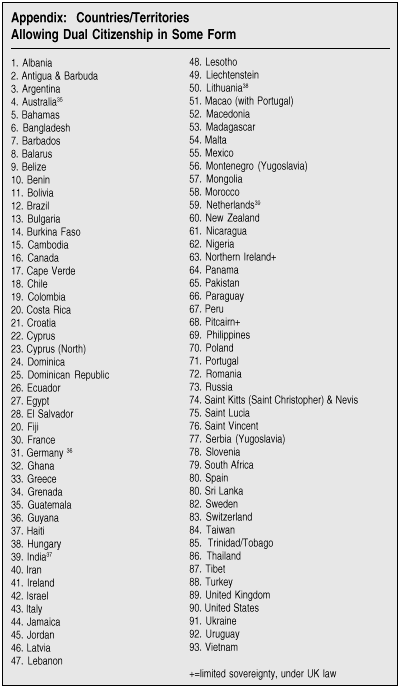
End Notes
1 For a detailed accounting of the source of this listing see Renshon, 2000a. Some material in this essay draws on that study.
2 Dual or multiple citizenship is not the same as dual nationality. Citizenship is a political term. It draws its importance from the political, economic, and social rights and obligations that adhere to a person by virtue of having been born into, or having become a recognized or certified member of a state.
Nationality, on the other hand, refers primarily to the attachments of members of a community to each other and to that community's ways of viewing the world, practices, institutions, and allegiances. Common community identifications develop through several, or more, of the following elements: language, "racial" identifications, ethnicity, culture, geography, historical experience, and identification with common institutions and practices.
Nationality is often thought of as expressed primarily through emotional attachments, and these are important. Yet, it would be a mistake to divorce a person's emotional attachments from the understandings and knowledge which both reflect and inform them.
In many culturally homogenous countries nationality and citizenship coincide, yet they are not synonymous. Or, as has been noted, "an individual's national identity is not necessarily the same as the passport she holds." See Editorial (1997, 1817).
3 The reasons for ignoring these circumstances vary. A country may simply not perceive the practice as sufficiently important or widespread to merit attention or action. Or, it may serve its own purposes — political, economic, or cultural — by ignoring other ties from which they benefit. Or, the country may have legal prohibitions against the practice, which are weakened by another of that country's political institutions. For example as Franck (1996) points out, Australian law as legislated in 1948 appeared to withdraw citizenship from any Australian who "does any act or thing: (a) the sole or dominant purpose of which; and (b) the effect of which; is to acquire the nationality or citizenship of a foreign country." Yet a recent court case there held that this provision did not apply to an Australian of partly Swiss origin who applied to the Swiss government for recognition of her jus sanguinis status as a Swiss citizen. The case thereby opened the door to recognition of dual nationality since the court held that to lose Australian citizenship, the citizen's motive must have been to acquire Swiss citizenship, rather than to obtain recognition of an already-existing status of foreign nationality.
4 For example, Jones-Correa (2000, 32) offers Bolivia, Honduras, and Venezuela as examples of Latin American countries which allow repatriation upon return. Goldstein and Piazza (1998,1630) add Haiti to this list. This is, of course, a form of de facto dual citizenship. This form does not allow the exercising of formal political rights in the immigrant's country of origin, but to the extent that repatriation is the person's ultimate goal, it may very well affect attachments to a new country.
5 While the Department of State now takes the position that acceptance of policy-level employment with a foreign government will be presumed to be a basis for denaturalization, a number of American dual citizens have held rather high positions without loss of citizenship. Raffi Hovannisian became Foreign Minister of Armenia, and stated publicly: "I certainly do not renounce my American citizenship," thus closing off a legal challenge to what he had done. Mohammed Sacirbey, Foreign Minister of Bosnia in 1995-1996, is an American citizen and dual national. The chief of the Estonian army in 1991-1995 also was an American, Aleksander Einseln. Many Americans have served at the United Nations as ambassadors of their other country's citizenship (Franck 1996).
6 For example, in 1986, following the Supreme Court's decision in Afroyim v. Rusk (387 U.S. 253), Congress repealed parts of the statutory provisions of American citizenship law by adding the key requirement that loss of citizenship could occur only on the citizen's "voluntarily performing any of the following acts with the intention of relinquishing United States nationality"[Act of Nov. 14, 1986, § 18, 100 Stat. 3655, 3658 (codified as amended in 8 U.S.C. § 1481 (1988)]. With that, the onus shifted to the Government to demonstrate that a designated act had been performed both voluntarily and with the specific intent to renounce U.S. Citizenship (Franck,1996).
7 These figures are drawn from the U.S. Department of Commerce (2000).
8 The figures are drawn from the U.S. Department of Commerce (1997, 52-53).
9 See U.S. Department of Justice/Immigration and Naturalization Service,(1999a, 8); also U.S. Department of Justice/Immigration and Naturalization Service (1999b, 9).
10 For an eloquent formulation of this view, see Levinson (1986).
11 The quotes in this paragraph are drawn from Aleinikoff (1999).
12 David Martin (1999 8, fn 24) points out that the bigamy metaphor was made in the context of dual citizenship debates in the early nineteenth century.
13 An example of the confusion that accompanies failures to think clearly about these distinctions can be seen in the recent article by David Martin. He begins his discussion of dual citizenship by informing the reader that he will use the terms citizenship and nationality interchangeably, and elsewhere refers to "mere nationality. " He terms (1999, 8-11) the distinction between citizen(ship) and national(ity) a "technical one," which is "rarely important for my purposes." He then goes on to discuss the issue of multiple and conflicting loyalties in which, of course, the distinction between nationality and citizenship are central, not mere technicalities.
14 The metaphor linking family life and national identity suggests certain parallels. There are of course, differences as well. The nation is not a parent writ large. Nor does it have the primary responsibilities of nurturing, guidance, and socialization.
On the other hand, like the nation, the family is present from the child's earliest experiences. It is to be found in the language, cultural practices, and national identifications of the parents. It is also part of the consistent context in which her development unfolds. It provides the institutions (e.g., schools, civic and community experiences) and objects (flags, rituals like the Pledge of Allegiance) through which the child's personal and national identity becomes fused at an early age.
15 Walzer (1997, 87) notes that "In immigrant societies people have begun to experience what we might think of as a life without clear boundaries and without secure singular identities."
16 What David Martin (1999, 31) refers to as "simple voting," is in fact anything but simple (Kelley and Mirer, 1974).
17 The National Assessment Governing Board (1998, 9) in its review of national civics education among students in grades 4, 8, and 12, found that "students tended to have only a superficial knowledge of civics; furthermore, the knowledge of civics they did possess had declined since 1976." The 1999 NAEP Civics Report Card for the Nation (U.S. Department of Education, 1999, x) found that for 4th, 8th and 12th graders only 22, 23, and 26 percent of the students performed "at or above the Proficient level. Only 2 percent of students in any of the three grades studied performed at the highest achievement level, Advanced."
I am indebted to Dr. Charles Bahmueller for making these materials available to me.
18 Or as Alexander and Smelser (1999, 3; see also Huntington 1981, 23) put it, "The core of the complaint concerns common values in American society." For a disclaimer from the view that common American political values are enough see Lind (1996, 242-43) and Smith (1987).
19 Historical views of American national identity coupled with a modern reformulation of the concept may be found in Renshon (2000b).
20 The best book on the seductive psychology of the image and the public's role in encouraging it is still Boorstin (1992 [1933]).
21 Yankelovich's (1981 xix, 259-260) national opinion data on the growing emphasis on self-fulfillment in American culture led him to conclude that, "it was not a by-product of affluence, or a shift in the national character toward narcissism, [but rather] a search for a new American philosophy of life." Of course, "philosophies of life" are themselves reflections of values and psychology and helped to facilitate the very psychologies that will buttress them.
Optimistically, he saw Americans growing "less self-absorbed and more prepared to take a first step toward an ethic of commitment." However, he also noted that the development of such an ethic would require direct support from "the larger society — political leadership, the mass media, institutional leadership (business, education, labor, artists and scientists, the intellectual community," in short, for the most part all the groups caught up in the ethic of relentless self-interest.
Small wonder that 17 years later, Lehmann (1998, 38) lamented a new consensus which "represents an embrace of...one-way libertarianism: the average citizen has no obligation to the country, but the government has a very serious obligation to that citizen."
22 For example, Yankelovich (1981 38-39, 163-218) reports that in the mid-1960s, 72 percent of college students agreed that "hard work always pays off." By the early 1970s, this figure had dropped to 40 percent. These findings were paralleled in adults, for whom, between the late 1960s and the late 1970s, the percentage of adults agreeing with that aphorism fell from 58 to 43 percent.
23 There is an important distinction to be drawn between being slow to pass judgments, and being adverse to making them. Why Americans now seem more adverse than slow is a question left unanswered by Wolfe, but is nonetheless critical in understanding the public's response to the dilemmas of diversity being fought out around them.
24 In an early work on American national character, the English psychoanalyst Geoffrey Gorer (1964, 25) wrote,
With few exceptions, the immigrants did not cross the ocean as colonists to reproduce the civilization of their homes on distant shores; with the geographical separation they were prepared to give up, as far as lay in their power, all their past: their language. And the thoughts which that language could express; the laws and allegiances they had been brought up to observe, the values and assured ways of life of their ancestors and former compatriots; even to a large extent their customary ways of eating, of dressing, of living.
This is the immersion into the "melting pot" which colors the myths of both assimilation’s advocates and critics. The former see that process as natural and desirable, the later see it as little better that the cultural rape of immigrant identity. Yet both sides would do well to keep in mind Gorer’s answer to the question he raised of why early immigrants might not wish to reproduce their homelands here. The answer was to be found in the fact that most immigrants had "...escaped...from discriminatory laws, rigid hierarchical structures, compulsory military service and authoritarian limitation of the opportunities open to the enterprising and the goals to which they could aspire." On the ambivalent implications of assimilation, see Skerry (2000).
25 In psychoanalytic theory the term that would cover all three is "object," which can refer to concrete (specific people, places) and categorical entities (like nation or America).
26 The authors also argue that remittances to "home countries" benefit the United States nationally. Their argument is based on the fungibility of financial figures. Thus if country x buys products from the United States and their immigrants abroad send money home, this money can be viewed as helping to pay from such imports. Examining in depth the few studies adduced (and their data) to support this claim is beyond the purposes of this paper.
However, the authors do acknowledge that the vast majority of remittances come from five states where such immigrants are generally located (California, Texas, Florida, Illinois, and New York) and they are substantial. The authors estimate (p.8) that over $3.1 billion in remittances were sent home by immigrants from these five states. They note (de la Garza et al., 1997, p. 8) that these remittances, "Clearly, constitute a major resource, which if invested locally [in the United States] could significantly improve state and local economies in general, and the personal conditions in which these immigrants live in particular."
27 Jorge A. Vargas is of Mexican nationality and a former professor of law in Mexico City, now visiting at the University of San Diego Law School.
28 These include aggressive government strategies to develop and maintain contact with important groups of Mexicans abroad, the creation and proliferation of sixteen Mexican Cultural Institutes and Centers, a promotional campaign in the favor of NAFTA (North American Free Trade Agreement), a considerable increase in the number of Mexican consulates, the development of special programs to provide legal and diplomatic protection to both documented and undocumented migratory workers, and the publication of a new bilingual newsletter, "La Paloma."
29 The quotation marks are mine and reflect the findings of biologists and anthropologists which suggest that race is a socially constructed political category. Rumbaut (1994, 763) says that the last two categories (three and four) are exclusively identities "made in America," and the last (four) represents "a denationalized identification with racial ethnic minority groups in the country of destination, and self-conscious differences in relation to the white [sic] Anglo majority population." He then counts together those who select a plain American identification (11 percent) and those who select a pan-racial/ethnic identification (21 percent) and concludes they are not connected to their origins but to their "American present."
He is certainly incorrect to state that the hyphenated identity is not also a "made in America" one. Yet, a larger and more important question arises from his characterizations of his identification data. From the standpoint of national coherence and integration, the major question of these data is how much identification with an American identity each category represents. It is quite clear that the plain American identifications (11 percent) are that. It is also likely that the national-origin identifications (27 percent) are not. Moreover, it is unclear how much identification with the United States is contained in the largest category, the hyphenated American identity (40 percent). And the same is also very true for those who eschew any category with the name American in it (21 percent).
30 There are reliability and validity problems with such data as well. For example, Rumbaut (1994, 760) reports correlations of the respondents' self reports with performance with the objective Stanford reading achievement test score. He reports there was a "strong correlation" of 0.42 (p=0.0001).
What these numbers don't reveal is that in a sample of over 5,000 respondents it is fairly routine to get findings of such magnitude and to reach "statistical significance." Moreover, a correlation of 0.42 sounds high, but it means that of all the variance in the relationship between self-report and object test measures, only 16 percent is actually explained. Or to put it another way, the objective test results "explain" or account for only 16 percent of the level of proficiency reflected in the self-report.
31 They base their list on a publication by Blaustein and Flanz entitled Constitutions of the World, but give no date for the publication.
32 Of course, the number of immigrants from Israel to the United States is low, both in numbers and percentages, in comparison to, for example, Mexico or the Philippines. The dual citizenship/loyalty issue arises primarily because of the historical circumstances preceding the establishment of the state of Israel and the fact that the ‘law of return' promises any Jew Israeli citizenship on immigration. So, for most American Jews the question is not returning to a state from which they once lived, but emigrated, but rather their attachment to the existence of a Jewish homeland after a 2000 years' diaspora.
33 Jerry Rawlings, President of Ghana, mentioned in a news conference with President Clinton that he was sponsoring a bill to allow to allow present and former nationals of Ghana dual citizenship. Part of that exchange follows:
Q: Would it be dual loyalty?
President Rawlings: Well, I guess that what we have a bit of — we don't have any problem with that...I have a problem with you because you're demanding loyalty to the American Constitution and yet I cannot command the same type of loyalty in my country.
President Clinton: ... Almost all countries allow some form of dual citizenship...it certainly won't hurt to get more Americans interested in Ghana and contribute to Ghana's future. I thought it [dual citizenship] was quite a clever idea myself.
34 Elsewhere, I (Renshon, 1998, 3-33) have described the basic public dilemma as a fundamental unresolved question concerning public psychology and governance facing the president on taking office. It is not a specific question about public policy, but rather the public's psychological connections to its institutions, leaders, and political process. This unresolved public concern underlies and frames more specific policy debates.
35 For information on Australia see Zappala and Castles (1999, 273, fn 137; see also Castles 1997) who quote the Australian Citizenship Act of 1948 as follows: “People must have deliberately sought and acquired the citizenship of another country in order to lose their Australian citizenship; if they acquire it automatically rather than by taking some action to acquire it they do not lose their Australian citizenship.”
36 In July 1999, The Citizenship Law Reform Act was published in the German official gazette. This act entered into force on January 1, 2000. Under the new law, German citizenship has always been and will continue to be passed on by parents to the children. Any child of a German national (mother or father, married or not married) will be considered a German citizen by birth, whether born inside or outside Germany. The Reform Act introduces an aspect of “Äûterritorial acquisition”: any child born inside Germany to parents of foreign nationality will acquire German nationality by birth if at least one parent has been lawfully resident in Germany for at least eight years and has for at least three years been the holder of a certain higher form of residence permit. This new provision will apply to most children of migrant workers who have been living in Germany for at least eight years. Those children, however, once they have grown up will have to decide between keeping German citizenship and renouncing their other citizenship (i.e. that of their parents) or keeping the foreign nationality and losing the German nationality. Under the existing German Citizenship Law (which in this respect corresponds to that of many other countries) German nationals lose their German citizenship if and when they acquire a foreign nationality upon their own application, i.e. by naturalization.
It has always been possible in theory to be granted a waiver by German authorities for keeping German citizenship when acquiring a foreign nationality. Under the new law this waiver will be granted more easily. The relevant section of the Act reads: “When deciding upon an application in accordance with sentence 1 (waiver), the public and private interests will have to be balanced. In the case of an applicant with residence abroad, it will have to taken into consideration whether he/she can make the case for continuing links to Germany.”
That means, in effect, that in terms of the naturalization of foreigners as well as the acquisition of foreign citizenship by Germans, the threshold of tolerance of dual citizenship (which has never been a problem in the case of acquisition of several nationalities by birth) will be made much more flexible.
While there is a provision requiring renunciation, Stephan Senders says that in the past there has been no requirement to prove that it was done. He reports that according to unofficial government estimates eight percent of naturalizing Turks retain their Turkish citizenship. Ethnic Germans who have other citizenships were allowed, even under the old law, to retain their German citizenships even when they were naturalized in other countries. A 1993 government study estimated that 1.2. million Germans legally held a second foreign citizenship. See Senders (1996, 158-159).
The fact that the United States makes no effort to follow through on the renunciation clause in its own oath of allegiance essentially renders any such provisions in the laws of other countries a moot point.
37 See Schuck (1997,11; 1998, 222).
38 Kalvaitis (1998, 231, fn 184, 227; footnote 184) reads: “Members of the Latvian diaspora, however, are allowed to hold dual citizenship. See Law on Citizenship (Lat.), supra note 175, transitional provisions 1, 2.” Footnote 227 reads: “Lithuania, however, allows members of its Western emigre community to hold dual nationality, despite the fact there is no established law to this fact.”
39 See Schmitter-Heisler (1998,103-104, fns14, 15).
References
Abramson, Harold J. "Assimilation and Pluralism," Harvard Encyclopedia of American Ethnic Groups, Stephan Thernstrom (ed.); Cambridge, Mass.: Harvard University Press, 1980, pp.150- 160.
Aleinikoff, T. Alexander. "Between National and Post-National: Membership in the United States, Michigan Journal of Race and Law, (1999) p. 241.
Aleinikoff, T. Alexander. "Between Principles and Politics: The Direction of U.S. Citizenship Policy"; Washington, D.C.: Carnegie Endowment for International Peace, 1998a.
Aleinikoff, T. Alexander. "A Multicultural Nationalism?"; The American Prospect, Jan./Feb., 1998b, pp. 80-86.
Alexander, Jeffrey C. and Neil J. Smelser. "The Ideological Discourse of Cultural Discontent: Paradoxes, Realities, and Alternative Ways of Thinking," Diversity and Its Discontents: Cultural Conflict and Common Ground in Contemporary American Society, Neil J. Smelser and Jeffrey C. Alexander, eds.; Princeton, N.J.: Princeton University Press, 1999.
Associated Press. "Attacks Put U.S.-Mexico Issues on Hold," September 19, 2001.
Barry, Dan and Nichole M. Christian. "Thousands March to U.N. to Support Palestinians," The New York Times, October 14, 2000, A1.
Blaustein, Albert and Gizbert Flanz eds. Constitutions of the World; Dobbs Ferry, N.Y.: Oceana Publications, nd.
Boorstin, Daniel. The Image, New York: Vantage, 1992 [1933].
Bourne, Randolph S. "Trans-National America," Atlantic Monthly, 118 (1916) 86-97 .
Bragg, Rick. "Stand Over Elian Highlights a Virtual Secession of Miami," The New York Times, April 1, 2000, A1.
Brown, DeNeen L. and Ceci Connolly. "Suspects Entered Easily From Canada," The Washington Post, September 14, 2001, A17.
Capriotti & Associates. International Law, Portland, OR 97208-2792 [www.capriotti.com] April, 16 2000.
Castles, Stephen. "Multiculturalism Citizenship: A Response to the Dilemma of Globalisation and National Identity?," Journal of Intercultural Studies, 18: 5, 1997.
Chang, Samantha Lan. "Debunking the Dual Loyalty Myth, "The New York Times, May 19, 1999, A17.
C.J. Chivers. "Police Investigating Vandalism at Door of Bronx Synagogue," The New York Times, October 9, 2000, A1.
Clinton, William J. "Remarks and Question and Answer Session with the American Society of Newspaper Editors," (April 11, 1997) Weekly Compilation of Presidential Documents, 14, April, 1997a. 33:15, 501-510.
Clinton, William J. "Remarks at the University of California at San Diego Commencement Ceremony," (June 14, 1997). Weekly Compilation of Presidential Documents, 23, June,1997b, 33:25, 876-882.
Clinton, William J. "Remarks at a Welcoming Ceremony for President Jerry John Rawlings of Ghana," (February 24, 1999) Weekly Compilation of Presidential Documents, March 1, 1999, 35:8, 298-99.
Cohn, D'Vera. "Illegal Residents Exceed Estimate: Experts Analyzing New Census Figures Say 6 Million May Instead Be 9 Million," The Washington Post, March 18, 2001, A01.
Corchado, Alfredo. "Zedellio Seeks Closer Ties with Mexican Americans," Dallas Morning News, April 8, 1995a, 11A.
Corchado, Alfredo. "Mexican Study Dual Citizenship, Implications of An Idea Intriguing to Many," Dallas Morning News, July 5, 1995b, 1A
Corchado, Alfredo and K. Anderson. "Mexican's Interest in Citizenship Up as Proposition 187 Prompts Increase," Dallas Morning News, December 1, 1994, 27-A.
Davis, A.F. "The Child's Discovery of Nationality," The Australian and New Zealand Journal of Sociology, 4 (1968) 107-125.
de Creveceour, J. H. St. John. Letters from an American Farmer. Susan Manning, ed. New York: Oxford University Press[1783] 1970.
de la Garza, Rodolfo O., Manuel Orozco and Miguel David Barona. "The Binational Impact of Latino Remittances ," Policy Brief, The Tomas Rivera Policy Institute, 1997.
de la Garza, Rodolfo O., Miguel David Barona, Harry Pachon, Emily Edmonds, Fernando Acosta-Rodriguez and Michele Morales. "Dual Citizenship, Domestic Politics and Naturalization Rates of Latino Immigrants to the United States," Tomas Rivera Policy Institute Brief, June 1966.
Dillon, Sam. "Mexico Wants to Make Dual Citizenship Legal," The New York Times, December 11, 1995, A6.
DiMaggio, Paul, John Evans and Bethany Bryson. "Have Americans' Social Attitudes Become More Polarized?" American Journal of Sociology, 102 (1996) 444-96.
Editorial, "The Functionality of Citizenship," Harvard Law Review, 110 (1997) 1814-1831.
Edsall, Thomas B. "Anti-Muslim Violence Assailed; FBI, Justice Dept. Probing Incidents Across the Nation," The Washington Post, September 15, 2001, A09.
Eggen, Dan and Darryl Fears. "Bush Weighs Legal Status Of Mexicans Illegal Immigrants May Get Residency," The Washington Post, July 16, 2001, A01.
Erikson, Erik Homburger. "The Problem of Ego Identity," Journal of the American Psychoanalytic Association, 4:1 (1956) 58-121.
Escobar, G. "Immigrants' Ranks Tripled In 29 Years," The Washington Post, January 9, 1999; A01.
"Exhibit of Vietnamese Art Arouses Immigrant Anger," The New York Times, July 7, 1999, A19.
Fox, Richard Wrightman and James T. Kloppenberg (eds). Randolph S. Bourne. A Companion to American Thought, Cambridge, Mass.: Blackwell, 1995, pp.85-87.
Finley, Bruce. "Hearts Torn Between Old, New Worlds," The Denver Post, August 23, 1998.
Finley, Bruce. "Mexican President Heads to U.S.," The Denver Post, August 26, 2001.
Fish, Stanley. "Boutique Multiculturalism," Multiculturalism and American Democracy, Arthur M. Melzer, Jerry Weinberger, and M. Richard Zinman, eds; Lawrence, Kansas: University of Kansas Press, 1998, pp. 69-88.
Franck, Thomas M. "Clan and Super-Clan: Law Identity and Community in Law and Practice," The American Journal International Law, 90: 359, 1996.
Gergen, Kenneth J. The Saturated Self, Cambridge, Mass.: Harvard University Press, 1998.
Geyer, Georgie Anne. Americans No More: The Death of Citizenship, New York: Atlantic Monthly Press, 1996.
Ghanea Bassiri, Kambiz. Competing Visions of Islam in the United States: A Study of Los Angeles. Westport, Conn.: Greenwood, 1997.
Gigot, Paul A. "Alien Notion: The Right Case for 'Amnesty'" The Wall Street Journal, August 17, 2001.
Gimpel, James G. and Karen Kaufmann. "Impossible Dream or Distant Reality? Republican Efforts to Attract Latino Voters," Backgrounder, Center for Immigration Studies, Washington, D.C., August, 2001.
Gleason, Philip. "American Identity and Americanization," Harvard Encyclopedia of American Ethnic Groups, Stephan Thernstrom, ed.; Cambridge, Mass: Harvard University Press, 1980, pp.31-58.
Goldstein, Eugene and Victoria Piazza. "Naturalization and Retention for Foreign Citizenship: A Survey," Interpreter Releases, 73:16 (1996).
Goldstein, Eugene and Victoria Piazza. "Naturalization and Retention for Foreign Citizenship: A Survey," Interpreter Releases, 75:45 (1998) Appendix I.
Gorer, Geoffrey. The American People: A Study in National Character. Revised Edition. New York: Norton, 1964.
Greenhouse, Steven. "Coalition Urges Easing of Immigration Laws," The New York Times, May 16, 2000, A1.
Gutierrez, Paula. "Comment: Mexico's Dual Nationality Amendments: They Do Not Undermine U.S. Citizens' Allegiance and Loyalty or U.S. Political Sovereignty," Loyola L.A. International and Comparative Law Journal, 999: 19, 1997.
Habermas, Jurgen. "Citizenship and National Identity: Some Reflections on the Future of Europe," Praxis International, 17, 1992.
Hammer, Tomas, "Dual Citizenship and Political Integration," International Migration Review, 19: 3, 1985, pp. 438-450.
Harrington, Mona, "Loyalties: Dual and Divided," Harvard Encyclopedia of American Ethnic Groups, Stephen Thernstrom, ed; Cambridge, Mass.: Harvard University Press, 1980, pp.676-686.
Herberg, Will. Protestant, Catholic, Jew: An Essay in American Religious Sociology. Garden City, N.Y.: Doubleday, 1955.
Higham, John. "Cultural Responses to Immigration," Diversity and Its Discontents: Cultural Conflict and Common Ground in Contemporary American Society, Neil J. Smelser and Jeffrey C. Alexander, eds.; Princeton, N.J.: Princeton University Press, 1999, 339-361.
Holmes, Steven A. "Hispanic Births in U.S. Reach Record High," The New York Times, February 13, 1998, A12.
Horowitz, E.L. "Some Aspects of the Development of Patriotism in Children," Sociometry, 3 1940, 329-41.
Hunter, James Davidson. Cultural Wars: The Struggle to Define America, New York: Basic Books, 1997.
Huntington, Samuel P. American Politics: The Promise of Disharmony, Cambridge, Mass.: Belknap Press, 1981.
Isbister, John. "Is America Too White?," What, Then, is the American, This New Man?, Compiled by E. Sandman, Washington, D.C.: Center for Immigration Studies, 1998, pp.25-32.
Isbister, John. The Immigration Debate: Remaking America, New York: Kumarian Press, 1996.
Jahoda, Gustav. "The Development of Children's Ideas about Community and Nationality," Growth and Change: A Reader in Political Socialization, Charles G. Bell, ed.; Belmont, Calif.: Dickenson, 1973, pp. 155-168.
Jones-Correa, Michael. "Under Two Flags: Dual Nationality in Latin America and Its Consequence for the United States," Working Papers in Latin America (no. 99/00-3), The David Rockefeller Center for Latin American Studies, Harvard University, 2000.
Jordan, Mary. "Mexican President Touts Open Borders," The Washington Post, August 25, 2000, A1.
Jordan, Mary and Mary Beth Sheridan," Mexico Seeks U.S. Shift In Immigration Policy," The Washington Post, April 2, 2001, A01.
Kang, K. Connie. "Dual U.S.-Korean Nationality Nears," The Los Angles Times, June 14, 1998.
Kalvaitis, Ruta M. "Citizenship and National Identity in the Baltic States," Boston University International Law Journal, 16:231 (1998).
Kelley, Stanley J. and T. Mirer. "The Simple Act of Voting," The American Political Science Review, 68, 1974, 572-591.
Kelly, H. Ansgar. "Dual Nationality, The Myth of Election, and a Kinder, Gentler State Department," University of Miami Inter-American Law Review, 23:2 (1991-92) 421-464.
Kempster, Norman. "Crisis in Yugoslavia: 3,000 to 4,000 U.S. Civilians Believed Stuck, Many of Those Living in the Two Republics Hold Dual Citizenship," The Los Angeles Times, April 3, 1999.
Kymlica, William. Multicultural Citizenship: A Liberal Theory of Minority Rights, Oxford: Clarendon Press, 1995.
Lasch, Christopher. The Culture of Narcissism: American Life in an Age of Diminishing Expectations, New York: Basic Books, 1979.
Lawson, E.D. "The Development of Patriotism in Children: A Second Look," Journal of Psychology, 55, 1963, 279-86.
Lehmann, Nicholas. "The New American Consensus: Government of, by, and for the Comfortable," The New York Times Sunday Magazine, November 1, 1998.
Levinson, Sanford. "Constructing Communities Through Words that Bind: Reflections on Loyalty Oaths," Michigan Law Review, 1440, 1986, 1463-1470.
Lind, Michael. The Next American Nation, New York: Free Press, 1996.
Lipset, Seymour Martin. The First New Nation, New York: Basic Books, 1963
Maharidge, Dale. The Coming White Minority: California's Eruptions and America's Future, New York: Times Books, 1996.
Martin, David A. "New Rules on Dual Nationality for a Democratizing Globe: Between Rejection and Embrace," Georgetown Immigration Law Review, 14 (1999) 1-34.
Martin, David A. "The Civic Republican Ideal for Citizenship, and for Our Common Life," Virginia Journal of International Law, 301 (1994).
Martin, Philip. "US and California Reactions to Dual Nationality and Absentee Voting," Foreign Ministry of Mexico, February 17, 2000.
McGarvey-Rosendahl, Patricia. "A New Approach to Dual Nationality," Houston Journal of International Law, 8:305, 1985, 305-326.
Mena, Jennifer. "3 Men, 2 Nations, 1 Dream," The Los Angeles Times, June 30, 2001.
"Mexico: Dual Nationality," Migration News, March 2000. Vol. 7, No 3. http://migration.ucdavis.edu.
Miller, Mark J. "Dual Citizenship: A European Norm?," International Migration Review, 33:4, 1991, pp. 945-950.
Morrison & Foerster LLP., "Issues Raised by Dual Nationality and Certain Reform Proposals," draft memorandum prepared for the U.S. Commission on Immigration Reform, July 13, 1997.
National Assessment Governing Boar,. Civics Framework for the 1998 National Assessment of Educational Progress, Washington, D. C., 1998.
National Research Council, From Generation to Generation: The Health and Well-Being of Children in Immigrant Families, Washington, D.C.: National Research Council, 1998.
O'Brien, Jeffrey R. "U.S. Dual Citizenship Voting Rights: A Critical Examination of Aleinikoff's Proposal, " Georgetown Immigration Law Review, 13:533, 1999, pp. 573-595.
Parekh, Bhikhu. "Minority Practices and the Principle of Toleration," International Migration Review, 30:1, 1996, pp. 251-287.
Porter, Eduardo. "Estimate of Illegal Immigrants Reaches As Many as 8.5 Million for Some Experts," The Wall Street Journal, August 14, 2001.
Prothro, James W. and C. M. Grigg, "Fundamental Principles of Democracy: Basis of Agreement and Disagreement," Journal of Politics, 22, 1960, pp.276-294.
Putnam, Robert. Bowling Alone, New York: Simon and Schuster, 2000.
Renshon, Stanley A. "Leadership Capital and The Politics of Courage: The President's Initiative on Race," One America? Political Leadership, National Identity, and the Dilemmas of Diversity, Stanley A. Renshon, ed.; . Washington, D.C.: Georgetown University Press, 2001.
Renshon, Stanley A. "Dual Citizens in America: An Issue of Vast Proportions and Broad Significance," Washington, D.C.: Center for Immigration Studies, 2000a.
Renshon, Stanley A. "American Identity and the Dilemmas of Cultural Diversity," Political Psychology: Cultural and Cross Cultural Foundations, Stanley A. Renshon and John Duckitt eds.; London: Macmillan, 2000b), pp. 285-310.
Renshon, Stanley A. High Hopes: The Clinton Presidency and the Politics of Ambition; New York: Routledge, 1998.
Riesman, David with Nathan Glazer and Revel Denny, The Lonely Crowd: A Study of the Changing American Character, New Haven, Conn.: Yale University Press, 1950.
Riesman, David. "Egocentrism: Is the American Character Changing?," Encounter 55, August-September, 1980, pp. 19-28.
Rodriguez, Cindy. "Latino Influx Boosts number of U.S. Immigrants to All-Time High," Boston Globe, September 12, 2000, A1.
Rumbaut, Rubén G. "The Crucible Within: Ethnic Identity, Self-Esteem, and Segmented Assimilation Among Children of Immigrants," International Migration Review, 28: 4 , 1994, pp. 748-794.
Russett, Bruce. Grasping the Democratic Peace: Principles for a Post-Cold War World, Princeton, N.J.: Princeton University Press, 1993.
Sachs, Susan. "Pop Stars and Public Officials Join Campaign for Tolerance," The New York Times, September 28, 2001.
Sanchez, Rene. "Days of Rage in Little Saigon: Portrait of Ho Chi Minh Incenses Vietnamese Immigrants," The Washington Post, March 5, 1999, A02.
Sandel, Michael J. Democracy's Discontent: America in Search of a Public Philosophy, Cambridge, Mass.: Belknap Press, 1966.
Schmitt, Eric. "Bush Aides Weigh Legalizing Status of Mexicans in U.S.," The New York Times, July 15, 2001, A1.
Schmitter-Heisler, Barbara. "Contents of Immigrant Incorporation," Immigration, Citizenship, and Welfare in Germany and the United States: Welfare Policies and Immigrants' Citizenship, Herman Kurthen, Jurgen Fijalkowski, and Gert. G. Wagner, eds; Stamford, Conn.: JAI, 1998, pp. 103-104.
Schuck, Peter M. Citizens, Strangers, and In-Betweens: Essays on Immigration and Citizenship, Boulder, Co: Westview Press, 1998.
Schuck, Peter M. "The Re-Evaluation of American Citizenship," Georgetown Immigration Law Journal, 12:1 (1997) pp. 1-34.
Senders, Stephan. "National Inclusion in Germany, New German Critique, 67, 1996, pp. 147-175
Seidman, Steven "Contesting the Moral Boundaries of Eros," Diversity and Its Discontents: Cultural Conflict and Common Ground in Contemporary American Society, Neil J. Smelser and Jeffrey C. Alexander, eds; Princeton, N.J.: Princeton University Press,1999.
Skerry, Peter. "Do We Really Want Immigrants to Assimilate?," Society, March/April 2000, pp. 57-62.
Skerry, Peter. Why Amnesty Is the Wrong Way to Go, The Washintgon Post, August 12, 2001, B01.
Slambrouck, Paul. "Sweeter Holiday for Mexican-Americans," The Christian Science Monitor, December 12, 2000.
Smelser, Neil J. and Jeffrey C. Alexander, Diversity and Its Discontents: Cultural Conflict and Common Ground in Contemporary American Society, Princeton, N.J.: Princeton University Press, 1999.
Smith, James F. "Mexico: In Zacatecas state, development projects as seen as a key to keep people from fleeing to U.S.," The Los Angeles Times, August 20, 2001.
Smith, Roger M. "The 'American Creed' and American Identity: The Limits of Liberal Citizenship in the United States," Western Political Quarterly, 41, 1987, pp. 225-251.
Smith, Tony. Foreign Entanglements: The Power of Ethnic Groups in the Making of American Foreign Policy, Cambridge, Mass.: Harvard University Press, 2001.
Spiro, Peter J. "Dual Nationality and the Meaning of Citizenship," Emory Law Review, 46:4 1997, pp.1412-1485.
Taylor, Charles. Multiculturalism and the Politics of Recognition, Princeton, N.J.: Princeton University Press, 1992.
Takaki, Ronald. A Different Mirror: A History of Multicultural America, Boston: Little Brown, 1993.
Thompson, Dennis F. The Democratic Citizen, New York: Cambridge University Press, 1970.
Thompson, Ginger. "Fox Urges Opening of U.S.-Mexican Border to Build New Partnership," The New York Times, August 14, 2000, A1.
U.S. Department of Commerce, "Current Population Reports: The Foreign-Born Population in the United States: March 1999" (P20-519) U.S. Government Printing Office: Washington D.C.: 2000.
U.S. Department of Commerce, Economics and Statistics Administration, U.S. Census, "Profile of the Foreign Born Population in the United States: 1997, Current Populations Reports Special Studies (P23-195), U.S. Government Printing Office: Washington, D.C., 1997.
U.S. Department of Education. Office of Educational Research and Improvement. National Center for Education Statistics. The NAEP 1998 Civics Report Card for the Nation (NCES 2000-457), Washington, D.C., 1999.
U.S. Department of Justice, Immigration and Naturalization Service, "Statistical Yearbook of the Naturalization and Immigration Service- 1998." Washington, D.C.: U.S. Government Printing Office, 2000.
U.S. Department of Justice, Immigration and Naturalization Service, "Annual Report: Legal Immigration, Fiscal Year, 1998," No. 2, May 1999b.
U.S. Department of Justice, Immigration and Naturalization Service, "Annual Report: Legal Immigration, Fiscal Year, 1997," No. 1, January 1999a.
Vargas, Jorge A. "Dual Nationality for Mexicans?," Chicano-Latino Law Review, 18:1, 1996, pp. 1-58.
Veale, Scott. "History 101: Snoop Doggy Roosevelt," The New York Times, July 2, 2000. Sec. wk.5.
Waldman, Amy. "Killing Heightens the Unease Felt by Africans in New York," The New York Times, February 14, 1999, A1.
Walzer, Michael. On Toleration, New Haven, Conn.: Yale University Press, 1997.
Weinstein, Eugene A. "The Development of the Concept of Flag and the Sense of National Identity," Child Development, 28 (1957) 167-74.
Wolfe, Alan. One Nation After All. Chicago: University of Chicago Press, 1998.
Yang, Philip Q. "Explaining Immigrant Naturalization," International Migration Review, 28:3, 1994, pp. 449-477.
Yankelovich, Daniel. New Rules: Searching for Self-fulfillment in a World Turned Upside Down, New York: Random House, 1981.
Zachary, G. Pascal. "Dual Citizenship is a Double Edged Sword," The Wall Street Journal, March 25, 1998, B1.
Zappala, Gianni and Stephan Castles, "Citizenship and Immigration in Australia," Georgetown Immigration Law Journal,13, 1999, pp. 273.
Zelizer, Viviana A. "Multiple Markets, Multiple Cultures," Diversity and Its Discontents: Cultural Conflict and Common Ground in Contemporary American Society, Neil J. Smelser and Jeffrey C. Alexander, eds.; Princeton, N.J.: Princeton University Press, 1999.