
Download this Backgrounder as a pdf
During their summit in early September, presidents Vicente Fox of Mexico and George W. Bush of United States discussed an amnesty for illegal Mexican immigrants in the United States. While at first both presidents indicated that giving legal status to illegals would be a long process that might take years to implement, in the course of their summit they both indicated that they wanted things to move quickly. Moreover, on September 7 the Senate judiciary committee held a hearing on Mexican immigration. Senators from both parties indicated their support for granting amnesty in some fashion to illegals from Mexico.
The Zogby poll reported on in this Backgrounder was one of the first to examine in detail how various segments of the population would view an amnesty. Using neutral language, the Zogby International poll of likely voters also explores how supporting an amnesty might affect votes for President Bush and members of Congress in the future among different groups of constituents. While overall the poll finds little support for an amnesty, it does show some significant differences among groups. The strongest opposition is found among conservatives, moderates, union households, and voters with lower incomes. Among the findings:
- Consistent with other polls, the Zogby poll finds that the majority of Americans (55 percent) think that an amnesty is a bad or very bad idea compared to 34 percent who think it is a good or very good idea.
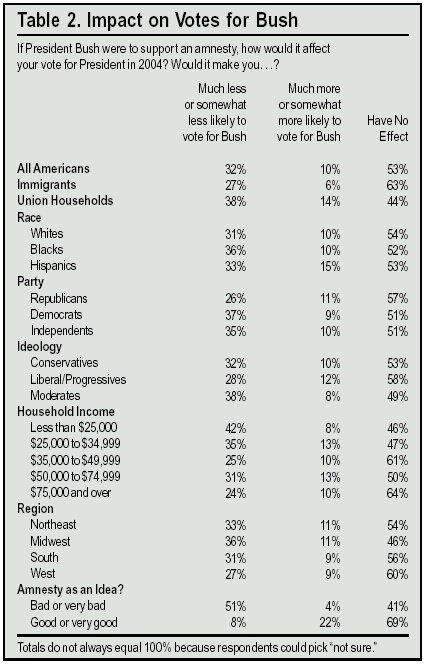
- The strongest opposition to amnesty can be found among conservatives, with 60 percent thinking it is a bad or very bad idea compared to 26 percent who think it is a good or very good idea. Perhaps most troubling for the president, almost one-third of all conservatives (32 percent) indicated that they would be less likely to vote for Bush if he supported an amnesty, while only 10 percent said they would be more likely to vote for him.
- Among Democrats, 55 percent said they thought an amnesty would be a bad idea and 36 percent thought it was a good idea. Some of the strongest opposition was found among voters in union households, a key Democratic consistency. Sixty percent of voters in union households thought it was a bad idea compared to 32 percent who thought it was a good idea. An amnesty splits the party’s liberal base right down the middle, with 46 percent of liberals thinking it was a good idea and 45 percent thinking it was a bad idea.
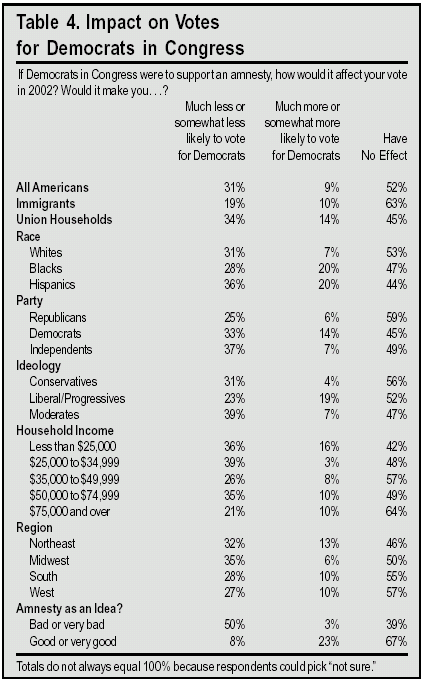
- An amnesty does not appear to be a way of winning Hispanic votes for either party, with 51 percent of respondents identifying it is a bad idea and 49 percent thinking it’s a good idea. When asked how it might affect their vote, twice as many Hispanics in the survey (33 percent) said they would be less likely to vote for Bush in 2004 if he supported an amnesty compared to 15 percent who said they would be more likely to vote for him. The same basic pattern exists for Democratic candidates, with 36 percent of Hispanics saying they would be less likely to vote for a Democrat in Congress who supports an amnesty and 20 percent indicating they would be more likely to vote for a Democrat who supports amnesty.
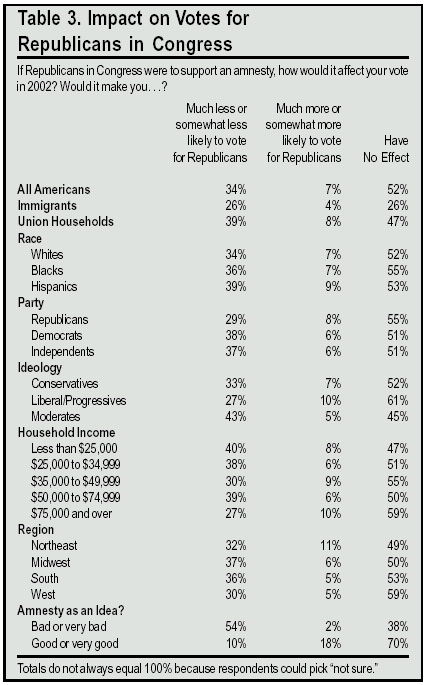
- Those who oppose an amnesty seem to be much stronger in their opposition than are supporters in their support of an amnesty. While 20 percent of voters said that they thought it was a very bad idea, only 6 percent said it was a very good idea. Moreover, of those who said it was a bad or very bad idea, 51 percent said they would be less likely to vote for President Bush if he supported an amnesty. In contrast, of those who thought an amnesty was a good or very good idea, only 22 percent said they would be more likely to vote for Bush if he supported it. Very similar proportions exist when asked about Congressional Republicans and Democrats.
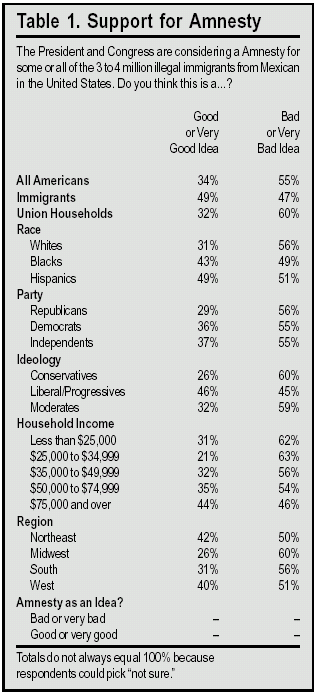
Not only does the president risk alienating his own conservative base, but he also risks alienating self-identified moderates, who are critical to his winning reelection in 2004. Moderates thought an amnesty was a bad or very bad idea by a margin of 59 percent to 32 percent. Moreover, 38 percent of moderates indicated that they would be less likely to vote for Bush if he supported an amnesty, compared to 8 percent who indicated that they would be more likely to vote for him if he supported an amnesty.
Most troubling for Congressional Democratic supporters of an amnesty, 33 percent of voters in union households said they would be less likely to vote for Democrats who supported an amnesty, compared to only 14 percent who said they would be more likely. Thus, an amnesty has the potential to drive a wedge between the Democratic Party and rank-and-file union voters.
Also troubling for Democrats, lower income voters who tend to vote Democratic, but face the most job competition from immigrants, take a very dim view of amnesty. Voters in households with income of less than $35,000 thought an amnesty was a bad idea by a margin of more than two to one. In addition, more than one-third of low-income voters indicated they would be less likely to vote for Democrats in congress who support amnesty.
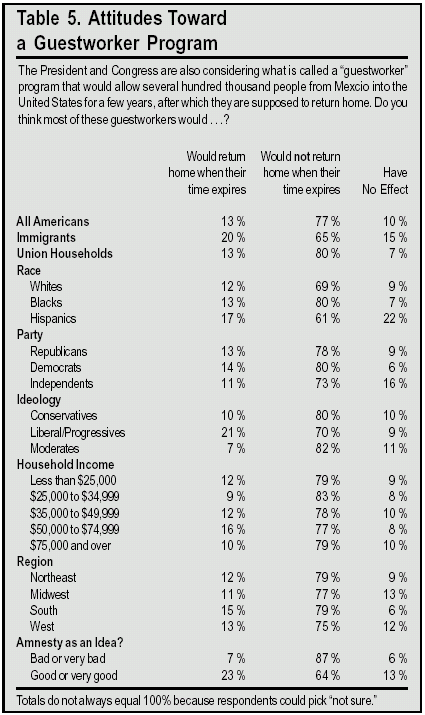
The poll also asked voters about a possible guestworker program that would allow Mexican immigrants into the country to work for a period of time after which they would have to return home. Voters were asked if they thought most of these workers would return home when they are supposed to. Overall, 77 percent of voters thought that most guest workers would not return home after their time expires compared to only 13 percent who thought most would return home. Similar attitudes hold for every subgroup in the population. It appears that most voters do not think that a guest worker program would solve the problem of illegal immigration.
Clearly, an amnesty for illegal immigrants would be only one issue among many considered by voters when deciding how to cast their ballots. However, by supporting an amnesty, Republicans may run the risk of having some of their conservative base sit home on election day and of alienating moderates, all without attracting significant Hispanic support. Democrats, too, may alienate moderates and also may reduce support among some union voters and lower income voters, who need to turn out in large numbers if Democrats are to regain the House of Representatives and the presidency.
Data Source
This nationwide poll of 1,020 likely voters was conducted by Zogby International from Saturday, August 25, to Wednesday, August 29, 2001. All telephone calls were made from Zogby International headquarters in Utica, N.Y. The margin of error is +/-3.2 percent. Margins of error are higher in sub-groups.
Neutral Question Wording. The Zogby poll on which this analysis is based attempted to ask questions about an amnesty in as neutral a manner as possible. The tables contain the full wording of the questions used in the survey, as well as the results. Purposefully, the question dealing with amnesty did not use a euphemism such as "regularization" nor did it make any mention of the fact that an amnesty would mean eventual citizenship, which is likely to elicit a more negative response (see Table 1). Moreover, the term "illegal immigrant" is used and not the more euphemistic "undocumented immigrant" or the more negative "illegal alien." Finally, the amnesty question does not characterize illegal immigrants, as some surveys have done, in a positive way such as "tax-paying" or in a negative way such as "violating our laws."
The three questions dealing with how candidates’ support for an amnesty might affect votes are also asked in as straightforward a manner as possible (see Tables 2,3,4). Moreover, these questions specifically give respondents the option of saying that a candidate’s position on amnesty would have no effect on their vote. By using neutral language and by not forcing those taking the survey to say that an amnesty would have an impact on their vote, this survey should provide a good deal of insight into voter preferences on this important issue.
Results
Intensity of Opinion
The fact that opponents of amnesty seem to feel more strongly in their opposition to amnesty than supporters do about their endorsement is one of the most important findings of this survey. This greater intensity of feeling on the part of amnesty opponents means that it is not simply that most Americans are against it, but also that it might affect how they vote in 2002 and 2004. Thus, supporting an amnesty seems only to hurt and not help the president or Democrats and Republicans in Congress who might support it.
The table shows that in every group examined here, a plurality indicate that they would be less likely to vote for a candidate who supports amnesty. In contrast, very few voters indicate that they would be more likely to vote for the president if he supported amnesty and the same holds true for members of both parties in Congress. Whatever its merits as a matter of public policy, it seems that politicians who oppose amnesty are likely to derive much more political benefit from their opposition than are candidates who support it.
Union Members
The opposition among persons in union households is one of the most interesting and in some ways the most surprising finding, because most union leaders strongly support an amnesty and have been actively making the case for it to their members for over a year. Yet, only a little over one-third (36 percent) of those in union households think an amnesty is a good idea. This strongly suggests that union leaders have a long way to go before their members agree with them on this issue. The fact that 60 percent of voters in union households oppose an amnesty and that 33 percent of all persons in union households said they would be less likely to vote for a Democrat who supports it, should be a matter of some concern to Democrats. It opens up the very real possibility that Republican congressional candidates who are opposed to amnesty could use the issue as a way to attract union members in much the same way that Ronald Reagan was able to get votes from union members who made up a significant share of the so-called "Reagan Democrats."
Hispanics
The even division among Hispanic voters in the survey may come as a surprise to some because, of any segment of the population, Hispanics are often assumed to be overwhelmingly in favor of an amnesty. It is generally assumed that one of the reasons President Bush may support an amnesty is that he hopes to attract Hispanic voters by doing so. However, this survey provides no evidence that supporting an amnesty will help the president with Hispanic Americans. If anything, it seems to hurt him. Hispanics in the survey responded two-to-one that they would be less likely to vote for the president if he supports an amnesty (see Tables). These findings are consistent with other surveys that have tried to measure the opinion of Hispanics. A number of polls have found that Hispanics, like other Americans, are concerned about immigration and think that the current level is too high. Thus, it’s not so unexpected that roughly half of all Hispanic voters think an amnesty is a bad idea and that many indicate they would be less willing to vote for a candidate who supports one.
It is also important to remember that the survey is confined to likely voters, and that a very large share of Hispanic adults are not citizens. Since they cannot vote, they are not included in this survey. The opinions of non-citizen Hispanics, many of whom may benefit from an amnesty, could differ significantly from their citizen counterparts. Of course, politically, it’s votes that count, which is why surveys of this kind are confined to likely voters. Certainly no amnesty beneficiary would be able to get citizenship in time to vote in the 2004 election. It should also be pointed out that it would be incorrect to say that Hispanic voters are against an amnesty — they are evenly divided. What does seem to be the case is that those Hispanic voters who oppose an amnesty feel much more strongly about their opposition than those who support it feel about their endorsement. As a result, despite being evenly divided on the issue overall, more Hispanic voters indicate they would be less likely to vote for a candidate who supports amnesty. None of this means that Republican efforts to attract Hispanic voters are misplaced. Instead, these results simply suggest that supporting an amnesty is not the best way to attract Hispanic voters.
Moderates and Independents. As already mentioned, self-identified moderates think an amnesty is a bad idea by a margin of 59 to 32 percent. Also, between 38 and 43 percent said they would be less likely to vote for Bush or Democrats in Congress if they supported an amnesty, compared to between 5 and 8 percent who said that they would be more likely to vote for Bush if he supported amnesty. Similar results exist among self-identified independents (see Tables). This is significant politically because moderates and independents often decide elections, especially in this era when the electorate is so closely divided. While some may imagine that amnesty is a way to appeal to individuals in the middle of the political spectrum, this survey indicates that the opposite is true. It seems that opposing an amnesty may be a way of winning support from this critically important segment of the population.
Unaffected Voters
Although the table shows that a plurality in every social group indicate that they would be less likely to vote for candidates who support an amnesty, it is important to realize that the table also shows that, for many voters, amnesty is not likely to effect how they cast their ballots. This should come as little surprise since voters consider many issues when deciding how they will vote. Still, it is interesting that a large share of voters across different socio-demographic groups indicate that they are more likely to vote against those who support amnesty, even if the candidate comes from the party that we would expect them normally to support. The large share of voters in union households who said they would be less likely to vote for Democrats in Congress if they support amnesty and likewise the significant share of conservatives who said they would be less likely to vote for Republican supporters of amnesty indicates that, for many Americans, amnesty is an issue that matters. Thus, to the extent that amnesty does matter to voters, they are for the most part opposed to it.
Conclusion
There are few issues on which Americans from a broad range of perspectives and backgrounds agree. Opposition to an amnesty appears to be one of those issues. There seems to be no major group in society that strongly supports amnesty. Moreover, there is no group for whom a candidate’s support of amnesty would increase votes. One of the main reasons for this is that opponents feel more strongly about the issue than do supporters. Of those who said they thought it was a good idea, 69 percent indicated that if president Bush supported an amnesty it would still have no effect on their vote. In contrast, 59 percent of those opposed to an amnesty indicated that his support for amnesty would affect their vote.
This same pattern exists for Democrats in Congress. As a result, support for amnesty seems to hurt candidates much more than it helps them. This is true for both parties and across every major constituency group. A second important finding is that although supporters of amnesty have been very effective in lining up support among union, business, church, and other leaders, this elite support has not translated into public support. Of course, none of this shows that an amnesty is sound or unsound as a matter of public policy. However, whatever its merits, it would certainly be better that the public is first convinced of the wisdom of such a major change in policy before granting permanent residency status to millions of illegal immigrants. It is always better in a democracy for public policy to reflect public opinion.
Advocates of amnesty certainly are trying hard to convince the public. One tactic that should probably not be employed is to use euphemisms such as "regularization," "legalization," or "normalization" rather than amnesty. Tactics such as this only make the public more cynical, especially since opponents as well as journalists will quickly point out that this is deceptive. If an amnesty has merit, then it should be debated as openly as possible. The results of this survey indicate that supporters of amnesty clearly have their work cut out for them across a broad range of the population.
Steven A. Camarota is Director of Research at the Center for Immigration Studies.