
A recent media headline during the governor's race in California in 1998 — "What a Difference Four Years Makes" — drew attention to the lack of any debate on the immigration issue. In 1994, in contrast, immigration was at the heart of gubernatorial debates in California. But has anything changed, especially at the local level? Are immigration's impacts different in 1998? A detailed analysis of communities where there has been large-scale immigration suggests that, while voter attention may not be directed to immigrant issues, immigration outcomes at the local level require even more political attention.
- About four million new immigrants (including Immigration Reform and Control Act (IRCA) immigrants) were counted in California in the last decade or so.
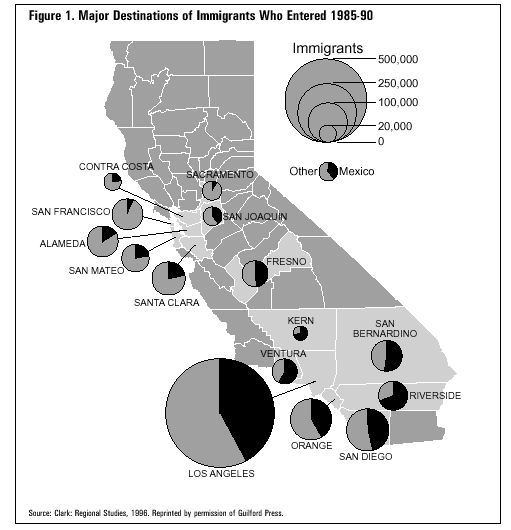
- Forty-one percent of all immigrants to California settle in Los Angeles, another 9 percent in Orange County. More than 16,000 immigrants settled in one zip code in Burbank, a suburban city in the San Fernando Valley of Los Angeles, and more than 25,000 new immigrants settled in two zip codes in San Francisco.
- Hispanic foreign-born women with less than a ninth grade education average about 4.6 births in California. In Santa Cruz and Santa Barbara counties, foreign-born Mexican teenagers account for more than 40 percent of all teenage births.
- In 1995, Los Angeles County had more than half a million Limited English Proficiency (LEP) students.
- In Los Angeles, more than a quarter of all the foreign born are in poverty and immigrants make up almost half of the welfare population.
- Cities that were largely non-Hispanic white in 1970, like South Gate in Southern California and Daly City in Northern California, have become largely Hispanic.
These examples highlight three important findings about immigration which are often glossed over in national studies and in media discussions:
- Immigrants are highly concentrated, even within the states with high levels of foreign-born populations.
- The foreign born who are already settled in the cities and towns of the United States are having dramatic impacts on the population growth of these localities because they have very high fertility.
- New immigrants are often disadvantaged and require special and additional resources now, and will require even more in the future as their children enter the schools and colleges of California and the nation.
The Impact of Immigrant Concentration
Immigrants have always tended to cluster together. This tendency partly is a response to the protection provided by an enclave of immigrants and partly created by the outside world, by the lack of acceptance from the native born. Whatever the relative strengths of the varying explanations, the concentration of immigrants in 1998 is much like the concentration of immigrants 90 years ago. So what is different? It seems that the concentration may be increasing. Statistics show that the flow of immigrants is increasingly centered on a few states and a few localities within those states. Thus, Los Angeles and Fresno, to cite two different contexts, have become home to local concentrations of large numbers of Mexican and Hmong immigrants respectively. Overall, California is divided into north and south. More immigrants flow to the south, hardly surprising given its geographic proximity to Mexico, and fewer to the northern Bay Area. But at the same time, the immigrants are selected by ethnic origin — many more Mexican-origin immigrants locate in Southern California than in Northern California, and the opposite is true for Asian immigrants (Figure 1). While this information is hardly new, it reiterates the age-old factor of chain migration, and of the importance of networks and connections. The outcome of this chain migration may be greater and greater concentrations of groups of immigrants.
In the most extreme cases, whole villages from Mexico have slowly, and sometimes not so slowly, transported themselves from Mexico to Southern California, where they have recreated familiar cultural patterns from their homeland. Cities and communities have changed in response to these immigrant flows. Some cities and communities are now more complex mixtures of people than is the state as a whole.
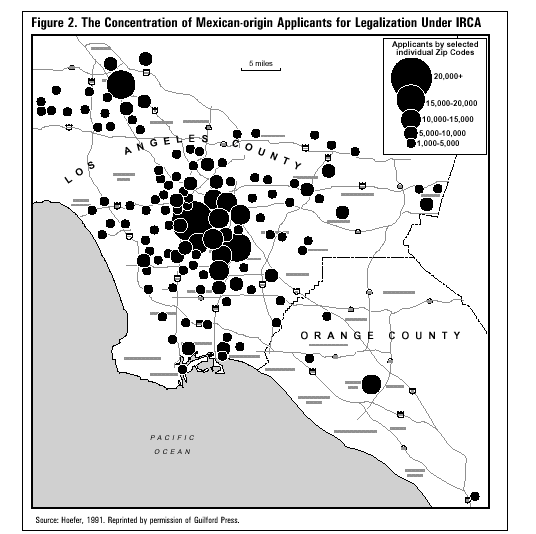
Applicants for residency during the IRCA amnesty program demonstrated the level of concentration of new immigrants. In Los Angeles alone, several hundred thousand applicants came from a dozen zip codes concentrated in a five mile radius of city hall in Los Angeles (Figure 2).
The New Resident and Citizen Population
Discussions of immigration tend to focus on the flows across the border, when in fact much of the change that will occur in California and the United States in general is already in place. High fertility among the new immigrants will create a new citizen immigrant population, one in need of substantial educational resources. The immigrants already here are going to change the California social structure fundamentally, so how we accommodate the new immigrants, educate them, and so on, is critical for the future of California. Even if immigration were to stop immediately, the processes now occurring would ensure continued population expansion and ethnic change. That change is embedded in the youthful immigrant population that has entered California in the past decade. Moreover, that young population is also showing signs of moving to other locations in the Midwest, the South, and the East — communities in those areas will also change.
Moreover, the localized concentration of recent waves of immigrants in crowded inner-city housing, sometimes in high-crime neighborhoods, makes it even harder for these new arrivals to make progress in U.S. society. Just as immigrants are divided, so is immigrant geography. Immigrants in the Bay Area by and large are doing much better than immigrants in Southern California. To be sure, some of this is the nature of the immigrant composition, but not all of it can be explained simply by ethnic origin.
Education, Skills, and the Future
In general, the new Latino population has the lowest levels of human capital, is the most disadvantaged, and is suffering greater levels of poverty and more limited access to educational resources. The immigrant Latino population, although perhaps better off in California than in rural villages in Mexico, is trapped in a cycle of inadequate education and low-paying jobs. The data from California test scores present a troubling but inescapable problem. In the Los Angeles Unified School District (LAUSD) reading and math scores for 11th graders (those who are about to join the labor force) are well below the national norms. In fact, for a selected set of high schools in LAUSD scores are at about the 10th percentile level for reading for both inner city and San Fernando Valley high schools. The Los Angeles high schools (and probably most large inner city school districts) are simply not providing an adequate education for new immigrants and their children. The high school completion rates and the college entry rates are abysmally low for these LEP students. Of course, one can take the position that everything will work out, that immigrants will get jobs and move up the income and occupational ladder. That was the process in the past and it may continue to be so. If not, however, California's work force will no longer be on the cutting edge.
Although money alone cannot be a solution, California's current position in educational spending — which is in the bottom fifth of the country — will not ensure that the new immigrants receive the education they need to participate in the 21st century economy. In addition, if the flow of legal and illegal immigrants without adequate human capital continues, the needs will be many times greater.
Test scores are declining and by extension the average level of education is declining, at least in California. In 1970 Californians had 12.4 mean years of education compared to 12.1 years for the United States as a whole. In fact, California outperformed the United States in 1970 in every age cohort for both high school education and for college education. The vaunted California educational system played some role in this, but a net inflow of bright students from the rest of the United States was a big part of this "California advantage."
At some point in the late 1980s, however, California's education advantage disappeared. Around 1987 the enrollment rate for California high school seniors dropped below the rate for the United States as a whole. The college enrollment rate in the United States as a whole is now higher than it was in California in 1977. All of this has implications for California's continuing competitive advantage. Clearly, the state continues to attract a highly skilled population, but at the same time the continuing influx of low-skilled immigrants who are having difficulty achieving at national standards has dramatic implications for the future competitiveness of the California economy. While California may not lose its competitive strength at the cutting edge of research and development in the information technology industries, these industries seem to be increasingly dependent on a small number of highly educated foreign professionals just at a time when most of the new immigrants are unable to perform at this level. The concentration of low-skilled immigrants in one locale and high-skilled immigrants in another only exacerbates the local outcomes of differential immigration flows.
Much of the current discussion in California, and indeed in the United States, is about education in general and about education for new immigrants in particular. How are we delivering education to these new immigrants and their children? Research to date suggests that the process of educating new immigrants will be slow and that the education of parents is an important factor in children's school achievement. Moreover, the results show real variations across the geography of the state. In Los Angeles, nearly two-fifths of school-age children live in households headed by an adult without a high school education. In the Bay Area, 11 percent of children are in households headed by an adult without a high school education. Again, the outcomes are extremely variable and impact the local delivery of services. Schools that are faced with large numbers of low-wage, low-education families have a major task in front of them, especially in the inner cities of Southern California (and by extension other inner-city areas that will soon have large numbers of new immigrants). To reiterate, California is spending significantly less per pupil than the national average on education and California's children are falling behind. A mild judgment is that this is a recipe for disaster.
In a nation where education and many other services are funded locally, it does not particularly matter that immigrants may be a net benefit to the country as a whole, as has been so frequently cited. It is already apparent that significant monetary costs arise in particular communities and neighborhoods, though these costs may not be the most critical in the long run. The costs of social tensions may be much more important as new groups struggle for a share of scarce resources for schools, medical care, and other services. Already, there are reports of tensions between older established African American communities and new immigrants in cities like Compton and Downey in Southern California.
There is a lot of talk about Balkanization, but it is too soon to tell how the assimilation process of our newest immigrants is going to work out. We know, however, that the assimilation process will be different. The new immigrants are arriving in a different social context, one where there is more emphasis on individual rights, on protected minorities, and on special programs. It is a different and more socially accepting climate. Another big difference, that others also have emphasized, is that the immigrants who came in the early 1900s were severing all ties with their home locations, whereas most immigrants to California, especially those from Mexico, still have very close ties to their homelands and are, in some senses, a nation within a nation. This is not to say that assimilation will not occur, but it will be a different process than that of 90 years ago.
While there is evidence of poverty and deprivation among some immigrant groups, others are "making it." There is evidence of increasing home-ownership for some Asian and Eastern European immigrant groups — some of which have ownership rates similar to those of the white native-born population and much higher than the native-born African-American and native-born Hispanic populations. For example, more than 60 percent of Chinese, Filipino, and Indian immigrants are home owners compared to only about 20 percent of Central American immigrants. This emphasizes yet another important finding which is often glossed over in the national studies: The outcomes both for immigrants and communities are very different for immigrants from different origins.
My recent book, The California Cauldron, explores whether the "California Cauldron" will come to a boil or continue to simmer: Will the social fabric stretch or tear? My tentative assessment is that the fabric of California society can stretch, but only with quite a bit of help from the local and state governments. Much of the problem is that the immigrant population, like the population as a whole, is bifurcating into relatively rich and relatively poor groups. Some new arrivals are making real progress, especially those who arrive with skills and generally high levels of human capital. Others, who arrive without even a high school education, with little chance or time for gaining more training, are becoming financially isolated. It is impossible to ignore the clear division between the foreign born (and their children) from some Asian and Middle Eastern and European countries and their counterparts from Central America and Mexico.
Immigration already has changed the old biracial view of the United States to a multiracial mix in California and the rest of the United States will follow fairly quickly. Today's responses to this change at the local, state, and even federal level will determine local outcomes well into the next century.
Immigration and California Communities
While there has been little debate in California on immigration lately, has anything changed, especially at the local level? A detailed analysis suggests that, while voter attention may not be directed to immigration issues, immigration outcomes at the local level require even more political attention than four years ago. Some facts:
- About four million new immigrants were counted in California in the last decade or so.
- Forty-one percent of immigrants to California settle in Los Angeles, another 9 percent in Orange County.
- In 1995, Los Angeles County had more than half a million Limited English Proficiency (LEP) students.
- In Los Angeles, more than a quarter of all the foreign born live in poverty.
William Clark is the author of The California Cauldron: Immigration and the Fortunes of Local Communities (Guilford Press, 1998, ISBN 1-57230-403-0) from which this Backgrounder is derived. He was born in New Zealand and completed bachelor's and master's degrees in geography at the University of New Zealand. His Ph.D. is from the University of Illinois, Urbana-Champaign. He is currently Professor of Geography at the University of California, Los Angeles, where he teaches courses on migration and metropolitan change. In addition to the recently published California Cauldron, he wrote Human Migration (Sage Publications), coauthored Households and Housing: Choice and Outcomes in the Housing Market (Rutgers University Press), and coedited Residential Mobility and Public Policy (Sage).