
Contents
Introduction
Background: The "Out-of-Control" Border
El Paso: Continued Success
Other Texas Sectors: Experiencing Pressures
Tucson and Nogales: The Old Frontier
Operation Gatekeeper: Mixed Results from a Mixed Operation
El Centro
San Diego Border Control Stations
Imperial Beach
Chula Vista
Brown Field
Campo and Boulevard
El Cajon and San Marcos
Temecula and San Clemente
Lessons Learned
New Challenges
Conclusions
Bibliography
Introduction
"It is wrong and ultimately self-defeating for a nation of immigrants to permit the kind of abuse of our immigration laws we have seen in recent years, and we must do more to stop it." -President Clinton, State of the Union Address, January 1995
The Clinton Administration has embraced a strategy of rigorous border control to help reduce the problem of illegal immigration.
That this approach can work was demonstrated in 1993 by an innovative operation in El Paso, where Border Patrol agents began standing watch right on the border to deter illegal crossers from even trying to enter the United States.*
This strategy of trying to deter illegal crossings before they happen, rather than attempting to catch illegal immigrants after they enter the country, resulted in a major drop in the number of illegal crossings in El Paso, which had been the second most popular border crossing point for illegal immigrants.
In our 1993 report on El Paso's Operation Hold the Line (at first named Operation Blockade), we asked whether this effort could be maintained over the long term and whether it could be replicated elsewhere on the border. In October of last year, a new campaign, dubbed Operation Gatekeeper, was begun in San Diego, the other major illegal crossing point on the southern border, in an effort to replicate the success in El Paso.
But deterrence appears to have been less effective in San Diego. This has raised many questions:
- What is the difference between these two major border control efforts?
- With increased deterrence at El Paso and San Diego, there has been an increase in illegal crossings elsewhere along the border — does this mean the overall objective of border control is illusory?
- Was the border control mess inherited by the Clinton Administration the result of inattention by its predecessors?
- Is the overall border control effort now on track?
- And, perhaps most importantly, what effect will the new strategies have on the number of illegal immigrants settling permanently in the U.S. each year, estimated by the Immigration and Naturalization Service (INS) at more than 300,000?
To observe the effect of the San Diego operation, to evaluate the continuing impact of Operation Hold the Line in El Paso, and generally to answer some of the questions posed above, we revisited the southwest border late last year, with stops in El Paso, Tucson, Nogales, and San Diego.
Our observations are that the El Paso operation continues to show success, while in San Diego, there is real potential in the recent Border Patrol efforts, though that potential has yet to be fully realized. The characteristics of the border and its attraction to potential illegal immigrants differ from one sector to the next, but the recent efforts have demonstrated that the border can be controlled.
For many reasons, the goal of total deterrence remains elusive, even at El Paso. The results in San Diego, as seen in the apprehensions statistics, are generally much less impressive than in El Paso, but they suggest nonetheless that illegal crossings can be deterred in that sector. This is evident from the Border Patrol's success at reducing, and keeping down, the level of crossings at Imperial Beach, the westernmost portion of the border at San Diego, which had been the favorite crossing point for illegal immigrants.
The Tucson sector, and the area around the border town of Nogales, Ariz., in particular, remains an area where the Border Patrol is unprepared to cope with increased pressure and establish effective deterrence. For that reason it has borne the brunt of the shifting patterns in illegal crossings and the recent increase in attempted illegal entry.
Rather than relax the effort to deter illegal border crossings — whether because of the greater effectiveness already achieved or out of resignation that some aliens will continue to slip through — the accomplishments already in place need to be consolidated and expanded. The effort at El Paso requires reinforcement; the San Diego operation needs a more coordinated approach; and the Nogales initiative is just beginning. Having proven that controlling the border is possible, the effort now should be to build on these achievements and close the remaining holes.
Would-be illegal immigrants and alien smugglers (coyotes) are a greater challenge to the Border Patrol than ever before, because of the increased capability of the smugglers to monitor and take advantage of weaknesses in border security and internal enforcement. Fortunately, the Border Patrol is now beginning to meet this challenge with upgraded technology to detect and identify illegal crossers. The availability and use of resources are of critical importance, but have not been adequate. And greater disincentives to illegal immigration are needed all along the route, at the start of the trek in the home country, at the border, on the routes leading inland from the border, and at the workplace in the United States.
Deterring illegal immigration is not, however, the responsibility of the Border Patrol alone. It also involves cooperative international efforts, enhanced enforcement of the law, and assured removal from the country of those who violate our frontier and laws. This effort would be significantly enhanced by effective laws and a national consensus that would deny illegal immigrants the benefits they seek, especially employment, and channel any demonstrable need for foreign workers into legal entry procedures.
Background: The "Out-of-Control" Border
"...Mr. Reyes approach through into question the fundamental border patrol strategy of the last several decades: Let aliens cross the border, and try and catch them. The way, the Patrol could demonstrate to Congress that it was catching more and more aliens every year and request even larger budgets. - A Success at the Border Earned Only a Shrug,"New York Times," 9/14/94
Illegal immigration through surreptitious entry into the country (Entered Without Inspection, or EWI in INS parlance) has not always been as great a problem as in recent years. In 1965, the number of Border Patrol apprehensions of illegal border crossers — mostly those who entered over the U.S.-Mexican border — was 110,000. By 1993, the level of apprehensions had grown to 1.35 million, over a twelve-fold increase (see Figure 1).
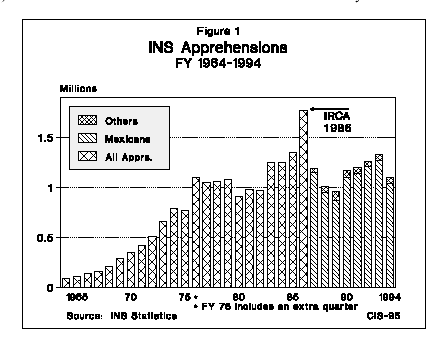
The appearance that the border was sieve-like contributed to the adoption — after several years of legislative effort — of the Immigration Reform and Control Act of 1986 (IRCA). This act established sanctions against employers who knowingly hire illegal aliens. A sharp drop in illegal entries (as indicated by a drop in apprehensions) resulted from concern among would-be illegal immigrants that they would be unable to find employment in the United States. This decline in attempted illegal entry is a clear indication of the potential long-term deterrent value of the employer sanctions system, if it operates effectively.
But, by 1989, the apprehension rate resumed its climb. This renewed increase of attempted illegal entry despite enactment of employer sanctions points to their ineffectiveness, as they have been implemented, as a deterrent. The reasons that the IRCA provisions have not worked are various, including a convoluted system of documents that may be used to establish entitlement to legal employment, the ready availability of fraudulent documents, deliberate disregard of the law by some employers who see little threat from limited enforcement efforts, and new arrangements whereby unscrupulous contractors furnish illegal workers to employers.
What Conclusions May Be Drawn from the Apprehension Data?
Because of the unavailability of any alternative timely data on the volume of illegal entry, apprehension data generally are used as an indicator of the relative magnitude of the problem. But INS and Border Patrol authorities readily acknowledge that the number of apprehensions does not equal the number of attempted entries, because the border control effort is less than totally effective.
Some Immigration and Naturalization Service (INS) officials have suggested in the past that two or three aliens slipped past the Border Patrol for every person caught. The Border Patrol Sector Chief in El Paso suggested an even lower rate of apprehension in that sector (one of eight illegal crossers) before the initiation of Operation Hold the Line. The percentage of apprehensions will vary over time and at different locations along the border, depending on Border Patrol interdiction capabilities and the numbers and resources of would-be illegal entrants.
To underscore the difficulty in interpreting apprehension data, we offer an example. To begin, the ratio of apprehensions to EWI border crossings might be 1:2 with 1,000 aliens apprehended and 1,000 avoiding apprehension. At a later time, because of increased Border Patrol resources, the ratio might become 9:1 with 1,800 aliens apprehended and only 200 avoiding apprehension. The latter situation might cause attempted illegal entry to drop in half, so that apprehensions dropped back to 900 and only 100 succeed in avoiding detention. The apprehension data then would reflect only a modest decline of 10 percent from the starting point of 1,000, but the level of illegal entry would be down by 90 percent. Alternatively, Border Patrol efforts could be undermined by diversion of resources to a more pressing responsibility, would-be illegal alien entry attempts might then double, and the ratio of apprehensions to attempted entries could drop to 1:5 with only 800 apprehensions for each 4,000 attempted illegal entries. The apprehension data would reflect a drop by one-fifth, but the illegal entry problem would be 220 percent worse.
In that case, what meaning can be derived from the apprehension data? At best, they are a rough indicator over time of the effectiveness of the Border Patrol. But, it must be remembered that a change in the data may reflect a change in the effectiveness of the Border patrol or a change in the influx of the illegal crossers or, more likely, a combination of factors.
There is one other statistic collected by the Border Patrol that serves as a check on the meaning of the apprehension data — hours of agent time spent on border (line) and non-border (non-line or interior) operations. By looking at the agent-hours (which we convert to agent-days by dividing by eight), it is possible to evaluate whether increased or decreased personnel resources explain some of a change in apprehension level. This becomes important in situations such as the closing of stations in the San Diego sector during Operation Gatekeeper.
If the fact of the closing were not known, and sector-wide or total apprehension data were studied, it would appear that a decrease in apprehensions might be equated with successful deterrence. When the agent-days of operations are looked at, it is clear that such a decrease relates to a reduced level of enforcement activity.
An informal check on apprehension data is in use in San Diego. Border Patrol agents report at the end of their shift on the number of illegal aliens they have detected. This data is refined by comparing it with the observation of others in the area to avoid double-counting and then compared with actual apprehensions. This data may be subject to manipulation, but it offers Border Patrol supervisors an unofficial indicator of the level of success in attempting to apprehend all illegal border crossers.
Despite the limitations in using apprehension data, some inferences may be drawn from them. Most of the EWI problem occurs at the U.S.-Mexican border, and it results primarily from the attempted illegal entry of Mexicans (see Figure 2). Over half of the challenge posed by illegal entry, to the extent that it may be judged by the level of apprehensions, has occurred in two sectors — San Diego and El Paso.
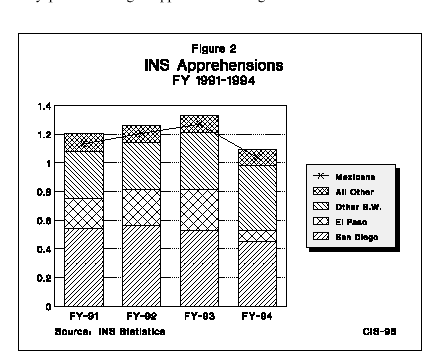
Hispanic advocacy groups have asserted that the disproportionate share of Mexicans in the apprehension data is because the Border Patrol has concentrated its efforts along the U.S.-Mexican border, and that reflects an anti-Hispanic prejudice. That this assertion is groundless is apparent in the results of the IRCA amnesty for illegal aliens. Three-fourths of the over three million applicants — those who had taken advantage of the out-of-control border to enter the United States to find jobs — were Mexican. More than an additional nine percent were from Central American countries. Most of these illegal aliens were in the EWI category. Thus about seven of every eight of the three million illegal alien amnesty applicants had taken advantage of inadequate security at the U.S.-Mexican border.
Recidivism
Another factor that must be understood about apprehension data relates to recidivism. What happens when the Border Patrol apprehends an EWI? If the alien is Mexican (over 95% of the cases), he or she is usually given the opportunity to waive a deportation hearing and accept "voluntary departure." At the border, this means release for return to Mexico or Canada. But other apprehended illegal aliens are also offered the chance to leave on their own — very few are actually de- ported. In some cases, EWI Mexicans are also deported, such as upon release from prison or even along the border when they have forcefully resisted apprehension or in cases of flagrant recidivism. However, since 1990, among apprehended EWI aliens, the largest share deported in any year was only slightly over three percent. The other 97 percent were quickly processed, with minimal data recorded regarding name, date and place of birth, and then "required to depart." These voluntary departure cases represent the vast bulk of the workload of the U.S.-Mexican border enforcement operations.
The Border Patrol has long known that many of the Mexicans whom it apprehends and requires to depart continue to repeat illegal entry attempts in the hope that they will succeed the next time. But, until recently, the Border Patrol had little ability to know how many of those apprehended were repeaters, unless the alien admitted that fact. This means that a million apprehensions in a year is not the same as a million different persons being deterred from illegal entry. Rather, the same person might be apprehended two or three or more times in a single day or week.
The recidivism rate indicates one of the difficulties in relying on apprehension data as an indication of the level of attempted illegal entry. If the Border Patrol is less efficient, it will be easier for aliens to slip into the country, and apprehension data will be lower. If, however, the Border Patrol is more efficient, a determined would-be illegal entrant might be apprehended a half dozen or more times before evading apprehension or giving up the effort. On the other hand, if the Border Patrol ordinarily caught only half of all EWI entrants, and then improved its operation so that it apprehended nearly 100 percent of the attempted illegal entrants, the result as seen in apprehension data would likely be a significant surge in apprehensions at first, and then, as word spread among would-be illegal crossers that the odds had become strongly against successful entry, the number of attempted illegal crossings would then drop off sharply, as would apprehensions.
Controlling for External Influences
One challenge in analyzing illegal alien apprehension data is to adjust for the considerable changes that take place over time. For example, a close look at the recent apprehension data reveals the upward trend since 1989, following the drop due to the adoption of the employer sanctions system in the 1986 IRCA.
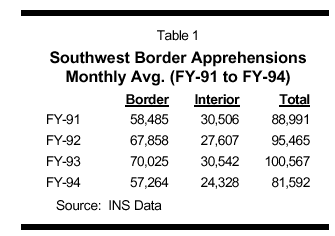
Between October 1991 and September 1993, when Operation Hold the Line was launched, total monthly average apprehensions increased more than five percent each year. Then in FY-94, after the El Paso operation was in place, apprehensions dropped (see Table 1). A comparison of just the FY-94 and FY-93 numbers would indicate a drop from an average of about 100,000 per month to under 82,000 (or about 19%). However, the earlier upward trend suggests that the level in FY 94 likely could have been about 120,000, and, therefore, the overall significance of the change caused by better border control was a reduction of about 40,000 (or nearly 40%) below the prevailing trend.
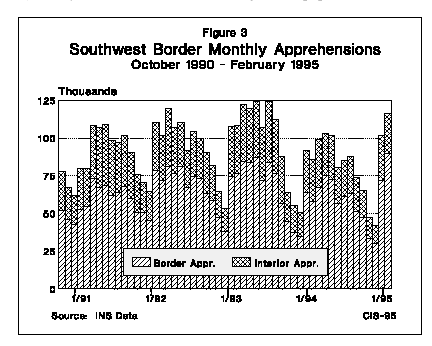
Another clear pattern that may be seen in the data is a seasonal fluctuation. At the end of each year, the apprehensions decline, with December the lowest level of the year (see Figure 3). They increase early in the new year — as the new planting season approaches. There tends also to be an increase near the start of the harvest season. The high apprehension months reflect the attraction of employment opportunities in agricultural labor, and the low apprehension months suggest that the pull of "home for the holidays" is stronger than the lure of U.S. economic opportunities.
Finally, there are also patterns that may be found in the apprehension data that correlate with the days of the week. This is noticeable in El Paso, especially before Operation Hold the Line, when large numbers of Ciudad Juárez residents were illegally entering El Paso for jobs. The weekend apprehension rates would decline, and on Monday they would rise. Careful analysis of border operations requires controlling for this type of variable.
What Are Other Measures of Successful Border Control?
A December 1994 report on border control operations by the General Accounting Office (GAO)* cited Border Patrol officials as identifying four measures for gauging their success: (1) a reduction in apprehensions; (2) an increase in fraudulent attempts to enter the country through ports of entry; (3) an increased level of apprehensions elsewhere on the border; and (4) fewer illegal immigrants detected in the interior of the United States.
Of course, the fourth indicator is the most important one. However, unless some new way of measuring the illegal alien population in the United States is devised, other than the census, we would have to wait until after the results of the 2000 census are available to see if current efforts are succeeding. Even if we were prepared to wait for so long, could we trust the resulting data? Census officials acknowledge a possible undercount of as much as one-third of the illegal alien population.
The current estimate of the Center for Immigration Studies and the INS of the net amount of illegal immigration into the United States each year is about 300,000, about half of whom are border crossers and the other half are legal non-immigrant entrants who violate their status. That estimate is derived from data collected from among the over three million applicants for the IRCA amnesty and from comparing the decennial censuses — that count all residents, including illegal aliens — with the number of immigrants who entered legally during the same period. Also estimated are the number of illegal immigrants who die or return home on their own. These methods are imprecise because the survey data depends on the information supplied by the illegal immigrants, and the census data are flawed by the problem of not counting persons who are anxious to escape official notice because of their illegal status. But most analysts think that the net level of illegal newcomers is in multiples of hundred thousands rather than the millions suggested by estimates based on the apprehension data.
The estimated level of over 300,000 net new illegal immigrants each year indicates that these uninvited newcomers constitute more than one quarter of all annual immigration. The administration and the Congress now agree with the American public that a major effort is required to better management the border and ports of entry and make effective secondary controls at the work site.
Data on aliens deported and "required to depart" also are of limited value in gauging the effectiveness of the border control effort (see Figure 4). If the INS and the Border Patrol were able to effectively identify and remove most illegal aliens who manage to avoid detection at the border or who overstay their terms of legal entry, then the data generated by interior control operations would serve as an indicator of how well the first line of defense is doing. However, compared to the estimates noted above of over 300,000 new illegal immigrants each year, the INS is finding and removing fewer than 50,000.
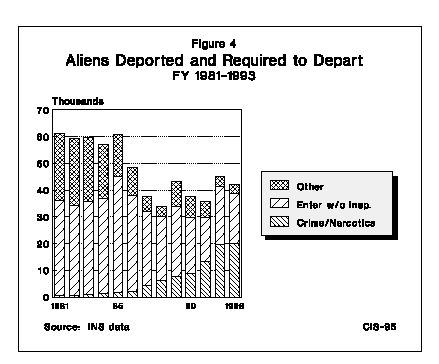
Like the overall decline in apprehensions in 1986 after the passage of IRCA, the number of deportation cases declined. But, unlike the resumed rise in apprehensions, a lower level of overall deportations has continued, along with increased removal of persons convicted of narcotics and other crimes. Thus, the removal of EWI illegal residents has not been keeping pace, and the data reflect a level of effort that has little relationship to the enforcement challenge. Therefore, little can be inferred from them about border control effectiveness.
INS acknowledges that it has inadequate resources to discharge its law enforcement responsibilities. For example, a March 21, 1995 San Jose Mercury News article quoted William Bonnette, the Livermore, California Border Patrol sector chief explaining that, "There's no way I can handle 52 counties with 52 agents." The report noted that the INS district investigations branch in San Francisco had 150 employees in 1988 and 95 today (65 of whom are agents) to cover 49 counties. It cited a General Accounting Office study that reported that the INS admitted to being unable to pursue 36,000 leads on possible illegal aliens. Even with an increased emphasis on identification and removal of criminal aliens, INS authorities, including Commissioner Meissner, acknowledge that they are not yet able to screen, identify and process for removal all deportable criminal aliens. Chief Bonnette noted that doing the job properly would mean interviewing all foreign-born criminal suspects after booking, not just after conviction.
We may look for some of the answers to questions about what conclusions may be drawn from the apprehension data by turning our focus to the U.S.-Mexican border. In El Paso, apprehensions fell dramatically in 1993. Did that mean the Border Patrol there was less effective in apprehending illegal crossers? Or did it indicate success, because the Border Patrol is deterring would-be illegal immigrants from even trying to enter? The same questions are now relevant for San Diego. Apprehensions were declining even before Operation Gatekeeper began. Does that indicate greater deterrence, as claimed by the Border Patrol? Or, as others suggest, does it indicate that the economic pull factor was weaker because of the depressed California economy?
El Paso, Texas: Continued Success
The El Paso Border Patrol sector, under the supervision of Chief Silvestre Reyes, proved that illegal immigration could be effectively deterred by a preventative deployment of agents along the border, as noted in our report last year. By mobilizing his sector's resources along the border around the clock, he converted what had been a widely-breached border river and fence between the busy cities of El Paso and Ciudad Juárez, Mexico into an effective deterrent. The apprehension data show a precipitous drop from the outset of the operation (see Figure 5).
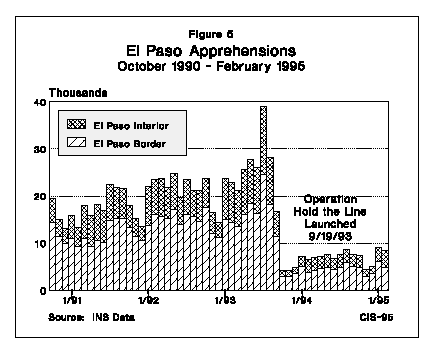
Apprehensions had been rising by an average of 33 percent per year for the two years prior to the start-up of the new strategy. The data show also that the initial rate of success, for the most part, has been continued. Upon visiting the border, it was possible to verify the continued absence of any large groups or more than the occasional solitary individual or twosome eyeing the border security on the U.S. side.
In our earlier report, we noted that one of the remarkable features of the El Paso operation was that it was accomplished without a major infusion of new personnel resources from outside the region. Rather, border deterrence was acheived by a reallocation of resources from non-border (non-line-watch) operations and an initial assignment of overtime hours. This led to a significant increase of Border Patrol agents on the border at the same time that a decrease occurred in non-border activities (see Figure 6).
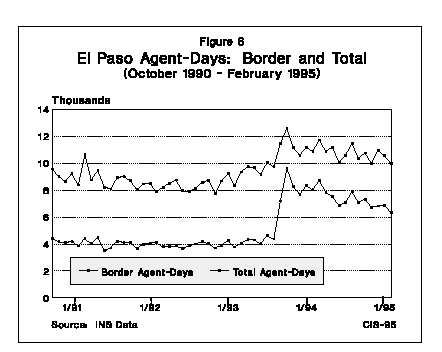
Chief Reyes in El Paso judged that he would have less need for agents in non-border control operations and administrative operations if there were fewer illegal entries. We raised the question in our earlier report whether the decrease in personnel resources involved in interior checkpoint operations might result in an easier entry into the interior of the United States for those illegal aliens who managed to evade the heightened border control presence.
A study by Frank Bean, et al* for the Commission on Immigration Reform asserted: "Once across the border, illegal crossers appear less likely to be apprehended by the Border Patrol than they were before the Operation."
The evidence to support this assertion, however, was anecdotal. Illegal aliens interviewed in El Paso had said that after the initial two months of the operation the possibility had opened up again to cross illegally. This information appears to be contradicted by the objective data showing the sustained lower number of attempted illegal entries, as reflected in the continued major reduction in apprehensions and in visual observation of the border. It is also contradicted by the continued public support for the operation and other correlations with the operation, such as a continuing reduction in auto theft, reported by Bean, et. al. Finally, Operation Hold the Line has not stripped the interior control operations of their entire personnel strength.
There continues to be Border Patrol surveillance at the El Paso airport and on the highways leading out of El Paso into the interior of the country. The number of apprehensions at these secondary control points acts as a test of the effectiveness of the enhanced border control. The level of apprehension fell off in the interior, as well as on the border (as could be seen in Figure 5).
One significant change in the profile of the Border Patrol that resulted from the launching of Operation Hold the Line was an end to Border Patrol operations in the El Paso rail yards. Prior to the operation this was one of the major destinations of illegal border crossers who intended to reach interior points. The railroads have their own security services, but the Border Patrol worked in collaboration with them. The effectiveness of the border control operation in preventing illegal entry was such that the joint operations were no longer necessary, and the railroad security was sufficient. If the effectiveness of the operation had waned, the rail yard security staff would be among the first to notice this change. In fact, the railroad security personnel state that there has been no such resumption of a major problem in controlling efforts of illegal aliens to "ride the rails." These observations suggest that the resumed ease of illegal crossings claimed by the Bean study's informants was exaggerated, or perhaps applied only to illegal crossers who were not attempting to continue on to the interior of the United States.
The primary objective of Operation Hold the Line at El Paso was to put an end to the sieve-like nature of the border there. It was recognized by the Border Patrol that, if the operation were successful, it would likely increase pressures elsewhere. That is the reason that the inspection staff at the legal crossing points was simultaneously increased — which incidently also led to public relations problems, when inspectors who were brought in from outside the sector applied a more confrontational inspection standard than was normal. This problem was quickly corrected, however. Another area in which increased pressure was anticipated was in attempted illegal crossings on the outskirts of El Paso, where the border terrain is both more difficult to cross and more difficult to patrol.
The apprehension data suggest there is some slight upward movement, and a jump in January and February of this year that was similar to that experienced elsewhere along the border. Chief Reyes explains that this is due primarily to increased efforts to break through the weak points in the border security measures at the outlying ends of the sector. Especially on the west end of the sector, where the border crossing is into Anapra, New Mexico, there are none of the physical barriers that facilitate control efforts in downtown El Paso, i.e., the Rio Grande river, an aqueduct, and fencing. In this area, aliens may still walk across the border with no physical impediment. The area is not heavily populated, but there are some housing settlements on both sides of the border. The Border Patrol is now requesting the extension of fencing and lighting to this area and out beyond where there are any settlements.
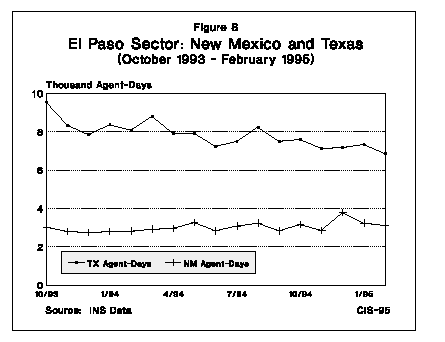
Another explanation for a slight upward trend in apprehensions following the initial success of the operation is that the pent-up pressures among would-be illegal border crossers never fully abated, and the level of personnel committed to the border could not be indefinitely sustained. Part of the initial effort was due to an allocation from Washington of year-end funding to pay for extensive overtime. From a total of over 9,000 agent-days on the border during October 1993, when the operation was launched at mid-month, the level of effort dropped to an average of slightly over 8,000 through March 1994, and since then has averaged about 7,000 agent-days per month. As the presence of agents on the border thinned, a corresponding increased effort to break through the line resulted in increased apprehentions. However, the data from the secondary control points still indicate that the effectiveness of the operation is largely intact despite a somewhat lower commitment of personnel.
The Bean Study
"Illegal Mexican Migration and the United States/Mexico Border: The Effects of Operation Hold-the-Line on El Paso/Juárez" — As the title suggests, the focus of the Bean study is both on the effects of the operation on illegal border crossing and on the social fabric of the two cities separated by the international border. A major effort was made to find objective indicators of the effects of the operation on the two communities, but anecdotal information was relied on to suggest that the purpose of the operation was not control of illegal immigration, but rather to control other problems such as illegal alien street vendors, problems for the Border Patrol in distinguishing between Mexicans and El Pasoans in effecting apprehensions, etc. This ignores statements by Chief Reyes that clearly enunciated the purpose as preventing the entry of illegal border crossers.
While the authors note the impact of the operation in reducing illegal crossings, the apparent community support in El Paso for the effort, and other benefits (such as a reduction in some crimes), they are nevertheless critical of the insensitivity to the problems that the operation has caused for the population of Ciudad Juárez, across the border. The authors suggest that much of the illegal crossing activity was harmless visiting or shopping by Mexicans that would have occurred legally if the procedures for obtaining a local border crossing card were liberalized.* It certainly is correct that pressure for illegal crossing would abate if more of these persons had a legal means of entry. However, whether these persons would be likely to confine their entry to visits and shopping is another matter. The border crossing card is valid indefinitely, so care must be exercised to determine whether the applicant is a potential illegal immigrant or illegal worker at some point in the future, not just on the day of application.
As the study notes, there already exists some volume of cross-border traffic by persons with the cards who use them to enter the United States to illegally work on a daily, weekly or seasonal basis. Although a looser standard for issuance of the crossing cards would ease pressure for illegal entry and be welcomed in Juárez, it would also undermine the effectiveness of the border control operation to the extent that persons who benefitted from the new standard violated the conditions of entry and sought employment in the United States.
The study drew on early apprehension data to signal that the deterrent effect of Operation Hold the Line was waning and that illegal crossings/apprehensions were on the rise. By comparing October-November 1993 data with the same months in 1992 and January-February 1994 data with the same 1993 months, the report found that, "The deterrent effect appears to have diminished the longer the Operation has lasted." Revisiting the data used in the Bean study, the reduction in border apprehensions in October-November was 71.7 percent, and the January-February reduction was less (only 70 percent). This was too slight a statistical change to justify the tentative conclusion. When the full FY-94 border apprehension data is compared with FY-93, the apprehension level does not indicate a trend of weakening deterrence. The decline over the first full year of the operation is 72.4 percent. That level of reduction is even more significant when the previous upward trend in apprehensions of 33 percent is recalled.
Observations
During a nighttime observation tour west of the city, the writer observed high-technology detention operations against illegal aliens. The sector's night vision system, which identifies illegal aliens by their body temperature, was not in service, but the Border Patrol was using an enhanced light-sensitive and magnification device. Two aliens were spotted in U.S. territory making their way towards a nearby community. When they were far enough away from the border that they could not easily run back into Mexico, a Border Patrol mobile unit that was on the scene was informed by radio, and it went after the aliens, who attempted to flee. One Border Patrol agent pursued on foot and attempted to detain the two. One of the two aliens attacked the agent, who then drew his side arm. The alien attempted to wrestle the gun away, but was subdued when a second Border Patrol unit arrived on the scene.
This incident was a tangible reminder that detention efforts — as contrasted with deterrence of illegal crossing — involve potential violence. In this instance, if the second alien had not chosen to opt out of the confrontation, the Border Patrol agent would likely have been overpowered, unless he had used his weapon. Even then, he might have lost control and had his weapon turned on him.
The situation with these aliens was perhaps more physical than usual because, as was readily apparent, both were intoxicated. The alien who had not fought the agent claimed in a conversation with the writer that they were coming across to seek work to support their families in Ciudad Juárez. He also asserted that he had never before crossed illegally into the United States, an assertion that the Border Patrol agents scoffed at as a typical lie.
Even though there has been some increase in attempted illegal entries outside the downtown areas, that is not seen by Chief Reyes as undermining the effectiveness of Operation Hold the Line. The operation continues to demonstrate the ability to deny illegal aliens easy entry into populated areas where the Border Patrol could conduct enforcement efforts only with great difficulty, and often with the result that Hispanic citizens and permanent residents would be misidentified as illegal aliens. In addition, the continuing border crossing in outlying areas is easier to control because of the open areas that must be crossed before the illegal aliens reach populated areas, where they can blend into the crowd.
In the New Mexico sector of the border, the natural barrier of the Rio Grande river disappears, as it bends north toward its sources in the interior of the country. This is an area where illegal border crossers, deterred by the effectiveness of Operation Hold the Line in the downtown area, would likely try their luck. In addition, if the interior area of the El Paso sector was less well patrolled as a result of the concentration of agents at the border, the incentive of long-distance illegal migrants to try to probe weaknesses of this area would be greater. According to the Border Patrol staff in El Paso, in fact this has happened, but not to a major extent.
Data on the level of apprehensions since the beginning of the operation indicate that, since an increase in apprehensions in the New Mexico portion of the sector in January 1994, the level of apprehensions has remained fairly constant, with the exception of the usual seasonal decrease in November and December (see Figure 7). In other words, it appears that the New Mexico portion of the El Paso sector has not become out of control. This level of apprehensions in the New Mexico portion of the sector has coincided with a fairly steady level of vigilance (about 3,000 agent-days per month).
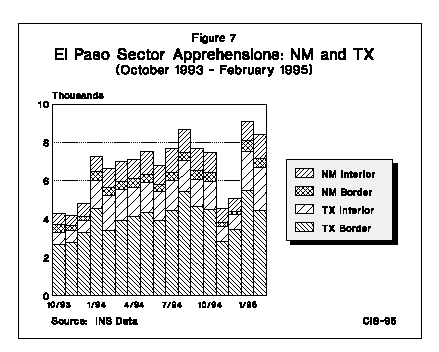
During this same period, the agent-days for the Texas portion of the sector has eased downward from nearly 10,000 in October 1993 to about 7,000 in February 1995. This shows that continued prevention of illegal crossing at El Paso is not being negated by simply rerouting the would-be illegal entrants to the outskirts of the city (see Figure 8). If they were going to be rerouted, as the Bean study suggested was likely, it would be to other less well controlled border areas in Texas or elsewhere in California or Arizona.
The Hold the Line effort is labor intensive. It required the redeployment of personnel from interior control points and from other operations, such as checking employment records of employers for illegal workers, and pulled persons out of desk jobs and put them on the line. In addition, the effort is tedious for the agents. As noted in our 1993 report, and mentioned also in the Bean Report, the positive elements of the successful operation, including fewer confrontations with illegal crossers, less conflict with U.S. citizens and residents, and strong community support, have been offset somewhat by morale problems among the agents related to less challenging assignments.
Overall, the objective data on the level of border apprehensions and some correlative data on apprehensions at interior control points suggest that Operation Hold the Line continues to demonstrate long-term success in deterring illegal entry.
Before turning to Arizona and California, the apprehension data regarding the other Texas Border Patrol sectors merit a brief review.
Other Texas Sectors: Experiencing Pressures
The four other Border Patrol sectors controlling the Texas-Mexico border are located eastward from El Paso at Marfa, Del Rio, Laredo and McAllen. They, like El Paso, had experienced increasing illegal-crossing pressures over the last several years (see Figure 9).
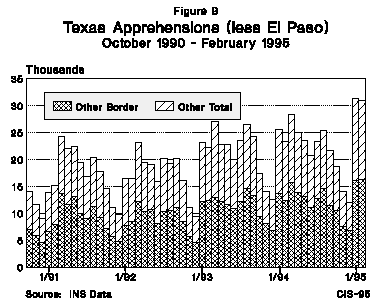
Between FY-91 and FY-93, the average annual increase in apprehensions was over 10 percent. In FY-94, after Operation Hold the Line, the annual increase in apprehensions was 4.7 percent. But the first two months of this year registered a surge of over 27 percent. The most seriously affected sectors were McAllen and Laredo, although Del Rio also registered a significant increase.
These sectors are scheduled to receive additional agents in FY-96, but, in the post-Operation Hold the Line environment, they have had to work with a static personnel level. The apprehension data, however, indicate that, prior to the peso devaluation, there was virtually the same level of agent-days in November and December 1994 as compared to a year earlier (see Figure 10).
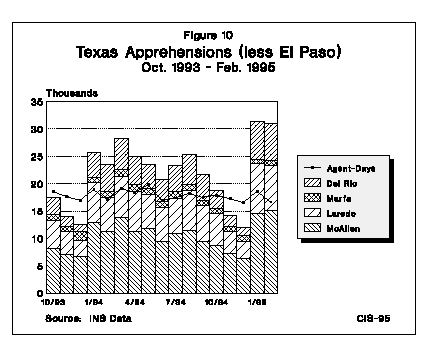
This most recent influx of illegal crossers indicates that these sectors are vulnerable to increased illegal entry attempts. Therefore, as greater control is gained over illegal entry elsewhere along the border, it seems likely that these other Texas jurisdictions will face increasing pressure. In this context, it makes sense to deploy additional personnel resources.
However, it should be kept in mind that El Paso's successful deterrent effort is not invulnerable to increased pressure from would-be illegal immigrants, as the increase in January and February apprehensions suggest. So resources elsewhere along the Texas border should not be increased at the expense of El Paso.
Tucson and Nogales: The Old Frontier
"...The most recent data indicate an incrase in traffic across the Arizona border. In anticipation of such an increase we launch Operation Safeguard, which will add 100 border patrol agents to the Tuscan sector by the end of the year and provide for new fencing, lighting, roads, and other construction to support security."
Tucson is the Border Patrol sector headquarters that is responsible for most of the Arizona border — all but the portion covered
by Yuma, at the border with California. The only major border crossing point for legal and illegal immigration is at Nogales, about 60 miles south of Tucson. Tucson sits astride the major east-west interstate highway (I-10) and where the only major route from Nogales (I-19) intersects with that highway.
The generally barren land in this area suggests that border control should be fairly straightforward. However, anecdotal information points to a significant illegal alien problem in Tucson, which
would appear to belie the effectiveness of the Border Patrol in this sector. The INS, drawing on experience with the 1986 IRCA legalization program (in which about 83,000 illegal aliens applied from Arizona), census data and other indicators, estimated that by 1992 the approximate number of illegal aliens in Arizona had risen to about 57,000. Of this number, the INS estimated that over 80 percent were Mexicans.
Apprehension data for the two Arizona border sectors reflect different patterns (see Figure 11). The Tucson sector, which accounts for the greater number of apprehensions, has witnessed an escalating number of attempted illegal entries at both the border (Nogales) and in the interior. Yuma, on the other hand, appears to have been immune to similar pressures.
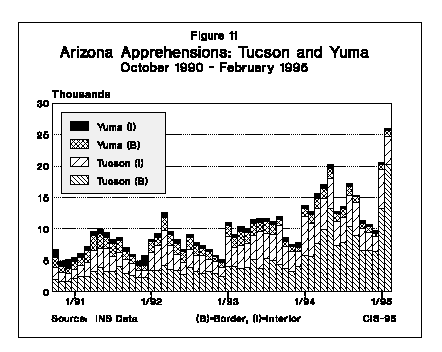
The greatest increase in apprehensions occurred after the El Paso border control operation was launched in September 1993. This suggests that Nogales became the secondary target for would-be illegal immigrants who were deterred by Operation Hold-the-Line's effectiveness. The average increase in apprehensions in FY-94 was about 2,000 higher than would have been expected from the rate of escalating apprehensions before the El Paso operation (see Table 2). The total increase of 4,000 apprehensions is a significant amount of dislocation. It is evidence of the effectiveness of the prevention strategy at El Paso for the overall border control effort to deter illegal immigrants, if that strategy can be replicated along the entire border.
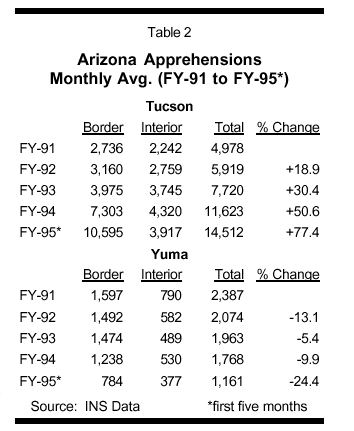
The decrease in apprehensions in the Yuma sector is somewhat surprising. It goes against the trend in increased pressure on the Border Patrol elsewhere on the border. The data on personnel levels during this same period of time do not reflect any decreased level of effort. The implication is that either the Border Patrol is so effective in this sector that alien smugglers steer clear of it, or that the sector is simply so unattractive to would-be illegal immigrants that they do not try their luck in this area. In either case, the Yuma sector merits a closer look.
Observations
On visiting Nogales and extensively observing the border downtown as well as in outlying areas, it was readily apparent that there would be little challenge to illegal entry into either Mexico or the United States given the current state of border fencing. There were numerous holes in the fence, and some entire sections that had been torn down to accommodate vehicular access. During a tour of this region with a Border Patrol agent, Mexicans freely crossed into the United States in order to pick up supplies they presumably had purchased. Residents noted that anything that was not bolted down was likely to disappear.
The loose semblance of control was true also in the downtown area. Within about 15 yards of a legal entry point — and within full view of anyone working at that point — there was a hole that had been cut in the fence, reportedly earlier in the day, and there were a half-dozen persons on the Mexican side of the fence presumably looking for an opportunity to make a dash through the informal portal. A short distance further on is a railroad point of entry with steel gates that are opened periodically to admit a train, and, officials said, the train is always accompanied by a number of aliens on board or on foot trying to take advantage of the opportunity to avoid detection and apprehension.
Although the local Border Patrol agents seemed resigned to this lack of control, it was encouraging to note efforts are underway to upgrade border security. Part of the new capability is in the form of surveillance equipment and part is new secure fencing. The fencing operation faces hurdles, such as awaiting the results of environmental impact studies and negotiating with landowners for the right to place equipment on their land that abuts the frontier.
Operation Gatekeeper: Mixed Results from a Mixed Operation
"We expect we will be able to secure the entire southwest border during this program. We do have a plan for activities in El Paso and San Diego to meet up. We intend to close the entire border [to illegal immigrants, a goal] many thought impossible." - Deputy Atty. Gen. Jamie Gorelick, AP 10/14/94<
The inauguration of Operation Gatekeeper at San Diego was accompanied by a blitz of publicity by the Clinton Administration — unlike the embarrassed silence that characterized the initiation of Operation Hold the Line. The California initiative was announced on the eve of the November elections, and it joined the hot political debate about illegal immigration that was fueling support for Proposition 187. The Administration said that an effective border control effort, such as Operation Gatekeeper, was the correct way to deal with the problem of illegal immigration rather than the initiative to restrict taxpayer-funded services to them.
This effort in San Diego would catch neither Washington nor Mexico City by surprise, as had the El Paso initiative. The new border control effort was not just advertised in advance, but it was as much the culmination of a series of efforts as it was the initiation of new measures. Both increased personnel commitments and a major infusion of high-technology equipment preceded the announced beginning of the operation. In addition, the new strategy coincided with the completion of the new border fence that had been begun during the Bush Administration and the installation of a significant amount of new stadium-type lighting, which facilitated night-time control efforts.
It is also noteworthy that Operation Gatekeeper was announced as a temporary measure. Clearly the infrastructure development was a permanent addition to the Border Patrol's deterrent capability. What may be subject to termination at the end of the current INS review of the operation's effectiveness — if that should be the recommendation — is not clear. It is clear, however, that if the decision should be to continue the operation as a permanent effort, some arrangements will need to be made to obtain on a permanent basis night vision equipment that was loaned by the Department of Defense to the INS for Operation Gatekeeper.
Has Operation Gatekeeper Been Successful?
To answer this question it is necessary to look at the criteria for success the operation incorporated and to ask whether these constitute a valid standard. San Diego Border Patrol Chief Gus de la Viña (since promoted to INS Regional Director) has insisted that the nature of the San Diego terrain and the profile of the would-be illegal entrant are such that an El Paso-style operation could not be mounted in San Diego.
There clearly is a difference in terrain between the two locations. El Paso is largely flat in the metropolitan section of the border, whereas sections of the San Diego border are extremely hilly. The complicated San Diego terrain affects both fence-building — although that now has been overcome — and road-building for patrolling the fence. Without vehicular mobility in places such as Smugglers Gulch in the Imperial Beach area, the Border Patrol is forced to apprehend illegal border crossers on foot or wait for them to proceed further away from the border to where the terrain is less of a factor.
Similarly, with regard to the profile of the intending illegal immigrant, the Chief's observation appears to be valid. In 1994, El Paso's Chief Reyes raised the question of the replicability of his success in San Diego because of the greater desperation of illegal crossers there. He was referring to the fact that many of the illegal crossers he was apprehending and deterring with Operation Hold the Line were local crossers, whose home is in Ciudad Juárez, unlike San Diego, where a majority are from inland points in Mexico and have undertaken a major effort, and cost in some instances, to get into the United States. The implication was that the latter would not be as easily dissuaded by a new posture by the Border Patrol. This is also the point that de la Viña makes.
Before attempting to answer the question of the efficacy of the Operation Gatekeeper strategy, it is useful to look at the results of the first five months of the operation and how they relate to the longer-term pattern of illegal entry (see Figure 12). The apprehension level and the personnel resources dedicated to the new profile are significantly different than those in El Paso.
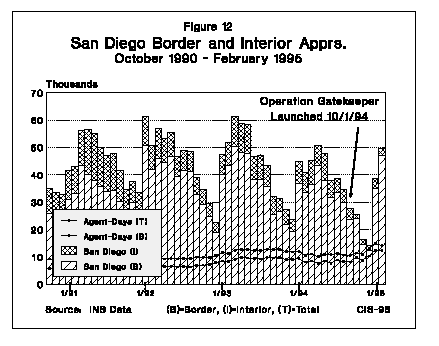
Both El Paso and San Diego had a similar amount of personnel resources (9,000-10,000 agent-days) during FY-91 and FY-92. In FY-93, San Diego's level of effort increased by about one-quarter. This increase seems appropriate given the higher numbers of illegal crossers at San Diego. For example, San Diego in FY-93 accounted for 43.8 percent of all southwest border apprehensions, compared with 23.5 percent for El Paso.
That increased personnel capability in San Diego declined by about 15 percent during FY-94 and then increased again after the start of Operation Gatekeeper by slightly over one-quarter. El Paso increased its level of effort by over 15 percent at the outset of Operation Hold the Line, but quickly dropped back to a level only slightly higher than before the operation was launched (as was seen in Figure 6). This pattern reflects the augmentation of San Diego's personnel strength twice during this period, while El Paso managed its increased level of effort largely within its already-allocated resources.
Apprehension levels at the border declined in November and December from what they had been previously — a clear indication of the deterrent effect of Operation Gatekeeper, but then the surge in January and February appeared to erase the benefits. Another difference may be seen in the personnel level. It increased with the launching of the operation but not as massively as it was increased in El Paso. In addition to the decrease in apprehensions at the border, interior control operations also registered a decrease. However, this does not necessarily signify that fewer illegal aliens were getting into the interior, because the personnel resources dedicated to interior control operations also decreased. Thus, the decline in apprehensions may simply indicate decreased surveillance.
The rate of change over the past four years reflects increased apprehensions from FY-91 to FY-92, but then a process of decline. This decline coincided with the upgrading of the San Diego border's physical security through construction of a new border fence and other measures (see Table 3).
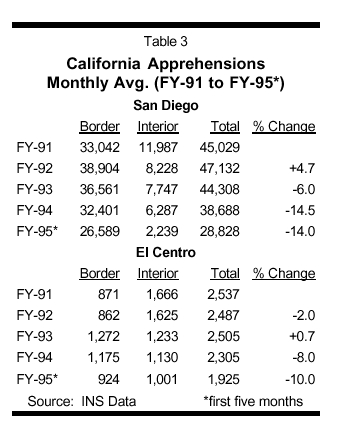
It is noteworthy that even though the apprehension level shot up in January and February, and in the latter month was higher than one year earlier, the overall level for the first five months of the fiscal year still showed a decline from the previous fiscal year. However, the decline was slightly less than the decrease between FY-93 and FY-94, when Operation Gatekeeper was not in effect.
This sector-wide data masks some significant developments that may not be seen without looking at the component sections of the border. Before turning to the San Diego sub-sector data, though, a brief review of the other California sector, El Centro, is appropriate.
El Centro
Data on apprehensions at El Centro, like those at Yuma, Arizona reflect a different pattern from San Diego, which is California's major crossing corridor. In the eastern part of the state, a greater number of apprehensions result from interior control operations, whether highway checkpoints or employment verification, than from operations at the border (with Calexico/Mexicali the major crossing point).
Also, like the Yuma sector which it abuts, the El Centro sector does not appear to have been significantly impacted by the heightened control efforts at El Paso or at San Diego, or even by the surge of illegal entries at the beginning of this year associated with the financial/employment situation in Mexico (see Figure 13).
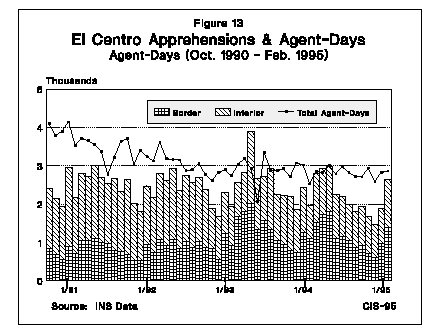
The number of apprehensions in FY-94 was nine percent lower than in FY-91. Although the number of apprehensions in February was slightly higher than a year earlier, for the first five months of FY-95 (through February), the apprehension level was lower by 10 percent.
The decrease in apprehensions does not appear to have been influenced by the personnel level. There was a reduction of 11 percent between FY-91 and FY-92 and a similar reduction the next year, but the number of agent-days has remained largely constant since then.
San Diego Border Control Stations
The San Diego sector is controlled by the Border Patrol at two principal interior traffic checkpoints (Temecula and San Clemente), by five frontier (or line) operation stations (Imperial Beach, Chula Vista, Brown Field, Campo and Boulevard) and by two backup (or area control) stations (El Cajon and San Marcos). Although the border operation stations engage in some interior detention activities, the reverse is not true. The roles of these stations in the overall deterrence effort may be seen in the figures on this page for FY-94, i.e., before the start up of Operation Gatekeeper.
It can be seen that three stations (Imperial Beach, Chula Vista and Brown Field) accounted for 97 percent of all the border apprehensions (see Figure 14). Imperial Beach by far was the most active station, accounting for half of the nearly 375,000 apprehensions.
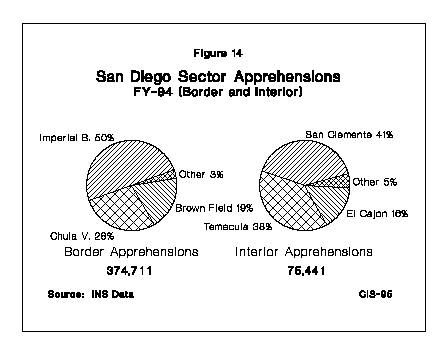
Three other stations (San Clemente, Temecula and El Cajon) accounted for 95 percent of all interior control operations. This workload fell almost equally between San Clemente and Temecula.
A somewhat similar distribution may be seen in the level of personnel resources in these six stations during FY-94 (see Figure 15). The three principal border control stations accounted for 85 percent of the agent-days. Imperial Beach is shown to account for a significantly larger share of the apprehensions compared to its level of personnel strength.
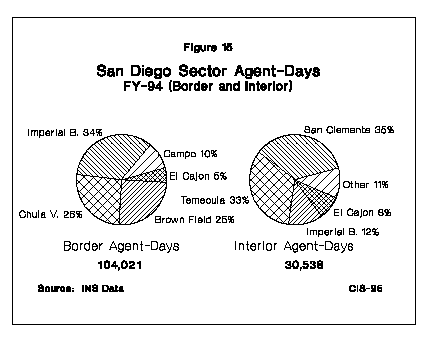
Data on interior control operations reflect that 77 percent of the total level of personnel resources was accounted for by the three stations that recorded 5 percent of the apprehensions, with San Clemente marshalling only slightly more personnel resources than Temecula.
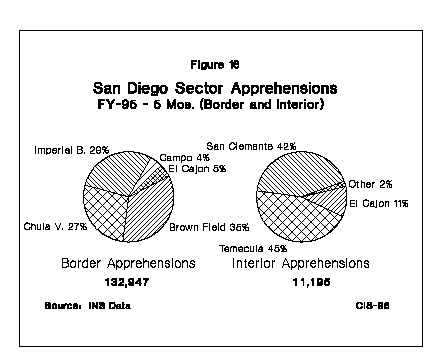
Data on apprehensions and on agent-days of effort for the first five months of FY-95 — a period that coincides with the inception of Operation Gatekeeper — reveal how the new strategy has affected both of these indicators of Border Patrol activities in the San Diego sector. The share of apprehensions by agents at the Imperial Beach station have fallen from 50 percent to 29 percent (see Figure 16). The largest share of the apprehensions this fiscal year (through February) has been recorded at Brown Field (35% compared to 19% last year). As will be shown later, this is due not only to a decrease in apprehensions in the Imperial Beach area, but also to an increase at Brown Field.
A significant shift may be seen in the level of agent-days of effort at San Clemente, although not in the share of apprehensions (see Figure 17). The change is attributable to the closing of the San Clemente station during part of this period, at the outset of Operation Gatekeeper. This will be discussed later.
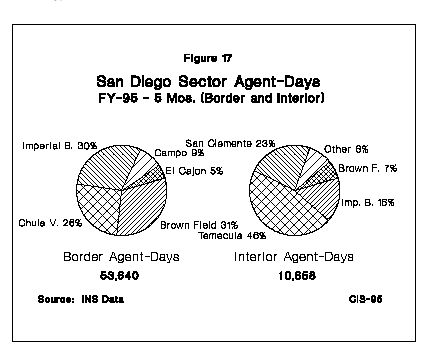
The shift after the start-up of Operation Gatekeeper is not as noticeable in the data on the agent-days level of effort by the major border stations (as compared to interior control station operations). The effort at Imperial Beach is only slightly decreased from FY-93 (30% compared to 34%). Brown Field's 16 percentage-point increase in apprehensions was achieved with only a six percentage-point increase in agent-days.
Each of these seven stations has somewhat different border control characteristics. They are discussed separately below, and the changes brought about by the new deterrence effort begun October 1, 1994 are described.
Imperial Beach
The Imperial Beach station takes its name from the fact that it begins at the Pacific shore and extends inland for 5.5 miles to the entry port of San Ysidro. The border control challenges that this terrain presents are formidable. Until the past year, there was no physical barrier across the beach. Because of the waves and the tide, a specially-designed piling system was required.
Inland, rugged foothills begin abruptly and the terrain features include deep canyons. Urban areas of Tijuana on the Mexican side of the border abut the frontier along most of the length of this section. Fencing this border section was a difficult undertaking, but it is now in place. An anomaly of the area is a state wildlife preserve on the U.S. side of the border, separated from the Mexican side only by a chain-link fence that, in the past, has proven easy to scale or cut through. Border Patrol agents explained that permission to extend the new steel landing mat fence across this portion of the border had been denied. They also asserted that the section continues to be used for alien smuggling operations, because successful illegal border crossers may not be pursued in vehicles once they are in the park area.
Another anomaly of the Imperial Beach zone is current residential construction not far from the U.S. side of the border. This development activity is likely to complicate Border Patrol apprehension efforts if the new fencing and control operations do not prove to be entirely successful in deterring attempted illegal entry.
According to INS Commissioner Meissner, former Border Patrol Sector Chief de la Viña and other officials, Imperial Beach was targeted in Operation Gatekeeper for the major increased deterrence effort. The concept was that if this most frequently used point of illegal entry and most difficult terrain could be effectively controlled, that the operational effect could be extended to the control points further inland.
The apprehension and agent-days of effort data for Imperial Beach are somewhat surprising in that they do not show either a major increase in operations or a dramatic reduction in apprehensions (see Figure 18). Almost all of the station's operational agent-days are devoted to border operations. They show only a modest increase of about 15 percent in October, which returned to previous levels in November and December, and then jumped about 25 percent as the challenge of attempted entry also rose in January and February.
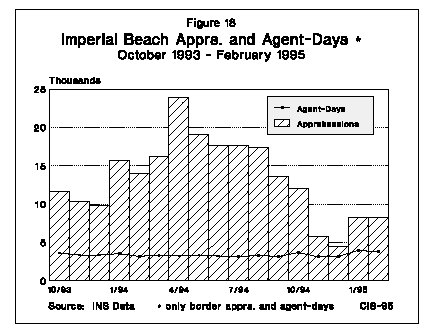
However, after an increase in October, apprehension data reflect lower numbers than the previous year. This pattern is not surprising. If the deployment of the Border Patrol was more effective in October, after the launching of Operation Gatekeeper, it is reasonable to expect apprehensions to rise. It is only after the increased chance of apprehension becomes known among aliens and coyotes (alien smugglers) that deterrence would be expected to be effective in producing fewer attempted entries, and, therefore, lower levels of apprehensions.
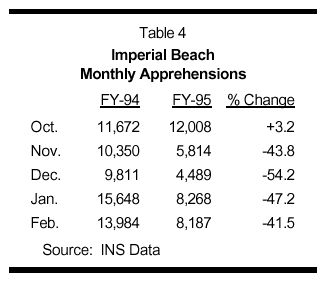
A closer look at the actual apprehension data shows that the increase in October 1994 over the previous year was a modest three percent, less than the recent average rate of increase experienced in San Diego (see Table 4). Beginning in November, and in each of the following months in the study, the apprehension rate was more than 40 percent below the rate in the previous year. The greatest drop was recorded in December, with the apprehension data reflecting over a 54 percent decline. This is indicative of the fact that the new Border Patrol profile in Imperial Beach constitutes a significant deterrence to attempted illegal entry. The decline in apprehensions would be very dramatic, if it were not judged by the El Paso experience, where apprehensions fell by about 75 percent.
The luster of success in the Imperial Beach data also is somewhat diminished by recalling that the apprehension level had been declining already before Operation Gatekeeper began. So, some of the decrease may be seen as part of that trend rather than attributable to the new deployment. This contrasts with El Paso, where the effectiveness was counter to a rising trend.
Observations
Touring the Imperial Beach sector with the Border Patrol was instructive. It not only brought home the difficulties of the terrain, but it also allowed observation of the new night detection capability. This particular evening, there were only two illegal border crossers, about a half-mile from the detection equipment, who were being tracked until they reached a point where they could be apprehended. There was no sign of any attempted illegal entry in the "Smugglers Gulch" area that had been notorious for the problem in gaining control that it represented.
At the Imperial Beach station, earlier apprehended illegal aliens were being processed with the Border Patrol's new automated identification and record software capability. This new equipment is an important advance in identification capability and in decreasing the amount of time agents must spend on preparing reports rather than patrolling. The electronic digital fingerprinting and the face imaging allow the Border Patrol, for the first time, to have a reliable means of measuring incidence and patterns of recidivism. This will be increasingly useful, as data bases are linked up among stations and sectors, and eventually nationwide, in evaluating deterrence and in efforts to find weak points in the Border Patrol's effectiveness.
The identification of recidivists also triggers an issue that needs to be looked at closely: At what level of repeated illegal entry does it become appropriate to detain and deport illegal aliens rather than continuing to offer them voluntary departure, as is the current practice? The ability to penalize the illegal enterer has not often been used except in cases of resisting detention. It has been hard to prove recidivism. Prosecutors have given low priority to efforts by the Border Patrol to make illegal entry costly to the alien. With the new identification system it will be much easier to make a case against a recidivist.
It still will be necessary to establish a policy framework for deciding how to use the new data. Will a recidivist be detained on the third illegal crossing in three days or a week? Such an effort has significant implications in terms of the capacity of detention facilities. The deterrent effect for would-be illegal border crossers of knowing that they face detention and deportation may be significant. But, the effectiveness will not occur if space is not available to begin to get the message out by actual experience. There will also be an initial surge in cost associated with increased detention and deportation. But this is a cost that is likely to produce dividends if it results in a significantly lowered level of attempted illegal entry over the long term.
Our conclusion from the Imperial Beach station data is that the decline in apprehensions after launching Operation Gatekeeper indicates successful deterrence, albeit not as great as at El Paso. The terrain clearly was a factor in making more difficult the construction of an adequate fence and in vehicular patrolling, but that should no longer be considered a reason for the Border Patrol not to be able to cope with the vast majority of illegal entry attempts.
Over time the new profile should increase in effectiveness as the assumption is generalized on the southern side of the border that attempted entry at Imperial Beach is a sure way to get detained. Some evidence that this is happening may be seen in the apprehension data for January and February of this year. Even though apprehensions at Imperial Beach shot up by nearly 60 percent over the November-December level, they still were down by 44.5 percent from a year earlier. This contrasts with the rest of the San Diego sector where the January-February apprehension level increased by over 60 percent from a year earlier. It also compares favorably with the comparable experience at El Paso, where the apprehension level at the border was up for those two months compared to the same months the previous year by nearly 24 percent, the average increase for the entire southwest border.
Chula Vista
Moving inland, the next border station, Chula Vista, is patrolled from the sector headquarters at San Ysidro. The length of border here is about one mile stretching from the San Ysidro port of entry inland. Most of the border area is urbanized on both sides of the border. Chula Vista represented the second greatest allocation of personnel after Imperial Beach and accounted for the second greatest number of apprehensions in the San Diego sector in FY-94.
With the launching of Operation Gatekeeper, Chula Vista became the second priority in stemming the illegal entry flow and, thereby, pushing efforts to find weak points eastward. The data on apprehensions and agent-hours of operations show Chula Vista falling to third place, as the numbers at Brown Field rose.
The data for Chula Vista show a significant drop off of apprehensions after the launching of Operation Gatekeeper (see Figure 19). The apprehension level for the first three months of the operation (October-December) reflect a 52 percent decline over the same months a year earlier. Then the cyclical surge in January and February, augmented by the Mexican peso devaluation, occurred. The apprehension level for those two months shot up by 414 percent over the preceding two months. To put this surge into perspective, however, it is necessary to compare the January-February data with the apprehension levels for the same months the previous year. When that is done, the increase drops to 39 percent.
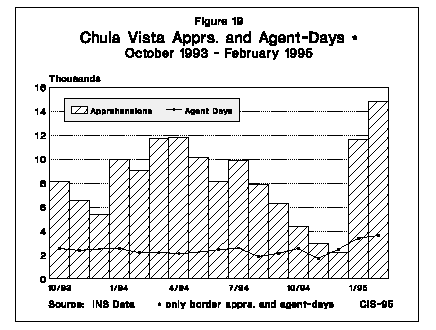
Nevertheless, the fact that the increased pressure on the border may be seen in an increase over the previous year at Chula Vista, but not at Imperial Beach, indicates that, despite an increased level of deterrence at Chula Vista, it still is insufficient to avert a surge in determined effort to gain illegal entry into the United States — as apparently has happened along the Imperial Beach section.
Observations
In direct observation of the Border Patrol operations at Chula Vista, it was possible to see the problem posed by the urban nature of the U.S.-side of the border. Once illegal aliens have gotten across the border, either by scaling the fence (or cutting through it with acetylene torches — as has occurred) or by running through the port of entry automobile lanes (as also occurs), pursuing them becomes an urban cat and mouse contest where there are many opportunities for the alien to out-maneuver mobile units of the Border Patrol.
A further limitation on Border Patrol operations is posed by the interstate highway (I-5) that connects to the San Ysidro border crossing port. When illegal aliens are on the edge of the highway, the Border Patrol is enjoined from attempting to apprehend them. The reason is concern for the safety of the aliens and of passing motorists who might find aliens running across the highway in front of them if apprehension were attempted. During the visit to this sector, three presumed aliens were spotted moving northward along the west side of the highway. The Border Patrol mobil unit was only able to radio information on their location and description. The response from the Chula Vista headquarters station at San Ysidro was that they probably were three of four illegal border crossers who had shortly before eluded efforts of the Border Patrol to apprehend them.
In the San Ysidro station, the new electronic identification systems are also in use. A demonstration was provided of video pictures of the faces of two dissimilar appearing detained aliens — who were identified by the software program as the same person — as evidence of how the system is not foiled by superficial changes such as the presence or absence of facial hair. The demonstration was less than satisfying because it was not backed up by fingerprint matching, and visually, it appeared that the two faces likely were not the same person. The question that arose from that demonstration is why have two systems? Isn't the fingerprint data sufficient? Presumably it is more reliable.
One other observation with regard to the Chula Vista headquarters relates to their detention facilities. They are very neat and clean. The Border Patrol escort noted that the center is regularly visited by advocacy groups to check on the treatment of apprehended aliens. If there is filth of any kind in the detention rooms, complaints are lodged about the inhuman conditions of detention. As a result, the Border Patrol has instituted multiple daily cleanings of the facilities.
It would appear that the Chula Vista sector is going to continue to need the increased personnel level that it added in January and February, and probably even more, if it is going to establish a long-term deterrence that will stand up to periodic surges in attempted illegal entry. Further effort is also needed in coping with illegal entry at a port of entry like Ysidro, where illegal migrants run through the traffic to enter the United States. It is clear that safety is an important consideration, but a policy that provides amnesty, albeit of limited duration, to the illegal border crosser as long as he or she is near auto traffic, cannot be the only solution.
Brown Field
The third segment of the border inland from the Pacific is Brown Field, an eight-mile frontier stretch that begins one mile east of the San Ysidro port of entry. The headquarters is at Otay Mesa. This zone is outside of the urban San Diego/Tijuana area, and is characterized by hilly and mountainous areas, as well as canyons in between. In this area the Border Patrol does not maintain a permanent physical presence, but instead relies on periodic patrolling and electronic surveillance to detect the movement of illegal aliens.
The Border Patrol states that Brown Field was recognized as the probable target of increased illegal entry following the inception of Operation Gatekeeper. In fact that has happened (see Figure 20).
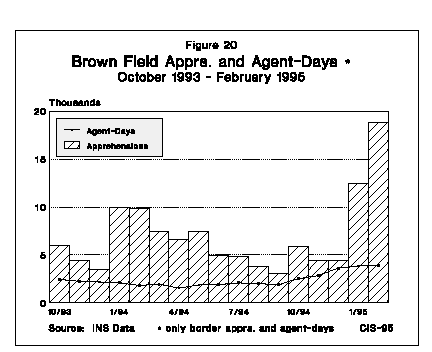
The level of apprehensions did not change significantly after the October 1 start-up date. But the agent-days data show an increase in border patrolling of slightly over 30 percent from the level during the first three months of the previous fiscal year. The capability was further augmented in January, so that the level of patrolling was up 83 percent over the January-February level in 1994.
Nevertheless this increased Border Patrol presence was not sufficient to deter would-be illegal immigrants. While the 11 percent increase in apprehensions in November and December 1994 over November and December 1993 may only reflect the greater level of effort, the data for January and February show a 58 percent increase over one year earlier. This demonstrates that the Border Patrol was well advised to augment the apprehension capability along this section of the border, but also that it is still considered vulnerable by would-be illegal immigrants and by coyotes.
Observations
Travelling along this section of the border, one finds an entirely different terrain than the border segments to the west. Although there are vantage points on the mesas from which vast areas of the border may be observed, and there is little protection in the way of underbrush or rocks, there are also numerous areas that are easy to hide in. Electronic surveillance is very useful for the purpose of covering less accessible points of access to the U.S. side of the border. This area is largely left outside of the Operation Gatekeeper effort.
According to the Border Patrol strategic plan, the enhanced surveillance and detention capability of the operation will be extended eastward to reach El Centro and beyond until it meets up with the Arizona and Texas sectors. It is clear, however, that cost\benefit questions will have to be answered as deterrence — rather than detention — becomes the objective in areas that have broad open spaces. Will it be worth the effort to construct new fencing and roads and observation points, as well as the personnel strength to be able to react to breaches in the fence? It is in this type of terrain where it is less likely that the U.S. will adopt a high profile physical presence along the border as a deterrent. Instead, the deterrent will have to be the understanding among would-be illegal immigrants that they are not likely to be able to breach the security of the area.
Even if the increased Border Patrol presence early this year led to a high apprehension success rate, as the high number of apprehensions suggests may have happened, this will not necessarily translate immediately into successful deterrence. Especially among coyotes whose livelihood is smuggling aliens, this terrain makes their clients more dependent than ever on the skills of the guide. Until such time that the deterrence effect of likely apprehension (and perhaps detention and interior deportation) reaches the sending villages and towns and barrios in Mexico, so that the stream northward dries up, the coyotes are likely to target areas such as Brown Field as the best choice between the traditional crossing points at or near large urban areas, yet not so far away that it limits their mobility.
Campo and Boulevard
The remaining Border Patrol operations in the San Diego sector between Brown Field and El Centro are covered by two small stations located at Campo and Boulevard. Campo is about 60 miles from the coast, and Boulevard is about 20 miles further inland. The area of jurisdiction is desolate countryside far from any urban areas. Some of the questions posed about how to manage the border at Brown Field are even more important at these outlying jurisdictions.
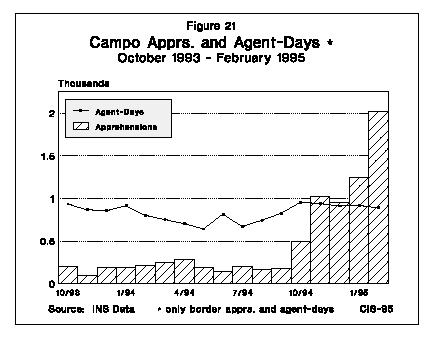
The principal focus of the Border Patrol at these jurisdictions is intercepting drug smugglers, who try to take advantage of the desolation. Yet, they are not entirely immune to the dynamics of illegal alien entry pressures. Looking just at the data for Campo (Boulevard apprehension numbers are much smaller), a jump in apprehensions of illegal aliens began in October — with the start of Operation Gatekeeper — and has continued to soar compared to earlier very low levels (see Figure 21). The increases have been accomplished without any increased personnel capability.
Observations
These outposts are the poor stepchildren of the San Diego sector. They generally have not been included in modernized equipment programs, except for an occasional new vehicle.
If there continues to be a significant diversion of illegal alien crossing to these areas as a result of the success of Operation Gatekeeper, they are going to need increased equipment and staff levels to cope with it. The alternative is to rely on efforts to control the flow of illegal aliens on the highways travelling into the interior of the country or at the work site. It seems clear that this would be a significant weakening in the concept of deterrence at the border.
El Cajon and San Marcos
These two interior control operating areas are designed to cover areas north and northeast of San Diego. Their operations include such activities as employer sanctions enforcement in the city and outlying areas, transportation checks, and criminal alien removal responsibilities. San Marcos was split off from the El Cajon station in 1987 to reduce response time to areas further north. The city of El Cajon is 27 miles north of the border, and San Marcos is 48 miles farther north.
Because much of the workload of these stations is considered a lower priority than border control, they have also served as a back-up resource for border reinforcement. With the advent of Operation Gatekeeper, San Marcos was closed, and its personnel used to reinforce the border.
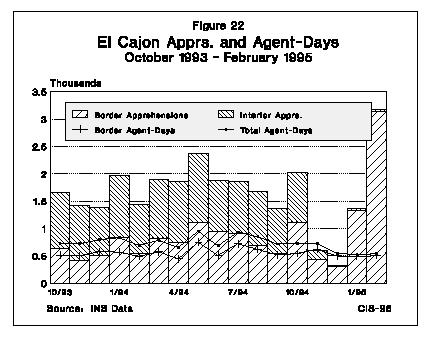
El Cajon, which previously had most of its apprehension activity associated with interior control operations, experienced a significant change as a result of Operation Gatekeeper (see Figure 22). Interior operations, which constituted about 27 percent of the stations operating hours during FY-94, have dwindled since the start of the operation to less than half of that amount. In January and February, when the border was hit by a surge in attempted illegal entry, El Cajon station's interior control operations fell on average to 16 percent of the level of effort one year earlier.
Observations
This pattern of considering interior control operations a secondary priority to be conducted when, and if, border control responsibilities permit, is a form of triage. It is not that checking employers for hiring illegal aliens is any less important, but that the task is not as urgent. Yet, if interior control operations in the San Diego sector, as well as elsewhere in destination areas of the intending illegal immigrant, are able to successfully enforce employer sanctions, this should enhance the deterrent effect at the border and decrease the pressure on the agents assigned there.
Temecula and San Clemente
These two traffic check stations sit astride the major inland routes leading northward from San Diego. They are not in continuous operation, but rather they are opened and closed intermittently. They have accounted for large numbers of illegal alien apprehensions and served as a major control on drug smuggling into the United States.
Temecula is located on highway I-15, and control operations are centered in a mountain pass south of the city, where the Border Patrol intermittently channels all vehicles through a visual screening process by agents. San Clemente operates in a similar fashion on highway I-5, along the coast headed into Los Angeles. In 1994 San Clemente was assigned 128 agents and Temecula 95 agents.
Temecula registered a significant decline in apprehensions with the launching of Operation Gatekeeper (see Figure 23). Did this decline, with a higher level of agent-days, represent an indication that the operation was successful in deterring illegal immigration? That would be a possible conclusion if it were looked at without noting that at the same period of time the level of apprehensions at San Clemente had fallen to zero (see Figure 24).
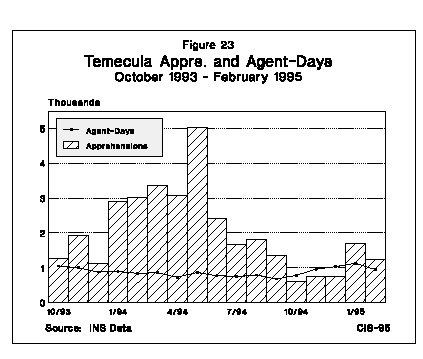
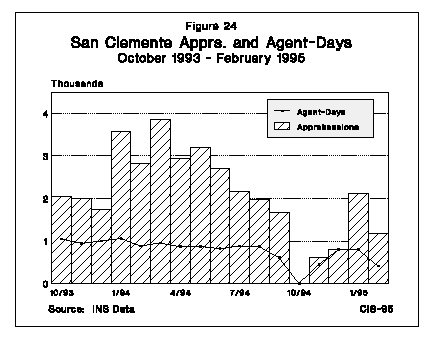
The San Clemente station had been closed. Information on the closing was readily available. It is amazing that the Temecula station would record any apprehensions at all. If illegal aliens and/or coyotes knew that they could proceed northward up I-5, why then would they use the I-15 route where the chance of apprehension still existed?
In November the "experiment" in closing San Clemente was ended and apprehensions resumed, and increased slightly at Temecula. However, the apprehension data must be somewhat suspect because of the intermittent nature of the operations. A question similar to the one posed above is why would a coyote risk detection by attempting to pass one of these traffic check stations, if it were possible to ascertain with little difficulty whether the checkpoint is functioning?
Observations
It is clear that the traffic control points do operate as a form of interior check on illegal entry. They have recorded significant levels of alien and narcotic apprehensions. Yet, in an increasingly technologically- sophisticated world, where portable phones and radios are commonplace, it is questionable whether spot-check operations can successfully cope with alien smugglers and others who wish to avoid the checking operations and can do so by transiting the check points when they are inactive.
It appears to make no sense to operate only one of these two checkpoints, as the Border Patrol did at the beginning of Operation Gatekeeper. There are three viable alternatives. One would be to close both of these checkpoints definitively. This is a position urged on the INS by legitimate users of these highways, who resent the delays they cause when they are functioning. The checkpoints operate by profiling likely illegal aliens and smugglers. As in police work, this type of activity tends to impact also on legal immigrants and ethnic minorities. Although the Border Patrol agents engaged in this work at Temecula did not say so, they did not appear to be at all enthusiastic about their mission.
The second alternative would be to have the traffic checks operating continuously. This would require an increased personnel commitment, but how much is not clear. Thus, it is not possible to estimate the cost/benefit trade-off from such a change. It is clear that there would be significant public and private sector (and, therefore, perhaps Congressional) pressure against this option. One Department of Justice official in San Diego cast the choices as being either closure or continuous operations.
The third approach is to continue to operate the checkpoints as they have been functioning. However, there may be a modification of this operation that would enhance their deterrent effect. Insufficient observation and exploratory conversations were held with the Temecula agents to know exactly what percentage of the day is covered by the current off-and-on checking operation. It would seem, however, that if intervals of uncontrolled traffic included ones of short duration, and the pattern were random, this would negate the assurance to coyotes provided by advance surveillance of the control point. If, in the time that it would take to get from a point south of the station to it, the station could well become activated, the difference between continual and intermittent checks might be lessened. There would still be a requirement for increased staffing if the intermittent operation were truly random, but it would have the advantage over continuous operation of allowing lines of backlogged vehicles to be eliminated. This might be more acceptable from a public relations perspective.
Lessons Learned
Has Operation Hold the Line at El Paso shown staying power?
Yes, it has. The deterrent effect of the strategy of 24-hour presence on the border in the most frequently crossed area has continued despite some slight lessening of the commitment of personnel to this effort. Nevertheless, El Paso is not invulnerable to renewed pressure from would-be illegal immigrants. A large jump in apprehensions in January and February this year demonstrated that the aura of impenetrability that constitutes deterrence was not sufficient to head off an influx that appears to be related to the Mexican peso devaluation crisis. Efforts to end-run the natural barrier of the Rio Grande and the fencing in central El Paso also demonstrate a need for additional physical barrier construction on the periphery of the city. As deterrence increases elsewhere, it will be important to not assume that El Paso is invulnerable and, thereby, allow it to become a weak link again.
What effect has the El Paso operation had on other Texas jurisdictions and on attempted illegal entry in New Mexico and Arizona?
The results are mixed. The New Mexico section of the El Paso sector has shown little increase of apprehensions, other than the usual seasonal fluctuation, since October 1993, when Operation Hold the Line began. But that changed at the beginning of this year, when greater pressure occurred all along the border. Although more illegal migrants may have entered at that time through New Mexico because of the El Paso operation, this cannot be demonstrated from apprehension data. In fact New Mexico apprehensions rose by less than those in the Texas portion of the jurisdiction.
Texas jurisdictions other than El Paso actually experienced a decline in the rate of increasing apprehensions (5% rather than an earlier 10% rate), but they also were hit by a major influx in January and February, when apprehensions were 27 percent higher than one year earlier. An isolated jurisdiction, like Marfa, shows little reaction to either Operation Hold the Line or to the start-of-year surge.
The Tucson sector, on the other hand, saw apprehensions increase by over 50 percent after Hold the Line began (compared to a 30% increase the previous year), and the first five months of the current fiscal year show apprehensions up by 77 percent. Yuma, by contrast, has witnessed declining apprehensions each year, including the current one. It appears that the Nogales border area has become the route of choice for intending illegal immigrants deterred by a less inviting environment in El Paso.
Is Operation Gatekeeper in San Diego demonstrating a successful strategy of deterrence?
It is showing potential. The INS insists that Operation Gatekeeper is showing successful deterrence. But this conclusion is sustained only when looking at the results in the Imperial Beach section — formerly the primary target of opportunity of the sector. There, apprehensions are down by over 40 percent, and, more significantly, the improved control appeared to be impervious to the surge in attempted crossings at the start of the year. However, the overall apprehension data for the sector reflect a more modest decline of 14 percent for the five months after the start-up of the operation. That is less significant than it seems when it is recalled that the apprehension rate also declined by 14 percent for the full fiscal year before Gatekeeper was launched. Thus, overall, Gatekeeper appears to represent continuation of improved control of the San Diego sector, rather than a dramatic new initiative.
Nevertheless, if the strategy of pushing illegal crossings eastward can be solidified in Chula Vista and extended to Brown Field, there is a real prospect for seriously reducing the illegal entry flow through the San Diego sector.
What is the difference between the El Paso and San Diego operations, and what explains the difference in deterrence?
Part of the difference is in the population of illegal crossers. To the extent that the Border Patrol at El Paso was dealing primarily with crossers whose departure point was Ciudad Juárez, and whose destination was El Paso, while the Border Patrol at San Diego is dealing primarily with long-distance illegal crossers, the latter population may be expected to be more determined in their efforts. Another aspect of that difference is that it will necessarily take longer for a heightened apprehension capability to have the same deterrent effect at the source when the source is in the interior of Mexico or in Central America rather than the other side of the border.
The deployment of agents is also different. The Border Patrol's San Diego deployment of agents in a layered strategy has been attacked as more of the same policy of apprehension rather than deterrence. It contrasts with the Border Patrol agents at El Paso constituting a visible deterrence. Although there are differences in deployment, the deterrent effect of both ultimately depends on the risk of apprehension as viewed by the would-be illegal immigrant. If they both can apprehend the vast majority of illegal border crossers, they should have the same deterrent effect, with the exception that a would-be crosser from Juárez or Tijuana is more likely to give up and go home than one who has a thousand-mile trip home.
The deterrence of the physical barrier at San Diego could be further improved, as indicated in the Sandia Laboratory study cited by the General Accounting Office in testimony before the Immigration and Claims Subcommittee of the House of Representatives on March 10, 1995. One issue that should be considered is the fact that the greater de terrence at El Paso has been achieved with a chain-link fence, i.e. one through which the Border Patrol agents may be seen by intending illegal crossers, whereas the San Diego and Nogales fence construction is steel sheeting. The latter offers security for the Border Patrol from rock throwing or even shooting from the Mexican side, but it also impairs visibility for both the Border Patrol and the would-be crossers. The Border Patrol recognized that the steel fence at San Diego was installed the wrong way, and it is not making the same mistake at Nogales. The wrong way is with the corrugation ripples horizontal — so that they can be readily scaled — rather than vertical. The Border Patrol insists that the horizontal installation was an economy move because the length-wise installation would go farther.
Will greater deterrence lead to a decrease in the number of new illegal immigrants settling in the United States each year?
This is the $64,000 question. At best, the answer would be a qualified yes. The qualifications are needed because the nature of the pressures on the border are variable and because the U.S-Mexican border is not the only way that illegal immigrants enter the United States. If the INS is correct in its estimate that half of the annual net increase of 300,000 illegal immigrants are entering legally and overstaying their visas, then the challenge at the border is to reduce the net increment of 150,000 who are EWI immigrants. Some progress in this direction was probably achieved in FY-94 akin to the overall decline in apprehensions that was also registered during this period (about 19%). It is difficult to do more than guess, though, because the data show only apprehensions, not those who succeed in avoiding apprehension or those who are deterred by greater border security. Any inferences are also made risky by the shifting pattern which shows up in increased pressure on Arizona and eastern San Diego sections of the border. If the apprehension capacity of these sectors was saturated by the rerouted illegal crossers, then the apprehension rate, as a percentage of EWI crossers, would have gone down and the number of successful crossers would have increased at those points. This probably happened in Arizona, where the personnel level of effort increased by about seven percent while the apprehension rate soared by 77 percent.
But, the new pressure on the border this year as a result of the peso crisis has probably negated whatever gains may have been achieved in 1994. At the same time, it is also probably true that if the border security upgrading had not begun, the 1995 surge would leave a much greater mark on the United States than it likely has done so far.
Most importantly, the results of Operation Hold the Line and the encouraging partial results of Operation Gatekeeper indicate that real progress can be made in controlling the U.S.-Mexican border, as the remaining weak spots are reinforced. This paper is not intended to deal with whether the U.S. economy needs low-wage agricultural, domestic or sweatshop labor supplied by illegal immigrants (we think not) or the international implications of shutting off the safety valve of emigration for large numbers of unemployed Mexicans or Central Americans. We would note only that there are countervailing U.S. national interests that offset these concerns.
Was the border control mess inherited by the Clinton Administration the result of inattention by previous administrations?
Yes, but the Congress, controlled up to this year by the Democrats, shares the responsibility. Funding and authorized personnel levels have not kept pace with the challenge. The administration should have pressed for greater resources, but the Congress could also have acted, as it did last year when the Clinton Administration did not ask for as many new Border Patrol agents as appeared to be required.
A major effort to upgrade border security in San Diego was begun during the Bush Administration, although the Clinton Administration expanded it and is extending the corrugated steel fencing to Nogales and, eventually, elsewhere. The major breakthrough in border control was the demonstration of effective deterrence at El Paso. The Justice Department and the Immigration and Naturalization Service (INS) were only reluctantly involved with, and very slow to embrace, the positive results of that now-heralded operation.
What remains to be done?
Still needed are increased physical barriers, increased personnel and a more coordinated approach to overall border management. Funding and authorized personnel levels have increased in the past two years and the current budget request is seeking still more resources. It seems clear that Congress, although it has its own priorities, also recognizes the need for additional reinforcement of the border. But this alone will address only the symptom rather than the underlying problem. The problem lies in the disparity of opportunity between the United States and the sending countries, whether Mexico or Cuba or China. It lies also in the laxity of our defense of our borders and our workplaces against illegal immigrants. Although we have limited ability to improve economic conditions abroad, beyond what we are doing already, we can do much more to reduce the attractiveness of illegal immigration by demonstrating that those who do penetrate our border security will be identified, denied jobs and sent home.
causes a decline in apprehensions at interior immigration checkpoints. Similarly, if there were successful deterrence against aliens finding employment, there should be significant spill-over effects in reducing the pull factors and further ease some of the pressure on the Border Patrol.
If illegal employment is curtailed and a need for foreign workers can be demonstrated that cannot be met by Americans or legal resident aliens in the short term at attractive wages, then mechanisms exist to import those foreign workers, either permanently or temporarily. If it should prove to be correct that the economy needs unskilled foreign workers — after allowing time for market forces to resolve the shortage — the legal immigration channel should siphon off some who otherwise would attempt to enter illegally. The end result is that each of these aspects of immigration — both legal and illegal — are interrelated. Better border management is a challenge of determining where best to allocate resources in order to have the greatest success.
Finally, the Border Patrol has shown at El Paso that more effective deterrence at the border causes a decline in apprehensions at interior immigration checkpoints. Similarly, if there were successful deterrence against aliens finding employment, there should be significant spill-over effects in reducing the pull factors and further ease some of the pressure on the Border Patrol.
If illegal employment is curtailed and a need for foreign workers can be demonstrated that cannot be met by Americans or legal resident aliens in the short term at attractive wages, then mechanisms exist to import those foreign workers, either permanently or temporarily. If it should prove to be correct that the economy needs unskilled foreign workers — after allowing time for market forces to resolve the shortage — the legal immigration channel should siphon off some who otherwise would attempt to enter illegally. The end result is that each of these aspects of immigration — both legal and illegal — are interrelated. Better border management is a challenge of determining where best to allocate resources in order to have the greatest success.
New Challenges
Too much of the discussion of border control is focussed on coping with the pressure of illegal immigration. The major challenge of controlling the flow of narcotics and other controlled substances is often forgotten. It is important to recognize that the two are related. The more out of control the border is in terms of illegal aliens, the easier it is for drug smugglers and other contrabandistas to penetrate border security. For example, the narcotic seizure rate at El Paso in FY-94 was up by 16 percent over the previous year before Hold the Line was in effect. This may be due to channelling more of the trafficking into areas easier to control.
Too much of the focus is on apprehensions, and the analysis becomes complicated by the fact that both increasing, as well as decreasing, numbers may represent success. In fact, a more reliable measure is available if the interior control points leading out of the major border crossing areas are operating effectively. Yet, the Clinton Administration's closing of the San Clemente traffic check station can only be understood as a possible precursor to closing it permanently. If that happened it would be absurd to leave open the Temecula station. If both are closed, however, the Border Patrol will have lost the primary means of evaluating the success of its border management. It is clear that the traffic check operations could be more effective, but that too, like improved border security, will be labor intensive.
The attention given to stopping the EWI illegal aliens has tended to distract attention from the fact that is only one part of the problem. Preventing alien smuggling, like preventing drug smuggling, is a recognized international responsibility. Effective measures will always be difficult as long as the United States approaches them unilaterally. Unfortunately, Mexico is not a member of the International Organization for Migration (IOM), which is grappling with the alien smuggling issue. In an October 1994 seminar on migrant trafficking, IOM Director General James Purcell noted that, "Trafficking in migrants is a major issue facing not only governments but societies at large in the coming years. This Seminar is a first step towards taking regional and international action to deal with a problem that confronts all countries."
The administration's recent bilateral negotiations with Mexico, with the peso devaluation crisis as a backdrop, have shown that it understands the need for greater bilateral cooperation to reduce immigrant smuggling. But the problem will be to get the Mexican government to overcome its view that illegal immigration to the United States is in Mexico's best interest.
In addition, the administration, the Commission on Immigration Reform, headed by Barbara Jordan, and many members of Congress have indicated their understanding that border control does not stop at the border. If illegal aliens are home free, or virtually so, once they have eluded the Border Patrol, then intending illegal immigrants will always be more determined, and the work at the border will always be more difficult. The corrective action that must be done is to deny jobs to illegal immigrants. The employer sanctions initiative begun in 1986 by IRCA must be made to work effectively. In addition, those illegal aliens who are identified at job sites or elsewhere must be fairly, but swiftly, removed from the country.
All of these measures require increased resources, as well as coordinated allocation of the resources already available. The administration's FY-96 budget request reflects a commitment to continue to strengthen control at the border. It remains to be seen whether it is prepared to make any commitment — other than a token nod toward experimenting with employment verification proposals — toward making the employer sanctions law effective. And it appeared that the administration was unprepared to increase deportations other than for criminal aliens.
That may be changing, however, given President Clinton's remarks in a radio address on May 6, 1995. He noted that it is nonsensical for law enforcement agencies not to identify illegal aliens to the INS — even though they may not be prosecuted for a crime — and for the INS not to act to secure their departure from the United States. He expressed concern also about the lack of follow-up to make sure that those who opt for voluntary departure actually leave the country.
Therefore, although there are some hopeful signs, it seems clear that a comprehensive package of measures to improve border management will require additional initiatives from the Congress to fill in the missing pieces.
Conclusion
Recent events make clear that the American public is calling on its representatives to deal effectively with the growing problem of illegal immigration. To deliver the most effective response requires that reform efforts not be piecemeal, as has characterized earlier efforts that have left, or created, loopholes.
The problem of illegal immigration begins in the sending countries, and effective control efforts must attempt to discourage this migration before it begins. Recent efforts to involve the Mexican government in aggressively dealing with alien smugglers must be continued.
The success of border control through deterrence demonstrated in El Paso needs to continue to be spread along the border. Although the Gatekeeper operation in San Diego shows the possibility of a significant reduction in illegal entry sector-wide, that remains to be proven. If the early results at Imperial Beach cannot be maintained while greater deterrence is established at the other San Diego stations, then the Border Patrol should revise its strategy and put the agents on the border, as was done in El Paso. At the same time, increased pressure on our deterrent capability will develop — at least until the appearance of a relatively impenetrable border for illegal entry discourages would-be illegal immigrants from trying their luck at avoiding apprehension — and the Border Patrol's strength must be up to the task of so effectively apprehending illegal border crossers that it will stifle the migration before it starts.
The greatest support that the Border Patrol could receive would be effective action to reduce the attraction of our economy to the poor or simply ambitious from other countries. This can only be achieved when it is clear that employment will be denied to illegal immigrants. National interests require a climate in the country that is inhospitable to illegal entrants, not because of hostility to them, but because the needs of Americans and legal residents for jobs and services must come first. When the border is no longer out of control and job opportunities for the illegal immigrant dry up and those who still manage to get in illegally are sent back home, then annual apprehensions of over one million along the U.S.-Mexican border should become a sign of the past carelessness of the United States in managing that border.
Bibliography
U.S. General Accounting Office, Border Control: Revised Strategy Is Showing Some Positive Results, GAO/GGD-95-30, Washington, DC, December 1994.
Immigration and Naturalization Service, U.S. Border Patrol, "Border Patrol Strategic Plan: 1994 and Beyond," Washington, DC, July 1994.
Martin, John L. "Operation Blockade: A Bullying Tactic or a Border Control Model?" Backgrounder, Center for Immigration Studies, Washington, DC, December 1993.
Bean, Frank D. et al, Illegal Mexican Migration and the United States-Mexico Border: The Effects of Operation Hold-the- Line on El Paso/Juárez, Population Research Center, Univ. of Texas-Austin, July 1994.