
Dr. Vernon M. Briggs, Jr., author of Mass Immigration and the National Interest (Armonk, NY: M.E. Sharpe, Inc.) is a professor of labor economics at the School of Industrial Relations at Cornell University. Dr. Briggs is also a member of the Policy Board of the Center for Immigration Studies.
Of all the economic issues confronting the United States, the least examined and the least discussed are the effects of the nation's immigration policy on the economy. The topic was carefully avoided during the 1992 presidential campaign by both major political parties. Despite the chronic need for policy reform, the subject has yet to surface as a distinct issue in the Clinton administration's agenda for domestic change.
It is true, of course, that specific immigration issues have arisen which the administration has had to confront. Among these have been the threat of a renewal of mass entry by boatloads of asylum seekers from Haiti; the Chinese alien smuggler problem; and the flood of legitimate complaints from state government officials (especially from California) concerning the mounting financial costs of the needs of illegal immigrants who continue to enter in significant numbers in violation of existing laws. Indeed, these events prompted President Clinton to say in July 1993 that "our borders leak like a sieve" and that "these things cannot be permitted to continue." There is also the issue of the eligibility of illegal immigrants for coverage in the administration's forthcoming health care reform program.
Despite these instances, there remains too little recognition by the administration that these are only symptoms of a larger problem — namely, the nation's immigration policies are out of synchronization with the nation's labor market trends. Unless and until comprehensive immigration reform is initiated, immigration issues will undermine any efforts by the Clinton administration to address successfully the myriad of economic problems currently besetting many of the country's cities and their urban work forces. In no area of public policy making has the nation interest been more conscientiously ignored than in this realm of public affairs.
The Revival of Mass Immigration
The revival of mass immigration as a prominent element of American life began inadvertently in the mid-1960s. Without any public expectation as to what was about to occur and with only minimal public debate over what would be the anticipated consequences, the level of immigration to the United States began to rise slowly in the late 1960s; it accelerated in the 1970s; it soared in the 1980s — to the highest level for any decade in U.S. history — and, as a consequence of the significant statutory, judicial, and administrative actions taken in that decade, the phenomenon is now institutionalized as a fact of life for the 1990s (see Figure 1). Unlike earlier immigrant waves in American history, however, the post-1965 wave of immigration shows no evidence of imminent decline. In fact, it is likely to grow in scale until such time as specific legislation is adopted to render immigration policy accountable for its mounting economic consequences.
Consider for the moment the following sample of economic indicators that depict what is transpiring. The decade of the 1980s witnessed the largest infusion of immigrants of any decade in U.S. history, probably close to 10 million people were admitted or entered (the exact number varies depending on what estimate of uncounted illegal immigration is used). In 1991 (a year when the number of employed Americans decreased by 1,047,000 workers and the number of unemployed Americans increased by 1,084,000 workers), more persons were granted permanent resident status — 1.8 million people — than in any single year in the country's history.
In late 1992, the U.S. Census Bureau announced that it was upwardly revising its population projections for the next 60 years to reflect the cumulative effects of renewed immigration. The Bureau stated it now recognizes that immigration will be more important as a population growth factor than will births to people already living here. Also, in 1992, the Census Bureau announced it was doubling its annual estimate of the number of illegal immigrants — to a figure of 200,000 persons a year — that it would use for its future projections of population growth (most experts would say even this dramatic upward adjustment is too low).
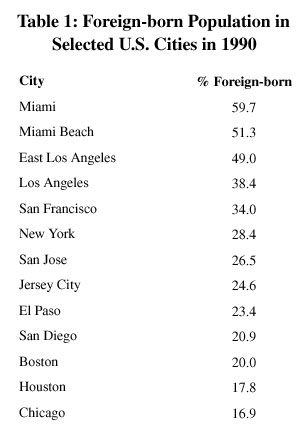
Moreover, the Census Bureau has recently revealed that the 1990 Census shows the size of the foreign-born population of many of the nation's largest cities has now become the major population characteristic of these cities. For example, the percent of the population that is foreign-born in Miami is 59.7 percent; in Miami Beach it is 51.3 percent; and in East Los Angeles it is 49 percent (See Table 1). All of these figures no doubt understate the "real" percentages due to the acknowledged statistical undercount of illegal immigrants.
The Debate Over Immigration
How has such substantial change occurred without any serious public cognizance of what was taking place? The signs of policy disarray were noted in the late 1970s when a Select Commission was appointed by President Jimmy Carter and Congress to study all elements of the nation's immigration policy. This 16-member commission, chaired by the Rev. Theodore Hesburgh, issued its historic report in March 1981. It warned that immigration was "out of control" and it specifically concluded that "this is not the time for a large-scale expansion in legal immigration — for resident aliens or temporary workers." It also called for comprehensive measures to reduce illegal immigration. Congress, however, chose to disregard the findings. In the years that followed, it more than doubled the level of legal immigration suggested by the Commission; it enacted an ineffectual set of half-hearted measures do deter illegal immigration; and it has allowed the annual scale of entry of temporary foreign workers (called non-immigrant workers) and of refugees to be influenced more by the whims of special interest groups than by actual need or circumstance.
When the few voices over the past decade have been raised to ask how it is that immigration policy has gone so far awry from any notion of serving the national interest, the immigration establishment (i.e., lawyers, consultants, lobbyists, and leaders of various business, religious, and ethnic interest groups who have a personal stake in expanded immigration) always responds with charges that the reformers are xenophobic or racist. Such broad accusations, in most cases, are designed to silence any opportunity for a reasonable reassessment of immigration to take place.
The legitimate issue for national debate is not the immigrants themselves; rather, it is the state of immigration policy. The immigrants are only taking advantage of the opportunities that prevailing policy has afforded. No one can blame them for that. The salient question is why does the nation have an immigration policy that is completely unaccountable for its sizable economic consequences and why do we continue to tolerate the mass abuse of the policy that is in place.
The answer, I believe, is that most Americans are completely unaware of what the nation's immigration policy actually is. Those who take the time to learn are invariably shocked by what they find.
How can it be that the annual number of legal immigrants admitted each year — currently over 700,000 a year not including refugee admissions — is totally unrelated to changing domestic economic conditions from year to year?
How can it be that 520,000 of those persons who are legally admitted each year are granted admission solely on the nepotistic basis that they are related to adult U.S. citizens of permanent residents — as opposed to being admitted for any skills, or education, or locational preferences they might have that the nation might need?
How can it be that 40,000 additional immigrants each year (55,000 per year beginning in 1995) are admitted solely on the basis of a lottery — the ultimate antithesis of responsible policymaking — as opposed to whatever human capital attributes they might possess or that the economy might need?
How can it be that, by law, 40 percent of those currently admitted under this lottery must come from only one country — Ireland?
How can it be that 10,000 immigrant visas are available each year for millionaires who can buy their admission in return for a faint promise to invest in some sort of job-creating activity?
How can it be that, despite mounting evidence that illegal immigration is continuing to soar, Congress refuses to address the flourishing business of fraudulent document abuse and grossly under-funded border enforcement agencies?
How can it be that virtually any Cuban who arrives on U.S. soil is automatically granted refugee status while persons from other nations are subject to careful scrutiny before being granted asylum status?
How can it be that, of the tens of thousands of persons already in the United States who seek political asylum each year, only twenty percent actually show-up for subsequent hearings on their status?
How can it be that over 50,000 persons will be admitted in 1993 as political refugees from the former republics of the Soviet Union when the Cold War is over and the UN High Commissioner for Refugees has conceded that almost no one currently emigrating from this region is a refugee?
The list could go on, but hopefully the point is made: U.S. immigration policy is essentially a "hodge-podge" of politically-motivated initiatives that pays no attention to its collective economic implications.
Unfortunately, the revival of mass immigration has not occurred in a vacuum. Instead, it has taken place at a time when the nation's labor force has been subject to unprecedented expansive forces related to the entry of women and members of the "baby boom" generation into the work force. There has not been any labor force shortage per se that would warrant such an increase in immigration. Moreover, the lack of attention to the human capital attributes of most of those who are admitted each year completely ignores the powerful economic changes that are restructuring the demand for labor in the United States. The emerging employment trends clearly reveal that most of the growth is occurring in occupations that require skills and education. Likewise, the occupations that require little in the way of human capital are precisely the ones that are rapidly disappearing.
In this context, it is absolutely mind-numbing to learn that, of the 1.8 million persons granted permanent resident alien status in 1991, over half (932,000) cited their occupation at time of entry as being farmworkers! No occupation is characterized by workers who have a lower level of educational attainment or a lower skill requirement than do farmworkers.
The paucity of human capital attributes of the post-1965 wave of immigration extends to more than just the record numbers who entered in 1991. All of the research on post-1965 immigration has revealed that these immigrants have less education, lower earnings, lower labor force participation rates, higher unemployment rates, and higher poverty rates than earlier waves of immigrants at similar stages of entry into the United States. It is very likely, therefore, that many of these new immigrants to the country are competing for the declining number of jobs in the low-wage sectors of many of the nation's large urban labor markets. Tragically, there are already far too many native-born persons in these same urban labor markets who are also seeking these same jobs. Many of these citizens are from minority groups, and the last thing they need is more competition.
As the Mayor of Washington, D.C., Sharon Pratt Kelly, candidly testified in 1991 at a hearing sponsored by the U.S. Civil Rights Commission on the causes of a two-day urban riot in the predominantly-immigrant section of her city: "the frustrations have been festering for 12 years because federal policy has forced immigration into this area with no programs to accommodate this thrust and no dollars for education or jobs of social services." She added that "we have become a repository but no beneficiary of federal actions." The tragic events associated with the urban riot in Los Angeles in the spring of 1992 not only echoed these same concerns; they magnified them.
Immigration Reform
Immigration reform is no panacea for the elimination of the economic problems confronting the urban labor markets of the United States, but it is a necessary part of any proposed set of solutions. Immigration is a discretionary action of a sovereign government. Its terms, therefore, should be designed to enhance the national interests of the citizens of the United States. Unless current immigration policy is significantly reformed, there is little chance that any of the improvements in urban life sought by the Clinton administration — such as raising the incentives for the urban poor to work instead of relying on public assistance; or reducing the magnitude of adult literacy; or controlling urban health care costs for those who cannot afford to pay; or improving the quality of urban school systems and reducing drop-out rates — will have a chance to succeed even if they are approved and funded by Congress. For many of these cities are on a squirrel-wheel in which any immediate progress is swamped by the continuing influx of poorer immigrants.
The key reforms that are needed would require that annual legal immigration levels be made flexible — as they are in Canada and Australia — so that the annual number of admissions can be linked directly to prevailing labor market conditions. The admissions criteria should be shifted from their present nepotistic focus to one that is selectively designed to fill demonstrated labor shortages until such time as domestic human resource development programs can provide qualified citizen workers. The administration of immigration policy should be shifted from the Department of Justice back to the Department of Labor — as was the case up until World War II — to reflect the need to focus on the economic effects of immigration as opposed to its political mollification role.
Enhanced deterrent measures to address mass violation of existing laws by illegal immigrants are essential. These would include the adoption of a counterfeit-proof employee identification system, the tightening of restrictions on the use of fraudulent documents to secure employment, the allocation of more funds and manpower to the enforcement of employer sanctions and border control, and the placing of fines on illegal immigrants who are found to be employed when they are apprehended.
Obviously, the admission of refugees will continue to be done without regard to labor market criteria. The federal government, however, should be firm and even-handed in its denial of entry of those seeking to improve their economic circumstances, while admitting only those who are in actual danger of being persecuted for reasons of their race, religion, membership in a particular social group, or political opinion. The federal government should assume all of the financial obligations associated with preparing refugees to meet the employment requirements of the local communities in which they are settled. Policies to address the actual causes of refugee outflows should become the mainstay of U.S. refugee policy, not resettlement.
Few policy subjects are as sensitive to the national consciousness as is immigration. But in the context of a transformation of the U.S. economy that is in progress, no element of public policy can be immune from critical examination as to its effects. For the mass immigration that the nation is experiencing is a purely policy-driven activity and immigration itself is a cause of economic change. As a discretionary policy, it is essential that the component parts of the nation's immigration policy be consistent with the emerging labor force needs of the country. The prevailing immigration policy of the United States cannot meet that standard. Moreover, as pointed out in this paper, prevailing immigration policy works at cross purposes to the economic and social goals elaborated by President Clinton and members of its cabinet.